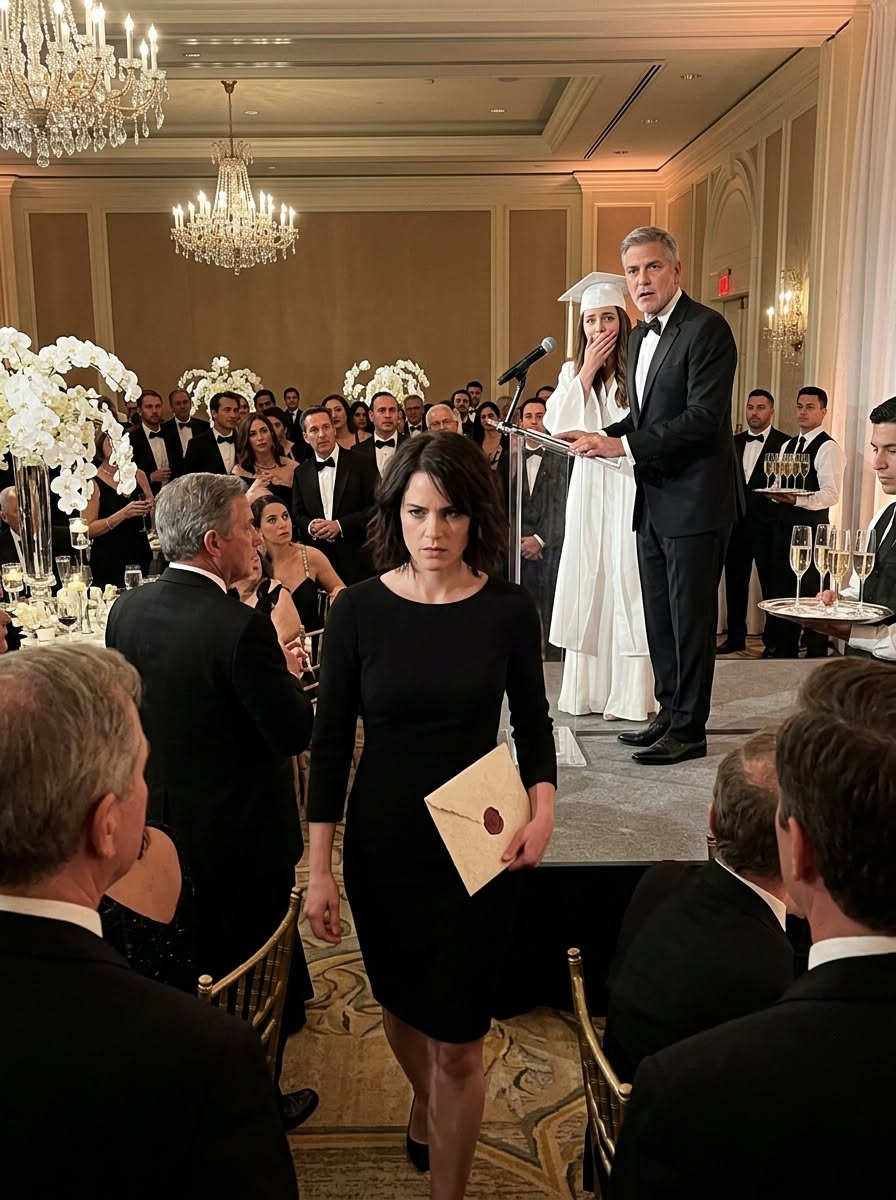
By the time my father raised his champagne glass at my sister’s graduation gala, he had already rehearsed my erasure. Not casually. Not impulsively. He had planned it the way other men plan mergers, political campaigns, or retirement portfolios. Every word had been chosen in advance. Every pause had been practiced. Every sympathetic expression had been rehearsed until it looked natural. He knew exactly what he intended to do. The grand ballroom of the Harcourt Hotel shimmered beneath layers of crystal and gold.
Massive chandeliers hung from the ceiling like frozen waterfalls, scattering light across polished silver trays and rows of champagne flutes. The room smelled faintly of expensive perfume, fresh flowers, and money old enough to have forgotten where it came from. Three hundred and fifty guests filled the ballroom. Judges. Investors. Attorneys. Local politicians. Business executives who had spent decades cultivating relationships with the Langford family. They moved through the room in graceful currents of black tuxedos and silk gowns, greeting one another with practiced smiles and carefully measured laughter. Everywhere I looked, I saw evidence of my father’s influence.
Waiters seemed to appear before his hand fully lifted. Investors leaned forward whenever he spoke. People laughed a little too quickly at his jokes. They listened a little too closely to his opinions. The Langford name was not printed on banners or projected on screens. It didn’t need to be. Its presence was woven into the evening itself. Tonight was supposed to be a celebration of my younger sister’s achievements. Ailia Langford. The future. The success story. The daughter everyone admired. The daughter my parents displayed. The daughter who fit neatly into the version of our family they preferred to show the world. I sat near the rear of the ballroom beside the kitchen doors.
A massive arrangement of white orchids occupied most of the table beside me. The flowers were beautiful, expensive, and positioned perfectly to obscure me from view. That had not happened by accident. Nothing about my place in the room had happened by accident. Earlier that evening, before we left the house, I had watched my mother stand in front of Ailia with the concentration of an artist perfecting a masterpiece. She adjusted one pearl earring. Smoothed an invisible wrinkle from Ailia’s dress. Straightened a strand of blonde hair. Then she turned toward me. The warmth vanished from her face immediately. She looked me over from head to toe. The expression was familiar.
It was the same look she used when discovering a stain on a tablecloth. Or damage to a piece of furniture. Something disappointing. Something inconvenient.
“Wear something forgettable,” she said.
Not cruelly. That was the remarkable thing.
She said it the same way another mother might remind a child to bring an umbrella. Matter-of-fact. Routine.
“Tonight is about your sister.”
I nodded.
“Sit in the back.”
Another nod.
“Speak only if someone speaks to you.”
That instruction was older than either of us cared to admit.
Different versions of it had followed me throughout my entire life. Stay quiet. Don’t embarrass us. Let Ailia answer. Let Ailia speak. Let Ailia shine. I learned those rules long before I understood why they existed. My name is Nora Langford. And for most of my life, my family never allowed me to be a complete person. I wasn’t viewed as a daughter with strengths and weaknesses. I wasn’t viewed as a complicated human being. I was reduced to a category. A label. A limitation. The story began when I was seven years old. That was the year doctors diagnosed me with severe dyslexia. In many families, such a diagnosis becomes the beginning of support. Specialized tutors. Patient teachers. Parents willing to learn.
Encouragement. Understanding. Someone kneeling beside a frightened little girl and explaining that different did not mean broken. In my family, it became something else entirely. It became silence. The diagnosis arrived like an unwanted secret. My parents never discussed it openly. They never asked what I needed. They never sat beside me and tried to understand how my mind worked. Instead, they quietly rewrote the narrative. A child who learned differently became a child who simply wasn’t good enough. And because that version of the story was easier for them, they kept telling it until everyone believed it. Including me. School meetings happened behind closed doors. Teachers spoke to my parents.
My parents spoke to each other. Decisions were made. Plans were created. And somehow I remained absent from every conversation about my own future. Report cards disappeared before I could examine them. Conferences happened without me. Questions went unanswered. By the time I reached middle school, my father had developed a habit of avoiding direct questions whenever other people were present. At first I didn’t understand why. Then I realized the truth. He was embarrassed by hesitation. A pause while I searched for the right word made him uncomfortable. A delayed response felt, to him, like public humiliation. So eventually he stopped asking. It was easier for him to pretend I had nothing worth saying.
My mother developed her own strategy. Whenever neighbors, relatives, or friends noticed that I read more slowly than other children, she laughed lightly and changed the subject. The transition was so smooth most people never noticed. She could redirect an entire conversation in less than ten seconds. By the time dessert arrived, nobody remembered the original question. And little by little, my parents stopped building their hopes around me. Instead, they built them around Ailia. The contrast between us became the foundation of our family mythology. Ailia was beautiful. Confident. Quick with words. Naturally charming. The kind of child who could walk into a room and immediately become the center of attention.
She collected accomplishments the way other children collected stickers. Music lessons. Academic awards. Debate championships. Leadership programs. Scholarships. Every success reinforced the story my parents wanted the world to believe. And every success pushed me a little farther into the background. I don’t blame Ailia for being talented. I never did. What hurt was watching my family use her achievements as evidence that something was wrong with me. As if one daughter’s success required another daughter’s disappearance. As if admiration could exist only in limited supply. As if there wasn’t enough room in the family for both of us. By the time we reached adulthood, the roles had become permanent.
Ailia was the future. I was the apology. Ailia was introduced with pride. I was introduced only when etiquette demanded it. And that was how I arrived at twenty-eight years old, sitting behind a wall of orchids at my sister’s graduation gala, watching my father prepare to tell three hundred and fifty people exactly what he believed my life was worth. I just didn’t know yet that my grandmother had spent years preparing for that moment too.
Only one person in my family ever noticed. My grandmother, Beatrice Langford. Even now, after all these years, I can still see her clearly. Not the way she looked in framed photographs, posed beside my grandfather at charity dinners or standing on courthouse steps after some major business victory. Those pictures showed the public version of her: silver hair swept neatly back, pearls at her throat, dark suit pressed so sharply it seemed capable of cutting paper. The grandmother I remember best was different.
She sat in her study on Sunday afternoons with reading glasses low on her nose, one lamp burning beside her, a fountain pen in her hand, and a stack of papers arranged with military precision on the desk in front of her. Her study smelled of leather, old books, black coffee, and cedar. Heavy curtains framed tall windows that looked over the back garden. In winter, the trees outside stood bare and gray against the sky. In summer, the branches threw slow-moving shadows across the carpet. That room was quiet in a way the rest of my family’s house never was. It was not empty quiet. It was thoughtful quiet. A quiet that made space for a person to think before speaking. At fourteen, I did not know how rare that was.
I only knew that when my grandmother called me into her study, I did not feel the same tightness in my chest that I felt with my parents. She never asked me questions in front of an audience. She never rushed me. She never finished my sentences. She never looked away while I struggled to organize my thoughts. She simply waited. And because she waited, I learned how to answer. The first time it happened, I thought I was being summoned because I had done something wrong. That was usually the reason adults wanted to speak with me privately.
My father had been in a foul mood all morning. He had come home from the office with a stack of documents tucked under his arm and a face like locked steel. During lunch, he corrected Ailia twice for speaking with her mouth full, corrected me once for spilling water, and corrected my mother for ordering the wrong wine for an upcoming dinner. Correction was his favorite language. After lunch, my grandmother looked at me across the table and said, “Nora, come sit with me for a while.” My mother immediately glanced toward my father. Ailia looked down at her plate. My father barely reacted. He had already decided I was not important enough to wonder about.
I followed my grandmother down the hallway to her study, my palms damp, my stomach folded into itself. She did not sit behind the desk like a judge. Instead, she took the chair near the window and motioned for me to sit beside the small round table where she kept coffee, stationery, and a silver letter opener shaped like a feather. On the table lay a ledger. The columns were narrow. The numbers were dense. At first glance, the page seemed designed to defeat me. I looked at it and felt the old panic rise. Letters could move on me. Numbers could blur. Rows could slip if I tried too hard to hold them still. My grandmother saw my face change.
She did not soften her voice in the pitying way people often did when they believed they were being kind. Instead, she tapped one finger on the page.
“Don’t read it like your father reads it,” she said.
I looked up.
“What do you mean?”
