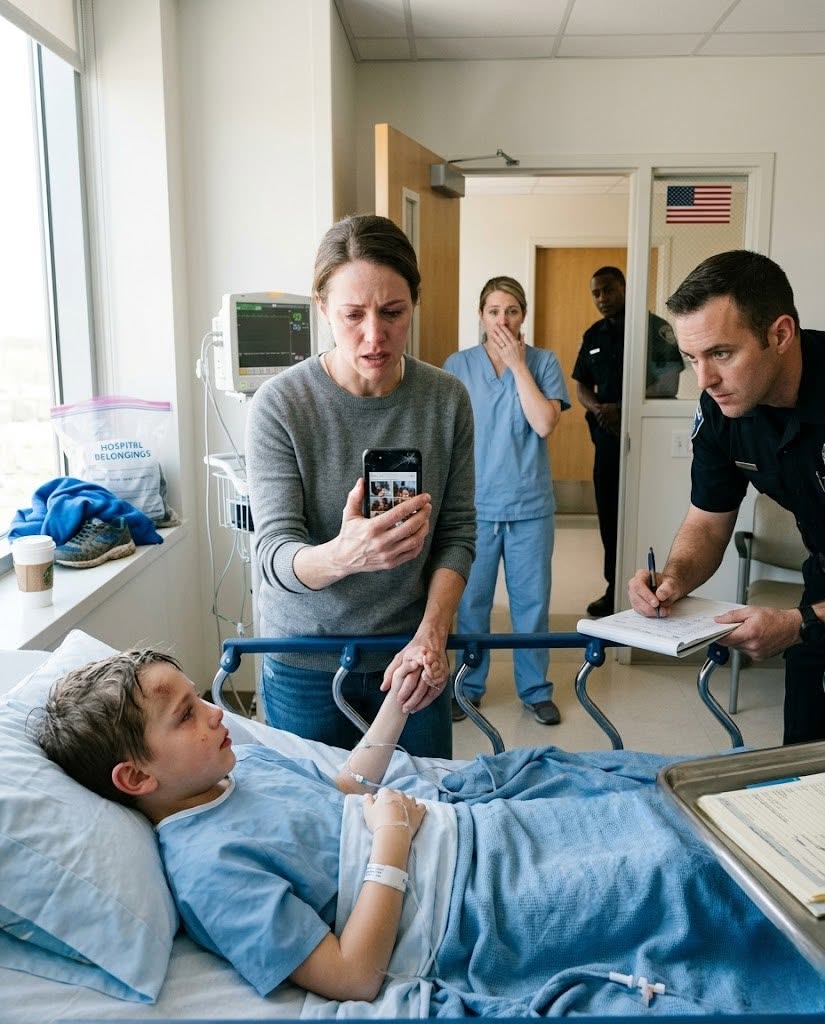
“You shouldn’t go in right now.”
The police officer said it with the kind of calm that made Jennifer Carter’s stomach twist harder than shouting would have.
The hospital hallway smelled like bleach, paper coffee cups, and wet coats drying over plastic chairs.

Somewhere behind the closed door, a monitor kept beeping in a steady rhythm, and Jennifer knew her nine-year-old son was on the other side of it.
She just could not reach him.
“What do you mean I shouldn’t go in?” she asked.
Her voice came out sharper than she intended, but fear had already taken over her body.
Her hands were still cold from the steering wheel.
Her phone was still in her palm, screen glowing with the last call from the hospital intake desk.
“That’s my son,” she said. “His name is Ethan Carter.
I’m his mother.”
The officer’s face stayed firm.
“I understand, ma’am,” he said. “But you need to wait here for a few minutes.”
A few minutes can be nothing.
A few minutes can also be the longest unit of time a parent ever survives.
Jennifer looked past him toward the door.
There were two officers, not one.
That was the first detail her mind held onto.
The second was the fact that one of them had an incident form clipped to a folder.
The third was that nobody in that hallway was using the word accident.
At 4:03 p.m.
that Saturday, Jennifer had been standing in her kitchen rinsing a coffee mug when the hospital called.
The dishwasher was running.
The afternoon light was sitting low across the counter.
A grocery list was stuck to the fridge with a Statue of Liberty magnet Ethan had picked out from a school fair.
“Mrs. Carter?” a nurse asked.
“Yes?”
“Your son Ethan has been brought into the emergency department.”
Jennifer’s fingers slipped on the mug.
It hit the sink with a dull clink.
“What happened?”
“We were told he fell down the stairs at a friend’s house,” the nurse said.
“He was unconscious when paramedics arrived. You need to come now.”
The call ended with directions Jennifer barely heard.
She grabbed her keys, ran out the front door, and left the mug sitting in the sink with water still running over it.
Her neighborhood looked painfully normal as she backed out of the driveway.
A family SUV rolled past the corner.
A little American flag hung from the porch across the street.
Somebody’s dog barked behind a fence.
Jennifer drove through every red light in her mind before the real ones even changed.
Her son had been at Tyler’s house.
Tyler was his best friend.
Tyler lived five minutes away.
Tyler’s mother, Lisa, was the kind of neighbor Jennifer had trusted without even noticing how much trust she had given.
That was how ordinary betrayal often entered a life.
Not through a locked door.
Through a neighbor who already knew where the coffee mugs were.
Lisa had moved into the neighborhood two years earlier after her divorce.
She brought banana bread to the Carters the first week.
She waved from her driveway when Jennifer pulled in after work.
She texted photos of Ethan and Tyler building Lego cities across her living room rug.
Once, when Ethan forgot his inhaler before soccer practice, Jennifer gave Lisa the garage code so she could grab it from the mudroom.
Jennifer remembered thinking it was a relief to have someone so close.
She would later understand that convenience had been the first unlocked door.
Mark Carter, Jennifer’s husband, had never liked being helped.
He especially hated needing help from his wife.
They had been married eleven years.
They owned a modest suburban house with a backyard Ethan used like a soccer field and a garage full of tools Mark kept but rarely touched.
Jennifer had worked as an accountant for the same financial consulting firm for fifteen years.
She was good at numbers because numbers did not flatter, sulk, or rewrite themselves when embarrassed.
Mark was a regional sales manager for a manufacturing company.
Five years earlier, he had lost a major client and, with it, the promotion everyone assumed he would get.
The company kept him on but moved him into a smaller territory.
His pay dropped.
Jennifer’s did not.
She made about $150,000 a year.
Mark made just over $100,000.
Jennifer never said those numbers like weapons.
She did not even like talking about them.
But Mark carried the difference around as if she had printed it on a sign and hung it over their bed.
Sometimes he joked about being “the secondary income.”
Sometimes he got quiet when Jennifer paid for repairs or school expenses without checking with him first.
Sometimes he looked at her across the kitchen table with a strange little resentment, as if her competence had stolen something from him.
Money does not ruin every marriage.
Shame does.
Especially shame that needs someone else to punish.
That Saturday morning had been ordinary enough to feel cruel in hindsight.
Ethan came into the kitchen wearing his blue hoodie, his hair still damp from the shower, asking if he could go to Tyler’s house.
Mark was in the living room with a basketball game on, though his eyes were on his phone.
“Be home by five,” Jennifer said.
Ethan grinned.
“Okay, Mom.”
He grabbed his backpack, kicked his soccer cleats out of the way near the back door, and ran down the sidewalk.
Jennifer watched him from the kitchen window.
The little bounce of his backpack was the last normal thing she remembered clearly.
At 4:19 p.m., she reached the hospital parking lot and parked crooked across a line.
At 4:22 p.m., she was at the intake desk saying Ethan’s name too fast.
At 4:24 p.m., she found two police officers outside the room where they had taken him.
“You shouldn’t go in right now,” one of them said.
Nothing in Jennifer’s life had prepared her for being kept from her child by strangers who knew more than she did.
She asked for the doctor.
She asked for a nurse.
She asked where her husband was.
The officer did not answer the last question quickly enough.
That was when the door opened.
Mark stepped out.
Jennifer saw him before he saw her.
He looked tired.
He looked rumpled.
But more than anything, he looked relieved.
Not relieved the way a father looks when his child has woken up.
Relieved the way a man looks when a problem might solve itself.
“Jennifer,” he said.
She stared at him.
His hair was damp at the temples.
His shirt was wrinkled on one side.
There was a red mark on the side of his neck.
It was not a scratch.
It was not a bruise.
It was something Jennifer’s mind recognized before her heart could stand to name it.
“What happened to Ethan?” she asked.
“He fell,” Mark said.
“Where were you?”
He blinked once.
“At home.”
The lie came too quickly.
Jennifer had heard Mark sell products to executives, calm angry clients, and charm waitresses when he wanted a better table.
She knew his polished voice.
This was polished.
That made it worse.
“The doctors said head trauma can cause confusion,” Mark added.
“Maybe memory gaps.”
Jennifer felt something cold move through her.
The words were normal.
His tone was not.
He sounded hopeful.
“Memory gaps?” she repeated.
He lowered his voice.
“Don’t make this harder than it already is.”
One of the officers looked at Mark then.
It was not a casual glance.
It was the kind of look Jennifer had seen auditors give a file when a number appeared in two places it should not.
A nurse finally came to the door and told Jennifer she could go in for a few minutes.
“You need to stay calm,” the nurse said. “He’s awake, but he’s disoriented.”
Jennifer did not remember crossing the room.
She remembered the light first.
Too bright.
Too white.
Too clinical.
Then she saw Ethan.
Her son looked smaller in the hospital bed than he ever had in his own.
A white band circled his wrist.
There was swelling near his hairline.
His lips were dry.
His blue hoodie was gone, replaced by a hospital gown that made him look like every child and no child at the same time.
“Mom,” he whispered.
Jennifer reached him and put her hand on his cheek.
“I’m here, baby.”
His skin was hot.
His fingers found hers under the blanket and held tight.
Mark stayed near the door.
The nurse asked Ethan simple questions.
His full name.
His birthday.
What day it was.
Ethan answered slowly.
Then his eyes moved toward Mark.
He stopped talking.
That silence hit Jennifer harder than any answer could have.
A child’s fear has a direction.
Jennifer did not yell.
She did not accuse Mark in front of the nurse.
She did not grab the clipboard off the counter and demand to read every line, though every part of her wanted to.
For one ugly second, she pictured crossing the room and slapping the calm off her husband’s face.
Instead, she held Ethan’s hand and watched.
There are moments when rage is not strength.
There are moments when staying still is the only way to hear what the room is trying to tell you.
On the counter near the sink, Jennifer saw the corner of an incident form.
Time of call: 3:47 p.m.
Location: private residence.
Reporting party: neighbor.
The words were upside down, but Jennifer had spent fifteen years reading documents across conference tables.
She knew the shape of official language.
She knew how people wrote around fear.
By 7:18 p.m., Ethan had been moved to observation.
The doctor said they needed to watch him overnight.
There were concerns about concussion symptoms and memory gaps.
Every time that phrase came up, Mark’s face changed by almost nothing.
Almost nothing was enough.
“I should go home,” he said finally.
Jennifer looked at him.
“Home?”
“To shower.
Clear my head. I’ll come back.”
“You’re leaving?”
He sighed like she was being unreasonable.
“Jen, I’ve been here for hours.”
Their son had been in a hospital bed with a head injury, and Mark was keeping score.
“Go,” Jennifer said.
He seemed surprised by how quickly she said it.
Then he kissed Ethan’s forehead too lightly and left.
Ethan watched the door until the footsteps faded.
The room settled into a weak quiet.
Outside, through the open doorway, Jennifer could see the nurses’ station.
A small American flag sticker was stuck to the glass near a visitor badge notice.
Someone laughed softly at the desk, then caught themselves and lowered their voice.
Life kept happening around them, which felt offensive.
Ethan’s fingers moved under the blanket.
“Mom,” he whispered.
Jennifer leaned close.
“What is it, baby?”
“Look at my phone.”
His phone was in the plastic belongings bag with his hoodie and one muddy sneaker.
The corner of the screen was cracked.
Jennifer pulled it out with shaking hands and entered the passcode she had made him memorize for emergencies.
The camera roll opened.
There were three blurry photos of a staircase.
One of a tipped-over laundry basket.
One dark shot of a hallway wall.
Then Jennifer saw the photo.
Mark and Lisa.
In Lisa’s bedroom.
In bed.
Not talking.
Not comforting each other after an accident.
Not standing too close in a moment that could be explained away.
In bed.
The timestamp at the top read 3:31 p.m.
Seventeen minutes before the 911 call.
Jennifer’s whole body went still.
The room did not spin the way people say rooms spin.
It sharpened.
The blanket.
The IV tape.
The crack across the phone.
The red mark on Mark’s neck from earlier.
Every detail lined up with sickening precision.
“I was trying to take a picture so you’d believe me,” Ethan whispered.
Jennifer looked at her son.
His eyes were wet.
He was nine years old, and he had already learned that adults could deny the truth so completely a child needed evidence.
That broke something in her.
Then it hardened something else.
She pressed the call button.
The nurse came in quickly.
Jennifer held out the phone.
“Get the officers back in here,” she said.
The nurse looked at the screen.
Her face changed.
She did not ask a single wasted question.
Within thirty seconds, the same officer who had blocked the door stepped into the room with his notebook open.
Jennifer handed him the phone but did not let go of Ethan’s hand.
The officer looked at the photo.
Then he looked at the timestamp.
Then he looked at Ethan.
“Ethan,” he said gently, “did you take this picture before you fell?”
Ethan nodded once.
“Did anyone see you take it?”
Ethan swallowed.
“Dad did.”
The nurse turned toward the counter.
Jennifer saw her hand lift toward her own mouth.
The officer scrolled back through the camera roll.
That was when he found the video.
Eleven seconds long.
Blurry.
Shaking.
Mostly carpet and the edge of a door frame.
But the audio was clear.
Mark’s voice came first.
“Give me the phone, Ethan.”
Then Lisa.
“He saw us.”
Then a thud.
Then Ethan crying out.
The officer stopped the video.
The room went silent in a way Jennifer had never heard before.
Not quiet.
Silent.
As if even the machines were waiting for someone to admit what everyone now knew.
The officer placed the phone into an evidence sleeve.
He asked Jennifer for Mark’s current location.
Before she could answer, her own phone buzzed.
Mark’s name lit up the screen.
Jennifer looked at the officer.
He raised one finger, telling her to wait, then nodded toward the speaker button.
Jennifer answered.
“Jennifer,” Mark said.
His voice was low and careful.
Too careful.
“Listen to me before you do something stupid.
Ethan is confused. He doesn’t know what he saw.”
Jennifer said nothing.
The officer’s pen hovered above the page.
Mark exhaled.
“You need to delete whatever he thinks he has.
This is a family matter.”
The officer’s pen froze.
Jennifer closed her eyes for half a second.
A family matter.
That was what people called damage when they wanted the victim to stay quiet.
Mark kept talking.
“If that picture gets out, do you understand what happens to me? To us?
To Ethan?”
Jennifer opened her eyes.
“To Ethan?” she repeated.
“Yes,” Mark snapped, and there he was, the real Mark under the polished voice. “He fell.
That’s what happened. He got upset, he ran, he fell.
You’re going to let a confused kid destroy our lives?”
The officer made a small motion for Jennifer to keep him talking.
She looked at Ethan.
Her son was crying silently now.
Jennifer squeezed his hand.
“What did he see, Mark?” she asked.
There was a pause.
A long one.
Then Mark said, “Something he shouldn’t have been looking for.”
That sentence ended the last piece of Jennifer’s marriage.
Not the affair.
Not the photo.
That sentence.
Because in Mark’s mind, even then, Ethan was not a hurt child.
He was a witness.
The officer took the phone from Jennifer and spoke clearly.
“Mr. Carter, this is Officer Reynolds.
I need you to tell me where you are.”
Mark did not answer.
The line went dead.
Things moved quickly after that, though Jennifer remembered them in pieces.
The officer stepped into the hallway.
The nurse checked Ethan’s vitals again with hands that were gentle but tense.
Another staff member came in with a hospital social worker.
Jennifer was asked to repeat what she knew.
She gave times.
She gave names.
She gave Lisa’s address.
She told them Ethan had left home at 2:00 p.m., that the hospital called at 4:03, that the incident form listed 3:47 as the call time, that the photo was timestamped 3:31.
Numbers had always made Jennifer feel grounded.
That night, they felt like stepping stones over a river she could not afford to fall into.
At 8:42 p.m., an officer asked Ethan if he could answer a few questions.
Jennifer wanted to say no.
She wanted to wrap her son in the hospital blanket and refuse the entire world access to him.
But Ethan looked at her and whispered, “I can.”
So she stayed beside him.
He told them he had gone upstairs to look for Tyler’s charger.
He heard voices.
He opened the wrong door.
He saw Mark and Lisa.
He took the picture because he knew no adult would believe him over his father.
Mark saw the phone.
Lisa panicked.
Ethan ran.
He remembered Mark grabbing his arm near the top of the stairs.
After that, the memory broke into flashes.
A shout.
The wall.
The stairs.
Tyler screaming from somewhere below.
Jennifer held Ethan’s hand through every word.
She did not interrupt.
She did not cry until he finished.
When he finally shut his eyes, exhausted, she leaned over and kissed his forehead.
“You did nothing wrong,” she whispered.
His lower lip trembled.
“I thought you’d be mad.”
“At you?”
“For taking the picture.”
Jennifer felt her tears fall then.
“No, baby. Never at you.”
That was the first night Ethan slept while Jennifer sat awake in a vinyl chair beside his bed.
Outside the window, the hospital parking lot lights shone on rows of cars.
Somewhere in that city, Mark was no longer just a husband who had cheated.
He was a father who had tried to make his injured child’s memory disappear.
By morning, Lisa had given her first statement.
She admitted Mark had been at her house.
She admitted Ethan had walked in.
She claimed she did not see exactly what happened on the stairs.
Jennifer read that line later and almost laughed.
Not because it was funny.
Because cowardice has a handwriting.
It signs its name under phrases like I didn’t see and I don’t remember and everything happened so fast.
Mark was found at a motel off the interstate shortly after midnight.
He had packed a duffel bag and two credit cards.
He told police he had panicked because Jennifer was “emotional.”
He said Ethan was confused.
He said the video was being taken out of context.
He said many things.
The phone said more.
The hospital records said more.
The incident form said more.
And eventually, Ethan said enough.
The weeks after that were not clean or cinematic.
They were ugly in ordinary ways.
Jennifer had to call her office and explain she would be taking emergency leave.
She had to sleep in the same house where Mark’s shoes were still by the garage door.
She had to change locks, passwords, bank access, school pickup permissions, and every contact form that listed Mark as a safe person.
She packed his clothes into boxes and labeled them by room because labeling was the only thing that kept her hands steady.
She filed copies of medical discharge papers, the police report number, Ethan’s follow-up appointments, and a printed timeline in a blue folder on the kitchen counter.
The folder became her anchor.
When people asked what happened, Jennifer did not give speeches.
She gave facts.
Photo timestamp: 3:31 p.m.
Emergency call: 3:47 p.m.
Hospital call: 4:03 p.m.
Police present when mother arrived: 4:24 p.m.
Sometimes truth does not need volume.
Sometimes it needs a timeline.
Ethan healed slowly.
The bruise faded before the fear did.
For a while, he would not go upstairs alone.
He slept with the hallway light on.
He asked Jennifer if people could get in trouble for telling the truth.
She told him yes, sometimes they could.
Then she told him the more important thing.
“They can also get free.”
In the months that followed, Jennifer learned how many people prefer a comfortable lie over an inconvenient child.
Some neighbors avoided her.
One woman from the block texted that she hoped they could “handle this privately for Ethan’s sake.”
Jennifer stared at that message for a long time before deleting it.
Privately was where Mark had wanted everything to stay.
Privately was the room where Ethan had learned to be afraid.
Lisa moved out before spring.
Tyler left a drawing in the Carters’ mailbox the week before he went.
It showed two stick-figure boys on bikes and a big crooked sun.
Ethan kept it in his desk drawer but never talked about it.
Jennifer did not push.
Children lose more than adults can list on forms.
A best friend.
A safe house.
A father they thought they knew.
An ordinary Saturday.
When the case finally moved forward, Jennifer sat in a family court hallway with Ethan beside her, both of them holding paper cups of vending machine hot chocolate.
There was an American flag at the end of the corridor and a scuffed floor beneath their shoes.
Ethan wore a navy hoodie and kept rubbing the edge of his sleeve between his fingers.
Mark looked smaller when he arrived.
Not sorry.
Smaller.
That was different.
He tried to look at Ethan.
Ethan turned his face toward Jennifer.
The old Jennifer might have tried to soften that moment.
She might have said, “He’s still your dad.”
She might have carried Mark’s shame for him just long enough to make the room easier for everyone else.
She did not.
She put her hand on Ethan’s shoulder and let him look away.
That was love too.
Not forcing forgiveness before safety.
Not decorating damage so adults could feel less guilty.
Not asking a child to make a grown man comfortable.
The legal process took longer than Jennifer wanted.
Everything important always seemed to require another form, another appointment, another person asking Ethan to repeat the worst day of his life in a calm voice.
But the phone remained the center of it all.
One photo.
One eleven-second video.
One child brave enough to press record when the adults around him had already decided truth was dangerous.
Jennifer often thought back to the moment outside the hospital room.
Two officers at the door.
Mark walking out relieved.
That phrase in his voice.
Memory gaps.
He had been relieved our boy might lose his memory.
He had not understood that some memories do not disappear just because they become inconvenient.
They settle into objects.
A cracked phone.
A hospital bracelet.
A blue hoodie in a plastic bag.
A mother’s timeline printed and filed because she knows the world will ask her to prove what nearly destroyed her.
Near the end of the process, Ethan asked Jennifer if she hated Mark.
They were in the kitchen.
The dishwasher was humming again, just like it had that Saturday.
Jennifer was packing his lunch, sliding grapes into a plastic container and cutting a sandwich the way he liked it.
She thought carefully before answering.
“I hate what he did,” she said.
Ethan watched her.
“But you don’t have to carry what I feel about him,” she added.
“You only have to tell the truth about what happened to you.”
Ethan nodded.
Then he said, “I’m glad I took the picture.”
Jennifer had to turn toward the sink for a second.
When she faced him again, she was steady.
“Me too,” she said.
Not because the picture broke their family.
The lie had already done that.
The picture simply turned on the light.
Years later, Jennifer would still remember the hospital hallway first.
The smell of bleach.
The beep behind the door.
The officer saying she should not go in yet.
The way Mark looked when he thought Ethan’s memory might save him.
But she would remember something else more clearly.
Her son, bruised and terrified, whispering, “Mom, look at my phone.”
That was the moment everything changed.
Not because a secret was exposed.
Because a child who had every reason to be scared still handed his mother the truth.
And Jennifer finally understood that protecting Ethan did not mean keeping the family together.
It meant making sure nobody ever stood between him and the door again