The front door had always sounded too heavy for one person to open.
Even when I was a kid, that groan made the foyer feel bigger than it was.
It was wood, brass, polished hinges, and money.

It was also the sound of a house that could hold everything except protection.
By the time Piper pulled into the driveway, I had been out of the hospital for less than two hours.
The sky was bright in that sharp after-rain way, the driveway still dark with wet patches, the mailbox flag clicking in the wind beside the small American flag my father kept near the porch.
I sat in the passenger seat with my discharge envelope across my knees and both hands pressed lightly over my stomach.
Not because it helped.
Because I was afraid my body would come apart if I stopped holding it.
My name is Emma, and at twenty-one I had gotten very good at being useful.
Useful girls do not ask too many questions.
Useful girls clean before guests wake up.
Useful girls say they are fine while trying not to bleed on the floor.
That was what Jessica had trained me to be.
My older sister was twenty-eight, beautiful in the expensive way that makes strangers forgive sharp edges before they feel them.
She could walk into a room late, complain about the lighting, laugh at the right person, and leave everyone thinking she had done them a favor by showing up.
When my father traveled, Jessica was in charge.
He meant it as responsibility.
She treated it like ownership.
My father, Michael, worked overseas on mining and logistics contracts, and his job kept him away for long stretches at a time.
The house stayed perfect because there was money for cleaners, landscaping, maintenance, and deliveries.
But the day-to-day mess of Jessica’s life somehow always found me.
I accepted packages.
I restocked the pantry.
I wiped down the kitchen after her friends made cocktails on a Tuesday night.
I texted repair companies and waited by the side door for men with clipboards who assumed I was the one in charge because I was the only one awake.
Jessica knew my class schedule.
She knew where I kept the spare key.
She knew how badly I wanted my father not to worry about me.
That was the trust signal I gave her without understanding what it would cost.
I handed her access to my life, and she used it to make me disappear inside my own home.
The fall happened on a Saturday morning after one of her parties.
She had called it a small get-together.
Small, to Jessica, meant twenty people, spilled liquor, dirty glasses, muddy heels, and music still vibrating in the walls at three in the morning.
At 6:18 a.m., I was carrying a cardboard box of empty bottles down the staircase before my 8:00 study group.
I remember the smell first.
Tequila, lemon cleaner, and something sour from a half-empty cup left on the landing.
I remember the texture of the cardboard going soft under my fingers.
I remember my sock sliding on the polished step.
Then my side hit the corner of the marble pedestal in the foyer.
There are pains your mind can turn into words.
This one came before language.
It was heat, pressure, and a terrible inner tearing that made my arms fold around my abdomen before I understood why.
I tried to call Jessica once.
It went straight to voicemail.
That was not surprising.
She turned her phone off when she wanted sleep, and what Jessica wanted had always ranked higher than whatever anyone else needed.
So I called 911 myself.
The county dispatch log marked the call at 6:21 a.m.
The hospital intake desk logged me at 6:57 a.m.
By 7:40 a.m., a surgeon was telling me I had a ruptured spleen and internal bleeding.
By 8:12 a.m., I was being wheeled down a hallway with lights passing over my face like white rectangles.
I woke up later with tape on my arm, a dry mouth, and a bandage across my stomach that made every breath feel negotiated.
The nurse said I was lucky.
People say lucky when they do not know what else to call surviving something you should not have had to survive.
My first real thought was my father.
Then came the second thought, the trained one.
Do not scare him.
He was overseas when I called.
I could hear machinery behind him, voices shouting across distance, the rough wind of an open job site cutting in and out of the call.
He said, “Emma? What happened?”
I looked at the IV in my hand and lied.
I told him I had fallen.
I told him I was resting at Piper’s apartment.
I told him not to fly home.
He went quiet, but not completely.
I could hear him breathing through the line, trying to decide whether to trust me.
In the end, he trusted the version of me he had accidentally helped build.
The daughter who did not make trouble.
The daughter who kept the peace.
The daughter who made herself smaller so everyone else could keep moving.
That evening, Jessica texted me.
I saw her name on my phone and felt a ridiculous flash of hope.
For one second, I thought she knew.
For one second, I thought my sister was about to ask if I was alive.
Her message said she needed the side-door key because the pool technician was outside.
I stared at the screen until it blurred.
Then I took a picture of my hospital wristband and sent it to her.
I wrote that I was in the hospital, that I had emergency surgery, and that I needed help with the insurance card.
The message changed to read.
Then nothing.
Not grief.
Not panic.
Not even irritation dressed up as concern.
Nothing.
The next morning, Jessica called to yell about the microwave.
She said I had probably broken it on purpose.
She said I was using surgery as an excuse to avoid cleaning the patio.
She said Dad was tired of me always making myself the center of things.
Piper walked into the room while Jessica was still talking.
She was carrying chicken soup in a paper bag, her hair pulled into a messy knot, her hoodie sleeves stretched over her hands.
She stopped at the foot of the bed and listened.
Jessica’s voice was loud enough that she did not need the speakerphone.
When I hung up, Piper did not ask me why I let my sister talk to me like that.
That would have made me defend myself.
Instead, she put the soup on the tray table, pulled the chair close, and said, “Emma, that is not normal.”
I looked away.
She said, “That is abuse.”
The word landed harder than I expected.
Not because I did not believe it.
Because some part of me had believed it for years and had been waiting for someone else to say it first.
That night, my father called again.
This time, his voice was different.
He was not rushing between meetings.
He was somewhere quiet.
He said, “Tell me the truth.”
I tried to laugh.
It came out wrong.
He said, “Emma, I know your voice.
Tell me what happened.”
So I did.
I told him about the party.
I told him about the bottles.
I told him about the fall, the ambulance, the surgery, the hospital intake form, the text message, and the call about the microwave.
I told him about the years before that too.
The laundry.
The errands.
The way Jessica called it helping when I did it and attitude when I asked her to stop.
The line was silent for so long I thought the call had dropped.
Then my father said, “Do not answer her again.”
His voice was flat.
It scared me more than shouting would have.
He said Daniel would meet me when I was discharged.
Daniel was his security lead, a quiet man who had worked for him long enough to understand what my father did not say.
Then Dad said, “I am coming home.”
Within five minutes, Jessica started texting.
She called me a liar.
She called me a traitor.
She said Dad had canceled her cards.
She said she would not pay a cent of my hospital bills, as if she had ever paid anything with money she earned herself.
She said if I did not come home the second they released me, she would put my clothes on the curb.
I read every message.
For the first time, I did not apologize.
Two days later, the nurse removed the last line, went over the discharge packet, and told me to avoid lifting, bending, stairs, and stress.
I almost laughed at that last one.
Piper signed the pickup form because my hands were shaking.
She drove slowly, cursing every pothole under her breath.
I sat with the seat belt pulled away from my abdomen and my hospital papers in my lap.
The closer we got to the house, the smaller my breathing became.
Piper noticed.
She reached over and touched the edge of the envelope, not my body.
“Whatever happens,” she said, “you are not making dinner.”
That sentence almost broke me.
Because love, real love, is sometimes just someone naming the one thing you should never have been asked to do.
Daniel was waiting two houses down.
He told Piper to park behind his SUV so we could walk in quietly.
He did not ask me to explain.
He looked at my wristband, my gray hoodie, the way I was leaning on the passenger door, and his face changed just enough for me to know he understood.
The front walk felt longer than it had ever felt.
The porch flag snapped in the wind.
The brass handle was cold under Daniel’s hand.
When the door opened, the house smelled like coffee, lemon cleaner, and the faint sweetness of candles Jessica burned when she wanted the place to look effortless.
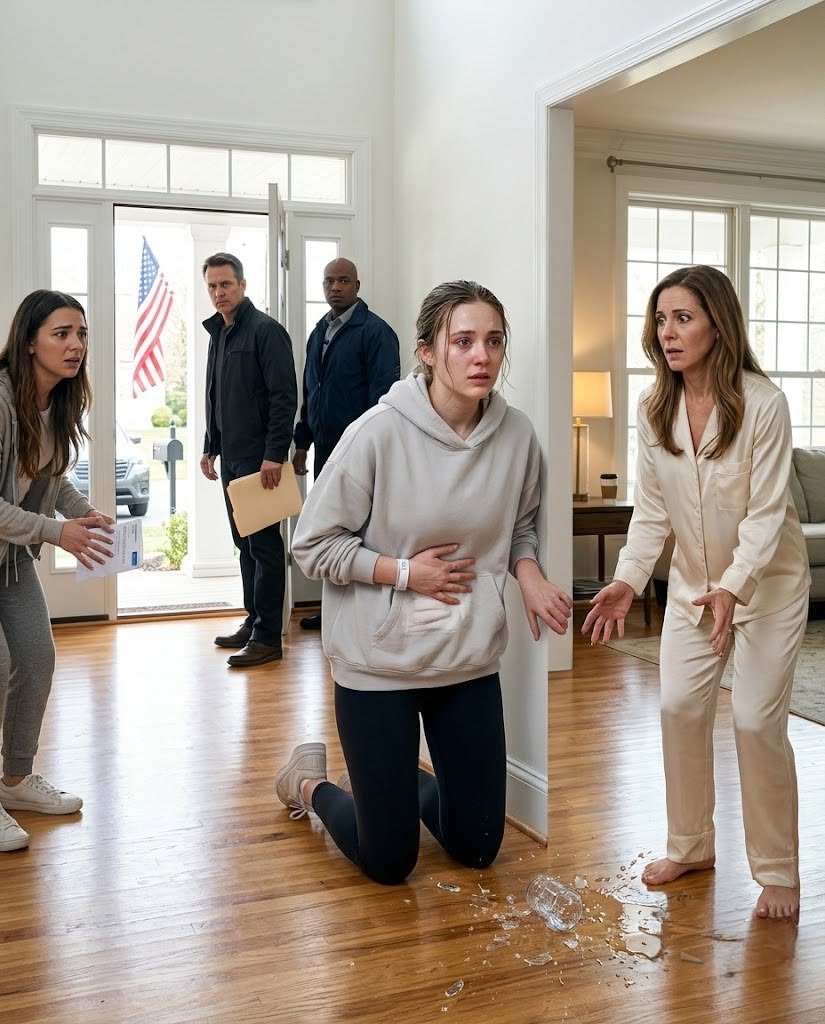
She was in the living room, barefoot, dressed in a cream silk lounge set, holding a glass of water and scrolling on her phone.
She looked expensive.
I looked discharged.
Her eyes moved over me slowly.
She saw the hoodie.
She saw my posture.
She saw the hospital band.
Then she looked annoyed.
“Are you serious right now?” she said.
Piper stiffened behind me.
Jessica lifted her chin toward the kitchen.
“Look at the time. Stop playing the invalid and get in here.
Dinner needs to be made.”
There are moments when the room teaches you exactly who everyone is.
That one did.
I could not answer because breathing hurt.
Piper made a sound like she had been slapped.
Daniel stepped into view.
Jessica’s expression flickered.
She saw him, and for the first time, she understood there might be consequences.
Then my father stepped through the open door behind him.
The glass slipped from Jessica’s hand and shattered across the hardwood.
Water spread in a thin shining line toward my shoes.
Ice cubes spun and clicked against the floor.
Jessica’s mouth opened, then closed.
My father stepped around the broken glass without looking down.
He was still wearing travel clothes, dark jacket creased from the flight, jaw tight, eyes fixed on my sister.
He looked at me first.
That was what made Jessica panic.
Not his anger.
His attention.
He took in my pale face, the hospital wristband, the way my hand was pressed over my abdomen, the discharge envelope against my chest.
Then he turned to her.
“Dinner?” he asked.
Jessica swallowed.
“Dad, you do not understand—”
“No,” he said.
One word.
It cut harder than a shout.
He looked at the broken glass, then back at her.
“She had emergency surgery, and you told her to cook.”
Jessica tried to bend for the glass.
Daniel said, “Leave it.”
She froze halfway down like even her body had forgotten who to obey.
My father set a manila folder on the entry table.
Inside were copies from the hospital billing office, the discharge packet, the intake form, and the county 911 dispatch note Daniel had printed while I was still in the car.
Jessica stared at the folder like paper could bite.
Dad opened the first page.
He did not read it dramatically.
He read it like a man checking an invoice, and somehow that made it worse.
“Patient arrived without family present,” he said.
Jessica looked at me.
For once, there was no insult ready.
Dad turned the next page.
“Emergency abdominal surgery. Splenic rupture.
Internal bleeding.”
Piper covered her mouth.
I had seen those words already, but hearing my father say them in the foyer where I had fallen made my knees weaken.
Daniel moved closer, not touching me, just close enough that I could lean if I had to.
Then Dad took out his phone.
“I want you to hear what your sister sent me while you were in recovery,” he said.
Jessica’s face changed.
I had expected anger.
What I saw was fear.
He read the texts out loud.
Traitor.
Liar.
Dad canceled my cards because of you.
I am not paying one cent of your hospital bills.
If you do not come home, I will put your clothes on the curb.
With every line, Jessica seemed to shrink.
The house did too.
All that marble, all that glass, all that money, and suddenly the room felt no bigger than the space between my father’s voice and my sister’s silence.
When he finished, Jessica whispered, “I was upset.”
Piper laughed once, sharp and disbelieving.
Dad did not even look at her.
“Upset people do not threaten to throw a surgical patient’s clothes outside,” he said.
Jessica’s eyes filled.
It was the first time I had seen her cry in a way that did not look chosen.
She said, “She always exaggerates.”
Dad opened the tablet Daniel had placed on the entry table.
The foyer camera showed me falling.
It showed me lying on the floor.
It showed me reaching for my phone.
It showed how long it took before the ambulance lights flashed against the front windows.
Jessica turned away before the clip ended.
“Watch it,” Dad said.
She did.
So did I.
It was strange, seeing my own body from above, small against all that polished floor.
I looked less dramatic than I had felt.
I looked alone.
That was the image that finally made my father close his eyes.
When he opened them, the warmth was gone from his face.
“Pack what belongs to you,” he told Jessica.
Her head snapped up.
“What?”
“You will not run this house. You will not use my cards.
You will not speak to your sister unless she chooses to hear from you.”
Jessica shook her head.
“You cannot kick me out.”
“I can stop paying for the life you used to hurt her,” he said.
That was the sentence that broke her.
She sat down on the bottom stair, one hand over her mouth, staring at him like the floor had vanished.
I thought I would feel satisfied.
I did not.
I felt tired.
Tired in my bones.
Tired in the places surgery had touched and in the places Jessica had touched for years.
Dad looked at me then, and for the first time since I was a little girl, he did not ask me to be reasonable.
He did not ask me to forgive quickly.
He did not ask me what I had done to upset her.
He said, “I am sorry I left you with someone I wanted to believe was better than this.”
I had imagined apologies before.
Big ones.
Perfect ones.
The real thing was smaller and harder to survive.
It made my throat close.
Piper helped me sit in the front room while Daniel called a cleaning service for the glass and my father called the hospital billing office.
He gave them his information and told them every charge connected to my surgery would go through him.
He used process words the way he used tools.
Document it.
Forward it.
Send the itemized bill.
Update the emergency contact.
For years, Jessica had used confusion as cover.
That day, my father used paperwork as a light.
Jessica went upstairs under Daniel’s supervision and packed two suitcases.
No one yelled.
No one dragged her out.
That almost made it more final.
She came down once with red eyes and tried to look at me.
“Emma,” she said.
I waited.
She said nothing else.
Maybe she wanted to apologize.
Maybe she wanted to blame me one last time.
Maybe she did not know the difference anymore.
I said, “I am not making dinner.”
The sentence came out rough, almost too quiet.
But everyone heard it.
My father’s face changed first.
Then Piper’s.
Then Jessica’s.
Because it was not about dinner.
It had never been about dinner.
It was about every plate I had carried while pretending my hands were not shaking.
It was about every mess I cleaned while telling myself family meant endurance.
It was about every time I chose silence so somebody else could stay comfortable.
Jessica looked at the floor.
For once, she did not tell me I was dramatic.
After she left, the house did not feel peaceful right away.
It felt stunned.
The refrigerator hummed.
The porch flag tapped in the wind.
Somewhere upstairs, a faucet dripped because someone had left it half-turned.
Piper made me tea I did not drink.
My father sat across from me in the front room with both hands around a paper coffee cup Daniel had brought from the kitchen.
He looked older than he had that morning.
I realized then that consequences do not erase pain.
They only stop new pain from being treated as normal.
Over the next week, Daniel cataloged the household access codes, changed the side-door lock, and made a list of every vendor account Jessica had been using.
My father hired a home health nurse for the first few days, not because I asked, but because he finally understood that needing help was not the same as being weak.
He also drove me to my follow-up appointment himself.
He sat in the hospital waiting room beside me, reading the care instructions twice, asking the nurse what symptoms would mean an emergency.
He did not take a work call.
Not one.
When we got home, there were no bottles on the stairs.
No strangers in the living room.
No voice calling from the kitchen that I had missed a spot.
Just the house, quieter than I knew it could be.
Healing was not pretty.
It was slow walks down the hallway.
It was sleeping with pillows braced around my stomach.
It was Piper bringing soup and pretending not to notice when I cried because I could not bend to pick up a dropped sock.
It was my father learning where the laundry detergent was.
It was him burning grilled cheese at lunch and looking so offended by the smoke detector that I laughed hard enough to regret it.
Jessica sent three messages in the first month.
I did not answer the first two.
The third said she was sorry.
I did not know yet whether I believed her.
Forgiveness, if it ever came, would not be another chore placed in my hands because everyone else wanted the room to feel better.
That was the lesson surgery did not teach me, but recovery did.
My body had split open in one terrible morning, but the truth had been leaking out for years.
I had just gotten out of the hospital after surgery, and my sister screamed at me to stop playing the victim and make dinner.
What she did not understand was that I had stopped playing anything.
I was finally telling the truth.
And the truth, once my father saw it lying there in hospital forms, dispatch notes, broken glass, and my shaking hands, was enough to change the house forever.