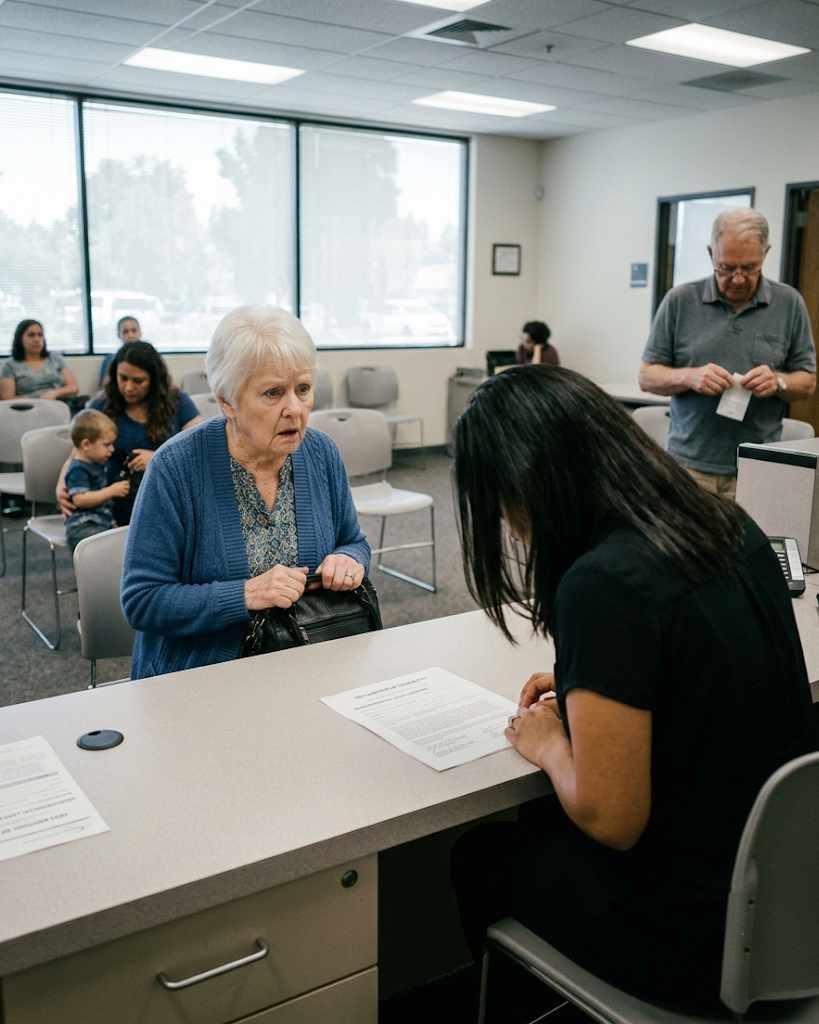
My son said he was taking me to renew my ID card “so I could get senior discounts.” but when the clerk checked my file, she went silent. two years earlier, someone had declared that I was no longer able to manage my own affairs. and the person allowed to make decisions for me wasn’t my son. it was his wife.
I was standing inside a county services office in Sacramento, holding my purse with both hands like it was the only thing keeping me upright.
The place smelled of printer paper, floor cleaner, and old coffee. People sat in plastic chairs, waiting for numbers to be called. A little boy was kicking his sneakers against his mother’s bag. An elderly man beside me kept folding and unfolding a receipt.
My son, Evan Whitmore, stood on my left.
Too still.
Too quiet.
Too careful for a man who had spent the whole morning pretending this was just a simple errand.
His wife, Lydia, stood on my right, scrolling through her phone with one hand and chewing mint gum like she was bored.
“Mom,” Evan had said over breakfast, smiling too brightly, “you should renew your ID. You know, for senior discounts. Restaurants, pharmacies, buses. It’ll save you money.”
I had laughed then.
At seventy-one, I didn’t mind saving money. I had spent my whole life stretching dollars until they screamed.
So I put on my blue cardigan, combed my hair, and let my son drive me downtown.
I thought it was a kind gesture.
That was my first mistake.
The young clerk behind the desk looked at my driver’s license, typed something into the computer, then stopped.
Her fingers froze above the keyboard.
She looked at the screen.
Then at me.
Then at Evan.
Then back at the screen.
“Ma’am,” she said carefully, “are you Margaret Whitmore?”
“Yes, dear.” I tried to smile. “That’s me.”
“Date of birth, May 14, 1955?”
“That’s right.”
Her face changed.
Not dramatically. Not enough for the whole room to notice.
But I noticed.
Old women notice more than people think.
The clerk lowered her voice. “Mrs. Whitmore, there appears to be a restriction on your record.”
“A restriction?” I asked. “What kind?”
Evan stepped forward too quickly.
“It’s probably just an old note,” he said. “My mother gets mixed up sometimes. Nothing serious.”
I turned and looked at him.
Mixed up?
I forgot where I placed my reading glasses sometimes. I once put the cinnamon in the refrigerator and the butter in the cabinet. I called my granddaughter by my sister’s name twice in one afternoon.
But I paid my bills.
I cooked my meals.
I remembered every password in the little green notebook I kept in my bedroom drawer.
And I remembered every dollar Evan and Lydia had “borrowed” from me and never mentioned again.
The clerk swallowed. “It says here that you have been listed as needing a legal representative for personal and financial matters.”
The room tilted slightly.
I gripped the counter.
“What does that mean?” I asked.
“It means someone filed paperwork saying you were not able to manage those decisions on your own.”
My mouth went dry.
“I never filed anything like that.”
Lydia stopped chewing her gum.
For the first time that morning, she looked nervous.
“Who is the representative?” I asked.
The clerk hesitated.
Evan coughed.
Lydia looked down at her manicure.
The clerk read the screen again, slowly.
“Lydia Whitmore.”
My daughter-in-law.
The same woman who called me “Mom” when she needed me to watch her children.
The same woman who said my house was “too much space for one older lady.”
The same woman who had spent the last year saying things like, “Margaret, are you sure you remember that correctly?” and “Maybe you shouldn’t keep important papers alone anymore.”
I felt something cold move through me.
Not fear.
Not yet.
Recognition.
“Why,” I said, turning to Lydia, “would your name be on my file?”
Lydia gave a small laugh.
The kind people use when they want everyone around them to believe the old woman is being difficult.
“Margaret, don’t make this uncomfortable,” she said. “We were only trying to help.”
“Help with what?”
Evan touched my elbow. “Mom, let’s go. We’ll fix it later.”
I pulled my arm away.
“No,” I said. “We will fix it right here.”
The clerk looked between us, unsure what to do.
I leaned closer to the counter. “Miss, I want to see what was filed under my name.”
Lydia’s smile tightened.
“She doesn’t need to see all that,” she said.
I looked at her.
“I am standing right here.”
Evan lowered his voice. “Mom, please. You’re making a scene.”
A scene.
That was what they called it whenever I asked a question they didn’t want to answer.
When I asked why my bank statement was missing.
A scene.
When I asked why Lydia had a copy of my house key.
A scene.
When I asked why Evan suddenly wanted me to sign papers I wasn’t allowed to read.
A scene.
For months, they had been moving things around my house. Utility bills disappearing from the mail basket. Bank notices tucked inside cookbooks. My prescription bottle placed in the wrong cabinet, then Lydia sighing and saying, “See? This is what we’re talking about.”
They had not been watching my memory fade.
They had been trying to make me doubt it.
The clerk printed a document and laid it on the desk.
At the top was my name.
Margaret Anne Whitmore.
Below it was a signature.
My supposed signature.
Uneven.
Shaky.
Wrong.
I stared at it.
“That is not how I sign my name.”
Evan wiped his forehead.
“Mom…”
“Don’t ‘Mom’ me,” I said quietly. “Not if you brought me here to find out your wife has been speaking for me behind my back.”
The waiting area went quiet.
A woman holding a baby looked up.
An older man behind me muttered, “That doesn’t sound right.”
Lydia spun around. “This is a private family matter.”
“No,” I said, still looking at the paper. “It became public the moment you put my name on something I did not sign.”
The clerk’s face had turned serious.
“There is also a medical note attached,” she said.
“What doctor?” I asked.
Evan’s jaw tightened. “That’s enough.”
I turned to him. “For whom?”
He didn’t answer.
Lydia stepped closer, voice soft and poisonous.
“Margaret, you don’t remember things. This is exactly why we had to step in.”
There it was.
The sentence she had been planting inside my life for over a year.
You don’t remember.
I remembered plenty.
I remembered scrubbing floors in office buildings at night after my husband, Walter, injured his back.
I remembered selling homemade pies on weekends so Evan could have braces.
I remembered skipping new winter coats so my children could go on school trips.
I remembered signing the papers for my little white house with trembling hands because I never thought a woman like me would own anything with her name on it.
The house had a narrow porch, a lemon tree in the backyard, and jasmine vines that climbed the fence every spring.
It was where Walter passed away in our bedroom, holding my hand and telling me, “Maggie, don’t let anyone make you small after I’m gone.”
And now my son and his wife were looking at me like I was a box to be moved.
The clerk glanced at another page.
“Mrs. Whitmore,” she said slowly, “there is also a pending change of residence request.”
My heart tightened.
“To where?”
Her eyes flicked toward Lydia.
“Willow Creek Senior Residence.”
I heard the words, but they seemed to come from far away.
Senior residence.
Not apartment.
Not vacation.
Not care visit.
A place chosen without my permission.
Lydia lifted her chin.
“It’s temporary,” she said.
“Temporary?” I repeated.
Evan finally spoke. “Mom, the house is too much for you. The stairs, the bills, the yard…”
“I have one step to the porch,” I said. “And I still trim my own roses.”
Lydia sighed, as if I were a stubborn child.
“The house can be rented out to cover your care.”
My care.
My house.
My life.
All folded into her neat little plan.
I looked at Evan. “How long?”
He blinked. “What?”
“How long have you two been planning to move me out of my own home?”
No answer.
And sometimes silence tells the whole story.
My hands shook as I took out my phone.
I called my youngest daughter, Nora, who lived in Oregon. She and Evan had never been close, and Lydia had spent years telling me Nora was “too emotional” to involve in family decisions.
Nora answered on the fourth ring.
“Mom?”
“Nora,” I said, and my voice almost broke. “Did you know Evan and Lydia filed papers saying I couldn’t manage my own affairs?”
Silence.
Then a tiny breath.
“Mom… Evan said you were getting worse.”
“Worse at what?”
“He said you left the stove on. That you gave money to strangers. That you didn’t recognize people at church.”
I closed my eyes.
The stove I had not left on.
The money I had not given away.