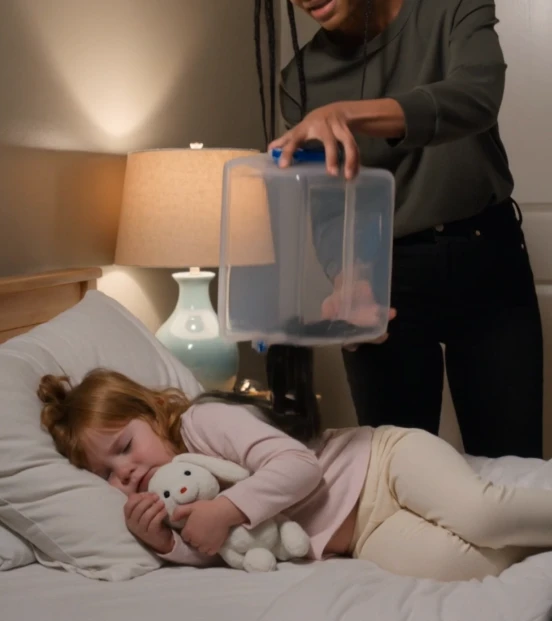
Lily was asleep when Kendra entered the bedroom carrying a clear plastic box.
The three-year-old was curled beneath her blanket, hugging a stuffed rabbit.
Inside the container, several small snakes twisted over one another.
Kendra had recently learned the family planned to fire her.
And apparently, she wanted revenge.
She stopped beside Lily’s bed and smiled.
“Your daddy thinks he can just fire me?”
Then she opened the lid.
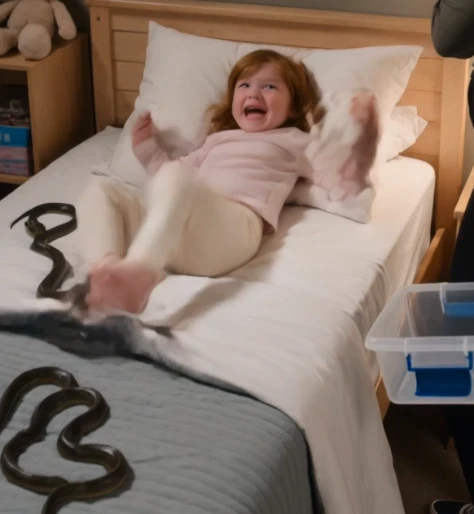
The snakes spilled across the blanket, pillow and near Lily’s legs.
“Let’s see him fix this.”
For several seconds, Lily remained asleep.
Then one snake crawled near her shoulder.
Her eyes opened.
The moment she saw it, she screamed.
“Daddy! Snake!”
Lily pulled her legs toward her chest and clutched her rabbit.
Kendra didn’t help.
She simply stood beside the bed.
“Keep screaming.”
“Daddy! Help!”
This time, the cry reached the hallway.
The bedroom door flew open.
Mark rushed inside.
He saw everything at once.
His daughter crying on the bed.
Snakes moving across the blanket.
Kendra standing beside her.
And the open container nearby.
“What the hell?!”
Mark ran straight to Lily and lifted her into his arms.
“I’ve got you.”
She wrapped herself around his neck and sobbed against his shoulder.
Then Mark turned toward Kendra.
“You put those snakes in her bed?!”
Kendra immediately shook her head.
“No! I came in and found them like this!”
Mark looked at the open container beside her.
“Then why are you holding the box?”
Kendra froze.
Before she could answer, Lily lifted her tear-covered face.
She pointed directly at the babysitter.
“She put snake.”
Kendra went pale.
Mark held his daughter tighter.
“You’re done.”
But Kendra suddenly snapped back.
“You don’t understand what your family did to me!”
And that is where the moment ends.
A terrified little girl in her father’s arms.
An open container that makes the babysitter’s story impossible to believe.
And one disturbing question left unanswered:
What did Kendra believe this family had done to her?
Mark did not answer the question.
Not yet.
His daughter was still shaking against him.
That mattered first.
He carried Lily into the hallway and called his wife, Rachel, who was downstairs finishing a work call.
“Come up now.”
Something in his voice made her stop asking questions.
She arrived seconds later.
Then she saw Lily.
“What happened?”
“Snakes.”
Rachel stared at him.
“What?”
Mark turned enough for her to see inside the bedroom.
Several small snakes were still moving across the bed while Kendra stood near the wall.
Rachel went pale.
Mark handed Lily to her.
“Take her downstairs. Don’t bring her back up.”
Lily clung to Rachel immediately.
“Kendra snake.”
Rachel looked at the babysitter.
Then at Mark.
“I’ve got her.”
Mark called animal control and explained that several pet snakes had been released inside a child’s bedroom.
Kendra laughed bitterly.
“You’re acting like I brought rattlesnakes into the house.”
Mark looked at her.
“I don’t care what species they are.”
“They’re harmless.”
“To you.”
“She was never going to get hurt.”
“She was asleep.”
Kendra rolled her eyes.
“That was the point. She would wake up, scream, you’d come running, and maybe you’d understand what it feels like when someone destroys your life without warning.”
Mark stared at her.
There it was.
Not denial anymore.
Not really.
A justification.
“What did we destroy?”
Kendra folded her arms.
“You know exactly what you did.”
“No. I know why we were going to fire you. I want to hear what you think happened.”
Her face hardened.
“You reported me.”
Mark said nothing.
“You called the agency. You told them I was unsafe. They suspended me before I could even explain.”
“Because you left Lily alone.”
“I was gone for twenty minutes.”
“Thirty-eight.”
Kendra’s eyes narrowed.
“You timed me?”
“No. The camera did.”
That was the beginning.
Three days earlier, Rachel had been reviewing footage from the front-door camera after a package went missing.
She expected to see a delivery driver.
Instead, she saw Kendra leave the house at 1:16 in the afternoon.
Alone.
No Lily.
No stroller.
No diaper bag.
Thirty-eight minutes later, Kendra returned carrying coffee.
Rachel checked the baby monitor archive.
Lily had been asleep when Kendra left.
She woke twelve minutes later.
For the next twenty-six minutes, the three-year-old wandered from her bed into the upstairs hallway calling:
“Kendra?”
Then:
“Daddy?”
Then finally:
“Mommy?”
Nobody answered.
The front door remained locked.
The alarm remained armed.
But Lily was alone.
When Kendra returned, she found the child sitting on the stairs crying.
The monitor microphone captured one sentence clearly.
“Don’t tell Daddy. Kendra came right back.”
Mark had watched that recording twice.
The first time, he felt disbelief.
The second time, anger.
He and Rachel confronted Kendra the following morning.
She admitted leaving.
She said Lily had been asleep.
She said the coffee shop was only around the corner.
She said experienced babysitters knew when a child was safe.
Mark told her none of that mattered.
They had hired her to stay with Lily.
Not leave a sleeping toddler alone inside a house.
Kendra became angry.
Then frightened.
“Are you firing me?”
Rachel answered:
“We’re ending your employment, yes.”
Kendra began crying.
She asked for another chance.
Mark refused.
Then Rachel said something Kendra apparently never forgave.
“We also have to notify the agency.”
Kendra’s tears stopped.
“You don’t have to do that.”
“Yes, we do.”
“You’ll ruin me.”
“No. We’re reporting what happened.”
“It happened once.”
Mark had believed that too.
Until tonight.
Now he looked at Kendra standing in his daughter’s bedroom beside an open snake container.
“You said we ruined your life because we reported the truth.”
Kendra’s voice rose.
“You know what that report does to someone like me? Families see one complaint and nobody calls. The agency suspended my profile. My landlord wants rent next week. I lost two weekend jobs because of you.”
Mark stared at her.
“And your answer was to put snakes in a three-year-old’s bed?”
“You wanted unsafe? Fine. Now you have unsafe.”
The sentence silenced the room.
Kendra seemed to hear herself only after she said it.
Her mouth closed.
Mark took out his phone.
“What are you doing?”
“Calling the police.”
Her expression changed instantly.
“Mark.”
He dialed.
“You already got me suspended.”
He kept dialing.
“You called the agency. Isn’t that enough?”
“No.”
“They didn’t even hurt her!”
Mark looked toward the empty doorway where Lily had disappeared downstairs in Rachel’s arms.
“You don’t get to decide how afraid she was allowed to be.”
The police arrived before animal control.
Officer Lauren Grant separated Mark and Kendra.
A second officer photographed the bedroom without disturbing the scene.
The snakes were later identified as small nonvenomous corn snakes belonging to a licensed local breeder.
Lily was checked carefully.
No bites.
No scratches.
Physically, she was fine.
Emotionally, she refused to enter the upstairs hallway.
Rachel sat with her on the living-room sofa.
“Snake gone?”
“Not yet.”
“No bed.”
“You don’t have to go near the bed.”
“Kendra gone?”
“Yes.”
That answer seemed to matter most.
Upstairs, Officer Grant asked Kendra where she got the snakes.
“At a pet shop.”
“Which one?”
Kendra hesitated.
Then gave a name.
The officer asked whether she purchased them.
“No.”
“Borrowed?”
Another pause.
“My cousin works there.”
Mark looked at her.
“You planned this?”
Kendra snapped:
“I wanted to scare you.”
“By using Lily.”
“I knew you’d hear her.”
Mark thought about how close that assumption came to being wrong.
He had been in the detached garage fifteen minutes earlier.
If he had stayed there longer, Lily could have been alone in that bed with the snakes while Kendra watched.
That thought made his stomach turn.
Then Officer Grant noticed something else.
The clear container had a white sticker across the lid.
Six words were written in black marker.
RETURN BEFORE CLOSING. DO NOT MIX.
The officer photographed it.
That label later led investigators directly to the reptile store.
Security footage from the store showed Kendra arriving that afternoon.
Her cousin was not working.
But another employee knew her and allowed her into the back room after she said she was picking up animals for him.
She left with the container.
Her cousin later confirmed he had never authorized it.
The snakes were not hers.
They were not a spontaneous object she happened to find.
She had gone somewhere, obtained them under a false explanation, transported them to the house, waited until Lily slept, and carried them into the bedroom.
The planning mattered.
But another discovery mattered more to Mark.
When police reviewed Kendra’s phone with appropriate legal authority, they found messages sent before the incident.
One was to a friend.
They think they can blacklist me and walk away clean.
Another:
He thinks his cameras make him powerful.
Then, less than an hour before she entered Lily’s room:
I’m going to give him something worth recording.
Mark read that sentence days later through the investigator.
His hands went cold.
The camera.
Kendra knew about the cameras.
She had not forgotten them.
She had expected them to record what happened.
That changed his understanding of the revenge.
She did not merely want Lily frightened.
She wanted Mark to see it.
She wanted the fear delivered to him through the same kind of device that had exposed her leaving Lily alone.
The child was the message.
That realization was harder to process than the snakes themselves.
Rachel understood it too.
“She used Lily to punish us.”
Mark nodded.
“And she knew Lily would scream.”
Rachel looked toward the playroom where their daughter sat coloring.
“She counted on it.”
The agency opened its own review.
Then another family contacted Mark.
They had employed Kendra the previous year.
Their message was cautious.
“We heard there was an incident. We don’t want to interfere, but did it involve leaving a child alone?”
Mark passed the message to the investigator rather than beginning a private exchange.
The other family eventually reported that Kendra had once disappeared during a babysitting shift for nearly an hour.
She told them she had taken their five-year-old daughter to the park.
But a neighbor’s camera showed the child never left the house.
At the time, the parents had believed Kendra’s explanation that she had stepped outside briefly to take an emergency phone call.
No formal complaint had been made.
The pattern did not prove every suspicion.
But it destroyed Kendra’s claim that Mark and Rachel had ended her career over one isolated mistake.
There had been warnings before.
People simply had not compared them.
Mark struggled with that for weeks.
He kept thinking about the night they hired Kendra.
Good references.
Warm smile.
Years of experience.
Lily liked her immediately.
None of those things had been fake.
That was what made it difficult.
Kendra had genuinely read stories with Lily.
She had made pancakes shaped like bears.
She had sat beside Lily through a fever.
A person could do caring things and still make dangerous choices later.
Mark had to resist rewriting the entire past into one simple story.
He did not need Kendra to have been a monster from the first day.
He only needed to take seriously what she had done now.
Lily’s recovery was slower than her parents expected.
The snakes were removed that night.
The bedding was replaced.
The bedroom was cleaned.
Still, Lily would not sleep there.
The first night she slept between Mark and Rachel.
The second night too.
On the third, Mark suggested the guest room.
Lily shook her head.
“Snake bed.”
“No snakes in the guest room.”
“Kendra come.”
“Kendra cannot come in.”
Lily stared at the doorway.
“Door lock?”
Mark understood.
He showed her the front-door lock.
Then the alarm panel.
Then he said:
“Daddy and Mommy are here.”
Lily eventually slept on a mattress in their room for two weeks.
Nobody turned it into a battle.
Her pediatrician recommended giving her predictable safety rather than repeatedly making her inspect the bedroom for snakes.
So Mark stopped saying:
See? Nothing is there.
Instead he said:
“You don’t have to sleep there tonight.”
That changed something.
Fear stopped becoming another test she could fail.
During play therapy, Lily used a dollhouse.
She placed a tiny child doll on a bed.
Then she put several green toy strings around it.
The therapist asked:
“What are those?”
“Snakes.”
“Who put them there?”
Lily pointed toward an adult doll.
“Kendra.”
“What does little girl do?”
“Scream Daddy.”
Then Lily moved the father figure into the room.
“Daddy get me.”
That was the story her mind could tell.
Simple.
Accurate to what she remembered.
Nobody asked her to explain revenge, employment, agencies or adult resentment.
Those were adult burdens.
Mark kept them away from her.
He also changed how he talked about the firing.
At first, he caught himself saying:
“This happened because we fired Kendra.”
Rachel corrected him.
“No. We fired Kendra because she made an unsafe choice. What she did afterward was another choice.”
That distinction mattered.
They had not caused the retaliation by reporting her.
Kendra had responded to accountability with another dangerous act.
Weeks later, Mark received a letter from Kendra’s attorney.
It included an apology she had written as part of the legal process.
Mark read it alone.
Kendra admitted that she had wanted to frighten him.
She claimed she never intended Lily to be physically harmed.
She wrote that she was desperate after losing work and felt Mark’s family had taken away the only career she knew.
Then came one sentence Mark read twice.
I wanted you to feel helpless for a few minutes the way I felt helpless when you reported me.
Mark put the letter down.
That was the answer to the question she had shouted in Lily’s bedroom.
What had the family done to her?
They had reported what she did.
They had refused to hide an unsafe decision simply because consequences might be painful.
Kendra experienced that as betrayal.
So she tried to turn their child’s fear into punishment.
Mark never answered the letter.
He did not need to.
Months passed.
Lily eventually returned to her bedroom.
Not because anyone made her.
One afternoon, she walked in to retrieve her rabbit.
Then stayed to play.
A week later, she asked Rachel:
“Nap here?”
Rachel kept her voice ordinary.
“Sure.”
Lily climbed onto the bed.
Then looked at the blanket.
“New blanket?”
“Yes.”
“No snake blanket.”
“No.”
Lily thought.
“Rabbit check.”
She made the stuffed rabbit inspect beneath the pillow.
Then laughed.
Rachel laughed too.
The nap lasted forty minutes.
That night Lily slept in Mark and Rachel’s room again.
Progress did not move in a straight line.
Nobody minded.
Several months later, the family visited a nature center.
Mark did not realize there was a reptile room until Lily saw the sign.
He immediately offered another direction.
“Want to see the turtles outside?”
Lily looked through the open doorway.
Inside, a small snake rested safely behind glass.
She squeezed Mark’s hand.
“Snake stay there?”
“Yes.”
“Can’t bed?”
“No.”
She watched for two seconds.
Then said:
“Turtles.”
They left.
Mark felt more proud of that decision than he would have if she had forced herself closer.
Lily did not owe snakes bravery.
She owed herself nothing except permission to feel safe.
The family changed babysitting arrangements too.
No single caregiver was given unquestioned authority simply because they had experience.
Schedules were clear.
Leaving the house required explicit permission.
Cameras were not treated as substitutes for trust.
And concerns were documented early rather than minimized because confrontation felt uncomfortable.
Mark learned something important about cameras.
They had helped expose Kendra leaving Lily alone.
But they had not created the truth.
A camera could record an empty hallway.
It could record a child calling for someone who was not there.
It could record a babysitter carrying snakes into a bedroom.
But someone still had to respond to what it showed.
Accountability began after the footage.
Not with it.
On Lily’s fourth birthday, she received a new stuffed animal from Rachel.
A turtle.
Lily placed it beside the old rabbit.
“What name?”
Mark asked.
She thought carefully.
“Daddy Turtle.”
Rachel laughed.
“Why Daddy Turtle?”
Lily hugged it.
“He come fast.”
Mark had to look away for a moment.
He remembered the scream through the monitor.
Daddy! Snake!
He remembered running down the hallway.
The bedroom door.
The moving blanket.
Kendra’s open container.
For months, he had replayed what might have happened if he had not heard Lily.
Eventually he stopped.
Imagined disasters could consume every safe day that came afterward.
What mattered was what actually happened.
Lily screamed.
He heard.
He came.
She pointed.
He believed her.
And when an adult offered an excuse designed to make the frightening thing seem smaller, Mark stopped accepting the excuse just because accepting it would have been easier.
Years later, Lily would barely remember Kendra’s face.
She remembered the stuffed rabbit.
The snakes.
Her father lifting her from the bed.
And one sentence.
“I’ve got you.”
Mark remembered another sentence.
“You don’t understand what your family did to me!”
At the time, it sounded like the beginning of some hidden injustice.
It wasn’t.
The family had discovered Kendra left a three-year-old alone.
They reported it.
They refused to protect her reputation at the expense of another child who might someday be left alone too.
Kendra lost work because of her own decision.
Then she made another one.
A worse one.
She turned a sleeping child into the target of an adult grievance.
That was what Mark finally understood.
Sometimes people describe consequences as cruelty when they are desperate to avoid responsibility.
Sometimes the person demanding sympathy is still the person who caused the harm.
And sometimes the clearest truth in the entire room comes from the smallest voice.
Lily pointed at Kendra.
“She put snake.”
Three words.
No elaborate accusation.
No adult explanation.
Just the truth.
This time, nobody talked over her.
Not again.