# The Night I Took My Seat
The night my husband finally got everything he said he wanted, he decided I was the one thing he could no longer afford to be seen with.
For seven years, I had believed sacrifice meant love.
I believed love was waking at four-thirty in the morning to open a neighborhood bakery, leaving at noon to clean offices downtown, then spending my evenings entering invoices for a dental supply company because the extra three hundred dollars a week covered Nathaniel’s exam fees.
I believed love was eating canned soup so he could buy the textbooks his certification program required.
I believed love was sleeping in the passenger seat of our old sedan during his night classes because the heater in our apartment had broken and we couldn’t afford both the repair and his tuition payment.
And when that sedan finally died on the shoulder of Interstate 90 during a February snowstorm, I stood beside Nathaniel with frozen fingers wrapped around his hand and laughed because there was nothing else left to do.
“One day,” he had promised me, snow melting into his dark hair, “I’m going to give you everything.”
I had smiled.
“I don’t need everything.”
Back then, I meant it.
I only needed him.
Seven years later, Nathaniel had finally become the man he used to describe in that freezing car.
And apparently, I had become something he wanted to erase.
Nathaniel had just been promoted to Vice President of Global Operations at Vance Global, one of the largest international infrastructure and technology conglomerates in the country.
The announcement had come on a Monday morning.
By lunch, his photograph was circulating through the company’s internal network.
By Tuesday, he had ordered three custom suits.
By Wednesday, he had stopped taking the train.
By Thursday, a leased black sedan began waiting outside our modest house every morning.
And by Friday, my husband had begun correcting the way I pronounced the names of wines I had no interest in drinking.
Tonight was the annual Vance Global gala at the Imperial Hotel.
Nathaniel had spoken about it for months.
Senior executives.
International partners.
Investors.
Board members.
The kind of room where careers were supposedly made with a handshake.
For six months, I had been putting aside ten dollars here, twenty dollars there from my paychecks.
I stopped buying coffee.
I repaired my old winter coat instead of replacing it.
I skipped lunch twice a week and told Nathaniel I wasn’t hungry.
At the end of those six months, I had enough to buy one dress.
It wasn’t designer.
It wasn’t couture.
It had no famous label sewn inside.
But it was beautiful.
Navy blue.
Simple.
Elegant.
When I had tried it on in the tiny fitting room of a department store, I had stared at myself in the mirror for a long time.
For once, I did not see the woman with dry hands from industrial soap.
I did not see the exhausted wife who fell asleep over utility bills.
I saw the young woman I had once been.
The woman who had walked through rooms without apologizing for occupying space.
The woman who had possessed dreams that did not begin and end with somebody else’s success.
I bought the dress.
Then I hid the receipt.
Nathaniel would have called it wasteful.
At six that evening, I showered, pinned my hair loosely behind my shoulders, and placed the gown on the bed.
Nathaniel came out of the bathroom wearing his new tuxedo.
He looked handsome.
Painfully handsome.
For a moment, I saw the twenty-eight-year-old man who had once proposed to me in a laundromat because it was the only warm place open after midnight.
Then he caught me looking.
“What?”
“Nothing.”
He adjusted his cuff links.
“You’re staring.”
“I was just thinking you look good.”
“I should.”
His answer was immediate.
No smile.
No teasing.
Just fact.
He walked to the mirror.
“This is a major night for me, Clara.”
“I know.”
“Sterling says several board members want to talk about the European expansion.”
“That sounds important.”
“It is important.”
I looked at the navy gown.
“I’ll stay out of the way.”
His hand stopped midway through straightening his bow tie.
For half a second, something crossed his face.
Not guilt.
Calculation.
Then he smiled.
It was small.
Almost kind.
“Of course.”
I should have understood then.
Instead, I kissed his cheek.
“I’m proud of you.”
Nathaniel looked at himself in the mirror while I said it.
Not at me.
At himself.
Forty-five minutes before we were supposed to leave, I went downstairs to find my earrings.
That was when I smelled smoke.
At first, I assumed a neighbor had lit a firepit.
Then came the sharp chemical odor beneath it.
Lighter fluid.
I crossed the kitchen.
The back door stood open.
Orange light flickered against the glass.
I stepped outside.
And stopped.
Nathaniel stood beside the stone grill at the far edge of our yard.
Perfect tuxedo.
Perfect shoes.
Perfectly calm expression.
In one hand, he held a bottle of lighter fluid.
On the grill lay my navy-blue dress.
Flames climbed through the fabric.
For several seconds, my mind simply refused to understand what my eyes were seeing.
The hem curled inward.
The satin darkened.
A sleeve collapsed into glowing ash.
“Nathaniel?”
My voice barely existed.
He looked at me.
No surprise.
No embarrassment.
Nothing.
I ran toward the grill.
“What are you doing?”
I reached for the metal lid.
Nathaniel caught my forearm and forced me away from the heat.
I stumbled backward onto the damp grass.
“Don’t,” he said.
I stared at him from the ground.
“My dress.”
“It was cheap.”
The words hit harder than the fall.
“You burned my dress.”
Nathaniel placed the lighter fluid on the stone counter.
“It looked cheap, Clara.”
I pushed myself upright.
“We’re leaving in thirty minutes.”
“No.”
I thought I had misheard him.
“What?”
“We are not leaving in thirty minutes.”
He adjusted one cuff.
“I am.”
The fire crackled behind him.
I looked from Nathaniel to the flames.
“I don’t understand.”
His expression changed.
I had seen impatience from him before.
Stress.
Frustration.
Exhaustion.
But this was different.
This was embarrassment.
And somehow, impossibly, the embarrassment was directed at me.
“You really want me to explain it?”
“Yes.”
Nathaniel sighed.
“You would be uncomfortable there.”
“I’ve been to company dinners with you.”
“Not like this.”
“So?”
“So look at yourself.”
The backyard became completely still.
Nathaniel continued.
“Your hands look like you scrub floors.”
“I do scrub floors.”
“That’s exactly my point.”
My throat tightened.
He looked at my hair.
My shoes.
My old cardigan.
Every glance felt like he was taking inventory of defects.
“You don’t understand how these people think.”
“These people?”
“Executives. Directors. Investors. People who matter.”
I almost laughed.
Instead, I said, “And I don’t?”
He did not answer immediately.
That pause told me everything.
“Nathaniel.”
He exhaled.
“Clara, my world has changed.”
Our world.
He had spent seven years calling it our world.
Our struggle.
Our plan.
Our future.
Now, suddenly, success belonged only to him.
“I worked three jobs while you studied.”
“I know.”
“I sold my mother’s jewelry.”
“I know.”
“I paid the registration fee for the exam that got you into Vance.”
“You’ve mentioned that before.”
His tone was bored.
Something inside me cracked.
Not loudly.
Quietly.
“You promised me that when you made it, we made it.”
Nathaniel gave me a tired smile.
“That was before I understood what making it actually meant.”
The flames behind him were getting smaller.
My dress was becoming blackened fabric and ash.
“I don’t belong beside you anymore.”
He looked relieved that I had finally said it for him.
“There’s going to be photography tonight.”
I stared.
“That’s your answer?”
“It matters.”
“To whom?”
“To everyone.”
He stepped closer, lowering his voice as though granting me confidential advice.
“You are a good person, Clara. But good isn’t enough in my position.”
I could smell his expensive cologne.
I had bought him the first bottle of that cologne three Christmases earlier when we could barely afford groceries.
“I need someone polished beside me.”
I swallowed.
“Someone?”
Nathaniel’s eyes shifted away.
And suddenly I knew.
“Who?”
“It doesn’t matter.”
“Who, Nathaniel?”
He looked irritated now.
“Chloe Mercer.”
I knew the name.
Senior Director Richard Mercer’s daughter.
Thirty-two.
Corporate strategy consultant.
Educated at Stanford.
Photographed constantly at charity dinners and art openings.
I had met her once.
She had shaken my hand without ever quite looking at my face.
“You invited her.”
“She understands the environment.”
“As what?”
Nathaniel’s jaw tightened.
“Don’t make this embarrassing.”
I actually smiled then.
Not because anything was funny.
Because sometimes humiliation becomes so complete the human mind has nowhere else to go.
“You burned your wife’s dress so you could bring another woman to your celebration, and you’re worried I might embarrass you?”
“Lower your voice.”
“There’s no one here.”
“That’s not the point.”
“No. I suppose image is the point now.”
He stepped toward me.
“If you come to the Imperial tonight, security has been instructed not to admit you.”
For one heartbeat, the world disappeared.
“You gave security my name?”
“I prevented a scene.”
“A scene.”
“Clara, please.”
Please.
As if I were making this difficult.
He picked up his car keys from the patio table.
“You’ll thank me tomorrow when you calm down.”
I stared at him.
“My dress is burning.”
“You can buy another one.”
“With what?”
He frowned.
The question annoyed him because we both knew the answer.
Nearly everything I earned had gone into our life.
His schooling.
His certifications.
His travel before the company started reimbursing him.
His interview clothes.
His debt.
His future.
Nathaniel looked at his watch.
“I have to go.”
He walked toward the house.
At the door, he turned back.
For one second, I expected something human.
Regret.
Maybe shame.
Instead he said, “And Clara?”
I waited.
“Don’t call tonight.”
Then he disappeared inside.
Two minutes later, I heard the front door close.
A car started.
The engine faded down our street.
I remained in the backyard.
The dress had almost finished burning.
A fragment of navy fabric lifted in the heat, curled, and became ash.
Seven years.
That was the strange thing about heartbreak.
People imagine it as noise.
Screaming.
Crying.
Breaking glass.
But sometimes the most important heartbreak happens in complete silence.
I sat on the cold stone step and looked at my hands.
Nathaniel was right about them.
They were rough.
A thin scar crossed my left thumb from the bakery slicer.
Two fingernails were chipped.
The skin near my knuckles was dry from cleaning chemicals.
These were the hands that had counted quarters on our kitchen floor when rent was due.
The hands that had rubbed Nathaniel’s shoulders while he studied.
The hands that had packed sandwiches for his exams.
The hands that had held him when he failed his first certification and whispered, “Try again.”
He saw disgrace.
I saw evidence.
And for the first time in seven years, I wondered whether love had not blinded me.
Maybe I had been using it as an excuse not to see.
There had been signs.
His first bonus had bought him a watch.
His second had bought him a new car.
When I suggested replacing our mattress, he told me we needed to think long-term.
At the company Christmas dinner last year, he had introduced me to his director as “Clara” instead of “my wife.”
When a colleague asked what I did, Nathaniel had answered for me.
“She helps out with some local businesses.”
I had smiled.
He had erased three jobs in six words.
Still, I had defended him.
Nathaniel is under pressure.
Nathaniel is adjusting.
Nathaniel worked hard.
Nathaniel deserves this.
Sitting beside the ashes of my dress, I finally stopped defending him.
And when the excuses disappeared, the truth was surprisingly simple.
Nathaniel did not love the woman who helped him climb.
He loved the usefulness of her.
A strange calm settled over me.
I stood.
Brushed damp soil from my knees.
Walked inside.
Upstairs, I passed Nathaniel’s newly framed promotion certificate in the hallway.
Vice President, Global Operations.
Vance Global.
I stopped.
There was an irony in those words so enormous that for a moment I almost laughed.
Nathaniel believed Vance Global was the summit of his new life.
He did not know the company had been part of mine since birth.
My name is Clara Elizabeth Vance.
My grandfather, William Vance, founded the original company with twelve employees in 1968.
My father transformed it into an international operation.
When he died, controlling ownership passed into a family trust structured largely in my name.
By thirty, I held enough voting power to determine the company’s board.
I had also hated every second of it.
Not the work.
I loved the work.
I hated what wealth did to people around me.
Friends became agreeable.
Men became attentive.
Every opinion I expressed became “brilliant.”
Every joke became funny.
Every room tilted slightly toward whatever I wanted.
Then came the board dispute.
I wanted to restructure several divisions and remove three executives I believed had become too comfortable.
The old directors called me impulsive.
Entitled.
Young.
I walked away from the public role.
Not from ownership.
Not from voting rights.
I simply disappeared from corporate society.
The board continued operating under professional management.
My identity became one of the most carefully protected facts in the company.
Nathaniel knew I came from a family with money.
He believed there had been a falling-out and the money was gone.
I let him believe it.
At first because I wanted something real.
Later because telling him seemed less important than the life we were building.
Eventually, the secret became so large I did not know how to reveal it without destroying the simplicity I had chosen.
So I kept waiting.
Waiting for the right time.
Waiting for proof that Nathaniel loved Clara the exhausted wife before he ever met Clara Vance the shareholder.
Tonight, he had provided the proof.
Just not the kind I had hoped for.
I went to the bedroom.
At the back of my closet sat a small black box Nathaniel had never opened.
Inside was a phone.
Old-fashioned.
Encrypted.
Charged once every month out of habit.
I turned it on.
One number sat in the contacts.
Sterling.
I pressed call.
He answered before the second ring.
“Miss Vance?”
His voice had aged.
Still steady.
Still formal.
“Mr. Sterling.”
There was silence.
Then, very quietly, “It has been a long time.”
“Are the preparations complete for tonight?”
A pause.
“Yes.”
“Is the board present?”
“All except Peterson. His aircraft was delayed.”
“Good.”
“Clara…”
Few people still used my first name with that particular combination of affection and caution.
“What happened?”
I looked through the bedroom window toward the backyard.
Smoke still drifted above the grill.
“I’m coming back.”
Another silence.
This one longer.
When Mr. Sterling spoke again, his voice had changed.
“Understood, Madam Chairwoman.”
The title felt strange.
Like clothing I had not worn in years.
“Send the executive car.”
“It will be there in twenty minutes.”
“And Mr. Sterling?”
“Yes?”
“Have the midnight gown brought from storage.”
“I’ll make the arrangements.”
“The Vance diamond too.”
That finally surprised him.
“Are you certain?”
I closed my eyes.
“Yes.”
A beat.
“Tonight,” I said, “I take my seat.”
Twenty-three minutes later, headlights filled our driveway.
Not one car.
Three.
I watched from the upstairs window as black executive sedans stopped outside the little house Nathaniel had recently started calling temporary.
A woman stepped from the second vehicle carrying a garment case.
I recognized her instantly.
Evelyn Shaw.
She had dressed my mother for twenty years.
When I opened the door, Evelyn stared at me.
Then at my clothes.
Then at my face.
Her eyes softened.
“Oh, Clara.”
I shook my head.
“Not tonight.”
She understood.
No pity.
No questions.
“Upstairs?”
I nodded.
Forty minutes later, the woman in the mirror looked like someone I remembered from another lifetime.
The gown was midnight silver.
Not flashy.
Architectural.
Perfectly fitted.
The silk moved like water.
Evelyn fastened the final clasp behind my neck.
Then she opened a velvet box.
The Vance Midnight Diamond rested inside.
My grandmother had worn it to the company’s twentieth-anniversary dinner.
My mother wore it only once.
I had refused it for years.
Tonight, I lifted my hair.
Evelyn fastened the necklace.
The diamond settled against my collarbone.
She stepped back.
“You look like your mother.”
That almost broke me.
Not Nathaniel.
Not the dress.
Not seven years.
That sentence.
I blinked once and steadied myself.
“Thank you.”
Evelyn looked toward the window.
“Does your husband know?”
“No.”
“About tonight?”
“No.”
“About any of it?”
“No.”
She considered this.
Then asked, “Do you want him warned?”
I looked at my reflection.
“No.”
The Imperial Hotel occupied an entire city block downtown.
By eight-thirty, the ballroom was full.
Nathaniel stood near the center of it.
Of course he did.
He had always been good at locating the place in a room where the most useful people gathered.
His scotch glass sat comfortably in one hand.
Chloe Mercer stood beside him in a silver sequined dress.
Her arm rested through his.
Nathaniel was telling a story.
People were laughing.
A senior investor raised his glass.
“To the new Vice President.”
Nathaniel smiled.
“To expansion.”
Someone asked, “Any truth to the rumor tonight is finally the night?”
“What rumor?”
“The Chairwoman.”
Nathaniel’s interest sharpened.
“You haven’t heard?”
“Heard what?”
“Sterling’s office cleared the east entrance. Half the board came in early. Something unusual is happening.”
Nathaniel looked toward the ballroom doors.
Chloe smiled.
“Maybe she’s finally appearing.”
“I hope so.”
Nathaniel straightened his jacket.
One of the directors laughed.
“You sound eager.”
“I’ve spent six months fixing problems that division tolerated for years.”
Nathaniel took a sip.
“If she’s half as intelligent as people say, she knows who deserves credit.”
Chloe touched his sleeve.
“I’m sure she’ll notice you.”
Nathaniel smiled at her.
“She notices results.”
At exactly eight forty-seven, the quartet stopped playing.
Conversation faded.
Mr. Sterling walked onto the stage.
The room slowly quieted.
Nathaniel placed his glass on a passing tray and adjusted his bow tie.
Chloe whispered, “This is it.”
Mr. Sterling reached the microphone.
“Ladies and gentlemen, thank you.”
The final conversations died.
“For many years, Vance Global has benefited from an unusual form of leadership. Our controlling shareholder has chosen privacy over publicity and substance over recognition.”
Nathaniel leaned slightly toward the man beside him.
“That’s about to change.”
Mr. Sterling continued.
“Some of you have worked for this company for decades without meeting the person whose family built it.”
The ballroom doors remained closed.
Nathaniel smiled.
“Whoever she is,” he murmured, “I intend to remember tonight.”
Mr. Sterling looked directly toward the doors.
“It is my privilege to welcome home the Chairwoman of Vance Global.”
The doors opened.
The security team entered first.
Not armed men.
Not theatrics.
Simply the discreet executive detail used whenever major shareholders attended sensitive corporate events.
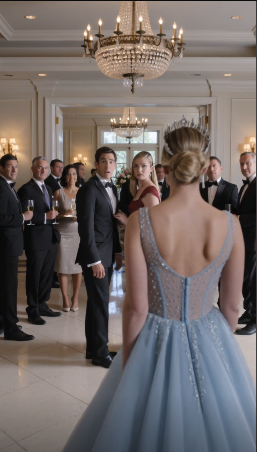
Then I stepped through the doorway.
The room went quiet in a way I had forgotten rooms could become quiet.
Not silence.
Recognition.
People began turning.
One row after another.
Faces shifted.
A director near the entrance whispered my name.
Another stood straighter.
Mr. Sterling stepped down from the stage.
Nathaniel did not see me immediately.
Chloe did.
Her smile disappeared.
“Nathaniel.”
He was still speaking to an investor.
“What?”
“Nathaniel.”
Something in her voice made him turn.
Our eyes met.
There are moments that seem to stretch beyond actual time.
His expression did not collapse all at once.
First confusion.
Then recognition.
Then disbelief.
His eyes moved from my face to the necklace.
Back to the face.
Across the room, Mr. Sterling approached me.
He stopped.
Inclined his head.
“Madam Chairwoman.”
That was the moment Nathaniel understood.
His hand loosened.
The glass slipped.
Crystal hit marble and shattered.
The sound cracked through the ballroom.
Every nearby conversation stopped.
Nathaniel stared at me.
“Clara?”
I kept walking.
Each step felt strangely easy.
I had imagined, once, what returning to this world might feel like.
Triumphant.
Terrifying.
Overwhelming.
Instead, I felt calm.
Nathaniel moved toward me.
“Clara.”
Chloe released his arm.
Mr. Sterling stepped beside me.
Several directors gathered near the stage.
Nathaniel stopped three feet away.
His face was colorless.
“What are you doing here?”
It was such an absurd question that I almost admired it.
“I was invited.”
“By whom?”
Mr. Sterling answered.
“The board.”
Nathaniel stared at him.
Then at me.
Then at the diamond again.
“No.”
Nobody spoke.
Nathaniel shook his head.
“No. Clara, stop.”
“Stop what?”
“This.”
I tilted my head.
“I’m afraid you’ll have to be more specific.”
His mouth opened.
Closed.
A hundred pieces of information were rearranging themselves inside his mind.
The company name.
My surname.
The private family history I rarely discussed.
My refusal to take his money.
My indifference to luxury.
The strange fact that senior executives had occasionally looked at me twice when Nathaniel brought me to company events.
He whispered, “Vance.”
“Yes.”
“Your name.”
“Yes.”
“Clara Vance.”
“That has always been my name.”
Several people nearby exchanged looks.
Nathaniel’s voice dropped.
“You own this company?”
“Not personally in the simplistic sense you mean. My family trust holds the controlling interest.”
His breathing changed.
“You’re the Chairwoman.”
“I am.”
Behind him, Chloe took another step away.
Nathaniel turned to her.
“Wait.”
She stared at him.
“You told me your marriage was basically over.”
The surrounding silence became heavier.
Nathaniel’s face tightened.
“Chloe, not now.”
She looked at me.
“I didn’t know.”
“I believe you.”
Relief crossed her face.
Nathaniel looked between us.
Then back at me.
His instinct finally found the only strategy it understood.
Control.
He forced a laugh.
“This is ridiculous.”
Nobody joined him.
He tried again.
“Clara, if this is some kind of revenge because of an argument—”
“An argument?”
His eyes flicked toward the people around us.
He did not want me to say it.
That alone almost satisfied me.
I looked at Mr. Sterling.
“Do you mind if I explain why my arrival was delayed?”
“Of course not.”
Nathaniel’s jaw tightened.
“Clara.”
I looked at him.
“My husband destroyed the dress I planned to wear tonight.”
A murmur traveled through the nearest guests.
Nathaniel’s face reddened.
“That is not what happened.”
I continued.
“He then informed me that I was no longer appropriate for his professional image.”
“Clara.”
“He invited someone else.”
Chloe closed her eyes briefly.
“He instructed event security not to admit me.”
Mr. Sterling’s expression became very still.
Nathaniel looked at him.
“It was personal.”
Mr. Sterling answered quietly.
“You used corporate event security to exclude the Chairwoman from her own company gala?”
Nathaniel blinked.
For the first time all evening, he seemed to realize there were consequences beyond marriage.
“I didn’t know.”
I nodded.
“No. You didn’t.”
He looked at me with something new.
Fear.
Not fear of me.
Fear of losing what he valued.
His title.
His office.
His status.
The future he had built in his head.
Nathaniel stepped closer.
“Can we talk privately?”
“You were comfortable discussing my value in the backyard.”
“Clara.”
“Why should this part require privacy?”
His voice softened.
“I made a mistake.”
“A mistake is forgetting an anniversary.”
“You know what I mean.”
“I’m not sure I do.”
His confidence was draining by the second.
“I was under pressure.”
“So was I.”
“I’ve been working constantly.”
“So was I.”
“I didn’t think.”
“That,” I said quietly, “I believe.”
A few people looked away.
Nathaniel lowered his voice.
“Please.”
That word again.
But this time, it sounded different.
In the backyard, please had meant stop inconveniencing me.
Here, it meant save me.
I studied the man I had loved for seven years.
And suddenly I remembered him at twenty-eight, sitting on the floor of our first apartment with a practice exam in his hands.
He had failed.
He had been devastated.
“I’m not smart enough,” he whispered.
I sat beside him.
“Yes, you are.”
“What if I fail again?”
“Then you take it again.”
“And if I fail after that?”
“Then again.”
He had looked at me.
“Why do you believe in me this much?”
Because I love you.
That had been my answer.
Seven years later, standing beneath chandeliers inside the company he had sacrificed our marriage to enter, I finally understood the difference between believing in someone and refusing to see them clearly.
I turned to Mr. Sterling.
“Has compliance completed its preliminary review of the operations division?”
Nathaniel froze.
Mr. Sterling nodded.
“Yes.”
“What review?”
No one answered him.
I had requested nothing vindictive.
Nothing illegal.
Nothing theatrical.
The company had procedures.
His promotion had already triggered routine scrutiny because his new position expanded his financial authority.
Mr. Sterling handed me a slim folder.
“We identified several irregular reimbursement patterns requiring formal examination.”
Nathaniel swallowed.
“That’s normal.”
“Perhaps,” I said.
“We will allow the process to determine that.”
He looked at me.
“You’re investigating me?”
“Vance Global investigates discrepancies. It is not personal.”
“But you just got here.”
“The audit predates tonight.”
That hurt him more.
Because it meant the machinery of the company did not revolve around his marriage.
He wasn’t being destroyed by an angry wife.
He was simply an executive subject to the same rules as everyone else.
I handed the folder back.
“Effective immediately, suspend Mr. Cole’s access to financial systems pending review.”
Nathaniel’s eyes widened.
“Clara.”
“His employment status can be addressed after compliance reports to the board.”
“You can’t do this.”
Mr. Sterling spoke.
“She can.”
Nathaniel looked around.
Nobody stepped toward him.
Nobody defended him.
The men who had laughed at his jokes ten minutes earlier suddenly found the marble floor fascinating.
His entire new world had not betrayed him.
It simply had never belonged to him.
That was worse.
Nathaniel took another step toward me.
“Seven years.”
His voice cracked.
“You’re going to throw away seven years?”
The irony was so perfect that I almost closed my eyes.
“I’m not the one who threw them away.”
His face changed.
For the first time that night, beneath fear and humiliation and desperation, I saw understanding.
Not complete.
But enough.
He remembered the backyard.
The fire.
My dress.
My hands.
His words.
I’m a Vice President now.
My world has elevated.
You don’t belong.
Nathaniel whispered, “I was angry.”
“No.”
“Clara—”
“You were honest.”
That stopped him.
I continued.
“You showed me exactly how you see me when you believe I have nothing to offer you.”
His eyes filled.
“I didn’t know who you were.”
“That is precisely the problem.”
He stared.
“I was your wife.”
The room disappeared for me then.
All five hundred people.
The chandeliers.
The stage.
The company.
There was only Nathaniel.
“You shouldn’t have needed to know my balance sheet.”
He said nothing.
“You shouldn’t have needed a title.”
His mouth trembled.
“You shouldn’t have needed that necklace around my neck or Mr. Sterling standing beside me.”
I took one slow breath.
“I was supposed to be enough when I smelled like dish soap.”
Nathaniel looked down.
That was the first moment I saw shame.
Real shame.
And strangely, it gave me no pleasure.
I had expected revenge to feel warm.
It didn’t.
It felt like closing a door in winter.
Necessary.
Final.
Cold.
Nathaniel whispered, “I loved you.”
“Maybe you did.”
His head snapped up.
“But somewhere along the way, you started loving what you thought you could become more.”
He wiped his face.
“Give me a chance to fix this.”
“I gave you seven years.”
“I didn’t know.”
“You keep saying that like it excuses you.”
He shook his head.
“No. I mean—I didn’t know you still had all this.”
I smiled sadly.
“And there it is.”
His face fell.
He understood what he had just admitted.
Not: I didn’t know how much I was hurting you.
Not: I didn’t know how loyal you had been.
Not: I didn’t know you still loved me.
I didn’t know you still had all this.
Power.
Money.
Status.
The exact things he had decided mattered most.
Behind us, the orchestra members sat completely still.
No one had told them whether to resume playing.
I turned to Mr. Sterling.
“Please continue the program.”
He nodded.
Nathaniel looked at me.
“That’s it?”
I faced him one last time.
“An hour ago, you told me I didn’t belong in your world.”
His eyes closed.
“You were right.”
He opened them.
I looked around the ballroom.
The company my grandfather built.
The people my father had trusted.
The responsibility I had spent seven years avoiding.
Then I looked back at Nathaniel.
“I don’t belong in the world you built.”
Hope flickered in his face, confused by the softness of my voice.
I continued.
“Because your world is a room where people only matter while they are useful to you.”
His hope disappeared.
“I spent seven years making myself smaller because I thought it made our life bigger.”
My voice remained calm.
“I won’t do that again.”
Nathaniel stood perfectly still.
Mr. Sterling signaled discreetly to two members of corporate security.
They approached.
Not grabbing him.
Not dragging him.
Simply waiting.
Professional.
Nathaniel looked at them.
Then at me.
“You’re having me removed?”
“You instructed this hotel to remove me first.”
He flinched.
“Clara.”
“Go home, Nathaniel.”
“Our home?”
I thought about the little house.
The broken heater we had replaced.
The kitchen table where he studied.
The backyard where navy fabric had become ash.
“No,” I said.
“My home.”
He swallowed.
Then, finally, Nathaniel turned.
The crowd parted.
There was no applause.
No laughter.
No spectacle.
Just silence.
And I realized silence was more powerful than humiliation.
Because everyone had seen exactly what happened.
Nathaniel had walked into the ballroom believing status had elevated him beyond the woman who built his foundation.
He walked out understanding he had mistaken proximity to power for ownership of it.
The doors closed behind him.
For several seconds, I could not move.
Mr. Sterling stood beside me.
“Clara?”
I exhaled.
“I’m fine.”
He gave me the same look Evelyn had.
Nobody who knows you believes that.
But he respected the lie.
“Would you like five minutes?”
I looked toward the stage.
The company logo glowed discreetly behind the podium.
VANCE GLOBAL.
Seven years ago, I had run from that name because I feared it would prevent me from knowing who truly cared about me.
Tonight, I finally understood something my father once tried to teach me.
Money does not reveal character.
Neither does poverty.
Power does not automatically corrupt everyone who touches it.
It merely gives people more opportunities to show what was already there.
Nathaniel had been kind when kindness cost him nothing.
Then success gave him choices.
He made them.
Now it was my turn.
“No,” I told Mr. Sterling.
“No five minutes.”
I walked toward the stage.
The room slowly settled.
I climbed the steps.
Mr. Sterling handed me the microphone.
Five hundred faces waited.
Executives who had only heard rumors about me.
Employees whose careers depended on decisions carrying my signature.
Board members who had not seen me in years.
I looked at all of them.
For seven years, I had believed hiding from power made me free of it.
It didn’t.
It simply meant other people exercised it in my absence.
I thought about my grandfather.
My father.
My mother’s jewelry.
My chipped fingernails.
The bakery alarm at four-thirty in the morning.
Nathaniel’s textbooks.
The ashes in the backyard.
Then I spoke.
“Good evening.”
My voice did not shake.
“I owe many of you an apology.”
The room remained silent.
“I convinced myself that stepping away from this company was humility.”
I looked toward the directors.
“It wasn’t.”
A few of the older ones exchanged glances.
“It was fear.”
Mr. Sterling watched me carefully.
“I was afraid that if people knew what I possessed, I would never know whether they valued me or my name.”
I paused.
“Tonight, I learned that hiding your value does not make other people more honest.”
You could feel the room listening now.
“It only makes their choices easier to see.”
I set one hand on the podium.
“Vance Global was built on an idea my grandfather repeated until everyone in our family was sick of hearing it.”
A few senior directors smiled faintly.
I smiled too.
“Character before capital.”
The phrase had been engraved inside my grandfather’s old desk.
I had forgotten it.
Or maybe I had misunderstood it.
“It is time this company remembered that.”
I looked across the ballroom.
“We will grow.”
“We will compete.”
“We will reward excellence.”
“But we will not confuse titles with character.”
The room was utterly still.
“We will not confuse expensive clothing with dignity.”
I thought about my burned dress.
“And we will never build a culture where the person at the bottom of an organizational chart is treated as though they are worth less than the person at the top.”
Mr. Sterling slowly began to clap.
One director joined.
Then another.
Within seconds, the ballroom rose.
I had attended enough corporate events in my life to know when applause was polite.
This wasn’t.
I stood beneath the lights and felt something loosen inside my chest.
Not triumph.
Release.
Later, after the speeches and board conversations, I stepped onto a quiet balcony overlooking the city.
The night air was cool.
Evelyn had insisted I bring a silver wrap, but I left it inside.
I wanted to feel the cold.
The ballroom glowed behind me.
A phone vibrated inside my clutch.
Nathaniel.
I looked at the screen.
Twelve missed calls.
Seven messages.
I opened none of them.
Then another message appeared.
Not from Nathaniel.
From Evelyn.
She had sent a photograph.
My backyard.
The fire was gone.
On the stone grill sat a single surviving piece of navy fabric.
A fragment from the dress.
Beneath the photograph, she had written:
I thought you might want this.
I stared at it for a long time.
Then I smiled.
Maybe I would keep it.
Not because I wanted to remember Nathaniel.
Because I wanted to remember Clara.
The woman on the grass.
The woman with rough hands.
The woman who believed losing a dress was the worst thing happening to her.
She did not know it yet, but she had just been given her life back.
The balcony door opened.
Mr. Sterling stepped outside carrying two glasses of champagne.
“May I?”
I nodded.
He handed me one.
For a while, we simply looked at the city.
Then he said, “Your father would have been proud tonight.”
I swallowed.
“He would have told me I was dramatic.”
Mr. Sterling laughed.
“Yes.”
“And then he would have been proud.”
“Yes.”
I raised the glass.
“To character before capital.”
Mr. Sterling touched his glass to mine.
“To coming home.”
I looked through the doors at the ballroom.
For seven years, I had lowered my voice.
Lowered my expectations.
Lowered my needs.
Lowered myself.
I had believed that was sacrifice.
Maybe some of it had been.
But somewhere along the way, sacrifice became disappearance.
And love should never require that.
I took one sip of champagne.
Not because it was expensive.
Not because everyone inside knew my name.
Not because Nathaniel had finally learned who I was.
None of those things mattered as much as they had seemed they would.
What mattered was simple.
Tomorrow morning, I would not wake up before dawn to support someone else’s ambition.
I would wake up for mine.
I would return to the headquarters my grandfather built.
I would sit at the table I had abandoned.
I would make decisions.
I would make mistakes.
I would rebuild relationships with people I had shut out.
And eventually, I would go home to a house that no longer required me to become smaller in order to keep the peace.
Nathaniel had spent seven years climbing toward Vance Global.
He believed reaching the top meant he had outgrown me.
He never understood that I had already stood there and walked away.
But the greatest surprise of the night was not discovering that my husband had underestimated me.
It was discovering how completely I had underestimated myself.
I looked through the glass doors toward the empty chair waiting at the center of the board’s table.
For years, I had thought power was something inherited.
Something stored in trusts.
Something measured in voting shares.
Tonight, I understood it differently.
Power was the moment you stopped begging somebody else to recognize your worth.
I set down my champagne.
Straightened my shoulders.
And walked back inside.
This time, I did not enter as Nathaniel Cole’s wife.
I did not enter as William Vance’s granddaughter.
I did not enter as the hidden heiress everyone had whispered about.
I entered as Clara.
And for the first time in seven years, that name was enough.



One Comment on “My husband ruined the only formal dress I owned so I could not attend his promotion celebration. He made it clear that he did not want me standing beside him that night. But when the grand ballroom doors opened, I stepped inside in a way he never expected—and before the evening was over, everything he thought he controlled had begun to change. For seven years, I had worked before sunrise and quietly paid for every exam, textbook, and second chance that brought Nathaniel into that room. He believed one ruined dress could erase me. He had no idea an empty chair was already waiting at the center of the ballroom.”