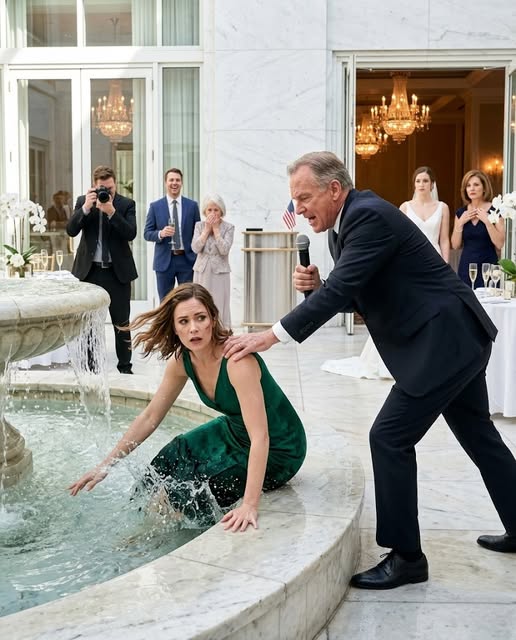
My family laughed when I walked into my sister’s wedding alone, and my father made sure every guest heard him say, “She couldn’t even find a date.”
Minutes later, after he shoved me into the fountain and the applause finally died, I looked straight at him and whispered, “Remember this moment,” because the truth I had hidden for three years was already on its way to those ballroom doors.
The worst part was not the water.

It was not the shock of cold closing over my head.
It was not the way my emerald silk dress clung to my legs, or how my heel scraped the stone edge, or how my mascara began to run in black lines down my face.
The worst part was the applause.
For a few seconds, I stood in the hotel courtyard fountain at my sister Allison’s wedding and heard my own family clap.
Not gasp.
Not rush to help.
Clap.
A man near the bar whistled.
Someone laughed so hard her champagne sloshed over the rim of her glass.
The photographer lifted his camera, hesitated for half a second, then started clicking anyway.
Across the courtyard, my father stood with the microphone still in his hand, looking as proud as if he had just delivered the closing argument of his life.
I was thirty-two years old, but in that moment I became twelve again.
The strange daughter.
The difficult daughter.
The one who never stood right in family pictures.
The one who could never make Robert and Patricia Campbell proud without Allison somehow standing brighter beside me.
My name is Meredith Campbell.
In the Campbell family, image was never just important.
It was the roof, the walls, the Sunday clothes, the polite laugh, the Christmas card, and the excuse for every cruel thing done behind closed doors.
My father, Robert Campbell, was the kind of man people admired from a distance.
He wore tailored suits, remembered judges’ birthdays, and could dismantle someone’s credibility without raising his voice.
My mother, Patricia, had spent her entire adult life making our family look effortless.
She knew which fork to use, which charity board to join, which guest mattered, and which wound could be covered with a smile before company arrived.
Then there was Allison.
My younger sister.
The golden child.
If Allison cried, she was sensitive.
If I cried, I was dramatic.
If Allison forgot something, she was overwhelmed.
If I forgot something, I was careless.
If Allison won an award, the house became a celebration.
If I won one, my father would ask whether the competition had been serious.
I learned young that love in our house came with lighting.
Allison stood in the bright part.
I learned to live in the edge of the frame.
At my sixteenth birthday dinner, my father rose with a glass in his hand.
For one wild second, I thought he was about to toast me.
My mother had ordered a cake with white frosting and sugared violets.
I remember the smell of candle smoke hanging over the dining room and the little scrape of my fork against the plate because I was so nervous I could not keep my hand still.
My father smiled.
Then he announced that Allison had been accepted into a summer program at Yale.
Everyone cheered.
My cake stayed in the kitchen until the candles burned too low to save.
That was my childhood in one clean scene.
A girl waiting for a plate that never came.
So when Allison’s wedding invitation arrived six months before the ceremony, I should have known better than to expect kindness.
The envelope was thick cream paper.
The letters were gold.
My name was printed alone.
No plus-one.
No question.
No space beside me.
I held it in my apartment for a long time before setting it on the kitchen counter beside my husband’s coffee mug.
Yes.
My husband.
That was the part of my life my family knew nothing about.
For three years, I had been married to a man named Daniel Hale.
I did not hide him because I was embarrassed.
I did not hide him because the marriage was uncertain.
I hid him because my family had a way of turning every good thing into a weapon.
Daniel had seen enough of my father through stories to understand.
He had never pushed me to introduce him.
He never said I was cowardly.
He never made me defend the part of myself that still flinched when my mother’s name appeared on my phone.
That was one of the reasons I loved him.
Daniel was powerful in the way quiet people can be powerful.
He did not need to dominate a room.
He read it.
He noticed where exits were, who had not spoken, whose hand shook near a glass, which apology came too fast.
He worked in a world of contracts, security, and private meetings that changed the shape of companies before the public ever heard about them.
My family would have loved the title, the money, the access, and the photographs.
They would not have loved him.
They would have tried to own him.
And Daniel was not a man anyone owned.
The morning of Allison’s wedding, he stood in our kitchen with his suitcase by the door and a paper coffee cup untouched beside him.
“I can move the Tokyo meeting,” he said.
His voice was calm, but his eyes were not.
“No,” I said.
I smoothed the front of my emerald dress even though it did not need smoothing.
“This contract matters. I’ll be fine for one afternoon.”
Daniel studied my face.
He had learned the difference between my truthful calm and my survival calm.
“This is your father,” he said.
“I know.”
“And your sister.”
“I know that too.”
He came closer and touched the diamond stud in my ear, the one he had given me on our first anniversary.
“You do not have to go alone.”
I wanted to say yes.
I wanted to let him move the meeting, walk into that ballroom beside me, and watch my mother’s entire social face crack in half.
But I had spent too many years being called needy, jealous, dramatic, and weak.
There are people who train you to refuse rescue, then blame you for bleeding quietly.
“I’ll be fine,” I said again.
Daniel did not believe me.
But he nodded.
“I’ll try to make it back before the reception ends.”
At 4:18 p.m., I walked into the Fairmont Copley Plaza alone.
The ballroom looked like money pretending to be romance.
White orchids hung from crystal chandeliers.
Champagne caught the light in long, narrow glasses.
The carpet was thick enough to swallow footsteps.
The air smelled like roses, perfume, polished wood, and the faint metallic chill of hotel air-conditioning.
An usher in a black suit checked my invitation.
His eyes flicked once to my empty side.
“Table nineteen,” he said.
Not the family table.
Of course not.
Table nineteen sat near the back, placed with surgical cruelty.
Close enough to prove I had been invited.
Far enough to show I had been sorted.
My cousin Rebecca found me before I had even sat down.
“Meredith,” she said, and her gaze dropped immediately to the space beside me.
“You came alone.”
“I did.”
“How brave.”
She smiled the way people smile when they have found a polite word for pathetic.
All afternoon, the comments came wrapped in silk.
Aunt Vivian asked whether I had given up on style.
Uncle Harold wondered if my government salary made dating difficult.
My cousin Tiffany told me Allison had not expected me to come, since I had missed the shower, the bachelorette weekend, and the rehearsal dinner.
I had missed them because of work I could not explain.
That Monday, my security clearance file had been updated.
At 7:06 a.m., my travel log had been signed.
A nondisclosure packet sat locked in my desk drawer under a plain label that would have disappointed my relatives because it did not look important enough.
I could have told them that my life was not small.
I could have told them that my calendar had more consequence than their guest list.
Instead, I said, “Work commitments.”
Tiffany laughed.
“Right. Your mysterious little job.”
I let her keep laughing.
Sometimes silence is not weakness.
Sometimes silence is storage.
My mother appeared after the first course.
She looked at me the way women inspect flowers before putting them in the center of a table.
“That color washes you out,” she said.
“Hello to you too, Mother.”
She ignored that.
“Try not to look so uncomfortable. The Wellingtons are important people.”
The Wellingtons were Allison’s new in-laws.
Old money.
Old manners.
Old enough to make my mother lower her voice when she said their name.
Bradford Wellington IV had the smooth face of a man who had never had to explain a bank overdraft, a rent increase, or why his car needed one more month before repairs.
He was not cruel to me.
He was worse.
He did not notice me at all.
At 5:42 p.m., I checked my phone under the table.
Daniel’s message was waiting.
Landing soon. Heavy traffic from airport. ETA forty-five minutes.
For the first time all day, my lungs opened.
Then the speeches began.
My father stepped up beside an ice sculpture of two swans and took the microphone like a judge taking the bench.
He smiled at Allison.
“My beautiful daughter has never disappointed us,” he said.
The room applauded.
I looked down at my water glass.
Never disappointed us.
The words were not aimed at me.
That did not stop them from landing.
He praised Allison’s grace.
Her achievements.
Her perfect match.
Her loyalty to family.
Her elegance under pressure.
My mother dabbed at her eyes.
Allison tilted her chin in that practiced way she had, accepting admiration as if it were weather.
I sat at table nineteen and felt the old shape of my place in the family settle around me.
After ten minutes of praise, I stood quietly and moved toward the terrace doors.
I needed air.
Two minutes away from the crystal, the flowers, the knives hidden inside compliments.
My hand was inches from the door when my father’s voice boomed through the microphone.
“Leaving so soon, Meredith?”
Every head turned.
I froze.
“Just getting some air,” I said.
My father smiled.
It was not a father’s smile.
It was a performer’s.
“Running away, more like it. Classic Meredith.”
A few people laughed.
My mother stood beside Allison and did not move.
“You missed nearly every wedding event,” my father continued.
His voice carried beautifully.
“You arrived alone. You could not even make the effort to bring someone.”
“Dad,” I said softly, “this isn’t the time.”
“It is exactly the time,” he snapped.
The microphone turned the word into a slap.
“Today is a celebration of success. Something you would know very little about.”
The room went still in that hungry way crowds do when they sense blood.
I saw Aunt Vivian lean slightly forward.
I saw Tiffany lift her glass.
I saw Allison watching me, her smile small and clean.
Then my father said it.
“She couldn’t even find a date.”
The laughter came fast.
Too fast.
Like people had been waiting for permission.
My father stepped closer.
“Thirty-two years old,” he said.
“Not a prospect in sight. Meanwhile, your sister has made a match any family would be proud of.”
I looked at Allison.
She did not look away.
She smiled.
Something inside me went very quiet.
Not broken.
Quiet.
My father kept talking.
Failure.
Embarrassment.
Jealousy.
Difficult.
Disappointment.
The words blurred together until they became the same sound I had heard my whole life.
Then his hands hit my shoulders.
I stumbled backward.
There was one breathless second where everything sharpened.
The chandelier light.
My mother’s pale blue gown.
Allison’s white dress.
The gold invitation still tucked in my clutch.
My father’s mouth still moving.
Then I fell into the fountain.
Cold swallowed me whole.
The water closed over my ears and made the room sound far away, like a party happening in another life.
My hip struck stone.
My palms scraped the bottom.
My dress twisted around my legs.
When I pushed myself up, the courtyard was laughing.
Forks hung over plates.
Champagne glasses paused midair.
A server stood frozen with a silver tray balanced on one palm.
Behind my father, the swan sculpture kept melting drop by drop.
One older guest stared down at the carpet instead of at me.
Nobody moved to help.
The photographer raised his camera.
Click.
Click.
Click.
My father looked satisfied, as if he had finally corrected a family defect in public.
For one ugly heartbeat, I imagined walking straight at him.
I imagined knocking the microphone from his hand.
I imagined screaming every truth he had ever taught me to swallow.
Instead, I stood.
Water poured from my hair, my sleeves, my ruined dress.
My heels slipped on the stone.
Mascara stung my eyes.
Every inch of me should have felt humiliated.
But I did not.
I felt awake.
For the first time in my life, I understood that I did not need those people to choose me anymore.
I pushed wet hair out of my face and looked directly at my father.
“Remember this moment.”
The laughter thinned.
My voice was not loud.
It did not need to be.
“Remember exactly how you treated me,” I said.
“Remember what you did to your daughter. Because I promise you, I will.”
No one clapped then.
No one laughed.
My father’s smile faltered.
I climbed out of the fountain and walked across the carpet, leaving water behind me in a dark trail.
Nobody offered a hand.
That was fine.
I was done reaching for them.
In the ladies’ room mirror, I barely recognized myself.
My mascara had cut black lines down my cheeks.
My hair was plastered to my face.
My emerald dress was ruined beyond repair.
But my eyes were steady.
My clutch had survived at table nineteen.
A distant cousin named Rebecca had guarded it, though she could not quite meet my eyes when she handed it over.
“I’m sorry,” she whispered.
I believed her.
It did not matter.
With wet fingers, I opened my phone and typed Daniel one message.
How close are you?
His reply came instantly.
Ten minutes. Security already at perimeter.
Security.
Of course.
Daniel had known.
Or maybe he had simply loved me enough to prepare for the worst.
At 6:31 p.m., I changed in the back of my car into the black emergency dress I kept folded in a garment bag.
It was not glamorous.
It was practical.
I had worn it after delayed flights, overnight briefings, and meetings where nobody cared if I had slept as long as I had the right file in my hand.
My family had always thought my life was vague because they had never bothered to learn its shape.
By the time I walked back into the ballroom, dry and composed, the band had started again.
My father had apparently decided the incident was over because he had decided it was over.
My mother stood near a circle of women with pearls at their throats.
“We’ve tried everything with Meredith,” she was saying.
“Some people simply refuse to thrive.”
Then she saw me.
Her smile tightened.
“Meredith. You look dry.”
“Yes,” I said.
“I always keep a backup plan.”
Before she could answer, the ballroom doors shifted.
Not opened.
Shifted.
As if the air itself had changed pressure.
Two men in dark suits stepped inside.
They did not look like hotel staff.
They did not look like wedding guests.
They looked at exits, corners, balconies, and hands.
The room noticed.
Conversations faded.
My mother frowned.
“What is this?”
I checked my phone.
One final message glowed on the screen.
In position.
One of the men touched his earpiece and spoke quietly.
“Perimeter secure. Proceeding.”
My father pushed through the crowd.
He had recovered enough anger to perform again.
“This is a private event,” he barked.
“If you are looking for the corporate conference, it’s in the west wing.”
The man did not blink.
Then the double doors opened wider.
Every guest turned.
My mother’s face changed first.
Then Allison’s.
Then my father’s.
Daniel Hale walked into my sister’s wedding wearing a dark suit, travel still visible in the set of his shoulders, and a kind of calm my father had never known how to fake.
He looked at no one else.
Only me.
The room did not recognize him at first.
Then whispers began moving through the tables.
A Wellington cousin knew his face from a business magazine.
One of Bradford’s uncles leaned toward his wife and murmured something that made her mouth fall open.
My father heard enough to understand he had misjudged the room.
That was the first change in his face.
Not guilt.
Calculation.
Daniel crossed the ballroom without hurrying.
The music died badly, one instrument at a time.
A violin note stretched too long and vanished.
My father lifted the microphone again.
“Sir,” he said, forcing a laugh, “I’m not sure who you think you are, but this is a family event.”
Daniel stopped beside me.
He did not touch me immediately.
He looked at my hair, still damp near the ends.
He looked at the black dress.
He looked at my father’s hand wrapped around the microphone.
Then one of Daniel’s security men opened a slim leather folder.
Not dramatically.
Not loudly.
Just enough for the front row to see the identification clipped inside.
My mother went pale.
At the same moment, the hotel manager came in from the side corridor with a printed incident report in his hand.
Behind him came the photographer, clutching his camera like it had become heavier.
The report had a timestamp.
6:04 p.m.
Fountain incident.
Guest pushed.
Multiple witnesses.
Images retained.
The words moved through the front tables faster than gossip because this time they were attached to paper.
My father lowered the microphone half an inch.
Allison looked from the report to the folded emerald dress I had carried back over my arm.
Her smile collapsed.
For the first time all day, she looked less like a bride and more like someone realizing the mirror had turned.
Daniel finally took my hand.
His thumb moved once across my knuckles.
A small thing.
A private thing.
The kind of care my family had never understood because it did not need an audience.
“My wife,” Daniel said quietly, “has asked me for one thing for three years.”
The room leaned in.
“She asked me not to make her family feel small.”
My father’s mouth opened.
No sound came out.
Daniel turned to him.
“And you repaid that by putting your hands on her in front of two hundred witnesses.”
The number landed because everyone knew it was close enough to be true.
The hotel manager looked at the carpet.
The photographer swallowed.
My mother whispered, “Meredith, what is this?”
I looked at her.
The woman who had corrected my dress while ignoring my bruises.
The woman who could hear a rumor from across a ballroom but never heard me when I said I was hurt.
“This,” I said, “is my husband.”
A sound moved through the room.
Not applause.
Not laughter.
Recognition.
My father tried to smile again, but it came apart before it reached his eyes.
“Well,” he said, “this is obviously a misunderstanding.”
Daniel’s security man looked toward the hotel manager.
The hotel manager held up the report.
“No, sir,” he said carefully.
“It is documented.”
Documented.
That word did something my tears never had.
It made my pain inconvenient.
My father stepped toward me.
Daniel stepped in front of him.
Not aggressively.
Completely.
“I would stop there,” Daniel said.
My father looked around for allies.
For once, the room did not rush to give him any.
Bradford’s mother had turned away from Allison.
Bradford himself looked like he had been handed a bill no family money could politely settle.
Aunt Vivian covered her mouth.
Uncle Harold stared at the floor.
Tiffany’s perfect smile had disappeared.
My mother reached for Allison’s hand, but Allison pulled away by half an inch.
It was tiny.
I saw it anyway.
Families like mine survive because everyone agrees to look away at the same time.
That night, too many people were looking.
The hotel manager asked whether I wanted to make a formal statement.
My father laughed sharply.
“Against me?”
I looked at him for a long time.
I thought of the sixteenth birthday cake in the kitchen.
I thought of every dinner where I had sat quietly while Allison became the story.
I thought of the fountain, the applause, the click of the camera.
I thought of a girl waiting for a plate that never came.
“Yes,” I said.
My mother made a small sound.
“Meredith, don’t be dramatic.”
There it was.
The family prayer.
The old commandment.
Do not be dramatic.
Do not make this visible.
Do not let consequences enter the room.
I looked at her and finally understood how small that sentence was.
“I’m not being dramatic,” I said.
“I’m being accurate.”
The statement took twelve minutes.
The hotel manager wrote down my words.
The photographer confirmed the images existed.
Rebecca, the distant cousin who had guarded my clutch, stepped forward with trembling hands and said she had seen my father shove me.
Her voice shook, but she did not take it back.
My father stared at her like betrayal had no right to come from anyone but him.
By 7:03 p.m., Daniel had arranged for my ruined dress, the incident report, and the photographer’s files to be preserved.
Boxed.
Cataloged.
Copied.
My father heard those words and finally understood that this was not a scene he could outtalk.
Allison started crying then.
Not because I had been hurt.
Because her wedding had changed shape.
“Meredith,” she whispered, “why would you do this today?”
I looked at my sister.
For years, I had wondered whether she knew what she was doing when she smiled at my pain.
Standing there in her perfect dress, surrounded by flowers and silence, I finally had my answer.
“Because Dad did it today,” I said.
That was the sentence that made Bradford step away from her.
Just one step.
But the room saw it.
My mother saw it too.
Her face folded with panic.
“Robert,” she whispered.
My father did not answer.
He was watching Daniel now.
Trying to measure him.
Trying to find the weakness.
Daniel gave him nothing.
When we left the ballroom, nobody applauded.
Nobody laughed.
Daniel draped his suit jacket over my shoulders even though the black dress was dry.
Outside, the evening air was cool.
Cars moved along the street.
Somewhere nearby, a siren passed and faded.
I stood under the hotel awning with my wet hair drying against my neck and realized my hands had finally stopped shaking.
Daniel looked at me.
“Are you ready to go home?”
Home.
Not the Campbell house.
Not the place where my cake stayed in the kitchen.
Not the ballroom where my father tried to turn me into a joke.
Home meant the apartment with the paper coffee cups, the garment bag, the quiet man who believed me before the evidence arrived.
“Yes,” I said.
We did not stay for the cake.
In the days that followed, my mother called seventeen times.
I let every call go to voicemail.
My father left one message saying the whole thing had been exaggerated.
Then another saying I had embarrassed the family.
Then a third, quieter one, asking whether Daniel really needed to involve lawyers.
That was my father’s version of regret.
Not sorry.
Just afraid.
The hotel report did not disappear.
The photographs did not disappear.
The witnesses did not all stay loyal to him.
That surprised him most.
It did not surprise me.
People follow cruelty when they think it is safe.
The moment it costs something, they start remembering their conscience.
Allison sent one text three weeks later.
You ruined my wedding.
I looked at the message for a long time.
Then I typed back one sentence.
No, Allison. Dad showed everyone what our family was, and for once I did not cover it up.
She did not answer.
I do not know what story the Campbells tell now.
Maybe they say Daniel changed me.
Maybe they say I became cold.
Maybe they say I chose power over family.
They can say whatever helps them sleep.
I know what happened.
I walked into my sister’s wedding alone because my family thought alone meant powerless.
My father pushed me into a fountain because he thought humiliation still worked on me.
And when the applause died, I finally understood that I did not need them to choose me anymore.
I had already been chosen.
Quietly.
Faithfully.
For three years.
By someone who did not need a microphone to prove I mattered.