At 65 years old, the woman had stopped expecting miracles.
She had built a life around absence because absence was what life had handed her.
For more than four decades, she had wanted a child with the kind of quiet ache that does not leave when people stop asking about it.

In her thirties, doctors told her to keep trying.
In her forties, they told her to consider alternatives.
In her fifties, they stopped softening their voices and finally said the word impossible.
By 65, she had learned to smile at baby showers without crying in the bathroom.
She had learned to buy small gifts for other people’s grandchildren and pretend the tiny socks did not feel like accusations in her hands.
She had learned to be the aunt, the neighbor, the woman who remembered birthdays, the woman who always said she was fine.
She was not fine.
She was only practiced.
The morning she saw the first pregnancy test turn positive, she thought the plastic stick had malfunctioned.
The bathroom smelled of antiseptic soap and lavender lotion.
The light above the mirror buzzed faintly.
Her hands shook so badly that she nearly dropped the test into the sink.
Two bright lines looked back at her.
Not faint.
Not uncertain.
Bright.
She bought another test at 8:11 a.m. from the pharmacy on the corner.
Then another from a different store two blocks away.
By noon, three tests sat on the bathroom counter like witnesses.
Each one said the same thing.
For the first few minutes, she did not call anyone.
She stood barefoot on the cold tile and pressed one trembling hand to her mouth.
Then the tears came.
“It’s a miracle,” she whispered.
She said it to the mirror.
She said it to the quiet house.
She said it again while holding both hands over her abdomen, though there was nothing yet to feel.
The first doctor she saw was cautious.
At her age, caution followed every sentence.
The nurse asked for dates, symptoms, medications, history, previous treatments, and whether she understood the risks.
She understood more than they knew.
She had collected medical language for years the way other women collected baby clothes.
Infertility.
Low probability.
Failed response.
Advanced maternal age.
Nonviable expectation.
Those phrases had lived in her filing cabinet longer than some families kept photo albums.
But this time, the test result was positive.
This time, the doctor ordered blood work instead of condolences.
This time, an appointment slip went into her purse beside a folded tissue and three pharmacy receipts.
Hope is cruelest when it returns wearing proof.
She built her faith out of objects.
A blue folder.
A printed lab report.
A vitamins list.
A clinic card.
A grainy ultrasound image she was told showed the beginning of the life she had waited for.
She carried that ultrasound everywhere.
At the grocery store, it sat inside the inner pocket of her purse.
At church, it rested against her Bible.
At home, she placed it on the kitchen table while she drank tea and stared at it until the black-and-gray shapes became a promise.
Her family reacted with fear before joy.
Her niece cried, but not the way the woman expected.
“Are they sure?” she asked.
Her brother came over that evening and stood in the doorway with his cap in his hands.
“You’re 65,” he said quietly.
She looked at him for a long moment.
“I know how old I am.”
He stepped inside and shut the door behind him.
“I’m not trying to hurt you.”
“I know.”
“This could hurt you.”
She placed one hand over her abdomen.
“Living without this already has.”
After that, arguments became softer but did not stop.
People used careful voices around her.
They spoke in hallways.
They looked at her belly before they looked at her face.
At St. Agnes Medical Center, one obstetrician circled her blood pressure numbers in red ink.
Another asked her to sign a high-risk acknowledgment form.
A nurse gave her a packet about warning signs and told her to call immediately if she felt dizzy, faint, short of breath, or suddenly weak.
She saved every page.
By the fourth month, her clothes felt tight.
By the sixth, she moved more slowly through her kitchen.
By the seventh, she kept a chair beside the stove so she could sit while soup warmed.
At 2:36 a.m. one rainy morning, she went to the emergency department because of pain low in her abdomen.
They sent her home before dawn with discharge instructions, a new appointment date, and a warning to rest.
She tucked those papers into the blue folder too.
The folder grew thick.
To her, thickness meant safety.
Proof made the impossible feel official.
She spoke to the baby every night.
“My child,” she would whisper, “I have waited so long for you.”
Sometimes she told stories.
She described the little yellow house where she lived.
She described the maple tree outside the kitchen window.
She described the blanket she had bought from a church sale, folded in the spare room for years because she could never quite give it away.
The house answered with ordinary sounds.
The refrigerator hummed.
The clock ticked.
Rain tapped against the windows.
Still, she smiled.
There are dreams people tell you to bury because they make everyone else uncomfortable.
But buried things do not always die.
Sometimes they wait.
Her belly grew, and so did the watching.
At family gatherings, conversation stopped when she entered the room.
Her niece helped her sit down.
Her brother carried groceries without being asked.
Neighbors asked if she needed anything, then looked away too quickly when she said no.
She knew what they feared.
They feared the story would end badly.
They feared her heart had mistaken longing for truth.
They feared that hope, at 65, might be more dangerous than grief.
She kept one answer for all of them.
“I have always wanted to be a mother. And now I have a chance.”
She said it at the clinic.
She said it at home.
She said it once to the doctor while her jaw was locked and her fingers were white around the edge of the exam table.
The doctor did not argue after that.
He only ordered another scan.
Another blood panel.
Another note in the chart.
Another instruction to call if anything changed.
Everything was changing.
She felt heavier.
She slept badly.
She woke sweating and afraid, then calmed herself by touching the curve of her abdomen.
Some nights she believed she felt movement.
A flutter.
A pressure.
A shifting weight beneath her palm.
She never knew how to explain it without sounding desperate.
So she stopped explaining.
She began preparing.
The spare room, once used for boxes and old coats, became a nursery in slow motion.
A neighbor helped move out the storage bins.
Her niece washed the curtains.
Her brother assembled a secondhand crib and pretended not to wipe his eyes when he tightened the last screw.
On the dresser, she placed a folded blanket, a small hat, and the ultrasound image in a white frame.
She would stand in the doorway at night and look at that room.
It was the first time in years the future had furniture.
Nine months passed faster than anyone expected.
Her family became quieter.
The doctors became more careful.
The woman became more certain.
On the morning the pain began, she was sitting at the kitchen table with tea cooling beside her.
A sharp tightening moved through her abdomen.
She gripped the edge of the table until the pain passed.
Then it came again.
Her breath caught.
She called her niece first.
“I think it’s time,” she said.
At the hospital, everything smelled clean and metallic.
The floor was cold beneath her slippers.
A monitor beeped somewhere beyond the curtain.
She was pale, frightened, and strangely happy.
When the nurse asked her pain level, she smiled through a wince.
“High,” she said. “But I’m ready.”
They led her into a delivery room.
The bed paper crackled as she climbed on carefully.
The blue folder sat beside her like a second patient.
Inside were the lab reports, appointment slips, discharge papers, medication lists, and the ultrasound image that had carried her through every warning.
The young doctor entered with a calm smile.
He introduced himself.
He checked her wristband.
He opened the chart.
She looked at him with exhausted relief.
“Doctor, I think the time has come…”
He nodded and began the examination.
At first, nothing seemed unusual to her.
Doctors always moved with concentration.
They always looked at screens and charts.
They always asked questions that sounded colder than they meant to be.
But then his face changed.
It was small at first.
A tightening around the eyes.
A pause that lasted half a second too long.
He looked at her abdomen.
Then at the chart.
Then at the ultrasound clipped to the folder.
His gloved hand stopped moving.
The woman’s smile faded.
“Is something wrong?” she asked.
He did not answer immediately.
That was the first real fear.
He stepped away and called a colleague.
Then another.
The second doctor entered with gray hair and a serious mouth.
The nurse stopped adjusting the tray.
The older doctor lifted the ultrasound photo and held it beneath the bright examination light.
The room changed without anyone raising their voice.
A hospital room can become a courtroom very quickly when paper starts accusing people.
The older doctor asked where the scan had been performed.
The woman named the clinic.
He asked who had explained the result.
She gave the name she remembered.
The young doctor opened the blue folder again, slower this time.
He found the lab report.
He found the discharge instructions from 2:36 a.m.
He found the appointment card.
Then he found a referral note tucked behind the ultrasound image.
It was stamped urgent.
It was signed.
It had never been explained to her.
The nurse saw the date first.
Her hand moved to her mouth.
The woman tried to sit up.
“What is it?”
The nurse gently pressed her shoulder.
“Please lie still.”
“I’m giving birth.”
Nobody answered.
The older doctor turned the referral note toward the young doctor.
The young doctor’s face drained of color.
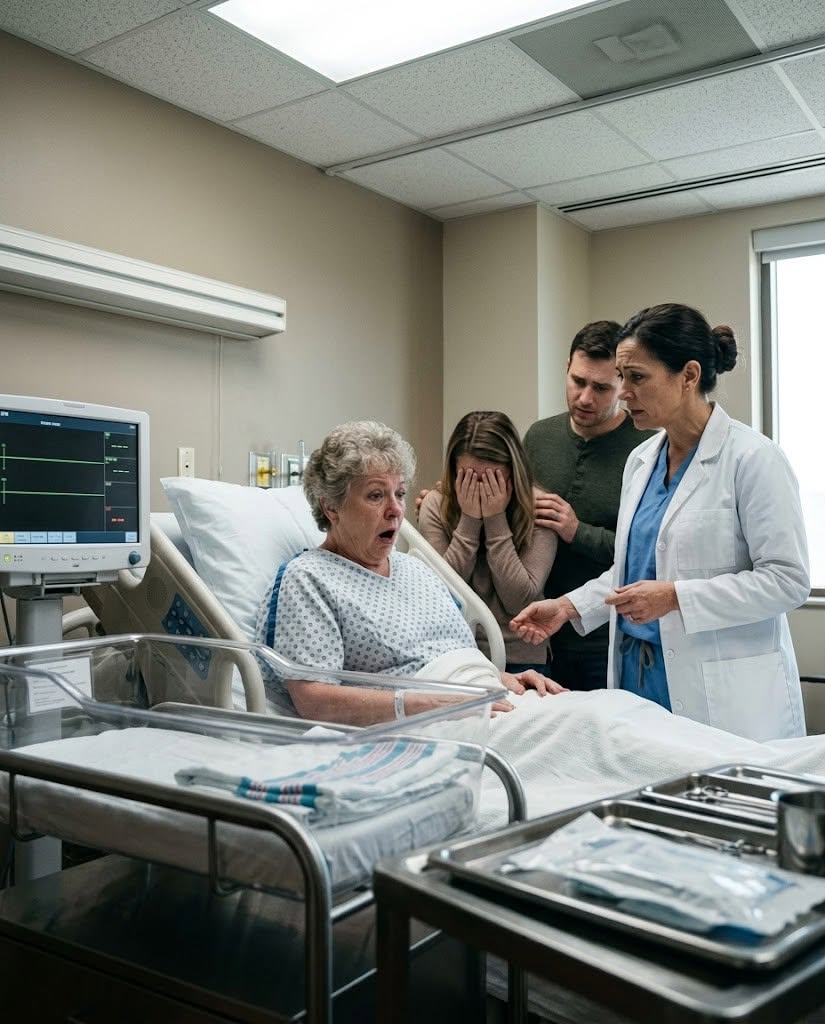
“Ma’am,” he said carefully, “excuse us, but… what was your doctor thinking?”
Those words did not sound like blame.
They sounded like fear.
She clutched the paper sheet until it tore under her fingers.
“My baby,” she said. “Is my baby all right?”
The doctors looked at each other.
That look hurt more than any answer.
The older doctor pulled a rolling stool closer and sat beside the bed.
He spoke softly, but not vaguely.
He explained that the current examination did not match a normal delivery.
He explained that the ultrasound photo in her folder appeared inconsistent with the dates listed in her file.
He explained that the urgent referral note suggested another concern had been raised months earlier.
A concern that should have been investigated immediately.
The woman stared at him.
“What concern?”
He hesitated.
Then he told her they needed imaging right away.
Not after delivery.
Not after more waiting.
Now.
The next hour moved in pieces.
A wheelchair.
A hallway.
Bright ceiling lights passing overhead.
Her niece arriving breathless at the nurses’ station.
Her brother arguing with a receptionist because nobody would tell him anything yet.
The blue folder on the woman’s lap.
Her hands resting over her abdomen as if protection could still be negotiated.
When the imaging results came back, the room felt too quiet for the number of people in it.
The doctors explained that what she had believed was a pregnancy was not what she had been told it was.
There had been a serious medical condition.
It had caused symptoms that mimicked pregnancy.
It had produced swelling, discomfort, changes in her body, and the cruel illusion of movement.
The earlier referral note suggested that someone had suspected this possibility long before the delivery room.
Someone had failed to make her understand.
Someone had allowed a 65-year-old woman to spend months preparing for a child while a dangerous condition went unaddressed.
For a while, she made no sound.
Her niece cried beside the bed.
Her brother stood with both hands on the rail, his knuckles pale.
The woman looked down at her belly.
Then she looked at the blue folder.
All those papers.
All that proof.
Proof had not protected her.
It had misled her because she trusted the people who handed it to her.
“I talked to the baby every night,” she whispered.
No one in the room knew what to say to that.
Grief is different when the world tells you the thing you loved was never real.
But her love had been real.
Her hope had been real.
The room she prepared had been real.
The blanket folded on the dresser was real.
The prayers were real.
The damage was real too.
The hospital admitted her immediately.
Specialists reviewed the records.
A patient advocate came in with a notepad and a voice that was calm without being empty.
Her niece requested copies of every document in the file.
The referral note.
The scan report.
The lab results.
The intake forms.
The discharge summary from the 2:36 a.m. visit.
Everything was copied, dated, and placed in a new folder.
This one was not blue.
It was plain white.
It did not hold a dream.
It held evidence.
The woman underwent treatment that week.
There was pain.
There was fear.
There were long hours under hospital lights while nurses checked her vitals and her family sat in chairs that made sleep impossible.
The doctors did not promise easy answers.
They did promise not to hide behind careful words.
That mattered.
Her brother brought the framed ultrasound from the nursery and asked whether she wanted it removed.
She looked at it for a long time.
Then she shook her head.
“Not yet.”
He placed it on the bedside table, face down.
That was all she could bear.
In the weeks that followed, the truth unfolded slowly.
The earlier clinic had documented abnormal findings.
A follow-up had been recommended.
The note had been filed.
The explanation had not reached the person who needed it most.
There were missed calls, unclear instructions, and one devastating assumption after another.
No single sentence could hold the harm.
Her family filed a formal complaint.
The hospital’s patient advocate helped them request a review.
The woman gave a statement in a quiet room with a box of tissues on the table and her niece holding her hand.
She did not yell.
She did not collapse.
She described the three pregnancy tests.
She described the ultrasound photo.
She described the nursery.
She described telling her belly good night.
The investigator stopped writing for a moment when she said that.
“I need you to understand,” the woman said, “I did not just lose information. I lost months of my life inside a promise.”
The review did not give her a child.
Nothing could.
But it gave names to what had happened.
Failure to communicate.
Failure to follow up.
Failure to verify.
Failure to protect a patient whose age and history should have made every warning louder, not easier to overlook.
Those words were cold.
They were also necessary.
She returned home thinner, weaker, and quieter.
The nursery door stayed closed for two weeks.
On the fifteenth morning, she opened it.
Dust floated in the window light.
The crib stood assembled.
The blanket waited on the dresser.
For a moment, she thought the grief might knock her down.
Instead, she walked to the dresser and picked up the blanket.
She pressed it to her face.
It smelled faintly of detergent and wood polish.
Then she sat in the rocking chair and cried until there was nothing graceful left in her.
Healing did not arrive like a miracle.
It came like small work.
A meal eaten.
A walk to the mailbox.
A night of sleep.
A morning when she did not reach for her belly before remembering.
Her niece visited every Sunday.
Her brother fixed the loose step on the porch.
Neighbors stopped asking questions and started bringing soup.
The woman eventually packed the baby things herself.
Not because anyone told her to move on.
Because she wanted to decide what happened to the dream that had been mishandled by everyone else.
She kept the blanket.
She donated the crib.
She placed the ultrasound image and the blue folder in a box, not hidden, but no longer displayed like a shrine.
Months later, she spoke at a patient safety meeting at St. Agnes Medical Center.
Her voice shook at first.
Then it steadied.
She told them that paperwork is not care if the patient does not understand what it means.
She told them that a signature is not consent when fear and hope are doing the reading.
She told them that older women are too often dismissed, corrected, hurried, or humored instead of heard.
Then she repeated the sentence she had once used to defend the pregnancy.
“I have always wanted to be a mother. And now I have a chance.”
She paused.
The room waited.
“That chance was taken from me by poor communication and careless certainty,” she said. “But my voice was not taken.”
Nobody moved.
This time, silence did not feel complicit.
It felt like people finally understanding the weight of what they had heard.
The woman never became a mother in the way she had dreamed.
But she did become the reason that hospital changed its follow-up policy for urgent findings.
She became the reason referral notes required direct patient confirmation.
She became the reason one nurse later told a frightened woman, “I’m going to explain this twice, and then I’m going to ask what questions you have.”
That did not erase the nursery.
It did not erase the nights she whispered to a life she believed was listening.
It did not erase the delivery room, the torn paper sheet, or the young doctor’s shocked question.
But it turned her pain into a warning that could protect someone else.
She had spent months believing proof made the impossible official.
In the end, truth had to become its own proof.
And the woman who once stood in a bathroom staring at two bright lines learned that even a broken miracle can leave behind a voice strong enough to change a room.