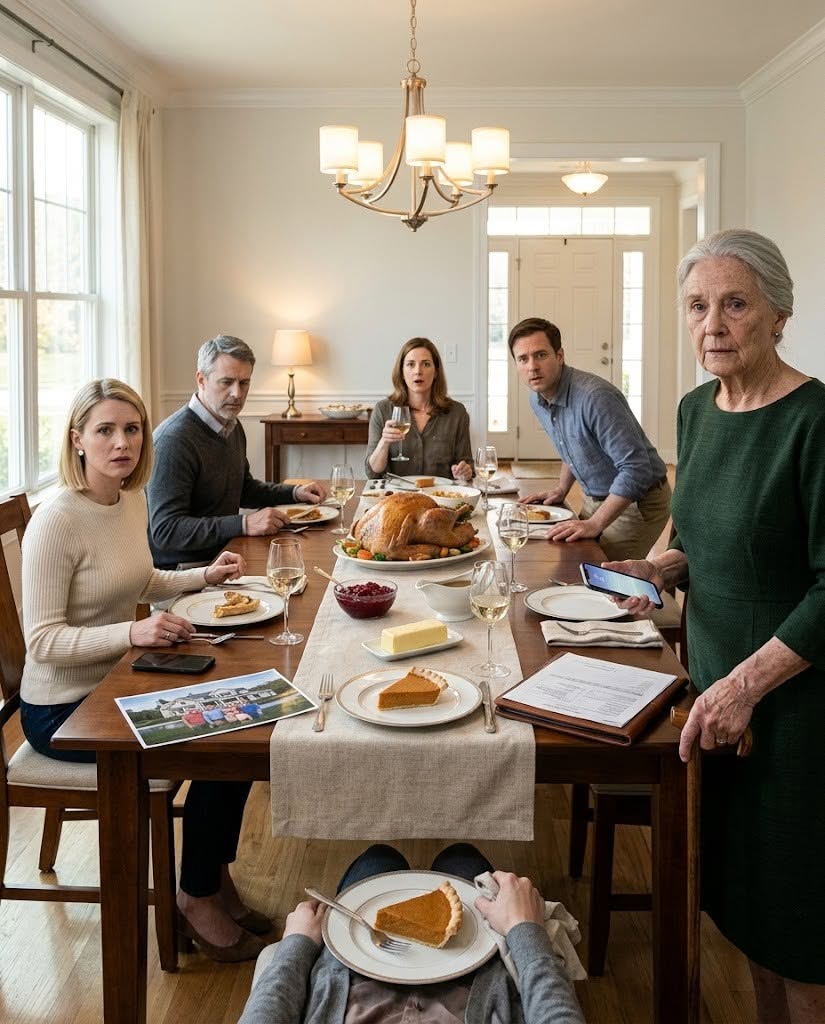
By the time Thanksgiving afternoon came, Mandy had already learned how to make hunger look like manners.
She had eaten half a banana before leaving her coworker’s apartment because the last thing she wanted was for her mother to watch her fill a plate and make that tight little face that always meant judgment.
Her bank account held $12.50.
Her duffel bag was hidden in the trunk of a borrowed car.
Her mail, what little still reached her, was being forwarded to a friend who had promised not to ask questions.
The apartment she had lost had not been luxurious, but it had been hers.
It had a narrow kitchen, a water stain near the bathroom ceiling, and one window that faced the brick wall of the building next door.
Mandy had loved that window anyway because nobody could tell her where to stand in front of it.
Then the hours at one of her part-time jobs were cut, the rent fell behind, and the late fees bred like something alive.
By the time the eviction notice became a date instead of a threat, she had already sold her small television, her winter coat with the good zipper, and the little gold bracelet her grandmother Dorothy had given her when she was sixteen.
That bracelet was the only sale she cried over.
Dorothy had always been different from the rest of the family.
Mandy’s parents treated love like a ledger, and somehow Ashley’s side of that ledger always came out clean.
Ashley was the younger sister, the prettier sister, the sister whose mistakes were “stress” and whose demands were “standards.”
Mandy was the useful one.
She was the one who picked up prescriptions, fixed phones, took extra shifts, drove people to appointments, and absorbed the family mood before it turned into a storm.
Dorothy saw that long before Mandy had language for it.
When Mandy graduated high school, Dorothy was the only one who told her, “You do not have to earn a place in this family by bleeding quietly.”
Mandy had laughed because she thought it was dramatic.
Years later, she understood it was a warning.
Dorothy had gone overseas for an extended stay after settling medical and property matters connected to an old family estate.
Her calls came at strange hours, sometimes with airport noise behind her, sometimes with the distant hum of a hotel air conditioner.
She asked about Mandy’s work, her bills, her health, and whether Ashley was still taking every room she entered and making it about herself.
Mandy always softened the truth.
She told Dorothy things were fine because people who grow up managing everyone else’s comfort often mistake silence for loyalty.
Three years before that Thanksgiving, Dorothy had made a decision nobody at the table knew how to deserve.
She bought a lakeside house through a trust structure and intended it for Mandy.
Not as a prize.
Not as a toy.
As a safety net.
Dorothy had watched Mandy spend years being dependable for people who would not have crossed a street for her unless there was an audience.
She wanted Mandy to have a locked door, a legal address, a place no one could evict her from just because a paycheck arrived late.
The property was a million-dollar lakeside house with white stone, tall windows, an iron balcony, and a private dock that caught morning light like glass.
Dorothy sent the documents home through her attorney, Grace Bellamy, with instructions that Mandy was to be notified, given the trust letter, and brought in to complete final beneficiary delivery paperwork.
The paperwork reached Mandy’s parents.
Mandy did not.
At the time, Mandy remembered signing forms her father called “routine family tax documents.”
They were spread across the dining table on a Sunday afternoon, stacked under a yellow legal pad, mixed with insurance statements and envelopes from the county.
Her mother had been standing over her shoulder.
Ashley had been in the kitchen, scrolling on her phone and making impatient little sounds as if Mandy’s hesitation were wasting everybody’s oxygen.
Mandy signed because she had been trained to trust the people who raised her.
That was the trust signal they weaponized.
She gave them her signature because they called it family.
They used it because family was the word that had always made her stop asking questions.
After that, nothing changed in Mandy’s life.
No keys appeared.
No letter arrived.
No attorney called her directly.
Dorothy, thousands of miles away and dealing with overseas obligations, was told the transfer had been received and understood.
Ashley, meanwhile, began posting photographs from a lakeside property she described as “the next chapter.”
There were captions about hard work.
There were pictures of Kevin grilling on a stone patio.
There was one photo of Ashley in sunglasses standing beside the dock, writing, “Finally building the life we deserve.”
Mandy liked the post.
She typed, “So happy for you.”
Then she went back to choosing which bills to pay late.
By the fall of that year, Mandy’s life had narrowed to schedules, couches, and numbers.
She worked morning shifts stocking shelves, evening shifts answering phones, and weekend shifts at a bakery where the smell of sugar made her hungrier than she wanted to admit.
She kept her toothbrush in a plastic bag.
She folded her few clothes so carefully they looked more permanent than her life felt.
When her mother called before Thanksgiving, Mandy almost did not answer.
“You need to come,” her mother said.
“I’m tired.”
“It will look bad if you don’t.”
That was the whole invitation.
Not “we miss you.”
Not “are you safe?”
Just optics.
Mandy arrived with clean hair, an empty stomach, and a smile she had practiced in the car.
The dining room looked exactly as it always had, polished and curated, with the heavy table, the linen runner, the good china, and the candles her mother saved for occasions where judgment needed flattering light.
Ashley was already there in a cream sweater and expensive earrings.
Kevin sat beside her with the relaxed confidence of a man who had never had to wonder where he would sleep.
Mandy’s father was carving turkey.
Mandy’s mother was directing everyone with a wineglass in hand.
Dorothy sat at the far end of the table, newly returned from overseas, silver hair pinned back and dark green dress immaculate despite the long flight two days earlier.
She looked at Mandy when Mandy came in.
For a moment, something in Dorothy’s face sharpened.
Mandy wondered later if Dorothy saw the weight loss, the borrowed shoes, or the way Mandy’s hands stayed close to her body like she was taking up as little space as possible.
Dinner began with the usual performance.
Ashley talked about renovations.
Kevin mentioned interest rates as if he personally controlled them.
Mandy’s mother corrected the placement of a serving spoon three times.
Mandy concentrated on not eating too quickly.
Then Dorothy set down her fork.
“Mandy, answer me. Why is there an elderly couple I don’t recognize living in the million-dollar lakeside house I bought for you?”
The sentence landed so cleanly that no one had time to pretend they misunderstood.
A knife slipped from Mandy’s father’s hand and struck his plate.
The clink was small, but it rang through the room like a bell in a courthouse.
Mandy looked at Dorothy.
Then she looked at Ashley.
Ashley’s face had gone so pale that her cream sweater looked darker than her skin.
For one suspended second, nobody moved.
The gravy boat sat tilted near Kevin’s elbow.
Mandy’s mother’s wineglass trembled but did not spill.
The candles burned with tiny upright flames.
Kevin stared at the cranberry sauce, his eyes refusing to rise above the rim of the bowl.
Nobody moved.
Mandy lowered the forkful of pumpkin pie she had been lifting to her mouth.
“Grandma,” she asked, “what did you just say?”
Dorothy repeated it with even more control.
She said she had purchased the lakeside vacation home for Mandy three years earlier.
She said Mandy was supposed to have been told.
She said the property was never meant for Ashley, Kevin, or Kevin’s parents.
Mandy’s first thought was that age or jet lag had confused Dorothy.
Her second thought was that Ashley looked too frightened for this to be confusion.
“I don’t own any house,” Mandy said.
Her voice sounded plain in the expensive room.
“I don’t own a vacation home.
I don’t own a condo. I don’t even own my apartment anymore.”
Her mother inhaled sharply.
Mandy kept going because the truth, once opened, had finally stopped asking permission.
“I was evicted last month,” she said.
“I’ve been sleeping on friends’ couches.”
“I have $12.50.”
There are humiliations that shrink a person, and there are humiliations that become a blade.
This one became a blade.
Dorothy’s face changed.
Not into surprise.
Into focus.
She reached into her purse and removed a glossy photograph.
In it, Ashley, Kevin, and Kevin’s parents stood smiling in front of the white lakeside mansion Ashley had once shown off online.
The same balcony.
The same stone path.
The same windows Mandy had admired through a screen while eating discount noodles from a paper bowl.
Dorothy placed the photo on the table.
Then she opened a thin leather folder and removed copies of a warranty deed, a trust letter, property tax receipts, and a stamped record from the Briar County Recorder’s Office.
The documents were too neat to argue with.
Paper has a cruelty that shouting does not.
It sits still and waits for lies to exhaust themselves.
Dorothy tapped the deed.
“Mandy Dorothy Lane,” she said.
“Primary beneficiary.
Sole intended resident. Recorded three years ago.”
Mandy felt the room tilt.
She remembered the forms.
The dining table.
Her father’s casual voice.
Her mother’s impatience.
Ashley rolling her eyes because Mandy was reading too slowly.
Her father tried to speak.
“Mom, this is not the place.”
Dorothy did not raise her voice.
“It became the place when my granddaughter said the word homeless at my Thanksgiving table.”
That was when Ashley slid one hand under the table.
Dorothy saw it without turning her head.
“Ashley, put your phone where I can see it.”
Ashley froze.
Then she laid the phone face down beside her plate.
The room learned something in that moment.
Dorothy did not need volume to command it.
She had evidence.
She had patience.
She had come home prepared.
Dorothy asked Mandy whether anyone had given her an envelope from Grace Bellamy.
Mandy said no.
Dorothy asked whether anyone had explained the house was meant to be a safety net.
Mandy said no.
Dorothy asked whether anyone had made her sign papers after Dorothy’s last visit.
Mandy looked at her parents, and the memory returned with enough force to make her hands cold.
“Yes,” she said.
Her mother finally whispered, “Mandy.”
The name was not comfort.
It was a command to stop.
Mandy did not stop.
“I thought they were tax forms,” she said.
Dorothy lifted her phone from the table.
The screen was already active on a call.
“Grace,” she said, “we are ready.”
The doorbell rang a few minutes later.
The sound was not dramatic.
It was one clean chime from the front hall.
And still, everyone at the table seemed to understand that the evening had just crossed a line it could not uncross.
Kevin opened the door.
Grace Bellamy stepped inside in a navy coat, carrying a black document case.
She did not look surprised by the silence.
Good attorneys rarely do.
She introduced herself to Mandy with a softness that made Mandy’s throat tighten.
Then she opened the case on the dining table and removed a sealed envelope with Mandy’s full name printed across the front.
Under it was a second line Mandy had never seen.
Beneficiary Delivery Confirmation.
Mandy’s mother whispered, “Dorothy, please.”
Dorothy looked at her daughter with the expression of someone who had spent a long flight deciding exactly how much mercy the truth deserved.
Grace slid out the first page.
It showed a delivery acknowledgment attached to the original trust letter.
The page stated that Mandy had received notice of the property, accepted beneficiary status, and acknowledged occupancy rights.
At the bottom was a signature.
It looked like Mandy’s name.
It was not Mandy’s hand.
The M was wrong.
The slope was wrong.
The little loop Mandy always made in the y was missing.
Mandy stared at it until the letters blurred.
“I didn’t sign that,” she said.
Her father closed his eyes.
That was the first confession his body made.
Ashley started talking quickly.
She said nobody meant harm.
She said Dorothy was overseas and details were complicated.
She said Mandy had been unstable.
She said Kevin’s parents needed somewhere quiet after selling their place.
She said the house was too much responsibility for Mandy, as if being robbed became charity if the thief sounded concerned enough.
Dorothy let her speak.
Then Dorothy asked one question.
“Who gave Kevin’s parents keys?”
Ashley looked at Kevin.
Kevin looked at the floor.
The answer crawled through the room without being spoken.
Grace removed another document.
It was an occupancy agreement, unsigned by Mandy but executed through a “family management authorization” that Grace had never drafted and Dorothy had never approved.
The document had been used to justify utilities, access, and maintenance under Ashley and Kevin’s direction.
Dorothy’s attorney had obtained it after Dorothy saw Ashley’s online photos and began asking why property tax notices were being copied to an address Dorothy did not recognize.
That was the forensic trail.
A photo.
A tax receipt.
A forged delivery confirmation.
An unauthorized occupancy agreement.
A county record that did not match the story Mandy’s parents had been feeding Dorothy for three years.
Mandy’s father finally spoke.
“We were going to tell her.”
Dorothy’s laugh was quiet and terrible.
“When?”
No one answered.
“When she stopped being poor enough to embarrass you?”
Mandy’s mother covered her mouth.
Dorothy turned to Ashley.
“You put your in-laws in her house while your sister slept on couches.”
Ashley’s eyes filled with tears, but even that looked practiced at first.
“She would have sold it,” Ashley said.
Mandy stared at her.
It was the first honest sentence Ashley had offered all night.
Not sorry.
Not confused.
Not afraid for Mandy.
Only afraid that Mandy might have used what belonged to her differently than Ashley wanted.
Mandy stood then.
Her knees felt unsteady, but her voice did not.
“You knew?” she asked Kevin.
Kevin rubbed his forehead.
“My parents thought it was Ashley’s family property.”
“That isn’t what I asked.”
He looked at Ashley again.
Mandy had known Kevin for six years.
She had attended his engagement party, helped address wedding envelopes, and once spent an entire Saturday helping Ashley choose between two reception centerpieces while Kevin joked that Mandy was “basically unpaid staff.”
She had laughed then.
She did not laugh now.
Kevin said, “I knew it came from your grandmother.”
That was enough.
Grace began outlining the immediate steps.
The house was still legally tied to Mandy’s beneficiary interest.
The forged acknowledgment would be challenged.
The unauthorized occupancy agreement would be voided.
Kevin’s parents would be contacted formally and given a lawful notice period because Dorothy had no intention of punishing an elderly couple if they had been misled.
Ashley and Kevin, however, would be held responsible for costs, unauthorized use, and any damage.
Mandy’s parents would be removed from every administrative role Dorothy had ever trusted them with.
Dorothy listened without blinking.
Then she asked Mandy where her belongings were.
Mandy almost said, “In my car,” but shame rose up by habit.
Dorothy saw it.
“Mandy,” she said, “where are your belongings?”
“In the trunk,” Mandy answered.
Dorothy nodded once.
“You are not sleeping on a couch tonight.”
Mandy’s mother stood.
“Mom, you can’t just tear this family apart.”
Dorothy turned slowly.
“No,” she said.

“You did that. I am only putting names on the pieces.”
There are moments when a family does not break.
It is revealed already broken.
This was one of them.
Mandy left the table with Dorothy and Grace.
She did not slam a door.
She did not throw the photo.
She did not give Ashley the satisfaction of a scene that could later be edited into “Mandy overreacted.”
She picked up the folder, the photograph, and the sealed envelope with her name on it.
Outside, the air was cold enough to make her breath show.
Dorothy stood beside her on the porch and looked suddenly older than she had inside.
“I thought I protected you,” Dorothy said.
Mandy’s anger shifted then.
Not vanished.
Shifted.
“You tried,” she said.
Dorothy’s mouth trembled once before she controlled it.
That night, Mandy slept in a hotel room Dorothy paid for under Grace’s name, because Dorothy did not want Mandy’s parents or Ashley calling the front desk.
The room smelled like clean sheets and lemon soap.
Mandy put her duffel bag on the chair and sat on the bed without taking off her coat.
For the first time in a month, there was a door she could lock.
She cried then.
Not prettily.
Not quietly.
She cried because the distance between $12.50 and a stolen million-dollar house was too absurd for the body to hold without breaking somewhere.
The next week moved quickly.
Grace filed the necessary notices, preserved copies of every document, requested handwriting review, and contacted the title company.
Dorothy sent a formal letter to Kevin’s parents explaining that the property had never belonged to Ashley or Kevin.
Kevin’s parents responded through their own attorney, stunned and embarrassed.
They had been told the house was Ashley’s inheritance.
They had paid utilities into an account Ashley controlled.
They had even mailed thank-you cards to Dorothy through Mandy’s parents, cards Dorothy had never received.
That detail hurt Mandy more than she expected.
The elderly couple were not villains.
They were another set of people placed inside a lie and told it was shelter.
By December 15, they moved out.
Dorothy had the locks changed the same day, not because she mistrusted them, but because she had learned what trust without verification had cost Mandy.
Mandy walked into the lakeside house two days later.
The mansion smelled faintly of lemon polish, lake air, and someone else’s candles.
Her footsteps echoed across the entryway.
The windows were taller than they looked in Ashley’s pictures.
The kitchen had a blue-tiled backsplash and a breakfast nook facing the water.
There was a guest room with folded blankets.
There was a small office with a view of the dock.
Mandy stood in that office for a long time.
Dorothy placed a key in her palm.
It was heavier than Mandy expected.
Keys should not feel like apologies.
This one did.
The civil settlement came months later.
Ashley and Kevin agreed to repay documented costs and unauthorized rental value over time.
Mandy’s parents signed acknowledgments admitting they had failed to deliver beneficiary documents and had participated in misrepresentations surrounding the delivery confirmation.
Grace told Mandy that a criminal case was possible, but Dorothy let Mandy decide how far to push.
Mandy chose documentation, restitution, and distance.
Not forgiveness.
Distance.
Forgiveness is private, and sometimes people demand it only because accountability feels expensive.
Mandy changed her phone number.
She blocked Ashley after one message that said, “I hope you’re happy ruining everyone’s life.”
Mandy almost answered.
Then she remembered the couch, the $12.50, the photo, the signature that was not hers, and the way Ashley said, “She would have sold it,” as if theft were stewardship.
She deleted the message.
Spring came to the lake slowly.
Mandy found work closer to the house.
She planted herbs in pots by the kitchen window.
She bought a used desk for the office and placed Dorothy’s trust letter in the top drawer, not hidden, but kept.
Some nights, she sat on the dock and let the water move beneath the silence.
She was not suddenly healed because a house had been returned.
A roof can protect a body before it teaches a heart to feel safe.
But safety began in small rituals.
Locking the door.
Opening mail addressed only to her.
Buying groceries without counting every item twice.
Sleeping without listening for someone else’s couch springs.
Dorothy visited often.
Sometimes they drank coffee in the breakfast nook and said very little.
Sometimes Dorothy apologized again.
Mandy always told her the same thing.
“You came back.”
That mattered.
At Thanksgiving the next year, Mandy did not go to her parents’ house.
She cooked a small meal at the lake.
Dorothy brought pie.
Grace Bellamy sent flowers with a card that simply read, “For the rightful resident.”
Mandy laughed when she saw it.
Then she cried for a minute in the hallway because joy still startled her.
At Thanksgiving, while Mandy had been trying not to think about the fact that she was basically homeless, living off $12.50 and crashing on friends’ couches, her grandmother had returned from overseas and asked one question that cracked the whole family story open.
The question did not give Mandy a house.
Dorothy had already done that.
The question gave Mandy the truth.
My bank balance was $12.50, and somewhere by a lake, strangers were sleeping under a roof my grandmother had bought in my name.
That sentence stayed with her because it held both betrayals at once.
The poverty they watched.
The shelter they hid.
Years later, when people asked Mandy why she no longer spoke to Ashley or her parents, she did not recite every document.
She did not show them the forged delivery confirmation.
She did not explain the county record or the unauthorized occupancy agreement unless they truly needed proof.
She only said, “They let me be homeless while they used the home that was mine.”
Most people understood.
The ones who did not were usually the ones who believed family meant never naming what family had done.
Mandy learned better.
Family is not the person who asks you to stay quiet so dinner can continue.
Family is the person who lets the whole table go silent because the truth finally deserves a place to sit.
