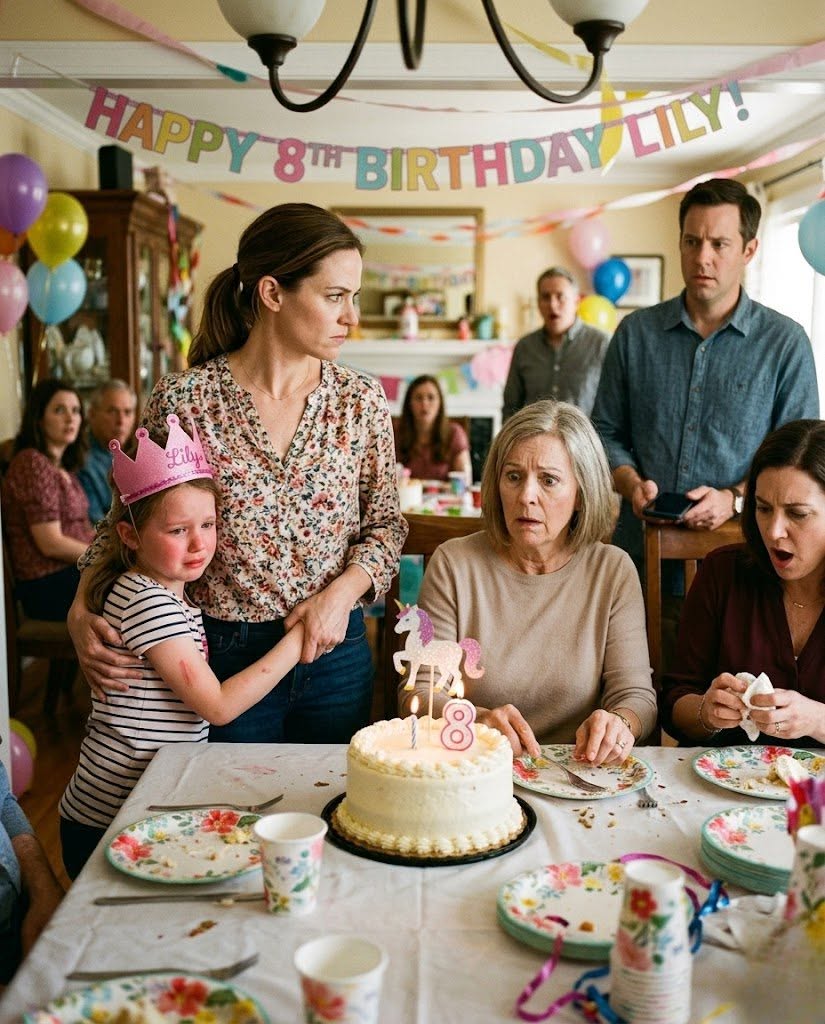
The frosting had been piped in soft white ridges around the edges, with pink stars pressed into the corners and one candle already waiting near the center.
There were paper plates stacked near the napkins, a half-open pack of plastic forks, gold ribbon curling off the side of the table, and too many adults standing too close together in a room that had always felt smaller when my mother was in it.
Mia was turning eight.
My daughter Lily was not.
That difference should have meant nothing more than whose name was on the cake.
In my family, it had always meant much more.
Lily stood near the table with both hands at her sides, trying so hard to be careful that it hurt to watch.
She had been told before we arrived not to touch the cake, not to get in the way, not to be too loud, and not to make today about herself.
Those were not rules I gave her.
Those were the rules she had learned by surviving rooms like this one.
My mother had a way of making a child feel like a guest in her own bloodline.
She did it with soft corrections, small glances, little pauses before saying Lily’s name.
She did it by praising Mia for things Lily was scolded for doing.
She did it by calling Mia spirited and calling Lily dramatic.
She did it so often that most people stopped hearing it as cruelty and started treating it like weather.
Something uncomfortable.
Something predictable.
Something no one wanted to challenge.
That afternoon, Lily saw the unicorn topper and forgot herself for half a second.
Not in a wild way.
Not in a spoiled way.
She didn’t grab it.
She didn’t yank it out of the cake.
She didn’t shove her fingers into the frosting or try to take something from Mia.
She reached out with one careful finger, her eyes wide, her mouth slightly open, like she was touching the surface of a dream.
That was all.
One careful finger.
One child believing, for one breath, that beauty near her might also be allowed to include her.
My mother’s hand snapped out so fast I didn’t understand what had happened until I heard it.
Skin on skin.
A sharp clap in the warm dining room.
The sound cut through the little birthday noises like a knife through ribbon.
Lily’s arm jerked back.
The fork in my aunt’s hand clinked against her plate.
Someone’s chair squeaked against the floor and then stopped.
My mother leaned down toward Lily with perfume surrounding her like a cloud.
It was the same perfume she wore to church, family dinners, weddings, and every argument she wanted to win while still looking graceful.
Floral.
Powdery.
Too sweet.
She smiled the way adults smile when they want cruelty to look like discipline.
Then she said, “This is not for you. You don’t belong in this family.”
For a second, Lily did not move.
She did not cry.
She did not look at the red mark beginning to rise on her arm.
She stared at the unicorn topper.
That was the image that lodged itself inside me.
My daughter staring at a glittery plastic unicorn as if it had betrayed her by existing on the wrong cake.
Children usually cry when pain lands suddenly.
Lily didn’t.
She froze because every adult around her froze first.
My sister Tessa sat at the head of the table near Mia’s birthday candles, wearing the smile she used whenever my mother crossed a line and expected everyone else to step around it.
It was a practiced smile.
A hostess smile.
A smile that said, Please don’t make this ugly in my house.
But it was already ugly.
It had become ugly the moment my mother put her hand on my child.
My aunt looked down at her plate.
She stared at the porcelain pattern as if the blue flowers painted around the rim had suddenly become fascinating.
Tessa’s hu
sband kept his eyes on his phone.His thumb hovered over the screen, frozen above a half-finished scroll.
He did not look up right away.
He did not say Lily’s name.
He did not say anything.
A napkin lay crushed in my aunt’s fist.
The candle flame shivered over the cake.
The fork my mother had been holding was still angled near her plate, bright against the porcelain.
The unicorn topper leaned in the frosting.
The plastic eight glittered like the room had not just shown me exactly what it was.
No one said, “Hey, that’s not okay.”
No one said, “Don’t touch her.”
No one said, “Lily is family.”
The silence in that room was not confusion.
It was agreement wearing a mask.
It was years of people deciding that keeping my mother comfortable mattered more than keeping Lily safe.
I had heard that silence before.
I had heard it when my mother told Lily to stop taking up space because she laughed too loudly during a family dinner.
I had heard it when Mia was allowed to open presents first at someone else’s celebration because my mother said she was excited.
I had heard it when Lily was told to go play somewhere else while the other children stayed in the room.
I had heard it when my mother’s voice went soft right before it turned cruel.
Soft voices can do a lot of damage when everyone agrees to call them manners.
At first, my body wanted to react in every loud way possible.
I wanted to scream.
I wanted to knock the cake off the table.
I wanted to say something so sharp that the walls would remember it.
But rage, real rage, did not come out hot.
It came out cold.
It settled into my shoulders.
It tightened my jaw.
It turned my hands steady.
I curled my fingers once at my side and forced them open again.
Lily was still looking at the topper.
She was still waiting to find out what kind of room she was standing in.
That was the moment I understood something I should have understood sooner.
A child should never have to watch the adults around her to decide whether she deserves protection.
I walked forward.
I did not shove anyone.
I did not touch my mother.
I did not raise my voice.
I reached for Lily’s hand.
Her fingers slipped into mine, small and cold.
She looked up at me, and there was no dramatic sobbing in her face.
Only confusion.
That was worse.
Confusion meant she was still trying to make sense of something that never should have happened.
Confusion meant some part of her was wondering whether she had caused it.
Confusion meant my family had done more damage than they knew.
I held her hand and looked straight at my mother.
My mother still wore that controlled expression.
The one she used when she believed everyone else would fold first.
She thought I would do what I had always done.
She thought I would swallow the moment for the sake of the party.
She thought I would tell Lily we would talk about it later.
She thought I would keep paying the price of peace.
She was wrong.
Some families don’t break with shouting.
They break with receipts.
I said four words.
“The money stops today.”
I said it quietly.
I said it clearly.
I said it like a door closing.
For a second, no one moved.
Then Tessa’s smile disappeared.
It vanished so quickly it was almost startling, like a curtain had dropped and revealed the panic behind it.
My mother’s face drained of color.
The expression she had been wearing cracked in a way I had never seen before.
Her fork slipped from her hand and struck the plate with a metallic clatter.
That sound did what Lily’s slap had not done.
It made everyone react.
My aunt flinched.
Tessa’s husband finally looked up from his phone.
Mia’s candle sputtered, the little flame bending sideways as if the room had inhaled at once.
Everyone stared at me.
Not at Lily.
Not at the red mark on her arm.
Not at the woman who had slapped a child beside a birthday cake.
At me.
As if I had become the dangerous person in the room.
That told me everything.
Lily squeezed my hand.
Her grip was tiny, uncertain, and searching.
I knew she did not understand what those four words meant.
She did not know why Tessa’s face had gone pale.
She did not know why my mother suddenly looked less angry than afraid.
She did not know why a room full of adults who had ignored her pain were now paying attention.
I wanted to kneel and explain it to her.
I wanted to tell her that money was not love, but sometimes money was the leash people counted on you never noticing.
I wanted to tell her that I had helped for years because family was supposed to mean something.
I wanted to tell her that I had written checks, covered gaps, paid for emergencies, softened consequences, and kept quiet when gratitude curdled into entitlement.
But not there.
Not in front of them.
Not while she was still standing beside the cake she had been punished for admiring.
Tessa whispered my name.
It was not a question.
It was a warning.
She said it the way she used to say it when we were younger and my mother was in one of her moods.
Careful.
Don’t make it worse.
Don’t embarrass her.
Don’t ruin everything.
But everything was already ruined.
My mother had slapped my daughter.
My mother had told my daughter she did not belong in her own family.
The room had agreed by saying nothing.
There was nothing left for me to protect except Lily.
My mother tried to recover first.
She gave a small laugh.
It was the kind of laugh people use when they are trying to turn a confession into a joke.
“Oh, don’t be dramatic,” she said.
The words landed exactly where they always did.
She had used that sentence my whole life.
When I was hurt.
When I was angry.
When I noticed something everyone else wanted hidden.
Don’t be dramatic.
It was never a defense.
It was a dismissal.
I looked at Lily’s arm again.
The red mark was still there.
Small.
Clear.
Real.
I looked at the cake.
The unicorn topper was still tilted in the frosting.
I looked at the fork on my mother’s plate.
I looked at my aunt’s crushed napkin.
I looked at Tessa’s husband’s phone lying face down now, finally abandoned because money had become more interesting than a hurt child.
The room was full of evidence.
No one could pretend they had not seen it.
My mother’s eyes narrowed.
She stopped trying to look gentle.
“You wouldn’t dare,” she said.
There it was.
Not apology.
Not concern.
Not shame.
A challenge.
Tessa inhaled sharply.
Her husband sat up straighter.
My aunt finally looked at me, and for the first time all afternoon, she looked afraid.
Not afraid for Lily.
Afraid of the consequences.
That was the family I had been trying to bargain with.
A family that did not move for a child’s pain but shifted in their seats at the mention of money.
My fingers tightened around Lily’s for one second before I loosened them.
I would not make my anger another thing she had to survive.
I kept my voice level.
“I already did,” I said.
Tessa stood halfway from her chair.
The legs scraped against the floor.
Mia looked from her mother to the cake, confused in the way children become confused when adults make a room unsafe and then demand that everyone call it normal.
I did not blame Mia.
She was a child too.
She did not create this system.
She had simply benefited from the way the adults arranged it.
My mother pushed her chair back slightly.
Her hand went to the edge of the table, near the plate where the fork had fallen.
She looked smaller without control.
That surprised me.
For most of my life, she had seemed enormous in rooms like this.
Her approval had been a ceiling.
Her anger had been weather.
Her disappointment had been a sentence everyone rushed to avoid.
But standing there with Lily’s hand in mine, I saw something different.
I saw a woman who had counted on silence so long she mistook it for loyalty.
I saw a room of adults who had mistaken my restraint for weakness.
I saw my daughter learning, in real time, whether her mother would choose comfort or her.
I chose her.
Tessa said, “Can we not do this right now?”
That sentence almost made me laugh.
Right now.
As if timing were the problem.
As if the issue was not a grown woman slapping a child beside an eight-year-old’s birthday cake.
As if cruelty became acceptable when cake was involved.
I looked at my sister.
For years, Tessa had mastered the art of looking wounded whenever anyone interrupted her convenience.
She could turn someone else’s boundary into an attack on her peace.
She could make a victim feel rude for bleeding on the carpet.
But her smile was gone now.
Without it, she looked exactly like someone who had always known more than she admitted.
“This already happened,” I said.
The candle kept burning.
The wax had begun to soften at the top.
No one sang.
No one moved to cut the cake.
The whole party had narrowed down to my daughter’s hand in mine and my mother’s face across the table.
My mother looked at Lily then.
Not with softness.
Not with regret.
With irritation.
As if Lily had caused trouble by existing visibly enough to be hurt.
That look confirmed every decision I had just made.
Lily shifted closer to my leg.
I felt it.
That small lean.
That quiet request for shelter.
I wanted to take her out immediately.
I wanted fresh air around her.
I wanted distance from the perfume, the frosting, the silence, the eyes.
But my mother was still standing there believing she could make me back down if she found the right pressure point.
She had always been good at that.
She knew where guilt lived.
She knew where obligation lived.
She knew how to say family like it was a debt instead of a bond.
“You’re going to punish everyone because she touched something that wasn’t hers?” my mother asked.
The sentence hung in the air.
There was the story she wanted the room to accept.
A child touched a decoration.
A grandmother corrected her.
A mother overreacted.
That was the version she would have told later.
That was the version she expected everyone to repeat.
But the room had heard the slap.
The room had heard the words.
This is not for you.
You don’t belong in this family.
No amount of careful retelling could remove those words from the air.
I looked at my mother and said, “No.”
One word.
It felt almost too small for the moment.
So I continued.
“I’m done rewarding people who hurt my child.”
My aunt made a tiny sound.
Tessa pressed her lips together.
Her husband looked down at the table, then back at me, like he was calculating how bad this might become.
That was when I reached into my bag.
The movement was small, but every eye followed it.
Lily’s hand tightened again.
I squeezed back, gently this time, letting her know I was still there.
Inside my bag was an envelope.
I had brought it for a different reason.
I had brought it because I had still been trying to do what I always did.
Smooth things over.
Help quietly.
Keep the machine running.
I pulled the envelope out and placed it on the table beside the cake.
The white paper looked almost too plain next to the pink frosting and glitter topper.
Tessa went pale before I opened it.
That reaction told on her.
My mother saw it.
So did everyone else.
For the first time, the silence changed shape.
It was no longer the silence of people ignoring harm.
It was the silence of people realizing there was a paper trail.
My mother’s eyes flicked to the envelope.
Tessa’s hand tightened on the back of her chair.
My aunt stopped folding the napkin.
Tessa’s husband did not touch his phone.
The candle flame bent and rose again.
Lily looked up at me, then at the envelope, then back at the cake.
She still did not understand.
That was okay.
She did not need to understand money.
She only needed to understand that I had seen what happened.
She only needed to understand that I was not going to pretend.
She only needed to understand that belonging was not something my mother got to hand out like slices of cake.
My mother swallowed.
It was small, but I saw it.
For once, she did not speak first.
For once, she waited.
For once, the room waited with her.
And that was when I opened the envelope.
Grandmother Slapped a Child at a Birthday Party—Then Four Words Changed Everything – olive