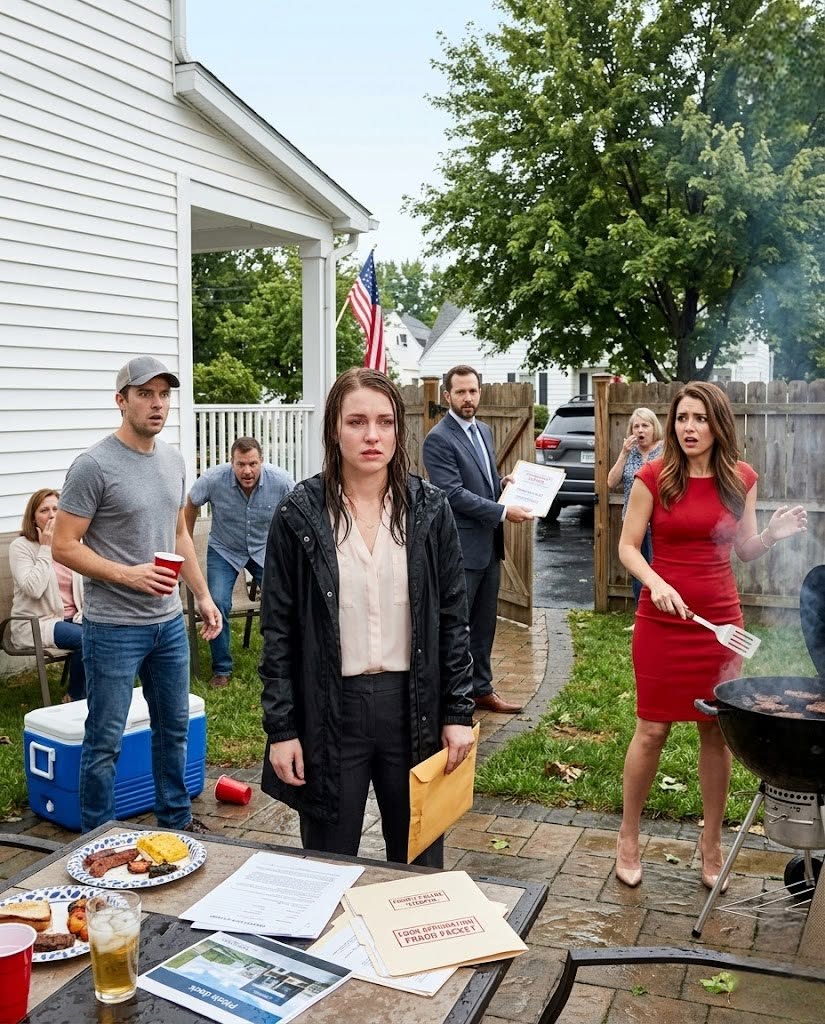
‘Don’t bother coming to the barbecue,’ my brother texted. ‘Tegan says you’ll make the whole yard stink,’ and while my mother answered with a laughing emoji and my father dropped a heart underneath it like this was just one more cute family joke, I was sitting forty floors above downtown Seattle, looking out over the water, a billion-dollar biotech contract drying beside my hand, and realizing with a sick kind of clarity that the backyard where they planned to celebrate did not belong to them at all.
The message came in at 4:07 on a Friday afternoon.
Outside my office, Seattle was wearing its usual gray like a coat it had forgotten to take off.

Rain moved in thin lines down the glass wall.
The ferries crossed Elliott Bay below, small and white against the dark water, while traffic hissed along the streets so far beneath me it sounded almost unreal.
On my desk sat the Nexura Biolabs agreement.
One billion dollars over five years.
My signature was still drying on the last page.
I should have been thinking about the champagne my team had hidden in the conference room refrigerator.
I should have been thinking about trial data integrity, manufacturing deadlines, and the board call scheduled for Monday morning.
Instead, I was staring at a text from my older brother, Gage.
Don’t bother coming to the barbecue.
Tegan says you’ll make the whole yard stink.
For a few seconds, I did not move.
The message thread sat open in the family group chat.
Then my mother reacted with a laughing emoji.
Then my father added a heart.
Not a question.
Not a private message asking whether I was all right.
Not even the weak parental performance of pretending to scold him.
A laugh and a heart.
That was how the Anderson family handled cruelty when it was pointed at me.
They decorated it.
I looked at the words again, and the office suddenly felt too clean.
The glass.
The polished desk.
The neat stack of legal pages.
The expensive pen beside my hand.
Everything around me said I had outgrown them.
My chest knew better.
At twenty-eight, I was Executive Vice President of Engineering at Nexura Biolabs.
I led teams full of people older than me, smarter than me in ways I respected, and careful enough to understand what a failed system could cost real patients.
I could walk into a room with senior counsel, clinical directors, and venture partners and explain exactly why their timelines were fantasy.
At family gatherings, I was still Liv, the difficult one.
The one who thought too much.
The one who did not know how to take a joke.
The one who should smile more because Gage did not mean it like that.
When I was seventeen, I won the state science fair with a project on enzyme stability that my teacher said could have passed for undergraduate work.
The ribbon was huge.
Blue satin, gold lettering, ridiculous in the way teenage achievements are ridiculous when you are still young enough to think people will finally see you.
I carried it through the front door, and it scraped the frame on the way in.
My mother glanced at it from the kitchen island.
“That’s nice, Liv,” she said, and handed me the keys.
Gage had twisted his ankle at football practice.
He needed ice.
That was the evening I learned that achievement did not weigh much in a house where favoritism had already decided what mattered.
Gage was golden without trying.
He was loud, handsome, charming, and forgiven before he finished apologizing.
If he failed, somebody else had set him up.
If he lied, he was under pressure.
If he needed money, it was support.
If I needed respect, it was ego.
My parents did not think they were cruel.
That was part of the problem.
People like that rarely imagine themselves as villains.
They imagine themselves as tired, practical, and simply asking the responsible child to be responsible one more time.
Three years before the barbecue text, Gage called me from a motel parking lot.
His voice was rough with panic.
He had dropped out of college for the second time.
His girlfriend had left.
He had missed two car payments.
He had nowhere to go.
I remember standing in my apartment kitchen with a half-folded dish towel in my hands while he cried into the phone.
“Liv, please,” he said.
He never said please unless he was out of options.
I told myself I was helping because that was what family did.
I told myself there was no point holding childhood against him when he was clearly drowning.
I told myself I was strong enough to help without needing gratitude.
That was the first lie.
The second was believing he would not mistake generosity for weakness.
I found him the house on Elm Street.
It was not big, but it was solid.
White kitchen.
Two bedrooms upstairs.
A fenced backyard.
A small porch with enough room for two chairs.
A maple tree near the back fence that turned a fierce orange every October.
I purchased it through a limited liability company and used a property manager as the contact.
I did not put my personal name anywhere Gage would see it.
I told him I knew a landlord willing to rent cheaply as long as he paid utilities on time and did not destroy the place.
That last part was wishful thinking.
The first winter, a storm lifted part of the roof.
I paid for the repair.
Seven months later, Gage clogged the downstairs toilet and somehow turned it into a hallway flood at 1:16 a.m. on a Tuesday.
I paid the emergency plumber.
I paid the taxes.
I paid the insurance.
I replaced the water heater.
I approved the fence repair after one of his friends backed a truck into the gate.
Through all of it, Gage believed a faceless landlord had rescued him.
I let him believe that.
Maybe part of me wanted to help without giving him another reason to resent me.
Maybe part of me wanted proof that he could become decent if life stopped cornering him.
Maybe I was still the girl with the science fair ribbon, waiting for someone in that family to look up and see me.
Then he met Tegan.
Tegan arrived in our lives smelling like expensive perfume and certainty.
She was pretty in a sharp way, with hair that always looked freshly blown out and opinions that entered a room before she did.
The first time Gage brought her to a family dinner, she looked me over like she was pricing something damaged.
I had come straight from work.
Black pants.
Badge still clipped to my bag.
Hair twisted into a knot because I had been in a cleanroom for part of the day.
“So you’re the chemistry genius,” she said.
I smiled politely.
“Engineering, mostly.
Systems design. Data architecture.
Some bioprocess integration.”
She lifted her eyebrows.
“Does that lab smell ever come out of your clothes?”
My mother laughed.
Not hard.
Not cruel enough that anyone would have to admit it was cruel.
Just enough.
Gage smirked into his beer.
My father said, “Now, now,” like he was calming a puppy.
That was how Tegan learned the family rules.
I was safe to mock.
At Thanksgiving, she asked if I was still doing my cute little science projects.
At Christmas, she handed me a
At my father’s birthday dinner, she told a cousin that I was one of those women who made work her whole personality because there was nothing else going on.
I kept smiling.
Smiling had become muscle memory.
There is a kind of silence people mistake for peace because it benefits them.
But silence is not always peace.
Sometimes it is evidence being collected in the body.
The barbecue was supposed to be a Saturday thing.
My parents were excited because Gage and Tegan had finally decided to host something.
My mother had spent all week texting about potato salad and folding chairs.
My father had offered to bring extra charcoal.
I had said I could stop by after work if I finished early.
Then came the text.
Don’t bother coming to the barbecue.
Tegan says you’ll make the whole yard stink.
I did not respond right away.
I watched the family chat sit there like a small crime scene.
My mother reacted first.
Then my father.
Then Gage sent three laughing faces.
I typed two words.
Okay, then.
A minute later, my father messaged me privately.
Don’t take this personally. Tegan is picky.
Maybe I’ll send over a gift card so everyone keeps the peace.
I stared at the message.
A gift card.
To help fund a barbecue at a house I owned.
To keep peace with people who had banned me from a backyard I had paid to fence.
Something inside me went very quiet.
It was not rage, exactly.
Rage is hot.
This was colder.
Cleaner.
The next morning, I went to the office even though it was Saturday.
I told myself I needed to review a compliance memo.
The truth was that I did not trust myself to sit at home with my thoughts.
At 10:30, my assistant called from the lobby security desk.
“Olivia, your brother is here with someone named Tegan. They don’t have an appointment.”
I almost laughed.
Of course they did not.
Gage and Tegan had always treated boundaries like decorative suggestions.
“Send them up,” I said.
When the elevator opened, Tegan stepped out first.
She wore a fitted red dress, nude heels, and the triumphant expression of a woman who believed she had discovered leverage.
Gage followed her in jeans and a jacket, looking around the executive floor with a confusion he tried to hide under swagger.
They stopped outside my office.
My name was etched on the glass.
OLIVIA ANDERSON.
EXECUTIVE VICE PRESIDENT, ENGINEERING.
Tegan read it.
For one clean second, her expression cracked.
“Is this your office?” she asked.
“It is.”
Gage drifted toward the window and stared at the bay.
“You work here?” he said.
I looked at him.
“I have for six years.”
He nodded like that information was mildly inconvenient.
Tegan recovered first.
She always recovered quickly when money was close enough to smell.
She sat without being invited and placed a glossy packet on my desk.
G&T Lifestyle.
The name looked like it had been designed by someone who thought fonts were a business plan.
“Family should invest in family,” she said.
I looked at the cover.
Then at her.
“What is this?”
“A brand,” she said.
“A brand of what?”
“Home, wellness, entertaining, lifestyle.
Curated experiences. Digital products.
Social campaigns. Eventually a line.”
It was a pile of words trying very hard to become a company.
I asked how much they wanted.
“Two million,” Tegan said.
Gage looked at the floor.
At least some part of him still had the decency to be embarrassed.
I let the silence stretch.
The rain ticked against the glass.
Somewhere outside my office, a printer started and stopped.
“Yesterday,” I said, “your husband told me not to come to your barbecue because you think I smell awful.
Today you’re asking me for two million dollars. Did I miss a step?”
Tegan laughed.
It was airy and fake.
“Oh, Olivia.
Come on. It was a joke.”
“No,” I said.
“It wasn’t.”
Gage sighed.
“Liv, don’t do this.”
That sentence nearly did it.
Not apologize.
Not explain.
Not tell my wife she crossed a line.
Don’t do this.
The responsibility had somehow already found its way back to me.
For one ugly heartbeat, I wanted to tell them about Elm Street.
I wanted to say, “Your yard? Your porch?
Your white kitchen? All mine.”
I wanted to watch Tegan understand that she had been performing ownership inside a house she had no claim to.
Instead, I pressed the security button under my desk.
When the guards arrived, Tegan stood so fast her chair scraped the floor.
“Are you serious?”
“Completely.”
“You’re bitter,” she snapped.
I folded my hands on my desk.
“Probably.”
“You’re lonely.”
“Maybe.”
“You’re jealous of people who actually have a life.”
That one made Gage glance at me, but he still said nothing.
The guards escorted them to the elevator.
Tegan kept shouting until the doors closed.
I sat in the quiet after they left and realized my hands were shaking.
At 8:42 that night, my phone lit up with a fraud alert from Wells Fargo.
A small business loan application had been submitted under my name.
Amount requested: $480,000.
Business purpose: lifestyle brand expansion.
Applicant: Olivia Anderson.
Guarantor: Gage Anderson.
Former home address attached to my Social Security number.
For a second, the kitchen vanished around me.
Then training took over.
I froze my credit before my tea cooled.
I saved screenshots.
I downloaded the alert.
I called the bank’s fraud department and wrote down the reference number.
At 9:37, I forwarded everything to my attorney, Daniel Price.
The subject line was simple.
FAMILY ISSUE — FINANCIAL IDENTITY MISUSE.
Daniel called six minutes later.
“Tell me this is not your brother,” he said.
“It is my brother.”
He exhaled once.
“And the wife?”
“Probably the wife.”
“Do not communicate with them about the application.
Do not threaten them. Do not warn them.
Send me everything.”
That was the first instruction that made sense all weekend.
By the next afternoon, the family messages had turned frantic.
My mother asked me not to ruin the barbecue.
My father said Gage had made a mistake.
Gage said I always thought I was better than everyone.
Tegan wrote, Maybe if you acted like family, people would treat you like family.
I was eating a turkey sandwich over the sink when the doorbell rang.
When I opened it, no one was there.
Only a brown envelope sat on my porch mat, damp at one corner from rain.
My name was written across the front in my father’s handwriting.
Inside was a note.
A private investigator’s report.
And proof that Tegan had done this before.
The note had only nine words.
I should have told you before the wedding.
I read it standing in my doorway with rain blowing across my socks.
Then I carried everything to the kitchen table.
The investigator’s report was dated Friday at 4:18 p.m.
It included a prior civil complaint from another state.
Two business registrations.
Three unpaid vendor claims.
A scanned loan document where another relative’s name had been used without permission.
Emails.
Addresses.
A pattern.
My father had known enough to hire someone.
He had known enough to be afraid.
He had not known enough to protect me before it was my name on the paperwork.
That hurt in a different place.
Parents often ask for forgiveness in the exact shape of the warning they refused to give.
By the time I finished the report, my phone lit up again.
Tegan had posted a photo from the backyard.
There was the grill.
The maple tree.
My mother sitting in a lawn chair.
My father holding a red plastic cup.
A small American flag hung from the porch post near the front steps.
Under the photo, Tegan had written: Some people bring bad energy. We keep our home clean.
Our home.
I looked around my own kitchen.
At the brown envelope.
At the report.
At the fraud alert printed on my counter.
Then I called Daniel.
“I want to go to the barbecue,” I said.
He was quiet for one beat.
“As a guest?”
“As the owner.”
Daniel did not laugh.
That was why I paid him.
“Then we do this clean,” he said.
“No threats. No performance.
Documents first. Statements second.
Consequences last.”
The next afternoon, I parked two blocks away from Elm Street.
The neighborhood smelled like wet grass, charcoal smoke, and somebody’s too-sweet barbecue sauce.
Kids rode bikes near the corner.
A family SUV sat crooked in the driveway.
Music came from the backyard, low and cheerful.
I could hear Tegan laughing before I reached the gate.
For a moment, I stood on the sidewalk and looked at the house.
The porch light I had replaced.
The fence I had paid to repair.
The roof I had authorized after the storm.
The maple tree glowing green in summer.
I had kept that house standing while they turned it into a stage for humiliating me.
Daniel arrived in a dark suit with a folder under one arm.
He looked at my face.
“Ready?”
“No,” I said.
He nodded.
“Good. That means you understand what this is.”
We walked through the side gate together.
The backyard was full of family.
My mother held a paper plate.
My father sat near the cooler.
Gage stood by the grill, telling a story with one hand in the air.
Tegan wore the red dress again.
She saw me and smiled like she had been waiting for an audience.
“Oh,” she said loudly.
“Look who decided to come anyway.”
A few people turned.
My mother looked instantly nervous.
My father went pale.
Gage frowned at Daniel.
“Who’s this?”
Daniel stepped forward.
“My name is Daniel Price. I represent Olivia Anderson.”
Tegan laughed.
“You brought a lawyer to a barbecue?”
“No,” Daniel said.
“She brought counsel to a property matter.”
The yard changed in a way you could feel before anyone spoke.
The music kept playing from a small speaker on the patio.
Smoke kept rising from the grill.
Somebody’s fork clicked against a paper plate and stopped.
Daniel opened the first folder.
“Mrs. Anderson,” he said, looking at Tegan, “before anyone says another word, you need to know who actually owns this house.”
My mother dropped her cup.
It bounced once against the patio and rolled into the grass.
Gage looked from Daniel to me.
“What is he talking about?”
Tegan’s smile stayed on her face, but only because she had not yet figured out where else to put it.
Daniel placed the property file on the patio table.
The stamped pages fluttered slightly in the breeze.
“The owner of record is an LLC controlled by my client.
The lease arrangement you have been living under was extended as a courtesy to Mr. Anderson.
That courtesy ends today.”
Nobody moved.
It was not dramatic the way people imagine exposure will be dramatic.
There was no thunderclap.
No music swell.
Just a backyard full of adults realizing, one by one, that the ground under their feet had belonged to the person they had spent years stepping on.
Gage stared at the file.
“Liv,” he said, and his voice was smaller than I had ever heard it. “You own this place?”
I looked at him.
“Yes.”
Tegan grabbed the folder.
Daniel put one hand over it before she could lift the pages.
“Do not remove documents from the table.”
Her face flashed.
“This is insane.
She tricked us.”
“No,” I said. “I housed you.”
That landed harder than I expected.
Even my mother flinched.
Gage took one step back from the cooler.
“You let me think—”
“I let you live cheaply in a safe house for three years,” I said.
“I paid the taxes, the insurance, the roof, the plumbing, and the fence you broke. I let you keep your pride because I thought maybe kindness would make you kind.”
Tegan scoffed.
“Oh, spare us.
You wanted control.”
Daniel opened the second folder.
“We can discuss control when we address the $480,000 loan application filed under Ms. Anderson’s identity Friday evening.”
The backyard went still again.
Stillness has layers.
The first was shock.
The second was fear.
The third belonged only to the people who already knew there was something to fear.
My father sat down without meaning to.
My mother’s hand went to her mouth.
Gage looked at Tegan.
That was when I knew.
He had known something.
Maybe not all of it.
Maybe enough.
But enough is not nothing.
Daniel laid out the fraud packet.
The bank alert.
The application reference number.
The old home address.
My Social Security number partially redacted.
Gage listed as guarantor.
Then Daniel placed one more document on the table.
A printed chain of emails between Tegan and a loan broker.
The subject line was circled in blue ink.
USE LIV’S CLEAN CREDIT FIRST.
My mother made a sound like she had been hit.
Gage whispered, “Tegan.”
Tegan’s mouth opened.
Nothing came out.
For the first time since I had met her, she had no sentence ready.
My father looked at me with wet eyes.
“Olivia,” he said, “I should have told you.”
I nodded once.
“Yes.
You should have.”
It was not forgiveness.
It was not cruelty either.
It was just the truth.
Daniel turned to Gage.
“You will receive formal notice through the property manager. You are not being removed today.
You will not damage the property. You will not contact my client except through counsel.
Any attempt to use her personal information again will be handled as a legal matter.”
Tegan found her voice.
“You can’t prove I submitted anything.”
Daniel looked at the email chain.
“I would not recommend making that your final position.”
One of the cousins near the fence whispered, “Oh my God.”
Gage sank into a lawn chair.
His face was gray.
“Liv, please.”
There it was again.
Please.
The word he saved for cliffs.
I remembered the motel parking lot call.
I remembered the hug after he moved in.
I remembered the ice run when I was seventeen.
I remembered laughing emojis and hearts under a message telling me I smelled too bad to stand in my own yard.
An entire family had taught me to wonder whether asking for basic respect made me difficult.
Standing in that backyard, I finally understood that difficult was just the word they used when useful stopped being silent.
I picked up the stamped property file.
Then I looked at my brother.
“You have thirty days to arrange other housing. If you cooperate, I will not accelerate anything beyond what the lease allows.
If you damage one cabinet, one window, one board of that fence, I will document it and pursue every dollar.”
Gage put his face in his hands.
Tegan stared at me like hatred might somehow still become leverage.
“And the loan?” my mother whispered.
Daniel answered before I could.
“The bank has been notified. Ms.
Anderson’s credit is frozen. The application is flagged.
We will provide supporting documents as requested.”
My father looked smaller than I had ever seen him.
“Liv,” he said, “I thought I was keeping peace.”
I looked at him for a long moment.
“No,” I said. “You were keeping comfort.
Yours. Gage’s.
Tegan’s. Never mine.”
He did not argue.
That might have been the closest thing to an apology he had ever given me.
I left before the food came off the grill.
Daniel walked me to my car.
Behind us, the backyard had dissolved into low voices, sharp whispers, and Tegan insisting that everybody was overreacting.
At the sidewalk, Daniel handed me the brown envelope my father had left on my porch.
“Keep this,” he said.
“Not because you need the pain. Because you may need the timeline.”
That was Daniel.
Practical even about heartbreak.
Over the next week, everything became paperwork.
A notice through the property manager.
A fraud affidavit.
A bank packet.
A police report intake conversation.
Screenshots preserved as PDFs.
The private investigator’s report copied and cataloged.
My father sent three messages before I replied to any of them.
The first was defensive.
The second was ashamed.
The third simply said, I am sorry I laughed.
I believed that one.
Not because it fixed anything.
Because it did not ask me to make him feel better.
My mother called twice, then texted.
I don’t know how to talk to you right now without making it worse.
For once, she was right.
I wrote back: Then don’t.
Sit with it first.
Gage moved out on day twenty-seven.
He left the house mostly intact.
Mostly.
One cabinet door was cracked.
The backyard was full of cigarette butts.
The white kitchen had grease staining the wall behind the stove.
I documented every room with timestamped photos.
The property manager met me there after the keys were returned.
The house smelled like old smoke, cleaner, and something sour under the sink.
The maple tree outside had just started to turn.
For a while, I stood in the kitchen and remembered the day I had first bought it.
I had imagined Gage making coffee there.
Laughing with friends.
Starting over.
I had imagined generosity becoming a bridge.
Instead, it had become a place for other people to practice entitlement.
Two months later, the bank confirmed the loan application had been denied and marked as fraudulent.
Tegan’s emails had made denial difficult.
Gage tried to call me after that.
I let it go to voicemail.
He said he did not know she had used my Social Security number.
He said he thought it was just a business thing.
He said he was sorry about the barbecue text.
He said he missed his sister.
I listened once.
Then I saved the file and did not call back.
Missing someone is not the same as respecting them.
My parents asked if we could have dinner before Thanksgiving.
I chose a diner halfway between my apartment and their house.
Public.
Neutral.
Fluorescent.
A place where nobody could pretend memory belonged only to them.
My father brought a folder.
For a second, I almost laughed.
The Anderson family had become very fond of folders.
Inside was a written apology.
Not perfect.
Not enough to erase anything.
But specific.
He named the science fair ribbon.
He named the barbecue text.
He named the heart reaction.
He named the private investigator report he had hidden because he did not want to admit he had been wrong about Tegan.
My mother cried quietly into a napkin.
For once, I did not comfort her first.
That may sound small.
It was not small to me.
She looked up and said, “I laughed because I wanted it not to be serious.”
“I know,” I said.
“That doesn’t make it better.”
“No,” I said. “It doesn’t.”
The waitress refilled our coffee.
The little bell over the diner door rang.
Outside, rain spotted the windows and blurred the headlights in the parking lot.
My father asked whether I would ever forgive Gage.
I looked down at my cup.
“Forgiveness is not housing,” I said.
“It is not credit. It is not access.
It is not pretending nothing happened so everyone can eat potato salad in peace.”
Neither of them spoke.
That was the first time silence in my family did not feel like a weapon.
It felt like listening.
I kept the Elm Street house.
After repairs, I rented it to a nurse and her teenage son through the same property manager.
They paid on time.
They planted mums by the porch.
They hung a small American flag near the steps, in almost the same place Tegan had used as a backdrop for her caption about keeping the home clean.
The first time the property manager sent me a photo, I stared at it longer than I expected.
The house looked lighter somehow.
Maybe houses can hold their breath too.
Maybe they know when the wrong people have left.
Months later, Nexura announced the contract publicly.
My team celebrated in the conference room with grocery-store cupcakes, paper plates, and bad champagne.
Someone made a toast about my leadership.
I laughed and told them to stop before HR wrote us all up for emotional sincerity.
But later, alone in my office, I looked out at the same gray water and thought about that text again.
Don’t bother coming to the barbecue.
It should have been just one more insult.
One more little family joke.
One more reason to swallow the hurt and keep functioning.
Instead, it became the sentence that finally showed me the shape of the whole thing.
They had not forgotten I was part of the family.
They had simply preferred me useful, quiet, and outside the gate.
That gate belonged to me.
So did my name.
So did my credit.
So did my life.
And the next time someone in my family wanted peace, they had to learn the difference between peace and permission
