I came home at 5:32 p.m. on a Tuesday with a grocery bag on my wrist, a paper coffee cup going cold in my cup holder downstairs, and the tired little hope that Lucy would run to the door like she always did.
That was the first thing wrong.
She did not run.

No cartoon music bled through the apartment door.
No plastic blocks clicked across the carpet.
No small voice shouted, “Mommy home,” with that breathless joy two-year-olds give you before they understand the world has sharp edges.
The hallway outside our unit smelled like microwaved noodles and laundry detergent from the downstairs machines.
Inside, our apartment smelled like stale air.
The TV was off.
The refrigerator hummed.
Somewhere in the kitchen sink, one drop of water kept ticking against a plate.
For a second, I stood with my keys in my hand and told myself not to be ridiculous.
Mothers learn to talk themselves down because panic is expensive.
Panic makes people call you dramatic.
Panic makes husbands sigh like your instincts are a character flaw.
Then I heard Lucy breathe.
It was not a cry.
It was a wet, thin pull of sound from the living room, like air being dragged through a straw that was folding in on itself.
I dropped the grocery bag.
A can rolled under the table.
Lucy was on the couch, half curled against the cushions, her cheeks flushed too red and her lips beginning to turn a color I had only seen in hospital posters.
Her little chest pulled in hard with every breath.
Her eyes were open.
That was the worst part at first.
She saw me.
She was scared and waiting for me to understand.
“Lucy,” I said, but it came out like a broken sound.
I picked her up, and her fingers clung weakly to the front of my hoodie.
Her skin was hot, not fever-hot, but fear-hot, damp at the back of her neck.
Her hair smelled like applesauce and sweat.
Across the room, my husband sat in the armchair by the window with his phone in his hand.
Travis did not stand.
He did not reach for her.
He did not even look frightened.
“What happened?” I asked.
He glanced up, irritated, like I had interrupted something important.
“She just fell.”
I stared at him.
“Fell from where?”
“The couch, maybe. She was climbing around.”
Lucy made a choking gasp against my shoulder.
Travis looked back down at his phone.
“She cried for a bit,” he said. “Then she calmed down.”
Calmed down.
I would remember that phrase later because it told me more than he meant it to.
Not got better.
Not stopped hurting.
Calmed down.
People think danger always looks like shouting, broken plates, and fists through drywall.
Sometimes it looks like a man in an armchair, scrolling while your child turns purple ten feet away.
“She needs the ER,” I said.
“You always do this,” Travis replied. “You overreact to everything.”
I grabbed my keys so fast they cut into my palm.
Lucy’s diaper bag was still by the door from daycare the day before.
I slung it over one shoulder, held her against the other, and moved before he could say another word.
At 5:42 p.m., I was trying to buckle her into the car seat.
My hands were shaking so badly I missed the latch twice.
At 5:44, I backed past the mailboxes in front of our apartment building.
Travis stood in the doorway with one hand on the frame.
He did not follow.
He did not ask which hospital.
He did not ask if she was breathing.
He called after me, “You’re being dramatic.”
I drove with one hand on the wheel and one hand reaching back at every red light to touch Lucy’s ankle.
Her little sock was twisted sideways.
I kept rubbing the soft strip of skin above it, needing proof she was still there.
“Stay with me, baby,” I kept saying.
I said it so many times the words turned into rhythm.
Stay with me.
Breathe.
Stay with me.
Breathe.
At the ER entrance, I did not park straight.
I left the car crooked near the curb, hazards blinking, the driver’s door not fully shut.
A hospital intake worker looked up from behind the desk and changed before my eyes.
Her face went from routine to emergency.
“She can’t breathe,” I said.
That was all I got out.
A triage nurse took Lucy from my arms, and for one terrible second my body resisted letting go.
Then another nurse put a hand on my elbow and said, “Mom, come with us.”
They moved fast.
A pulse oximeter went on Lucy’s finger.
A small oxygen mask came down over her face.
A doctor listened to her chest.
Someone asked for her name and birthday.
Someone else asked when symptoms began.
The hospital intake form had 6:03 p.m. printed across the top when they clipped it to the board.
I saw it because my mind was grabbing details the way a drowning person grabs anything that floats.
6:03 p.m.
Lucy Reynolds.
Female.
Age two.
Respiratory distress.
The doctor said, “Possible airway trauma.”
My brain rejected the words.
Airway trauma did not sound like falling from the couch.
Airway trauma sounded like a room I had not been inside.
It sounded like a truth that had happened between four o’clock and five-thirty while I was still at work and Travis was supposed to be making macaroni for our daughter.
A respiratory therapist adjusted the oxygen.
A nurse taped an IV to Lucy’s hand.
Lucy whimpered, but even that sound came out thin.
I stood near the wall with my palms flat against the paint and forced myself not to fall apart.
Mothers are allowed to break later.
In the moment, you count breaths, answer questions, sign forms, and become useful because useful is the only thing standing between your child and the dark.
Twenty minutes later, Lucy’s breathing sounded less like scraping.
Her eyes opened halfway.
When I said her name, she turned toward me.
That tiny movement nearly sent me to the floor.
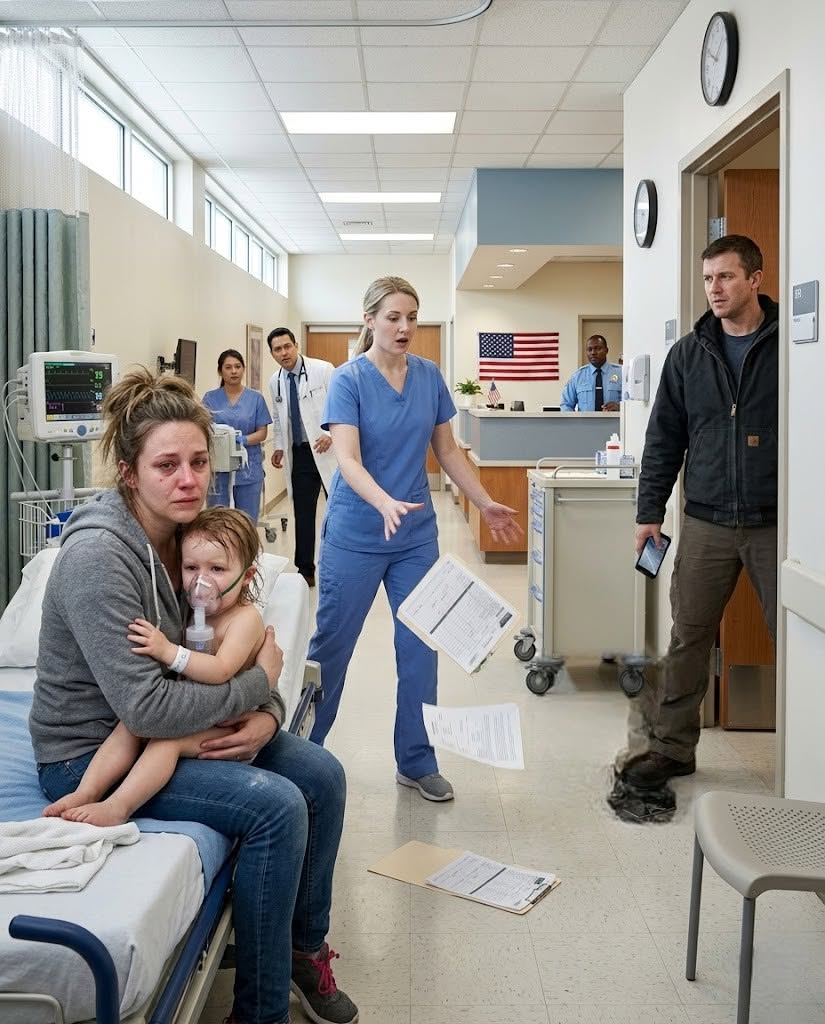
Then the automatic doors sighed open at the end of the ER hallway.
Travis came in.
He had changed nothing.
Same dark jacket.
Same phone.
Same annoyed expression.
Like this was a chore he had finally decided to handle.
The pediatric nurse standing near Lucy’s bed looked up.
She saw his face.
The chart dropped from her hand.
It hit the floor with a flat slap.
Everyone turned.
Her face went white in a way I had never seen a face go white outside a funeral home.
Travis stopped walking.
“What?” he said.
The nurse bent for the chart, but her hands were trembling.
She looked at Lucy.
Then she looked at Travis.
Then she stepped closer to me and whispered, “Why… why is he here?”
My heart seemed to stop and then come back wrong.
“What do you mean?” I asked.
She did not answer right away.
She moved her body slightly, not dramatically, just enough to place herself between Travis and the bed rail.
Travis noticed.
His face tightened.
“I’m her father,” he said. “What is this?”
The nurse looked at the doctor.
The doctor looked at Travis, then at the nurse, and something silent passed between them.
“Sir,” the doctor said, “please remain by the doorway.”
Travis laughed once.
It was too short.
“Are you kidding me?”
The nurse turned the computer cart just enough for me to see the screen.
A red alert bar sat near the top of Lucy’s prior visit notes.
My eyes found the timestamp before they found the words.
8:19 p.m.
Nine weeks earlier.
That date opened a hole in my stomach.
I had been at work that night because two people had called out and my manager had begged me to close.
Travis had texted me a picture of Lucy sleeping on the couch and written, “Tiny stomach bug. She threw up but she’s fine.”
He had not mentioned an ER.
He had not mentioned any nurse.
He had not mentioned signing anything.
The nurse clicked once.
A scanned hospital incident report opened beneath the note.
Travis’s signature was at the bottom.
I knew his signature.
I had seen it on our lease, on daycare forms, on the car insurance card tucked into the glove box.
My husband had brought our daughter to the hospital nine weeks earlier and hidden it from me.
The room seemed to tilt.
“What is that?” I said.
Travis took one step forward.
The security guard near the nurses’ station moved at the same time.
“Don’t,” the doctor said.
That single word was quiet, but it landed hard.
Travis stopped.
The doctor picked up the fallen chart from the floor and looked at me with the kind of careful calm people use when the truth is about to change your life.
“Mrs. Reynolds,” he said, “I need you to tell me who was alone with Lucy today between four o’clock and five-thirty.”
I looked at Travis.
He looked back at me.
For the first time that night, he was not annoyed.
He was afraid.
“He was,” I said.
The words came out before my fear could make them smaller.
“Travis was alone with her.”
The doctor nodded once.
The nurse’s eyes filled with tears, but she blinked them back.
No one accused him in that moment.
No one shouted.
That almost made it worse.
They moved with process, with quiet authority, with the dreadful discipline of people who had done this before.
The doctor ordered imaging.
A hospital social worker was called.
The nurse documented the prior visit note.
Security stayed outside the treatment bay.
A second nurse asked me to step into a small family room with a box of tissues, a round table, and a framed map of the United States on the wall near a faded poster about child safety.
I hated that room immediately.
Rooms like that are not built for good news.
The social worker did not waste time.
She asked direct questions in a gentle voice.
Had Lucy ever come home with marks I could not explain?
Had she become fearful around anyone?
Had Travis ever discouraged medical care?
Had he ever called me dramatic when I tried to get help?
I wanted to say no because no would mean my life was still my life.
Instead, memories began arranging themselves in a new order.
A bruise on Lucy’s upper arm that Travis said came from daycare.
The way she cried when I worked late.
The way she clung to my neck when I handed her to him on Saturday mornings.
The time he snapped, “She’s too spoiled,” because she reached for me instead of him.
The night nine weeks earlier when he said stomach bug and then took the trash out twice.
I had seen pieces.
I had not known they made a picture.
That is the particular cruelty of trust.
It does not just blind you.
It teaches you to explain away what your body already knows.
When the social worker asked whether I felt safe taking Lucy home if Travis was there, I looked through the glass wall and saw him standing at the end of the hallway, talking fast to a security guard.
His hands were moving the way they moved when he was trying to make someone believe him.
I said, “No.”
It was the smallest word.
It changed everything.
The hospital helped me make a safety plan before Lucy was discharged.
A police report was filed at 9:47 p.m.
A temporary no-contact order was explained to me in plain language while I sat with my hands wrapped around a paper coffee cup I never drank from.
Travis kept insisting it was a misunderstanding.
He said Lucy choked on a snack.
Then he said she fell.
Then he said I had always wanted people to think he was a bad father.
His story moved every time anyone touched it.
Mine did not.
I had walked in at 5:32.
Lucy was fighting to breathe.
Travis was in the armchair.
He said she just fell.
The first night, I did not sleep.
I sat beside Lucy’s hospital bed and listened to the soft hiss of oxygen until every sound became part of my bones.
She woke around 3:18 a.m. and reached for me.
I climbed carefully onto the edge of the bed, and the nurse helped arrange the wires so I could hold her without pulling anything loose.
Lucy pressed her face into my shirt and whispered, “Home?”
I almost broke then.
“Soon,” I told her.
But I knew home could not mean the same apartment anymore.
By morning, my sister had driven over with a duffel bag, Lucy’s blanket, and my work sneakers.
She did not ask for the full story in the hallway.
She just hugged me hard and said, “You’re coming with me.”
That was the kind of love I could understand in that moment.
Not speeches.
Keys in hand.
A car waiting.
A clean pillowcase on a spare bed.
Later that day, with an officer present, I returned to the apartment to collect essentials.
Travis was not there.
The armchair by the window looked ordinary, which made me hate it more.
Lucy’s stuffed giraffe was wedged behind the couch.
Her pink sock was still under the armchair.
The grocery can I had dropped was still under the table.
My sister picked up Lucy’s favorite board book from the floor and started crying without making a sound.
In the kitchen trash, beneath paper towels and a cracked plastic cup, I found the hospital discharge packet from nine weeks earlier.
Travis had not even destroyed it.
He had hidden it badly because he had trusted my exhaustion more than his own caution.
I photographed every page.
I photographed the date.
I photographed the discharge instructions.
I put the packet in a plastic folder the officer gave me and watched him write it into his notes.
Documented.
Collected.
Logged.
Those words did not heal anything, but they gave the truth a spine.
The medical team did not tell me every detail at once.
They used careful language.
They explained what was consistent and what was not.
They explained why a simple couch fall did not match what they were seeing.
They explained that mandated reports were not punishment for asking questions; they were the system’s way of stopping adults from burying patterns under excuses.
I wished someone had said that to me earlier.
I wished I had said it to myself.
At the first family court hearing, Travis wore a button-down shirt I had ironed for him many times.
He looked tired and offended.
His attorney said the situation had been misunderstood during a mother’s panic.
I sat at the other table with a folder in front of me and Lucy’s hospital bracelet in my purse because I could not let go of it yet.
The judge read quietly for a long moment.
The prior ER visit was in the file.
The new medical notes were in the file.
The police report was in the file.
The safety plan was in the file.
The photographs from our kitchen trash were in the file.
Travis stared straight ahead.
When the judge asked him why he had not told me about the previous hospital visit, he said, “I didn’t want to worry her.”
That sentence did something to the room.
Even his attorney looked down.
The judge did not raise his voice.
He did not need to.
He continued the temporary order and restricted Travis from contacting Lucy while the investigation moved forward.
I walked out of that hallway shaking so badly my sister had to hold my elbow.
Outside, the sky was bright and rude, the way skies are after the worst nights of your life.
People were walking to their cars.
Someone was laughing near the courthouse steps.
A small American flag moved in the wind above the entrance.
The world had kept going.
I resented it for that.
Recovery was not cinematic.
Lucy did not become magically fine because we left.
For weeks, she startled at loud male voices.
She cried when I stepped into the bathroom.
She slept with one hand twisted in my sleeve.
I learned how to sit still beside her instead of demanding that she feel safe on my schedule.
The pediatrician told me children heal in layers.
The therapist told me consistency would matter more than promises.
So I became consistent.
Breakfast at the same time.
Bath toys in the same blue basket.
Bedtime story, then nightlight, then the stuffed giraffe tucked against her shoulder.
I answered every “Mommy?” even when she had asked it ten times in five minutes.
Especially then.
Travis tried to reach me through relatives.
He said I had ruined his life.
He said I had taken his daughter.
He said the hospital had poisoned me against him.
The old me might have argued.
The old me might have tried to make him understand.
The woman who sat in that ER and heard a nurse whisper, “Why is he here?” knew better.
Some people do not want the truth.
They want access.
They want the door open long enough to move the story back in their favor.
I kept the door closed.
Months later, Lucy and I moved into a small duplex with a front porch just big enough for two chairs and a pot of flowers my sister insisted would make the place feel less temporary.
There was a mailbox at the curb and a neighbor with an old pickup who waved every morning.
The first time Lucy ran from the living room to the front door yelling, “Mommy home,” I had to set my bags down on the porch before I could pick her up.
I held her so tightly she squealed.
That sound became the beginning of our new life.
Not the court date.
Not the paperwork.
Not the final order that came later and made the protection permanent.
Her laugh.
Her feet running.
Her breath easy in her chest.
I still think about the nurse.
I think about her face going white.
I think about the chart hitting the floor.
I think about how one horrified question did what all my excuses had not been able to do.
It made me look at my husband without the soft filter of marriage.
It made me look at my daughter without dismissing what her fear had been trying to tell me.
People think danger kicks down the door.
Sometimes it sits in your armchair with a phone in its hand and calls you dramatic while your child fights for air.
Lucy did not survive an accident that night.
She survived the moment I finally stopped believing the person explaining it away.
And because one nurse remembered, because one doctor listened, because one scared mother said “no” when asked if home was safe, my daughter got the chance to learn that home can be a place where nobody has to fight for breath.
