Until the invitation arrived.
It was thick, ivory-colored, with gold lettering and a dark green ribbon. “Marcus Fernandez and Elena Alvarez request the honor of your presence at their wedding.”
I stood staring at the envelope for several minutes. Marcus. The very same Marcus who had dragged me to that party where I met Rachel. The same one who lent me money when Alma had bronchitis and I couldn’t make ends meet. The same one who held my invisible coffin when they told me my wife had died. My best friend.
I didn’t understand why he hadn’t told me sooner that he was getting married. I called him. “Elena?” I asked the moment he answered.
There was a strange silence. “You have to come, Frank.” “Since when do you have a girlfriend?” “Just come.” “Marcus.” “Bring Alma.”
That bothered me. Not the invitation itself, but his tone. As if he weren’t asking—as if he were begging from a place where he couldn’t speak freely. “What is going on?”
He took a deep breath. “If you still trust me, just come.” He hung up.
I didn’t sleep that night.
Alma found the invitation on the table the next day while she was having milk and cookies for breakfast. “Are we going to a wedding, Daddy?” She was six years old, with Rachel’s eyes and my clumsy way of crinkling her nose when something didn’t make sense to her. “I don’t know.” “Will there be cake?” “Most likely.” “Then we’re definitely going.”
I smiled for her sake. I went for her sake. Because for five years, I had tried to make sure Alma didn’t grow up inside my sadness. I would take her to Central Park to feed the ducks, even though people later explained to me that it wasn’t a good idea. I bought her pastries when there was extra cash. I told her that her mother was in a star because I didn’t know how to explain a death without a body, without a grave, and without a goodbye.
The wedding was at an estate in upstate New York, up toward the mountains, with oak trees, light-colored stone, and views of the rolling hills. Everything smelled of lavender, freshly cut grass, and old money. Black SUVs rolled up a gravel driveway. Women in elegant hats stepped down slowly. Men in tailored suits talked about business as if they were in a boardroom rather than a wedding.
I wore my only decent suit. Alma wore a light blue dress and patent leather shoes that pinched her feet, but she refused to take them off because she said, “At weddings, princesses hold it together.”
That phrase hurt me. Entirely too many women hold it together, believing it makes them elegant.
Marcus was waiting for me near the entrance. He looked thinner. He had dark circles under his eyes. He didn’t look like a groom; he looked like a condemned man. “Thanks for coming,” he said.
I hugged him, but he didn’t hug me back the way he usually did. “What’s wrong?” He looked down at Alma. “Hey there, little one.” “Hi, Uncle Marcus. Where’s the bride?” He went completely pale. “Inside.” “Is she pretty?” Marcus closed his eyes. “Yes. Very.”
I wanted to press him further, but an older woman wearing a heavy pearl necklace appeared. I recognized her instantly. Mercedes. Rachel’s mother. The woman who had told me over the phone that my wife was dead and never to call again. She hadn’t aged as much as I had. Malice keeps some people well-preserved.
She stood staring at me as if she had spotted a stain on the rug. “What are you doing here?” My hand tightened around Alma’s. “I was invited.” Her gaze drifted down toward my daughter. For a second, her mouth twitched. Alma hid slightly behind my leg. “Who is that, Daddy?” “Nobody important.”
Mercedes lifted her chin. “Leave, Frank.” The exact same tone her estate security guard had used five years ago.
Marcus stepped between us. “I invited him.” “You had no right.” “At this point, ma’am, I don’t have much fear left.” She glared at him with pure hatred.
In that moment, I knew this wedding was anything but normal.
The guests began taking their seats in front of an arch overflowing with white flowers. A string quartet was playing something soft. The officiant waited with a leather folder. Everything looked perfect—entirely too perfect.
Marcus placed me in the front row, right by the aisle. “Stay here,” he whispered. “Marcus, tell me what is going on.” He looked at me with brimming eyes. “Forgive me for not knowing sooner.” I couldn’t even reply.
The music changed. Everyone stood up. Alma stood on her tiptoes to get a better look.
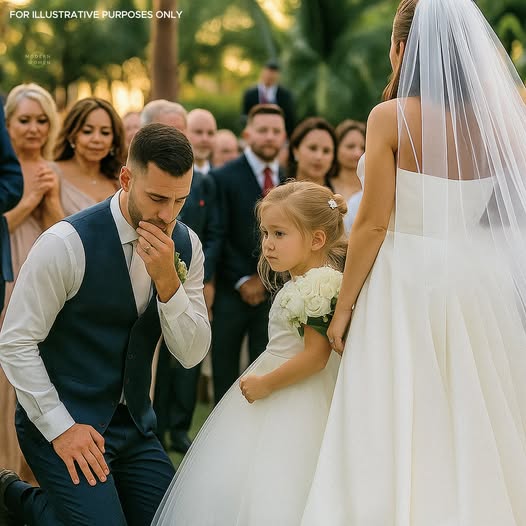
The bride appeared at the far end of the garden. She wore a simple, long-sleeved dress without much embellishment. Her veil covered her face completely. She walked down the aisle on the arm of a man I also recognized: Arthur Belmont, Rachel’s father. The man who didn’t attend our wedding because I wasn’t good enough.
I felt a sudden strike in my chest. I didn’t know why. Maybe because that way of walking felt instantly familiar. Maybe because the body remembers before the mind does.
The bride advanced slowly. One step. Another. The wind caught her veil. Alma squeezed my hand. “Daddy, why are you crying?” I didn’t even realize I was crying.
The bride reached Marcus. He didn’t look at her like a man in love; he looked at her like someone begging for forgiveness.
The officiant spoke words I didn’t hear. The world turned into the rushing sound of water. I saw Arthur sit down next to Mercedes. I saw two security guards standing near the arch. I saw Marcus reach his hands up toward the veil.
Then, he lifted it. And my world shattered.
Rachel. My Rachel. Thinner. Paler. Her eyes filled with absolute terror. But alive. Alive.
Alma tilted her head. “Daddy… that lady looks like Mommy.”
Rachel looked at me. She didn’t look at Marcus. She didn’t look at her parents. She looked right into my eyes. And in that exact instant, everything unraveled. The mourning. The grave I never saw. The cruel phone call. Alma’s five birthdays without a mother. The nights I slept with my hand on the empty side of the bed. It all dissolved into a single word that forced its way out of my mouth like blood: “Rachel.”
She brought a hand to her mouth. “Frank…”
The entire garden froze. Mercedes stood up abruptly. “Continue.” The officiant blinked. “Ma’am…” “Continue!”
Marcus took a step back. “No.” Arthur stood up as well. “Marcus, remember our agreement.”
I walked toward the altar. Two security men tried to step in, but Marcus raised a hand. “Let him through.” Alma came with me, clinging tightly to my leg.
Rachel saw her and completely broke down. It wasn’t a delicate cry; it was a raw, animalistic sound. “Alma.” My daughter hid deeper behind me. “Daddy, does she know my name?”
I could barely breathe. “Are you alive?” I asked. What an absurd question. She was standing right in front of me. But my mind desperately needed to hear it.
Rachel tried to step forward. Mercedes barked, “Not another step.” Rachel froze. And right there, I saw it. Fear. Not guilt—pure fear.
“Frank,” Marcus said, “just listen to her.” I turned on him. “You knew?” His expression sank. “For two months.” I wanted to hit him. “Two months?!” “I found her by accident at a private care facility upstate. She was with her mother. She wasn’t going by Rachel; they had her registered under the name Elena Alvarez.” “What?”
Rachel closed her eyes. “After the crash, they told me you didn’t want to see me.” The phrase cut straight through me. “What crash?” “The car. The night I walked out. I got into an argument with my parents. I wanted to come back home. To you. To Alma. But I crashed on the interstate. I woke up weeks later.”
Mercedes interjected, “You woke up completely disoriented. We took care of you.” Rachel looked at her. “You locked me away.”
The guests began to murmur loudly. Arthur tightened his jaw. “Watch what you say.”
Rachel was trembling, but she pushed forward. “They told me Frank had signed the divorce papers, that he wanted nothing to do with me, that Alma was better off without a mother who had abandoned her. They showed me papers. Letters. Messages. All of it forged.”
I felt dizzy. “They told me you were dead.” She covered her mouth. “No.” “Your mother told me herself.”
Rachel looked at Mercedes. Not with surprise, but with an ancient sadness, as if a horrific puzzle piece had finally slotted into place. “You told me he never came to the hospital.” Mercedes didn’t deny it. “I did what was necessary.”
Alma began to cry silently. I knelt down beside her. “Sweetheart…” “Is it Mommy?” I didn’t know how to answer.
Rachel knelt down a few steps away. She didn’t lung forward; she didn’t demand anything. She simply brought herself down to our daughter’s eye level. “Yes, my love. I am your mommy.” Alma looked at me, searching for permission to believe it. That broke me more than anything else. “I thought you were in a star,” she whispered. Rachel wept. “I thought you were so far away from me too.”
Alma didn’t run into her arms. It was too much. Too many years. Too many lies. But she took a step—just one. Rachel didn’t touch her; she waited for her.
In that heavy silence, Marcus pulled a thick folder from underneath the podium. “I didn’t come here to get married,” he announced. The murmurs grew into a roar. Mercedes turned white. “Marcus.” “I came to bring witnesses.”
The officiant closed his book. “I believe this goes far beyond my duties here.” “Perfect,” Marcus said. “Then just listen as a citizen.” He opened the folder. “Two months ago, I found Rachel. She didn’t have the freedom to leave on her own. Her mother controlled her phone, her medical appointments, and her documents. When I spoke to her about Frank and Alma, she had a complete breakdown. They called security. Later, she tracked me down with the help of a nurse.”
Rachel nodded. “I didn’t remember everything. I had memory gaps. But I remembered Alma’s laughter. I remembered your hands covered in construction dust. I remembered our tiny kitchen. They kept telling me it was all delusions.”
I glared at Mercedes. “You declared her dead?” “There was never an official death certificate issued,” Marcus stated. That sentence hit me like a stone. I remembered—I had never actually seen a death certificate. I had never seen a grave. I never had a funeral. Just a single phone call. A cold voice. A locked door.
“I went to the city registry,” Marcus continued. “There is no record of a death certificate for Rachel Belmont in the state of New York. What does exist are private medical holds, manipulated legal documents, and a false identity used to keep her entirely out of Frank’s reach.”
Arthur turned bright red. “This is absolute defamation.” “I have medical logs too,” Marcus said. “And text records. And recordings.”
Mercedes tried to step toward Rachel. I blocked her path. “Don’t touch her.” She looked at me with the same utter disdain from years ago. “You are still just a construction worker in a suit.” “And you are still a mother who buried her daughter alive.” The phrase left the entire garden breathless.
Rachel sobbed harder. Marcus turned toward the crowd of guests. “This wedding was orchestrated by them to force Rachel into marrying me under a false identity. I only agreed to play along to get her out of that house and ensure there would be witnesses. There are corporate attorneys and law enforcement waiting right outside the gates.”
Mercedes shrieked, “Liar!” But her scream arrived far too late.
At the back of the estate garden, two state investigators walked in alongside a woman in a dark tailored suit. Marcus took a deep breath, as if finally letting go of a heavy weight. “That’s my lawyer.”
Arthur tried to make an exit. My father used to say that the truly wealthy don’t run; they delegate the escape. But this time, Arthur actually ran a couple of steps before an investigator stopped him.
The picture-perfect estate descended into absolute chaos. Guests scrambling up from their seats. Wine glasses shattering on the stone path. The string quartet frantically packing away their instruments. An older aunt whispering a hurried prayer.
Alma covered her ears. I lifted her into my arms. Rachel looked at her, as if desperately wanting to touch her but not daring to. “Can I?” she asked—not to me, but to Alma. My daughter observed her closely. “Are you really my mommy?” “Yes.” “Why didn’t you come to my birthdays?”
Rachel completely shattered. “Because they made me believe you didn’t want to see me. Because I was a coward before I walked out. Because I made a terrible mistake. Because they took my life away from me, and it took me entirely too long to find my way back.”
Alma thought about it for a second. Then, she reached out a tiny hand and gently touched Rachel’s cheek. “You have my face.” Rachel let out a tearful laugh. “You have mine.”
They didn’t embrace just yet. But the world had started moving again. That was enough.
There was no wedding that afternoon. There were formal depositions taken inside a room at the estate, and later at the precinct. There were documents. Questions. Wounds being forced open with an official legal seal.
Rachel detailed everything: the immense guilt, the pressure, the crash, the blurred weeks, the months confined to a family property in upstate New York, the private doctors paid off by her parents, the false identity of Elena, the systematic lies regarding my supposed resentment, and the photos of Alma they hid from her until a household maid finally showed her a local news article about my design firm.
I detailed my side: the note left in the crib, the sudden divorce filing, the complete waiver of parental custody that their high-priced attorneys pushed through as if a mother could be permanently erased from a child’s life with a signature, and the phone call from Mercedes claiming Rachel was dead.
Marcus’s attorney explained that parental rights aren’t a piece of property you can just discard out of pride, and that the legal obligations toward a minor do not simply vanish with a convenient waiver. Listening to her, I felt a burning rage. Rage for not having known. Rage for having been poor when I desperately needed lawyers. Rage for having accepted her death just because wealthy people know how to sound official even when they are lying through their teeth.
Rachel spent that night at a hotel, protected by Marcus and his legal team. I took Alma back to our apartment. We didn’t sleep. My daughter sat on my bed clutching her stuffed toy. “Is Mommy good?”
I stayed silent. I didn’t want to lie to her, but I didn’t want to tarnish a newborn hope either. “Mommy did things that caused us a lot of pain,” I said softly. “But they also caused an immense amount of pain to her. We are going to take things slow.” “Do you still love her?” I looked out the window at the dark city skyline. “A part of me never stopped loving her.” “What about the other part?” “The other part is very angry.” Alma squeezed her toy. “Me too.”
The following day, Rachel came to the apartment. She didn’t step inside until Alma told her she could. She stood at the doorway holding a small bag, with her wedding dress enclosed in a black garment cover. She looked like a woman who had just escaped from her own ghost.
She looked at our kitchen. The table. Alma’s drawings taped to the refrigerator. The worn-out sofa. “It still smells like burnt coffee,” she whispered. “I still make it terribly.” She offered a faint smile. Then she spotted her photograph on the shelf—the only one I could never bring myself to throw away. Her holding a newborn Alma, exhausted, beautiful, right before the spark died out. She pressed a hand to her chest. “I thought you had erased me.” “I tried to a thousand times.” “And?” “I couldn’t.”
Alma appeared holding her stuffed animal. “You can sit down, but not there. That’s Daddy’s spot.” Rachel quickly obeyed.
For weeks, everything was incredibly clumsy. Supervised visits. A child psychologist. Lawyers. Court petitions. Reinstated records. Medical evaluations. Official depositions against Rachel’s parents. The local media tried to pounce when they caught wind of a massive scandal involving one of New York’s oldest real estate families, but Marcus managed to keep them entirely at bay. He owed me that. I still didn’t know if I could fully forgive him, but I owed him respect for bringing Rachel back without demanding my blind faith first.
I confronted him one afternoon. “You could have told me sooner.” “If I told you without ironclad proof, you would have stormed her parents’ estate, and they would have hidden her all over again.” “You let me see her dressed as a bride with you.” Marcus looked down. “I know.” “That was cruel.” “Yes, it was.” “Do you love her?” He shook his head slowly. “Not the way you think. I wanted to help her. And maybe… maybe I wanted to repair the immense guilt of having dragged you to that party the night this all began.” I didn’t answer. Forgiveness has its own legal timelines on the inside.
Rachel didn’t ask to move back into my bedroom. That was what saved her. She asked for time to get to know Alma. She asked for forgiveness without demanding immediate absolution. She told me the raw truth about her departure: the overwhelming exhaustion, her shame at having chosen love and then not knowing how to live it without luxury. She didn’t offer excuses for herself.
“I abandoned you,” she said one afternoon at the park while Alma played near the fountain. “That part was completely on me. The rest was done to me, but walking out was my choice.” It pained me to hear it, but it also brought relief. Because I desperately needed at least one part of our history to be called by its correct name.
“Alma cried for you so many nights.” Rachel closed her eyes. “I know.” “No. You don’t know.” She accepted the blow. “You’re right. I don’t.”
Months later, Alma called her Mommy for the very first time. It happened without any grand ceremony. She dropped her ice cream cone at the plaza, and Rachel immediately knelt down to wipe the spill off her dress. Alma, frustrated, blurted out, “Mommy, tell Daddy to stop laughing.”
I wasn’t laughing. I was crying. Rachel froze completely. Alma had no idea of the emotional earthquake she had just caused. “What?” Rachel pulled her into a slow embrace, and this time, Alma actually hugged her back.
We didn’t magically get those five years back. Nobody gets that time back. Rachel didn’t see her lose her first tooth, or her first day of kindergarten, or the high fevers, or the time Alma asked if stars could burn out. I didn’t get back the woman who walked out leaving a cruel note in a crib. The woman who returned was someone else entirely. And so was I.
We didn’t get remarried. Technically, we were still married on paper, because her death record never officially existed and our quick divorce was being legally contested due to massive regularities. What a profound irony: the law kept us bound together when life had split us completely apart.
But we didn’t rush. We learned how to sit at the same table. To talk without tearing each other’s skin off. To let Alma love without being forced to choose a side.
Rachel’s parents lost a massive amount. Not everything—wealthy people rarely lose everything. But they lost control, which to them was far worse. There was a full federal investigation into identity fraud, systemic coercion, and unlawful confinement. Mercedes disappeared entirely from the high-society charity circuits. Arthur sold off a massive commercial property upstate just to fund defense attorneys who ultimately couldn’t buy enough silence.
Rachel testified against them. Shaking, but she stood her ground. The day she walked out of the courthouse, she looked at me and said, “Today, I finally left my parents’ house.” I held her close—not as a husband yet, but as a witness. As someone who knew exactly what it cost to cross a door.
Two years later, we live in a bright apartment overlooking the city, filled with sunlight and plants that Rachel desperately tries to keep alive. Alma is eight years old now, and she maintains two separate toothbrushes in the bathroom because she says one is for our “before house” and one is for our “now house.”
I still design homes. Rachel works at a small independent gallery—not the high-end one from before, but a place where nobody uses her family name as a skeleton key. Marcus comes over for dinner on some Sundays. Alma forgave him long before I did; I still pour him less wine than he asks for.
Life never went back to being the exact same. It turned out much better than that. It turned out true.
Sometimes at night, I watch Rachel sleep and feel a sudden, sharp pang of that old bitterness. I think about those five missing years. About the phone call. About my daughter asking about a star. Then Rachel stirs, as if sensing the sheer weight of my gaze. “I’m sorry,” she whispers. She doesn’t say it out of obligation anymore; she says it because she lives with those same ghosts. I take her hand. “Me too.”
Because I made a mistake as well. Not for believing she was dead, but for not demanding a grave, a certificate, a body—the absolute truth. For accepting that people with money could simply close a door and declare it destiny.
Five years after losing my wife, my daughter and I attended my best friend’s wedding. When he lifted the bride’s veil, I saw Rachel. Alive. Broken. Mine and not mine. The mother of my child. The victim of her parents. Guilty of walking out. Innocent of being buried alive.
Alma had asked me: “Daddy, why are you crying?” I didn’t know how to explain to her then that sometimes you cry because the dead return, but also because the mourning was entirely real. Because joy can carry a sharp ache when it arrives so late. Because holding someone who is alive doesn’t magically erase the countless nights you wept for them as dead.
Today, I could finally answer her. I was crying because everything they had stolen from me was standing right in front of me. I was crying because my daughter finally had a mother, and I finally had answers. I was crying because love doesn’t resurrect perfectly clean. It returns with mud, legal papers, guilt, and deep scars.
But it returns. And when it does, you get to decide whether to look at it as a miracle or as a wound.
I chose to look at it as both. Because that afternoon at the estate, I didn’t recover the past. I recovered the truth. And sometimes the truth cannot give you back the missing years, but it gives you back the absolute right to live the ones that remain without a single lie.