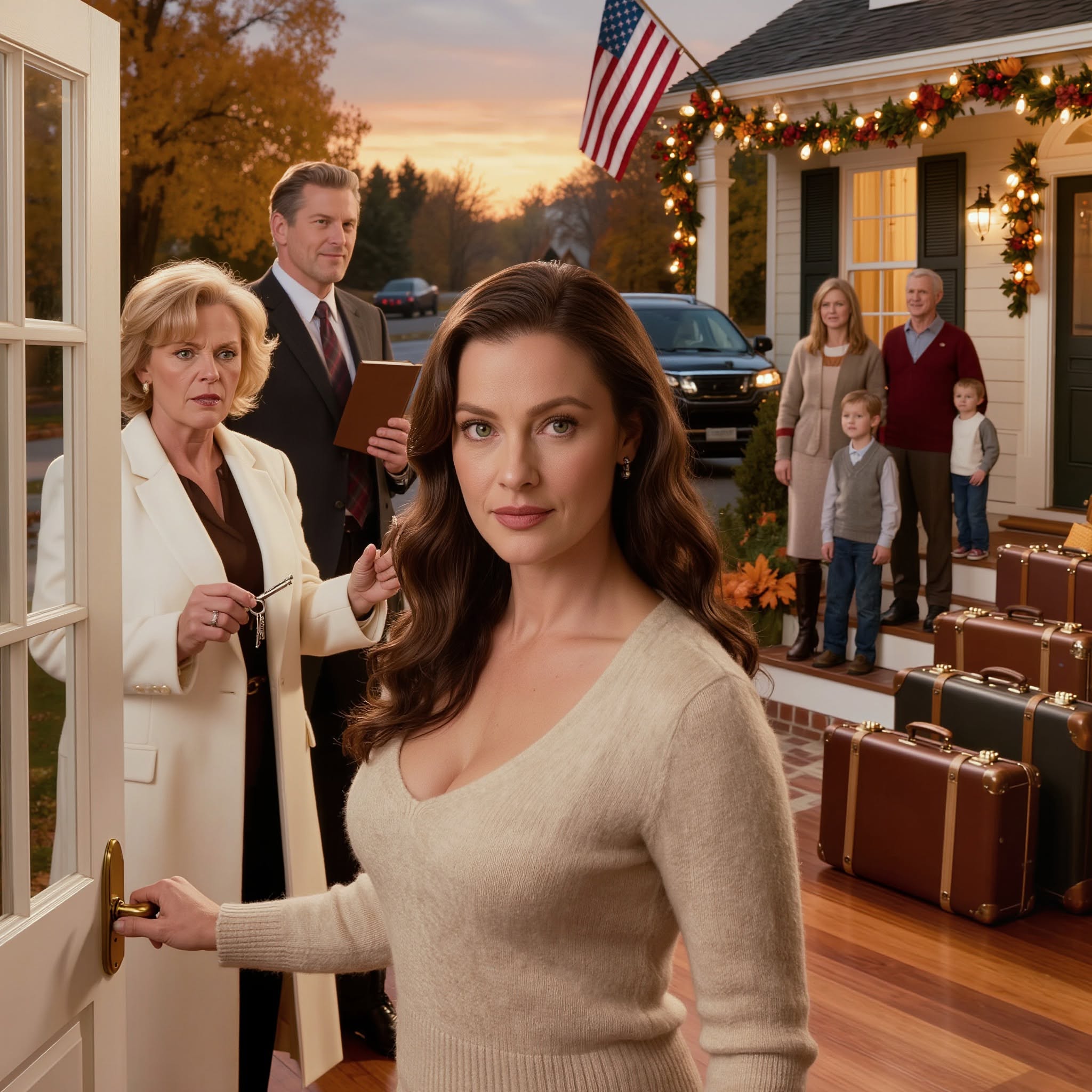
My Family Bought My Dream House, Not Knowing I Had Already Purchased the One Next Door
My Family Bought My Dream House, Not Knowing I Had Already Purchased the One Next Door
Part 1
The first thing I saw was my father’s silver Lexus in the driveway.
I stopped at the curb with one hand still on the steering wheel, my coffee gone cold in the cup holder, my heart doing that stupid hopeful little jump before my brain could catch up. Maple Street was quiet that morning, washed in thin October sunlight, with yellow leaves stuck to wet pavement and the smell of rain lifting from the old gutters. At the end of the block, behind a row of iron fencing and overgrown boxwoods, stood the house I had loved since I was nine years old.
The Hawthorne House.
A Queen Anne Victorian with a wraparound porch, stained-glass windows, a crooked witch-hat turret, and gingerbread trim so delicate it looked carved from sugar. When I was a kid, I used to walk past it after piano lessons and imagine myself inside. I imagined reading in the turret during thunderstorms. I imagined Thanksgiving dinners under the chandelier. I imagined coming home to a place that did not feel like I had to apologize for taking up space.
For twenty-six years, that house had lived in my head like a promise.
Three months ago, the for-sale sign appeared.
For three months, I had studied the listing photos like sacred text. Original oak floors. Pocket doors. Six bedrooms. A butler’s pantry. A library with built-in shelves. I knew the price, the taxes, the inspection notes, the roof age, even the strange little clause about the shared carriage lane between Hawthorne House and the neighboring estate.
I had saved for years. Invested carefully. Lived in a plain apartment with thrift-store chairs and one good espresso machine because I wanted my money working somewhere else. My family thought I lived small because I had failed.
That morning, as I stared at their cars in the driveway, I realized they had never misunderstood me by accident.
Amanda opened the front door before I even got out of my car.
My older sister stood on the porch wearing white jeans, a camel coat, and the kind of smile people wear when they have rehearsed being surprised.
“Rebecca!” she called, waving too hard. “Oh my gosh, you’re here.”
My mother appeared behind her, pearls at her throat even though it was barely ten in the morning. My father stood beside them, jangling a set of keys from one finger.
Keys.
The sound reached me across the lawn, bright and cruel.
I stepped out of my car slowly. Wet leaves stuck to my flats. The cold air smelled like damp wood, old roses, and fresh paint. Someone had already placed two urns of white mums on the porch steps. My mother’s touch. She loved making ownership look effortless.
“What’s going on?” I asked.
Amanda’s smile widened. “We wanted to surprise you.”
My father lifted the keys. “Closed yesterday.”
The words hit so cleanly that for a second, I felt nothing.
Then my mother sighed with satisfaction. “Isn’t it wonderful? When Amanda told us you had been thinking about bidding, we realized this house really needed to stay in the family.”
In the family.
Not with me.
I looked up at the turret window. For years, I had imagined lamplight glowing from that room while rain tapped the glass. Now Amanda’s reflection floated there, pale and smug.
“You bought Hawthorne House,” I said.
Amanda laughed softly. “Don’t sound so shocked. You always said it was your dream house. We listened.”
My father jingled the keys again. “Some dreams are better handled by people who understand money.”
I kept my face still.
Across the narrow strip of trees, hidden behind a taller iron gate and a wall of ivy, I could see the roofline of the property next door. Riverside Manor. Older. Larger. Quiet for so long that most people forgot it existed.
My family thought they had taken my dream.
But as I watched my father swing those stolen-looking keys in the cold morning light, one question settled in my chest like a match waiting to strike.
What would they do when they learned they had only bought the house I let them chase?
Part 2
My family always believed winning was the same thing as loving.
That was the problem. In our house, affection had points attached to it. Amanda got points for being pretty, popular, married young, and giving my parents two grandchildren they could display in Christmas cards. I lost points for studying too much, working too late, not wearing enough lipstick, and getting a PhD instead of a husband.
My father, Harold Chin, owned a small chain of appliance stores that had done well in the nineties and poorly ever since. He still spoke like a man who expected people to stand when he entered a room. My mother, Elaine, had never held a job longer than three months, but she could judge another woman’s life with the precision of a surgeon.
Amanda inherited their talent for turning any room into a scoreboard.
When I published my first research paper, Amanda announced her pregnancy at dinner before dessert.
When I won a grant, my mother said, “That’s nice, but Amanda’s kitchen renovation will really increase their home value.”
When I bought my first car without help, my father inspected it and said, “Reliable, I suppose. Not impressive.”
I learned early that if I wanted joy, I had to keep it private.
That was why Hawthorne House mattered. It was not just beautiful. It was mine before it was ever for sale. My secret after-school kingdom. My proof that one day I could build a life so solid no one could vote me out of it.
The year I turned thirty-five, my career finally entered the kind of air my family could not understand. I led a biomedical research division at a private institute outside Boston. My work was boring to them because it involved data, grants, clinical partnerships, and patient outcomes instead of kitchens and weddings. Boring paid well. Boring gave stock options. Boring let me invest quietly for ten years while they called my apartment “sad.”
I did not correct them.
Why would I?
Every time my mother wrinkled her nose at my secondhand dining table, I bought more index funds. Every time Amanda sent photos from another resort vacation funded by credit cards and her husband’s bonus, I increased my down payment account. Every time my father told me education was “expensive decoration,” I smiled and let my portfolio grow.
Three months before that morning on Maple Street, my realtor, Nora Bell, called me before sunrise.
“You need to sit down,” she said.
I was in my kitchen, barefoot, grinding coffee beans. “It’s listed.”
“Officially at eight.”
I did sit down.
Hawthorne House had come on the market after its last owner, Mrs. Vale, moved into assisted living. The listing price was high but not absurd. The inspection packet showed age, not disaster. Roof serviceable. Foundation sound. Plumbing old but manageable. It needed love, and I had enough money to give it.
For exactly four days, I let myself believe it would be simple.
Then I saw Amanda’s SUV outside the open house.
She did not see me. I was parked half a block away under a red maple, holding a folder of financial documents on my lap. Amanda stepped out in heeled boots, followed by my mother and a listing agent I did not recognize. My mother glanced around like she was afraid someone might catch her. Amanda laughed, touched the porch railing, and said something that made the agent smile.
My stomach tightened.
I did not go inside.
Instead, I called Nora.
“She’s here,” I said.
Nora was quiet for a second. “Your sister?”
“Yes.”
“Did you tell your family you were bidding?”
“I told my mother I was thinking about it.”
Nora exhaled. “Rebecca.”
“I know.”
That night, Amanda texted me a photo of her kids eating spaghetti with the message, Crazy day! Hope your little apartment is cozy in this rain.
That was when the first clue slid into place.
The next morning, I found my saved inspection notes moved on my cloud drive. Someone had opened the folder. Someone with access to the family account my mother had insisted we all use years ago for shared photos.
I stared at the screen, feeling the old familiar burn behind my ribs.
They had not stumbled onto my dream.
They had followed my footprints.
By noon, I had changed every password I owned. By evening, Nora had sent me a private file on Riverside Manor, the shadowed estate next door.
And by midnight, I understood that Hawthorne House was no longer the prize.
It was bait.
Part 3
Amanda looped her arm through mine and pulled me into Hawthorne House like she was welcoming me to a museum of my own humiliation.
“Come on,” she said. “You have to see what we’re doing with the place.”
Inside, the house smelled of lemon cleaner, old plaster, and something faintly damp behind the walls. The foyer was still beautiful. I could admit that. Sunlight moved through the stained glass beside the door, scattering ruby and green pieces across the oak floor. The staircase curved upward with the grace of an old movie star. Dust floated in the beams of light like tiny ghosts.
My mother walked ahead, already narrating.
“We’ll put a console table here. Fresh flowers every week. Real flowers, Rebecca, not those grocery-store bundles you keep in jars.”
Amanda squeezed my arm. “And wait until you see the dining room. Mom says we can host Thanksgiving here this year.”
“Thanksgiving was supposed to be at Aunt Sarah’s,” I said.
My mother waved a hand. “Sarah’s place is too cramped.”
Aunt Sarah owned a four-bedroom colonial with a backyard big enough for thirty people. But facts had never been safe around my mother.
We entered the dining room. It was long and formal, with green wallpaper, a brass chandelier, and three tall windows overlooking the side yard. Through those windows, I could see the wall of trees separating Hawthorne House from Riverside Manor. Branches scraped against an iron fence beyond them. The manor itself remained hidden, except for a slice of slate roof and one tall chimney.
Amanda followed my gaze.
“Creepy, isn’t it?” she said. “That place next door looks abandoned.”
“Not abandoned,” I said.
My mother turned. “How would you know?”
I smiled lightly. “I read neighborhood history.”
My father snorted. “Of course you did.”
He led us through the parlor, the library, the kitchen. Each room hurt in a different way, not because they owned it, but because I could see how little they actually loved it. Amanda talked about knocking down walls. My mother wanted to paint the carved wood trim white. My father complained about the heating system before bragging that he had negotiated “like a shark.”
“You over asking?” I asked.
His eyes narrowed. “We made a competitive offer.”
“How competitive?”
Amanda laughed. “Don’t worry about it.”
That meant very.
In the kitchen, a copper pot filler gleamed above an old stove. I ran my fingers lightly over the marble counter. I had memorized this room from the listing photos, but standing in it now, I noticed what the pictures had hidden. Hairline cracks near the ceiling. A water stain under the sink. A loose tile by the back door.
Not ruin. But expense.
A lot of it.
My mother watched me touching the counter. “It must be difficult,” she said.
“What?”
“Seeing it in person after imagining yourself here.”
Amanda made a sympathetic face so fake it could have been printed. “You have to admit, Becca, this house makes more sense for a real family. All these bedrooms would be wasted on one person.”
There it was.
Not concern. Not surprise. Just the old knife with a new handle.
I looked around the kitchen, letting them see my calm. “It is a lovely house.”
My father’s mouth twitched. He had wanted tears. Amanda had wanted a scene. My mother had wanted proof she could still decide what I deserved.
Instead, I opened the back door and stepped onto the porch.
The yard sloped toward the shared carriage lane. Beyond the hedge, workers’ trucks sat behind Riverside Manor’s iron gate. One truck had its logo covered with a tarp, but I recognized the dark green paint.
My restoration contractor.
Amanda stepped outside beside me and frowned toward the gate. “Someone’s finally doing work over there?”
“Looks like it,” I said.
“Probably some developer,” she muttered. “I hope they don’t ruin the neighborhood.”
I almost smiled.
Then she leaned close enough that I could smell her vanilla perfume.
“You know,” she whispered, “you always get too attached to things. It makes you easy to beat.”
I turned my head and looked at her.
From somewhere behind the kitchen wall came a faint ticking sound. Water, maybe. Or pipes cooling. Or the slow countdown of consequences.
Amanda thought she had won because she was standing in the house I once wanted.
She had no idea the house next door had already started waking up.
Part 4
One month earlier, Riverside Manor looked like a dare.
The first time Nora drove me through its gates, the sky was low and gray, and the long driveway was half-swallowed by weeds. Rainwater gathered in the dips of old brick. Ivy climbed the east wall in thick ropes. A stone lion near the steps had lost half its face, which made it look less like a guardian and more like a witness who had seen too much.
“This is either insane,” Nora said, “or brilliant.”
I sat in the passenger seat, staring up at the house.
Riverside Manor was not delicate like Hawthorne House. It was grand in a heavier, older way, built of pale stone and dark slate, with arched windows, a central tower, a conservatory wing, and a roofline that seemed to stretch forever under the trees. The online photos had been terrible. Dark rooms. Bad angles. Dust sheets. The listing had never gone public because the estate was tied up in a quiet trust sale.
Most buyers wanted easy beauty.
Riverside required imagination.
I had plenty.
The trustee, Mr. Elian March, met us under the portico. He was thin, elderly, and wore leather gloves even though it was not that cold. He looked me over with the mild suspicion of someone who had watched too many people promise to “restore” a house before gutting it for profit.
“You understand the restrictions?” he asked.
“Yes,” I said. “Exterior preservation, no subdivision, approved restoration materials, conservation easement on the river garden.”
His eyebrows lifted. “You read the packet.”
“I read all ninety-six pages.”
Nora coughed to hide a laugh.
Inside, the manor smelled of stone dust, old wood, and rain. It was dim, but not dead. Light entered through tall windows and landed in strips across marble floors. The foyer rose two stories, with a sweeping staircase and a ceiling painted in faded clouds. The library had shelves up to a balcony level. The ballroom, hidden behind double doors, was wrapped in dust sheets and silence, its chandeliers lowered for storage like sleeping planets.
I walked through each room feeling something I had not expected.
Not grief for Hawthorne House.
Recognition.
This house did not ask me to be smaller. It did not look at my life and ask where the husband was, where the children were, where the approval was. It stood there with cracked plaster and covered mirrors and waited to be met honestly.
The conservatory sealed it.
Glass panels curved above me, streaked with rain. Dead vines curled in iron planters. A broken fountain sat at the center, dry and leaf-filled. Beyond it, through the fogged glass, I could see the side of Hawthorne House.
Close enough to watch.
Far enough to breathe.
I called a structural engineer that afternoon. Then a historic restoration contractor. Then my attorney. Within a week, we had inspections, estimates, and a strategy. Within two weeks, I made an offer through an LLC named Larkspur Holdings, one my family would never connect to me. Not because I wanted to hide forever, but because I wanted one thing in my life untouched by their hands until it was legally mine.
While my family fought for Hawthorne House, I negotiated for Riverside Manor.
When Amanda and my parents toured the Victorian, Nora and I were in a conference room three towns over reviewing roof bids. When my mother casually asked about my “little house dream,” I told her I was still thinking. When my father bragged that smart buyers moved aggressively, I agreed.
Then the wire transfer went through.
Closing happened on a Friday afternoon. moved aggressively, I agreed.
Then the wire Rain beat against the attorney’s office windows. I signed my name seventeen times while my phone buzzed with Amanda’s texts about nothing.
At the end, Mr. March handed me a brass key so heavy it pulled my palm downward.
“I chose your offer,” he said, “because you spoke about the house as if it had a future, not just value.”
I closed my fingers around the key.
Outside, Nora hugged me hard.
“You did it,” she said.
I looked across the wet parking lot, breathing in cold rain and disbelief.
For once, I had won something before my family even knew there was a game.
Then Nora’s phone rang. She answered, listened, and turned slowly toward me.
“Hawthorne House just accepted an offer,” she said. “Your parents and Amanda. They paid far over asking.”
I looked down at the brass key in my hand.
And for the first time in years, my anger felt calm.
Part 5
The two weeks after my family bought Hawthorne House were the quietest of my life.
Not because nothing happened.
Because everything happened behind gates.
Riverside Manor filled with contractors before sunrise and emptied after dark. Floors were uncovered, pipes examined, windows measured, chandeliers cataloged, murals photographed, old hardware labeled in tiny paper envelopes. The house woke in layers. First the scraping of ladders on marble. Then the smell of sawdust. Then the low murmur of specialists arguing lovingly over plaster.
I stayed in my apartment during the worst dust but spent every free hour there. I learned the house’s moods. The library held warmth longer than any other room. The ballroom made sound travel strangely, so one dropped pencil became a tiny gunshot. The conservatory smelled green even before the plants arrived, as if memory had roots.
My family, meanwhile, performed ownership like a stage show.
Amanda posted photos with captions like New beginnings and Feeling blessed. My mother texted me pictures of wallpaper samples I had once mentioned liking, asking which one looked more “elegant” while pretending not to know she was twisting the knife. My father sent one message.
Hope you’re not taking this personally. Business is business.
I wrote back nothing.
Moving day came on a clear Saturday.
By seven in the morning, three trucks turned onto Maple Street and stopped in front of Riverside Manor’s gate. The air was cold enough to show breath. Leaves skittered along the curb. A few neighbors opened curtains. Across the hedge, Hawthorne House sat freshly washed and smug, its porch mums already drooping from neglect.
I stood in Riverside’s foyer wearing jeans, boots, and a cream sweater I had bought for myself the day after closing. Not for them. For me. It was soft against my skin and smelled faintly of cedar from the new closet.
The first truck backed through the gates with a sharp beep-beep-beep that echoed down the street.
Amanda appeared on her porch within three minutes, coffee mug in hand, hair in a messy bun too perfect to be accidental.
I watched her through the foyer window.
Her face moved from curiosity to confusion to the first pale edge of fear.
The movers unloaded my dining table first, a long walnut piece I had commissioned from a craftsman in Vermont. Then came wrapped antiques, framed photographs, crates of books, two bronze lamps, a rolled Persian rug, and twelve boxes labeled Library, East Balcony.
Amanda stepped off her porch.
A second truck opened.
My father’s Lexus arrived almost sideways ten minutes later, tires kissing the curb. My mother got out before the car fully stopped. She wore sunglasses even though the sun was behind clouds.
I walked outside just as one mover approached with a clipboard.
“Miss Chin,” he said, “where would you like the Steinway? Music room or ballroom?”
The word ballroom traveled across the lawn like a lit match.
Amanda froze with her coffee halfway to her mouth.
My mother removed her sunglasses.
My father stared at the iron gate, then at me, then at the moving trucks as if the scene might rearrange itself into something less humiliating if he glared hard enough.
“The music room for now,” I said. “The ballroom chandeliers are still being restored.”
Amanda’s coffee spilled over her fingers. She didn’t seem to feel it.
I turned toward them with the pleasant expression my mother had taught me to use at funerals.
“Oh,” I said. “Good morning. I didn’t realize you were outside.”
My father crossed the lawn first. “What is this?”
I looked back at Riverside Manor, its stone facade rising behind me, larger and older and suddenly impossible to ignore.
“My new home,” I said.
My mother’s mouth opened, then closed.
Amanda whispered, “No.”
I smiled.
And when the gate behind me swung wider for the third truck, I saw all three of them understand at once that they had not taken my dream.
They had moved next door to it.
Part 6
They followed me inside because people like my family cannot resist seeing exactly how badly they have miscalculated.
I did not invite them twice. I opened the door and let the house speak.
The foyer did its job immediately.
My mother stepped in and stopped so abruptly Amanda bumped into her. Above us, the restored ceiling mural glowed with soft blue sky and painted swallows. The marble floor had been cleaned but not polished to a fake shine; it held a quiet depth that made every step sound important. To the left, the staircase curved upward beneath a window of amber glass. To the right, the music room waited with cream walls, dark wood, and space enough for the grand piano now rolling carefully across protective mats.
“This is…” My mother’s voice failed her.
“Large,” my father said.
It was not a compliment. It was a calculation.
I took them through the lower floor slowly. The front parlor with its carved fireplace. The breakfast room facing the river garden. The conservatory where new lemon trees stood in terracotta pots among ferns and climbing jasmine. The kitchen, fitted with modern appliances but built around the original brick hearth. The library, which made Amanda stop pretending.
She stood under the two-story shelves and looked up at the narrow balcony circling the room.
“You don’t even read this much,” she said.
“I wrote half my dissertation in public libraries because our house was never quiet,” I said. “I think I’ll manage.”
Her face flushed.
My father ran his finger along a shelf, checking for dust as if that might give him back control. “How did you afford this?”
“Money,” I said.
His jaw tightened. “Don’t be cute.”
“I’m not. I saved. I invested. I earned.”
My mother turned from the window. “You let us think you were living paycheck to paycheck.”
“No,” I said. “You assumed that because my apartment didn’t impress you.”
Amanda’s eyes narrowed. “You hid this from us.”
“Yes.”
The room changed temperature.
My mother placed a hand to her chest. “Family shouldn’t hide things.”
I looked at her. “Family shouldn’t use private information to outbid someone on a house they know she loves.”
Silence settled over the library, thick and dusty.
Outside, a saw whined somewhere near the service wing. A hammer tapped three times. The house felt alive around us.
My father recovered first. He always did when money was nearby.
“Well,” he said, forcing a laugh, “at least both properties are in the family now. That could be useful. We could coordinate landscaping, events, maybe combine some access—”
“No.”
He blinked. “Excuse me?”
“No,” I repeated. “Our properties are separate. Our finances are separate. Our plans are separate.”
Amanda crossed her arms. “You’re really going to act like this?”
“I’m going to act like the owner of my home.”
My mother’s eyes sharpened. “We already told everyone Christmas would be at Hawthorne this year.”
“You told everyone that before asking anyone.”
“It’s tradition.”
“Then enjoy your tradition.”
Her face hardened in a way I knew well. “Rebecca, don’t be difficult.”
I led them down the corridor before she could continue and opened the ballroom doors.
Even unfinished, it stole the breath from the room.
Sunlight poured through tall arched windows. Drop cloths covered part of the floor. Scaffolding rose at one end where artisans were restoring gold leaf on the ceiling. Three chandeliers hung lowered on mechanical rigs, each wrapped in protective fabric, their crystals tagged and waiting.
Amanda whispered, “This was here?”
“Yes.”
My father looked around like a man seeing his own bank account bleed.
“This must cost a fortune to maintain,” he said.
“It does.”
“And you’re doing it alone?”
“I prefer the word independently.”
My mother turned on me. “You bought this to humiliate us.”
“No,” I said. “I bought this because I wanted it. You bought Hawthorne to humiliate me.”
For once, no one had a quick answer.
Then a contractor in a dust mask appeared at the far door.
“Miss Chin?” he called. “Sorry to interrupt. We opened the old service passage near the west wall. It leads toward the shared carriage lane.”
My father’s head snapped up.
“Shared?” he said.
The contractor looked from him to me, realizing he had stepped into something sharp.
“Yes,” I said calmly. “There are a few historic easements between the properties. Nothing major, as long as everyone follows the documents.”
My father’s eyes flickered.
And in that flicker, I saw the next battle begin.
Part 7
My father asked for copies of the easement documents before he left.
Not politely.
He stood in my foyer with his hand out as if paperwork might fall from the ceiling into his palm.
“I need to review anything involving our property,” he said.
“Your attorney can request public records,” I told him.
“I’m your father.”
“That isn’t a legal category.”
Amanda made a small disgusted sound. My mother whispered, “Rebecca,” in that warning tone she had used when I was thirteen and refused to apologize for something Amanda did.
But they left without documents.
Through the window, I watched them cross the narrow lawn back toward Hawthorne House. They moved differently now. No longer floating with victory. Huddled. Tight-shouldered. Whispering. Amanda looked back once at Riverside, and her face held something beyond jealousy.
Fear.
That should have satisfied me.
It didn’t.
Not yet.
The next week became a war of polite paperwork.
An anonymous complaint went to the town preservation office claiming my renovations were illegal. Another went to the building department about noise. A third claimed my trucks were blocking the shared carriage lane, even though my contractor had placed cameras there precisely because Nora warned me my family would try something.
Every inspector who arrived left impressed by my permits.
Every complaint produced a new inspection of my family’s side too.
That was the funny thing about official attention. It rarely looks in only one direction.
On a windy Tuesday morning, I stood beside the carriage lane with Miguel, my restoration contractor, while a town inspector examined the old drainage channel between the two properties. The air smelled like wet stone and cut grass. Hawthorne’s side porch loomed nearby, newly painted but already peeling where moisture pushed from underneath.
Amanda stood on her porch pretending to check her phone.
Miguel crouched by a rusted grate. “This drain feeds from both properties, but the maintenance responsibility is split.”
“Meaning?” I asked.
“Meaning your side was cleared during prep. Their side is packed solid.”
The inspector shone a flashlight into the grate. “That’ll cause water backup into the Hawthorne basement if they don’t address it.”
Amanda stopped pretending not to listen.
“How expensive?” she called.
The inspector looked up. “Depends how far the blockage goes.”
Her face tightened.
I said nothing.
That afternoon, Amanda brought wine.
I opened the front door to find her smiling too brightly, holding a bottle with a gold label and two glasses she had brought herself, which was somehow the most Amanda thing imaginable.
“I thought we should stop being weird,” she said.
“Weird?”
“You know. Neighbor tension.”
I looked past her at Hawthorne House. My mother was visible through the parlor window, watching.
“Did Mom send you?”
Amanda rolled her eyes. “Can’t I visit my sister?”
“You can. But I know when something has a hook.”
Her smile thinned. “Fine. Dad wants to know if you’ll share your contractor list. Our inspection missed a few things.”
“There are public directories.”
“Rebecca.”
“No.”
She set the wine on the porch table a little too hard. “You are enjoying this.”
I looked at her carefully. The wind lifted strands of hair around her face. For the first time in years, she looked tired under the makeup.
“I’m enjoying not rescuing you.”
Her mouth parted.
“I didn’t make you buy that house,” I said. “I didn’t tell you to overpay. I didn’t tell you to chase something because you thought it would hurt me.”
Amanda stepped closer. “You think you’re so innocent? You bought this place next door and waited for us to look stupid.”
“I bought this place before you closed.”
“Because you knew.”
“Because I learned.”
Her eyes shone, but not with tears. Anger.
“You always have to make us the villains.”
“No,” I said. “You keep applying for the role.”
That evening, after Amanda left the unopened wine behind, Miguel called me from the carriage lane.
“You need to see this,” he said.
Behind the old gatepost, half-buried in ivy, he had uncovered a stone marker engraved with the original estate boundary.
The marker sat three feet inside what my family had already started calling their private garden.
Part 8
The surveyor arrived with orange flags, a tripod, and the expression of a man who enjoyed ruining assumptions.
His name was Paul Wexler. He had white hair, square glasses, and zero patience for neighborhood drama. I liked him immediately.
“This old neighborhood is a mess,” he said, unfolding maps across my kitchen island. “Half the fences were placed by gardeners who guessed.”
Amanda must have seen his truck, because within twenty minutes my father appeared at the carriage lane wearing a navy jacket and the tight smile he used with bank managers.
“What’s happening?” he asked.
“Survey,” I said.
“We already have a fence.”
“A fence is not a deed.”
His mouth twitched.
Paul worked for two hours. The day was cold but bright. Sunlight flashed off his equipment. Crows shouted from the bare branches above Hawthorne’s roof. My mother watched from an upstairs window, her face small and pale behind lace curtains.
By noon, orange flags marked the truth.
The old stone path my parents had claimed as part of Hawthorne’s side garden belonged to Riverside Manor. So did the half-collapsed carriage shed Amanda had planned to turn into a “wine barn.” More importantly, the service lane they needed for deliveries crossed land under my ownership with a limited access easement.
Limited.
Not decorative. Not unlimited party traffic. Not contractor staging. Not whatever my father imagined “shared” meant.
He stared at the flags as if they had personally betrayed him.
“This is ridiculous,” he said.
Paul looked at him over his glasses. “It is recorded.”
“We bought that house with the understanding—”
“Then you should speak with your agent.”
My father turned to me. “You knew.”
“I suspected. That’s why I paid for a survey.”
Amanda came rushing across the lawn in leggings and a cashmere wrap. “What are all these flags?”
“Reality,” I said.
She glared. “You’re loving this.”
I wanted to say yes. I wanted to let her see every sharp little satisfaction I had stored behind my teeth. But the truth was stranger.
I was not loving their panic.
I was loving my own steadiness.
For once, their anger did not enter my body like weather. It stayed outside me, noisy and useless.
That night, my father called three times. I let each call go unanswered. Then came texts.
We need to discuss this as a family.
Do not make this legal.
You owe us some cooperation.
Owe.
That word again, crawling under the door like smoke.
I deleted the messages.
The next morning, I hosted my first event at Riverside Manor.
Not a family gathering. Not a revenge party. A small reception for colleagues and donors connected to the pediatric research foundation I supported. The ballroom was not finished, so we used the conservatory and south terrace. Caterers set up under cream parasols. String musicians played near the restored fountain. The air smelled of rosemary, polished silver, and late roses clinging stubbornly to the garden.
People came.
Not because they wanted to see me defeat my family, but because Riverside Manor had become beautiful. Because the work I did mattered. Because adults outside my family understood that a woman could live alone in a large house without needing to be pitied or corrected.
Halfway through the reception, I saw my family standing in their yard.
Amanda held a wineglass. My mother wore pearls. My father looked at the guests’ cars lining Maple Street with open irritation.
Then Aunt Sarah appeared beside me.
“I was invited to your mother’s last night,” she said quietly.
I turned. “Last night?”
“She called it an intimate family preview of Hawthorne House. Seven people came. The heat failed in the dining room.”
I covered my mouth, not fast enough to hide my smile.
Aunt Sarah’s eyes twinkled. “This is better.”
Before I could answer, my phone buzzed.
An email from the town office.
Subject: Notice of Complaint Filed Regarding Riverside Manor Event Use.
I opened it under the fading gold light of my own terrace, and the first line told me exactly who had decided to turn jealousy into paperwork.
My family had escalated.
Part 9
The complaint accused me of operating an illegal commercial venue.
It was dramatic, inaccurate, and written by someone who had learned the phrase “irreparable harm to neighborhood character” ten minutes before typing it. My father’s fingerprints were all over it. He loved words that sounded expensive.
Nora read it at my kitchen island and laughed into her coffee.
“This is nonsense,” she said.
“My family specializes in nonsense.”
“Your zoning allows private charitable events under a certain size. You filed everything correctly.”
“I know.”
She tapped the printed complaint. “But this part about increased traffic on the shared lane could become annoying.”
“Annoying I can handle.”
Annoying arrived two days later wearing a town blazer.
Mr. Danvers from zoning came at nine in the morning, apologetic but official. We walked the grounds together while maple leaves blew across the lawn in dry little scratches. He checked my permits, event approvals, parking plan, caterer access route, and noise agreement.
Every page was in order.
Then he asked to see the shared carriage lane.
My father was outside before we reached it, as if he had been waiting behind the door.
“Good,” he said. “You’re finally looking at the problem.”
Mr. Danvers nodded politely. “We’re reviewing both properties.”
My father’s confidence slipped. “Both?”
“Yes. Shared access concerns require full context.”
I said nothing.
That was the new discipline I was learning. Silence could be an instrument if you stopped using it as surrender.
We walked the lane. On my side, gravel had been leveled, drainage cleared, lighting installed according to historic guidelines. On Hawthorne’s side, delivery boxes sat stacked near the carriage shed. A cracked planter blocked part of the access route. The old drain Miguel had mentioned was still clogged.
Mr. Danvers took photos.
My father’s face reddened.
“This is temporary,” he said.
“Everything is temporary until it becomes a violation,” Mr. Danvers replied.
Amanda arrived late, hair damp, carrying one of her children on her hip. For half a second, seeing my nephew’s sleepy face softened something in me. He had dinosaur pajamas on under his coat. None of this was his fault.
Then Amanda looked at me and said, “Are you proud of yourself? Making life harder for everyone?”
I looked at my nephew instead of her. “He should be inside. It’s cold.”
Her jaw tightened. “Don’t tell me how to parent.”
“I didn’t.”
“You implied it.”
“I stated weather.”
Mr. Danvers pretended to write something.
By the end of the inspection, Riverside was cleared. Hawthorne received three correction notices.
That should have been the end.
My family made sure it wasn’t.
In early December, my mother announced in the family group chat that Christmas dinner would be at Hawthorne House. She wrote it as if history itself had selected her dining room. Amanda followed with photos of garland on the staircase. My father added, Looking forward to a proper family gathering in a proper home.
I waited one hour.
Then I sent my own message.
I’ll be hosting Christmas Eve at Riverside Manor for anyone who would like to come. Dinner at six. No pressure either way.
Amanda responded first.
Wow.
Then my mother.
Rebecca, don’t be divisive.
I stared at the word.
Divisive was what people called you when you stopped letting them be in charge.
For the next two weeks, relatives called with awkward questions. Was I really hosting? Was there tension? Could they attend both? Would my mother be angry? Aunt Sarah said she was coming to mine and bringing pie. Two cousins followed. Then three more. Then my father’s brother, Uncle Dennis, who had not attended a family holiday in years because he and my father fought over money.
By Christmas week, my guest list was twice the size of theirs.
On December twenty-third, I came home from a late grocery run to find Riverside Manor dark.
Not dim.
Dark.
The gate keypad was dead. The exterior lights were out. The house stood black against the winter sky, all its windows blank.
My phone buzzed.
A text from an unknown number.
Maybe next time don’t steal Christmas.
I sat in my car, cold air leaking through the vents, and felt the old fear rise for one breath before anger burned it clean.
Then I remembered the new security cameras.
And I wondered which member of my family had forgotten they were being watched.
Part 10
The camera footage was almost insultingly clear.
At 8:42 p.m., a gray sedan stopped near the service entrance. Someone in a dark coat stepped out, hood up, face partly covered by a scarf. The person moved quickly to the exterior breaker panel, opened it with a key, and flipped the main switch.
Not smashed.
Not forced.
Opened with a key.
I replayed the clip three times in my office while the emergency electrician restored power downstairs. The room smelled faintly of dust warmed by old radiators. Rain ticked against the windows. On my desk, a half-finished seating chart waited beside a bowl of sugared cranberries I had been planning to use for cocktails.
Miguel stood behind me, arms crossed.
“Who has a key to that panel?” I asked.
“Only my crew, you, and the old estate set we found in the carriage office. I gave those to you last month.”
I turned slowly.
The old estate set had been in a brass ring with twelve keys. I had placed it in the library drawer after showing Amanda the room during the first tour.
The same day she brought wine.
I opened the drawer.
The ring was there.
One key was missing.
The betrayal did not surprise me. That was the sad part. It landed without shock, just confirmation.
I sent the footage to my attorney, the electrician’s report to my insurance company, and a short message to Amanda.
Return the key you took from my home. Do not contact me directly again.
She called within seconds.
I did not answer.
Then my mother called.
I did not answer.
Then my father sent a text.
Don’t make accusations you can’t prove.
I sent him a still image from the video.
The scarf hiding Amanda’s face was blue cashmere with a silver stripe. She had worn it to Thanksgiving two years in a row and once told everyone it was Italian.
His reply never came.
Christmas Eve arrived cold and bright, with clean snow dusting the lawns like sifted sugar. The power held. The caterers arrived through the front drive, nowhere near the disputed carriage lane. The ballroom chandeliers, restored at last, blazed overhead with hundreds of small lights. Evergreen garland framed the mirrors. The long tables wore white linen, gold-rimmed plates, and red winter berries in low glass bowls.
I stood at the ballroom entrance before anyone arrived and let myself breathe.
For years, holidays had meant bracing. Who would insult me first? What would Amanda announce? How would my father turn dinner into a financial lecture? How long before my mother asked why I looked tired, lonely, too thin, too serious, too something?
That night, the house smelled of cedar, cinnamon, roasted garlic, and candle wax.
It smelled like mine.
Guests arrived in waves. Aunt Sarah kissed both my cheeks. Uncle Dennis brought an expensive bottle of scotch and whispered, “Your father is going to choke on his own envy.” My cousins wandered through the house with open mouths. Their kids slid in socks across the music room until I pretended not to notice.
At seven, Amanda appeared in the doorway.
No coat. No children. No husband. Just her, pale and furious, standing under my chandelier like a ghost who had been refused haunting rights.
Conversation softened around us.
“You didn’t invite us,” she said.
“No.”
“It’s Christmas.”
“It’s also my home.”
Her eyes darted around the room, measuring who was watching. “So this is it? You’re cutting off your own family over houses?”
I walked toward her slowly. The room smelled sweet and warm behind me. Outside, through the tall windows, Hawthorne House glowed with only a few lights on. A smaller party. A quieter one.
“I’m cutting off people who steal keys, file false complaints, sabotage utilities, and call it family.”
Her face went white.
Aunt Sarah inhaled behind me.
Amanda whispered, “You wouldn’t.”
“I already did. My attorney has the footage.”
For once, Amanda did not have a comeback.
Then she looked over my shoulder at our relatives, and I saw the question in her face.
How much do they know?
I stepped aside, giving her a clear view of the ballroom full of people who were no longer automatically on her side.
And Amanda finally understood that this time, the story would not belong to her.
Part 11
Amanda left before dessert.
She did not slam the door. That would have made her look guilty. She walked out slowly, chin high, as if she had chosen dignity instead of retreat. Through the window, I watched her cross the snowy lawn back to Hawthorne House, her footsteps cutting dark marks through white.
My mother called twenty minutes later.
I let it ring.
Then came a text.
You humiliated your sister.
I typed one answer.
She did that herself.
After Christmas, the family split in ways my mother had spent decades preventing. Not dramatically at first. Quietly. Cousins stopped repeating her version before asking mine. Aunt Sarah invited me to lunch and apologized for believing I was “cold” all these years.
“I thought you kept your distance because you felt superior,” she said, stirring tea she did not drink.
“I kept my distance because every visit cost me something.”
She nodded, eyes wet. “I should have noticed.”
I did not know how to answer that. Apologies from people who had stood near the fire but never lit the match are complicated. I accepted hers carefully, without giving her permission to pretend the past had been harmless.
My parents did not apologize.
They strategized.
In January, my father showed up at Riverside without calling. Snow had melted into dirty piles along the curb, and the air smelled of wet earth and chimney smoke. He stood on my porch wearing his long wool coat, looking older than he had at Thanksgiving but not softer.
I opened the door only because Miguel and two workers were restoring trim in the front hall behind me.
Witnesses helped.
“We need to talk,” my father said.
“You can email my attorney.”
“This is family.”
“It stopped being family when Amanda cut my power.”
His eyes flicked toward the workers. “Lower your voice.”
I smiled. “No.”
He stepped closer. “We are considering selling Hawthorne.”
That surprised me, though I did not show it. “Already?”
“The upkeep is more than expected.”
“You bought a 130-year-old house out of spite. That tends to happen.”
His mouth tightened. “Your renovations have increased local assessments. Taxes are going up.”
“My restoration increased property values. You’re welcome.”
He ignored that. “It would make sense for you to buy Hawthorne. Keep both estates together. You wanted it first.”
There it was.
A year earlier, those words would have found the softest part of me. You wanted it first. The old dream. The turret. The child walking past the fence.
But I had walked through Hawthorne after they bought it. I had smelled the damp walls. Heard the ticking pipes. Watched them discuss painting history white. The dream had not died. It had grown up and moved next door.
“I’m not interested,” I said.
My father stared. “Don’t be ridiculous.”
“I have enough house.”
“You can afford it.”
“That isn’t a reason.”
His face darkened. “After everything we’ve done—”
I laughed.
I could not help it. The sound echoed in the foyer, clean and sharp.
“What exactly did you do for me?”
He looked offended, which was impressive.
“We raised you.”
“You raised Amanda. You tolerated me.”
His mouth opened, then closed.
I continued, because some truths only arrive once and demand to be used.
“You mocked my education. You called my apartment pathetic. You used information I trusted Mom with to buy a house you didn’t even want until you knew I did. Then when that failed to hurt me, you complained, sabotaged, and asked me to save you from the bill.”
My father’s eyes went cold. “You think a big house makes you better than us.”
“No,” I said. “But it makes it harder for you to pretend I failed.”
That landed.
For one second, I saw something move behind his anger. Not regret. Recognition.
Then he leaned close and said, “You are going to end up alone in this museum, and when you do, don’t come crying to us.”
I looked past him at Hawthorne’s turret rising above the trees.
“I was alone with you,” I said. “This is different.”
His face turned red.
Then my phone buzzed with an email from the town clerk.
Public hearing scheduled regarding event-use objection: Riverside Manor.
My father saw the subject line on my screen before I turned it away.
And the small satisfaction in his eyes told me he had one more card to play.
Part 12
The hearing was held in the old town hall, in a room that smelled of varnished wood, radiator heat, and paper files.
I arrived fifteen minutes early with Nora, my attorney Caroline, and a binder thick enough to qualify as furniture. My family was already there. My mother sat in the front row wearing a navy dress and pearls, hands folded as if she were attending church. Amanda sat beside her, lips pressed together. My father stood near the aisle talking to a board member like they were old friends.
That worried me for about three seconds.
Then Caroline touched my elbow and whispered, “Let him perform. Paper beats performance.”
The complaint had grown since Christmas. My family and two neighbors they had recruited now claimed my events would destroy the character of Maple Street, increase traffic, damage historic structures, and create “a commercial atmosphere inconsistent with residential peace.” They attached photos of delivery vans, though one showed their own caterer blocking the carriage lane. Another showed cars from my Christmas Eve dinner parked legally on the public street.
My father opened with a speech.
He spoke about heritage. Privacy. Family neighborhoods. He said Riverside Manor had become “a spectacle.” He described me as “ambitious,” which sounded like a disease in his mouth. My mother dabbed her eyes at all the right moments. Amanda stared straight ahead.
Then Caroline stood.
She did not raise her voice. She did not need to.
She presented permits, zoning allowances, traffic plans, preservation approvals, charity-event limitations, restoration records, contractor affidavits, and photos showing Riverside before and after my work. She showed that every event had been private, limited, and compliant. She showed that the foundation reception raised money for pediatric research. She showed that Christmas Eve had been a family gathering, not a business operation.
Then she displayed the anonymous complaint history.
Dates. Times. Repeated claims. Repeated clearance.
My father’s face tightened.
Caroline turned a page. “We also request the board note that several alleged access concerns originate from the Hawthorne property, which currently has unresolved correction notices regarding drainage, blocked carriage access, and porch safety.”
My mother stopped dabbing.
The board chair looked over his glasses. “Hawthorne House has unresolved notices?”
The town inspector, Mr. Danvers, was called to speak.
He confirmed everything.
The room shifted.
Amanda leaned toward my father and whispered something sharp. He shook his head.
Then the board chair asked me if I wanted to make a statement.
I stood.
For a moment, the room blurred into memory. Family dinners. Report cards ignored. My mother’s sighs. Amanda’s little smiles. My father’s voice telling me what I could not afford, could not handle, could not deserve.
Then I saw Riverside in my mind. The conservatory glass cleaned of grime. The library shelves filled. The ballroom full of warm light and people laughing without waiting for permission.
“My goal,” I said, “has never been to disrupt Maple Street. It has been to restore a historic home with care and use it responsibly. I understand that change can make neighbors uncomfortable. But discomfort is not damage.”
My father stared at me.
I continued. “I will follow every rule this town applies fairly. I will not accept rules invented because my family dislikes seeing me succeed.”
A small sound moved through the room. Not applause. Recognition.
The board voted unanimously to deny the objection.
Riverside Manor could continue hosting limited private and charitable events.
Then Mr. Danvers handed my father a separate notice.
Hawthorne’s front porch had failed safety review.
Until repaired, no large gatherings were permitted there.
My mother made a soft choking sound.
Amanda looked at me with pure hatred.
I felt nothing but clean air.
Outside, on the town hall steps, snow began to fall again, light and slow under the streetlamps.
My father pushed past me without speaking, but Amanda stopped.
“You’re destroying us,” she whispered.
I looked at her carefully.
“No,” I said. “I’m just no longer cushioning the fall.”
Part 13
By spring, Hawthorne House looked tired.
Not ruined. Just tired in the way expensive mistakes get tired when the performance fades. The white mums were long gone. The porch railing remained wrapped in caution tape while my father argued with contractors about estimates. The drainage work had torn up part of the side yard. Amanda’s wine-barn carriage shed sat untouched, surrounded by orange flags and damp leaves.
Riverside, meanwhile, bloomed.
The river garden came alive first. Daffodils under the old trees. Then tulips along the terrace. Then climbing roses on the restored iron arches. The conservatory filled with citrus, orchids, and herbs. In the east wing, I began construction on a small research fellowship center, not a lab exactly, but a quiet place where young scientists could stay for short writing residencies, meet mentors, and work without the constant grind that had nearly swallowed me in my twenties.
Aunt Sarah asked once if I was doing it because the house was lonely.
“No,” I said. “I’m doing it because I know what it feels like to need a room where no one is rooting against you.”
She cried a little when I said that.
I did not.
My family’s attempts to regain control became smaller and sadder.
My mother sent articles about forgiveness. I did not respond. Amanda sent one long email that began with I know we’ve both made mistakes, which was impressive considering I had not cut anyone’s electricity. My father sent a formal letter offering to sell Hawthorne to me at “a reasonable family price,” which was still above market and did not include repairs.
I declined through Caroline.
No explanation.
Two months later, the house went on the open market.
Seeing the sign in the yard surprised me. Not because I thought they would keep it forever, but because pride had always been the strongest beam in my father’s structure. If he was selling, things were worse than he admitted.
Open house signs appeared on a Sunday.
I watched from my rooftop garden with a cup of coffee warming my hands. The garden had become my favorite place in the morning. Planters of lavender and dwarf maple trees lined the parapet. From there, Hawthorne House looked almost gentle again, softened by distance and early light. People came and went through its front door. Young couples. Older investors. One woman with a baby strapped to her chest who paused on the porch and looked up at the turret.
For a second, I saw myself at nine.
Then my phone rang.
Amanda.
I considered ignoring it, but curiosity can be a flaw. I answered without speaking.
Her voice came tight. “Are you happy now?”
I looked out over the roofs, the river flashing silver beyond the trees. “I’m drinking coffee.”
“We have to sell.”
“I noticed.”
“Dad’s underwater. Mom is blaming me. The kids are upset. Everything is falling apart.”
I said nothing.
Amanda laughed once, bitterly. “You really don’t care.”
“I care about your children. I care that they’re safe. I do not care that your plan failed.”
“You could help.”
“I could.”
The silence stretched.
Then she said, very softly, “Will you?”
I thought about all the years I had mistaken being needed for being loved. How quickly my family called me selfish when I stopped paying emotional rent on their approval. How easily Amanda had smiled while standing in the house she believed she had stolen from me.
“No,” I said.
Her breath caught.
“I hope you find a good place for the kids,” I added. “But you and Mom and Dad will not use me as a rescue plan.”
“You’re heartless.”
“No. I’m finished.”
I ended the call.
My hand shook afterward, but only a little.
That evening, a buyer made an offer on Hawthorne House.
Not me. Not my foundation. Not anyone I sent.
A young couple from Maine bought it two weeks later. They had two dogs, no interest in family drama, and a restoration blog with twelve thousand followers. The first thing they did was remove my mother’s white paint samples from the trim and hire a preservation carpenter.
Watching my family pack should have felt triumphant.
Instead, it felt like watching a storm move away after damaging a town. Relief, yes. Satisfaction, yes. But also exhaustion.
On their last day, my mother stood at the edge of the lawn between our houses.
For a moment, I thought she might wave.
She didn’t.
She stared at Riverside Manor as if the house itself had betrayed her.
Then she got into the Lexus and left.
I never chased her.
Part 14
A year after my family left Maple Street, I hosted the first Riverside Fellowship dinner in the ballroom.
The chandeliers burned bright overhead, each crystal throwing tiny stars across the restored ceiling. The long tables were filled with young researchers, doctors, donors, neighbors, and students who looked stunned to be eating mushroom tartlets under painted clouds. Music drifted from the corner where the Steinway finally sat in its proper place. Outside, the garden doors stood open to a warm spring night smelling of lilacs and river water.
I wore a dark green dress and shoes comfortable enough to stand in for hours. That alone felt like wisdom.
A twenty-four-year-old fellow named Maya found me near the fireplace after dinner. She had been quiet all evening, watching everything with careful eyes.
“Dr. Chin,” she said, “can I ask you something personal?”
“Depends how personal.”
She smiled nervously. “Do you ever feel guilty having all this?”
I looked around the ballroom.
All this.
The house. The lights. The restored floors. The voices. The life I had built so slowly that even I sometimes forgot how much weight each piece carried.
“No,” I said.
She seemed surprised.
I softened my voice. “I feel responsible for it. That’s different.”
She nodded like she was filing the sentence somewhere important.
Later, after the guests left and the staff cleared the last glasses, I walked alone through the house.
The foyer smelled of extinguished candles and flowers. The library lamps glowed low. In the conservatory, night pressed black against the glass, and the fountain murmured with the patient sound of water returning to itself.
I climbed to the rooftop garden.
From there, I could see Hawthorne House next door. Its new owners had strung warm lights along the porch. The turret window glowed amber. Someone had planted blue hydrangeas near the steps. It looked loved.
For the first time, seeing it did not hurt.
My phone buzzed.
A message from an unknown number.
Mom is sick. Dad says enough time has passed. We should talk.
Amanda.
I read it once.
Below the message was a photo of my mother sitting in a living room I did not recognize, older now, smaller, wrapped in a blanket. My father stood behind her with the same hard mouth. Amanda must have thought the image would reach into me and pull the old cord.
It did not.
I felt sadness, yes. I am not made of stone. I remembered my mother brushing my hair when I was little, before comparison became her language. I remembered my father teaching me to ride a bike, his hand steady on the seat for three whole seconds before he let go. I remembered Amanda and me building blanket forts before she learned that winning our parents’ approval meant stepping on me first.
Those memories were real.
So was everything after.
I typed slowly.
I hope she receives good medical care. Do not contact me again.
Then I blocked the number.
Some people think endings require explosions. Screaming. Courtrooms. Public victory. I used to think that too, maybe because my family made everything loud.
But my real ending was quiet.
It was the night air moving through lavender on my rooftop garden. It was the house below me, steady and warm. It was Hawthorne next door belonging to people who loved it without needing it to wound anyone. It was my name on the deed, my work in the east wing, my friends laughing in the ballroom, my coffee in the morning sun, my silence when the phone no longer deserved an answer.
My family bought my dream house because they wanted to watch me lose.
They never understood that dreams can grow. They can outlive the people who try to steal them. They can move behind a taller gate, into a larger room, under brighter chandeliers, and become something better than revenge.
I did not forgive them.
Forgiveness would have been another room they expected me to clean after they trashed it.
Instead, I chose distance. I chose peace. I chose a life where love does not arrive as a competition and family does not mean surrender.
Sometimes I still walk past Hawthorne House in the evening. The new owners wave from the porch. Their dogs bark at the fence. The turret light glows like the childhood dream I once carried.
Then I turn through my own gates and go home to Riverside Manor.
The house rises before me, stone and glass and golden windows, no longer sleeping, no longer waiting.
Mine.
Not because I took it from anyone.
Because I finally stopped letting anyone take from me.
