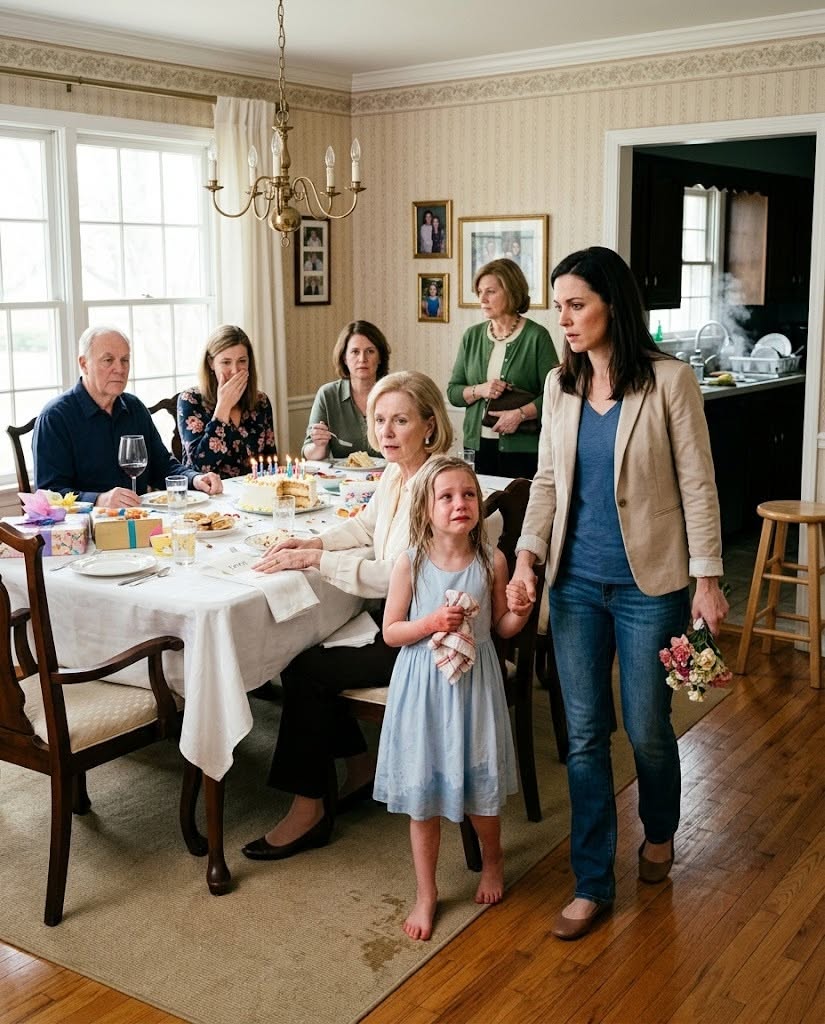
Rachel Bennett had never liked walking into Patricia’s house through the back door
It was not because the door was ugly or hidden or hard to open.
It was because Patricia treated that entrance like a dividing line.

Family came through the front.
Help came through the back.
For years, Rachel told herself she was imagining it.
Patricia had a way of making everything sound smaller than it was.
A sharp comment became “just teasing.”
A public correction became “helping.”
A private insult became “you’re too sensitive, sweetheart.”
Rachel had married Mark Bennett twelve years earlier, and Patricia had been present for every large milestone with a camera in her hand and judgment in her eyes.
She cried during the wedding toast, then told three guests the flowers were “a little grocery-store looking.”
She brought soup when Rachel was pregnant, then rearranged Rachel’s pantry while she slept.
She held Emma in the hospital and called her perfect, then told Rachel that nursing made the baby “too dependent.”
Rachel learned early that Patricia’s kindness usually arrived carrying instructions.
Still, Rachel tried.
She tried because Mark loved his mother.
She tried because Emma loved birthdays and grandparents and houses full of cake.
She tried because most mothers are trained to confuse endurance with peace.
When Patricia called that Monday and asked to keep Emma for the weekend, Rachel hesitated for only a second.
Mark was out of town for work all week, stuck in meetings and late flights, calling at night from hotel rooms with tired eyes and a loosened tie.
Rachel was scheduled for a late Saturday shift at the dental office.
Patricia’s birthday celebration was supposed to be big, with relatives, neighbors, old friends, and at least forty guests.
“Let me have her,” Patricia said. “She can help me decorate. She’ll love it.”
Rachel asked, “Are you sure it won’t be too much?”
Patricia laughed softly, the way she did when she wanted Rachel to feel foolish for asking a practical question.
“Don’t worry. Emma will be spoiled rotten here.”
Rachel believed her because she wanted to.
That was the trust signal.
She packed Emma’s blue dress, the one with the soft skirt Emma liked to spin in, along with pajamas, clean socks, her little white shoes, and the paperback she was reading before bed.
She wrote Emma’s bedtime routine on a sticky note, even though Patricia said she knew perfectly well how to care for a child.
Rachel wrote it anyway.
Brush teeth.
No soda after dinner.
Read one chapter.
Call Mom if she gets homesick.
Patricia looked at the note and smiled.
“Rachel, she’s eight, not eight months.”
Emma hugged Rachel’s waist before leaving.
“I’ll save you cake,” she promised.
Rachel kissed the top of her head and told her to be good, the careless phrase parents use when they believe the adults in the room already know how to be kind.
Saturday at the dental office smelled like fluoride, latex gloves, and lemon disinfectant.
Rachel spent most of the afternoon assisting with a cracked molar, two cleanings, and a nervous teenager who cried before the X-rays even started.
At 7:16 p.m., the last patient canceled.
Rachel remembered the time because she was standing beneath the office clock, peeling off gloves beside the sterilizer, when her manager said they could close early.
The night outside was cool, and the parking lot lights had just flickered on.
Rachel considered calling Patricia.
Then she imagined Emma’s face if she arrived unexpectedly with flowers.
So she stopped at the grocery store on First Avenue, bought a small bouquet wrapped in brown paper, and drove to Patricia’s house in Cedar Rapids, Iowa.
The closer she got, the more she relaxed.
The house was bright when she arrived.
Cars lined both sides of the street.
Music shook gently through the walls.
Laughter spilled from the windows, warm and careless.
Through the dining room glass, Rachel saw long tables crowded with plates, glasses, napkins, flowers, and people leaning into one another like the night had already become a memory they would tell warmly later.
Patricia sat near the head of the table in a cream blouse and pearl earrings.
She looked pleased.
She looked powerful.
Rachel shifted the bouquet in her hand and searched the room for blue.
She did not see it.
She checked the living room through the side window.
Adults stood shoulder to shoulder with drinks in their hands.
A man laughed with his head thrown back.
Two women took pictures near the fireplace.
No children ran through the hallway.
No small white shoes sat near the door.
No Emma.
Rachel told herself Emma might be upstairs.
Then she saw the staircase from the window and saw no movement there either.
Something in her chest tightened.
It was not panic yet.
It was the beginning of recognition.
Mothers know the difference between quiet and wrong.
Quiet rests.
Wrong waits.
Rachel walked around to the back door because it opened into the kitchen and because, for once, she did not care what entrance Patricia thought she deserved.
The porch light buzzed above her head.
The bouquet paper crinkled in her hand.
From inside came the muffled thump of music, the bright scrape of silverware, and the layered sound of adults enjoying themselves.
Then she heard a small sniffle.
It was so soft she almost missed it.
Rachel pushed the back door open quietly.
The kitchen was dimmer than the dining room.
Only the stove light and a narrow spill of brightness from the party reached across the tile.
Steam curled over the sink.
Dirty plates covered the counter in leaning stacks.
A wooden stool had been dragged in front of the basin.
Standing on it, barefoot, was Emma.
Her blue dress was soaked at the bottom.
Her sleeves had been pushed up unevenly.
Her little hands were red from hot water and dish soap.
She was holding a plate too large for her, rinsing it with the careful concentration of a child who had been told punishment would continue if she made one more mistake.
When she heard the door, Emma turned.
“Mommy?”
That one word broke in the middle.
Rachel crossed the kitchen so fast the bouquet hit the counter.
“Emma, why are you in here? Why are you washing dishes?”
Emma’s face crumpled.
Tears ran down both cheeks and gathered under her chin.
“Grandma said I’m not allowed inside until it’s done,” she sobbed. “She said I embarrassed her because I dropped lemonade on the floor.”
Rachel looked down at her daughter’s feet.
They were bare on the stool.
The kitchen floor beneath her was damp.
“Where are your shoes?” Rachel asked.
Emma swallowed hard.
“Grandma said I didn’t need them if I was staying in the kitchen.”
The words did something to Rachel that anger alone could not have done.
Anger burns hot.
This went cold.
For one second, Rachel imagined sweeping every plate off the counter.
She imagined porcelain exploding against Patricia’s clean tile.
She imagined walking into that dining room with the broken pieces in her hands and making every person at that table look at what they had ignored.
Instead, she took a breath.
She reached for a towel.
She dried Emma’s hands slowly, checking each finger, each red knuckle, each place the soap had roughened her skin.
Then Rachel pulled out her phone.
She photographed the sink full of dirty dishes.
She photographed the wooden stool.
She photographed the wet hem of the blue dress.
She photographed Emma’s bare feet on the kitchen floor.
Those pictures would later matter more than Rachel understood in that moment.
At the time, they were not strategy.
They were proof.
When Rachel lifted Emma off the stool, Emma wrapped both arms around her neck.
“I’m sorry,” Emma whispered.
Rachel closed her eyes.
“No, baby,” she said. “You are not the one who is sorry.”
She set Emma down, wrapped the towel around her hands, and took her fingers.
The dining room was only a few steps away.
It felt much farther.
When Rachel entered, the sound changed before anyone spoke.
Laughter faltered.
A fork paused halfway to someone’s mouth.
A wineglass stopped in the air.
A woman near the cake turned, saw Emma’s bare feet, and looked immediately down at her plate.
The serving spoon kept dripping sauce onto the white tablecloth as if it were the only honest thing in the room.
Nobody moved.
Patricia looked up from the head of the table.
For one polished second, she smiled.
Then her eyes dropped to Emma’s towel-wrapped hands.
“Oh, Rachel,” she said. “She had a little accident. I was teaching her responsibility.”
The room held its breath.
Rachel felt Emma’s fingers tighten.
She looked at Patricia, and for the first time in twelve years, she did not search for a softer way to say the truth.
“You will never touch her again.”
Six words.
Patricia’s face went white.
The silence that followed was not empty.
It was full of people deciding whether they had seen what they had seen.
Then Patricia moved her hand toward the napkin beside her plate.
It was a small movement.
Too small for most people to notice.
Rachel noticed because Patricia’s fingers trembled.
Beneath the napkin was a folded note with Emma’s name written across the front in Patricia’s careful cursive.
Rachel reached for it.
Patricia said, “Don’t.”
That one word told Rachel everything.
She picked up the note and opened it.
At the top were the words “Rules for Emma.”
The list was not long, but each line made the dining room shrink.
No running in the house.
No interrupting adults.
No crying for Mommy.
No dessert if she makes a mess.
Kitchen until she learns.
Rachel read the last line twice.
Kitchen until she learns.
Someone at the table made a sound under their breath.
Patricia’s friend put a hand over her mouth.
The man with the wineglass finally lowered it.
Patricia straightened in her chair, trying to gather herself back into the woman everyone knew.
“She needs boundaries,” Patricia said.
“She is eight,” Rachel answered.
“She humiliated me.”
“She dropped lemonade.”
“She has to learn that actions have consequences.”
Rachel held up the paper.
“So do adults.”
At exactly 7:43 p.m., Mark called.
Rachel saw his name flash across the screen and answered on speaker before Patricia could speak again.
“Rachel?” Mark said. “Mom just texted me that Emma was acting out. What happened?”
The room shifted.
Patricia had texted him first.
That meant she had already started building her version before Rachel arrived.
Rachel looked at Emma.
Emma was staring at the floor.
“Mark,” Rachel said, keeping her voice steady, “your mother made our daughter stand barefoot on a stool in the kitchen and wash dishes while forty adults ate dinner.”
There was silence on the phone.
Then Mark said, “What?”
Patricia leaned forward.
“That is not what happened.”
Rachel looked down at the paper in her hand.
“She also wrote rules for Emma. One of them says, ‘Kitchen until she learns.’”
Mark’s breathing changed.
Rachel heard it through the speaker.
“Mom,” he said, and his voice was no longer confused. “Tell me that is not true.”
Patricia opened her mouth.
For once, no polished sentence came out.
Emma lifted her face then.
Her cheeks were still wet.
Her voice was small but clear.
“Daddy,” she said, “Grandma said if I told, I couldn’t come back for Christmas.”
That broke something in Mark.
It broke something in the room too.
A cousin pushed back his chair.
One of Patricia’s friends whispered, “Patricia.”
The woman in the floral dress began crying silently, though Rachel had no patience for tears that arrived only after the evidence became public.
Mark said, “Rachel, take her home.”
“I am.”
“And send me everything.”
“I already took pictures.”
Patricia stood so quickly her chair scraped the floor.
“You are making this ugly.”
Rachel folded the note and put it in her purse.
“No,” she said. “You made it quiet. I’m making it visible.”
Then she picked up Emma’s shoes from the small mudroom shelf where Patricia had placed them out of reach, slipped them gently onto her daughter’s feet, and walked out through the front door.
She did not say goodbye.
In the car, Emma sat in the back seat with the towel still around her hands.
Rachel turned on the overhead light and checked her again.
No burns.
No cuts.
Only redness, trembling, and the kind of shame a child should never have to carry home from a birthday party.
“I’m sorry about the lemonade,” Emma whispered.
Rachel turned around in the driver’s seat.
“You can spill every drink in the world, and nobody gets to treat you like that.”
Emma looked at her as if she was trying to believe it.
That look stayed with Rachel longer than the anger did.
Because humiliation does not end when the room goes quiet.
It follows a child home and waits to see whether the adults will explain it away.
Rachel did not explain it away.
That night, she documented everything.
She saved the photos with timestamps.
She photographed the handwritten note again under bright kitchen light.
She wrote down Emma’s exact words while they were still fresh.
She called Mark again after Emma fell asleep.
This time, Mark was not defending Patricia.
He sounded wrecked.
“My mother told me Emma was being defiant,” he said.
“She is eight.”
“I know.”
“She told her she couldn’t come back for Christmas if she told us.”
“I know,” Mark said again, and this time his voice cracked.
He flew home the next day.
By Monday morning, Rachel had spoken to Emma’s pediatrician, who documented the redness on her hands and the emotional distress Rachel described.
By Tuesday, Rachel had called the school counselor, not because the school was involved, but because Emma needed a neutral adult who knew how to talk to children about shame.
By Wednesday, Mark had gone to Patricia’s house alone.
Rachel did not ask for every word of that conversation.
She only knew Mark came home pale, carrying a cardboard box of Emma’s toys and books that Patricia had kept at the house.
On top of the box was the framed photo of Emma missing both front teeth.
Patricia had given it back.
That hurt Emma more than Rachel expected.
“She doesn’t want my picture?” Emma asked.
Rachel pulled her close.
“Grandma is angry because grown-ups do not like being told they were wrong.”
“Was I bad?”
“No.”
“Was I embarrassing?”
“No.”
“Then why did everyone laugh in the other room?”
Rachel had no easy answer.
So she gave Emma the true one.
“Because sometimes adults choose comfort over courage. That does not make what happened okay.”
Two weeks later, Patricia’s lawyer called for the first time.
His tone was smooth and official.
He said Patricia felt “defamed.”
He said family matters should remain private.
He said Rachel’s written record, if shared, could create unnecessary damage.
Rachel listened until he finished.
Then she said, “Are you asking me not to show people the note your client wrote?”
The line went quiet.
He called again the next day.
Then again three days later.
Each time, Rachel repeated the same thing.
She had photographs.
She had timestamps.
She had the handwritten note.
She had Emma’s pediatric documentation.
She had Mark’s full support.
By the fourth call, the lawyer stopped sounding confident.
Patricia wanted access to Emma restored.
Rachel said no.
Patricia wanted Rachel to tell relatives it had been a misunderstanding.
Rachel said no.
Patricia wanted the note returned.
Rachel said absolutely not.
Mark made the final call himself.
He told his mother that she would not see Emma without Rachel present, and not anytime soon.
He told her that apologies delivered through lawyers were not apologies.
He told her that if she ever threatened their daughter again, the next conversation would not be inside the family.
Patricia cried.
Mark cried too after he hung up, but his tears did not change the boundary.
Months passed before Emma stopped apologizing for tiny accidents.
A dropped spoon.
A tipped cup.
A smear of toothpaste in the sink.
Each time, Rachel said the same thing.
“Messes can be cleaned. People cannot be shamed into being careful.”
Slowly, Emma began to believe her.
The blue dress was washed and folded, but Emma never wore it again.
Rachel kept it in a box with the note, not as a trophy, but as a record.
Proof mattered because Patricia had counted on silence.
She had counted on politeness.
She had counted on forty guests laughing in the next room and one little girl being too scared to tell the truth.
What she did not count on was Rachel coming through the back door early.
What she did not count on was a mother who finally understood that peace without protection is not peace.
It is permission.
Years later, Rachel would still remember the kitchen first.
The steam over the sink.
The stool legs against the tile.
The red marks on Emma’s hands.
She would remember the dining room too, the forks in the air and the faces turning away.
An entire room had taught Emma, for one terrible moment, to wonder if she deserved it.
Rachel spent every day after that teaching her the opposite.
And when Emma spilled lemonade again at home months later, she froze so hard Rachel saw the old fear return.
Rachel picked up a towel, handed Emma one too, and smiled gently.
“See?” she said. “We clean it together.”
Emma looked down at the puddle, then back at her mother.
This time, she did not apologize.
That was the real ending Patricia never got to control.
