The ship didn’t wait for my emotions to settle.
It pulled away from the dock in Barcelona slowly, almost gently, like it didn’t care what had just happened on land. The kind of calm movement that makes the world behind you feel smaller with every second.
I stayed at the port long after boarding closed.
Just standing there.
Holding that empty folder.
Watching the ship shrink into the horizon until it became just another white shape on the water.
For the first time in a long time, I didn’t feel tired.
I felt… done.
Not broken. Not angry.
Just finished with something I had been carrying for too long.
I didn’t expect my phone to ring.
But it did.
Unknown number.
I almost didn’t answer.
Then I did.
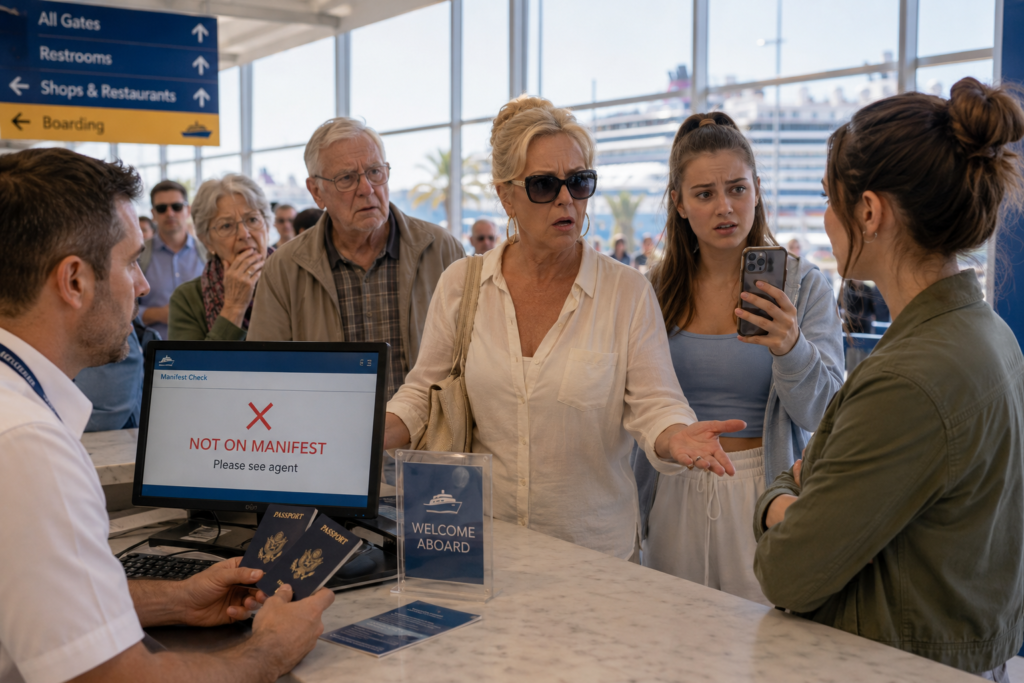
“Mum is in a state,” my sister’s voice snapped through the line immediately. No greeting. No warmth. Just panic wrapped in blame. “Security had to escort us out of the terminal. People were staring at us like we were criminals.”
I stayed quiet.
“She’s saying you humiliated her,” she continued. “Do you understand what you’ve done?”
I looked out at the water where the ship had gone.
“No,” I said calmly. “She did that herself.”
A pause.
Then my sister’s voice changed—less sharp, more uncertain.
“…you didn’t have to take it that far.”
That line.
That same family line.
The one used every time I was supposed to swallow something unfair.
I finally spoke.
“I spent three years taking things ‘not that far’,” I said. “That’s how I ended up here in the first place.”
Silence again.
Then she hung up.
I took the earliest flight back.
Not because I regretted it.
But because I knew something else was coming.
And I was right.
When I arrived home, the house felt different.
Not physically.
Emotionally.
Like the walls had already chosen sides.
My mum was waiting inside.
No shouting this time.
No dramatic entrance.
Just sitting at the kitchen table like she had been there for hours, staring at nothing.
Grandma’s kettle was still on the counter.
Unwashed cups still in the sink from before the trip.
Life paused mid-sentence.
She didn’t look at me when I walked in.
“You ruined everything,” she said quietly.
I put my keys down.
“No,” I replied. “You tried to take everything.”
That made her finally look up.
And for the first time, I saw something I had never seen before in her face.
Not anger.
Not entitlement.
Something weaker.
Fear.
Because deep down, she knew this time she couldn’t rewrite it.
It didn’t take long for the truth to spread.
Not the dramatic version she told people.
The real one.
The cruise company had documentation. Emails. Authorization logs. Everything tied to the cancellation attempt.
And fraud protection flags don’t lie politely.
They record everything.
My aunt called me two days later.
Then my uncle.
Then someone from my mum’s side of the family I hadn’t spoken to in years.
All asking the same thing:
“What happened?”
I only said one sentence each time.
“I gave my grandparents what I promised them.”
Some stayed silent after that.
Others didn’t like the answer.
But none of them asked again.
Meanwhile, the ship kept moving.
Barcelona turned into open sea.
And on that deck, something I had only ever imagined started becoming real for them.
Grandma sent me the first message.
A shaky photo.
Ocean stretching forever behind her.
Her caption was simple:
“I didn’t know silence could look this beautiful.”
The second day, Grandad sent a video.
It was short.
Just him sitting on the balcony, wind in his hair, smiling like a man who had forgotten what pain felt like for a moment.
“I thought I’d feel seasick,” he said in the video. “Turns out I just needed peace.”
I watched it five times.
Back home, things didn’t settle.
They fractured.
My sister stopped talking to me entirely.
My mum tried something else first.
Guilt.
Then anger.
Then silence.
But silence was the only thing I was no longer afraid of.
One evening, she finally said it directly.
“You chose them over your own mother.”
I looked at her.
Not with emotion.
With clarity.
“No,” I said. “You made me choose between respect and being used.”
That was the moment something shifted permanently.
Not loudly.
Just quietly snapping in place.
Like a door locking.
A week later, a letter arrived.
No return address.
Just cruise ship stationery.
Inside was handwriting I knew too well.
Grandma’s.
“We have seen half the Mediterranean now. Every morning your grandfather eats breakfast on the balcony like he is afraid the world might disappear if he doesn’t look at it enough.”
“We talk about you a lot. Not what happened. Just you.”
“There is something I want you to understand, my dear.”
“You did not lose anything that day in Barcelona.”
“You only stopped letting others take it.”
I had to sit down after reading it.
Because suddenly, everything I had carried for years didn’t feel heavy anymore.
Ten days later, I went back to the port.
Not because I needed to.
But because I wanted to.
When the ship returned, I stood at the terminal waiting.
No drama.
No confrontation.
Just waiting.
And when they walked out, it didn’t feel like a reunion.
It felt like completion.
Grandma saw me first.
Her face broke into a smile before she even reached me.
Grandad just shook his head, half laughing.
“You caused a scandal in Spain,” he said.
I smiled. “I heard.”
Then Grandma did something she almost never did.
She hugged me tightly.
Not politely.
Not carefully.
Like she was afraid I might disappear again.
My mum didn’t come that day.
But she called later.
One last time.
Her voice was different.
Tired.
Smaller.
“I didn’t think you would really shut me out like that,” she said.
I stayed quiet.
Then she added something I didn’t expect.
“I thought you would always come back.”
That line stayed in the air longer than anything else she had ever said.
I finally answered.
“I used to,” I said. “Until I stopped disappearing for people who only noticed when I was useful.”
She didn’t reply.
And this time, she didn’t call again after.
Months passed.
Life didn’t magically become perfect.
But it became honest.
I worked.
I saved.
I lived without constantly subtracting myself from my own future.
Grandparents came back changed.
Not younger.
Not richer.
Just… lighter.
Like something inside them had been given back.
And sometimes, on quiet evenings, Grandma would still say it.
“That cruise didn’t just take us somewhere beautiful,” she said once, sipping tea.
“It brought our family back to where it should have been.”
I didn’t answer.
Because she was right.
Not about everyone.
But about me.
Some things don’t end with revenge.
Some things end when you finally stop letting people decide your worth.
And for the first time in my life…
I wasn’t the one left behind anymore.
The Weight of the Return
The train from the airport back into the city center of Barcelona didn’t rattle so much as it hummed, a low, metallic vibration that vibrated right through the soles of my shoes. Through the scratched plexiglass window, the Catalan countryside blurred from dusty olive groves into the sharp, graffiti-scrawled concrete of the suburban margins. I watched the numbers on the digital display above the door click through the kilometers, each digit a tiny anchor dropping away.
When I stepped out onto the platform at Estació de Sants, the humidity hit me first—thick, salty, and smelling faintly of diesel and roasted coffee from the station kiosks. It was the exact same air I had breathed forty-eight hours ago on the observation deck, but it felt entirely different now. Then, it had been a stage set for an execution; now, it was just weather.
My phone remained face down on the small laminate table inside my tiny rented apartment off Carrer de Sardenya. I had intentionally left the ringer off, but the screen kept pulsing with that relentless, rhythmic glow that signifies a family in the middle of an administrative collapse.
- 14 missed calls from Sarah.
- 3 text messages from Aunt Clara.
- 1 voicemail from an unlisted landline in Girona.
I didn’t open any of them. Instead, I went to the small sink in the corner, filled a glass with tap water that tasted heavily of chlorine, and sat on the edge of the unmade bed. The silence in the room was immense. For three years, my life had been structured around the sound of my mother’s voice—specifically, the sharp, rising cadence she used when she was about to explain why an arrangement I had made was inconvenient for her social calendar.
The silence didn’t feel like loneliness; it felt like space. Like an empty room where the furniture had finally been cleared out after a long, messy eviction.
The Inventory of the Invoices
By Tuesday, the official notification from the cruise line’s legal department arrived via email. The attachment was a ninety-eight-page PDF titled Disputed Transaction Audit: Hull Number 4122. It was beautifully, ruthlessly clear.
---------------------------------------------------------------------- CRUISE LINE TRANSACTION AUDIT Log – SYSTEM ID: 992-BCE ---------------------------------------------------------------------- TIMESTAMP USER_ID ACTION DESCRIPTION ---------------------------------------------------------------------- 2026-05-14 14:22:11 WEB_RES_99 Booking Confirmed (Platinum Tier) 2026-05-28 09:11:42 M_FLORES_IP Manual Cancellation Attempt 2026-05-28 09:12:01 SYS_FRAUD Flagged: Account Holder Name Mismatch 2026-05-28 09:15:33 SYS_SECURE Cardholder Notified via Secure Link 2026-05-28 10:02:19 WEB_RES_99 Reservation Re-Authorized (Verified) ---------------------------------------------------------------------- I printed the log at a small locutorio down the street, the laser printer spitting out the warm pages into a metal tray. The columns of data were a perfect antidote to the version of history my mother was currently constructing on her social media accounts. In her narrative, she was the tragic matriarch who had been turned away at the gangway due to a “clerical error” engineered by an ungrateful child.
I took the pages back to the apartment and laid them out on the floor, side by side, like a puzzle that had already been solved.
The phone rang again at four o’clock. This time, the display showed my uncle’s name—Julian. He was the only one of my mother’s brothers who had ever looked at her with anything resembling objectivity, mostly because he had been the one who had to audit the family business records after my grandfather retired.
“I’ve seen the posts, Elena,” Julian said when I answered. He didn’t sound angry; he sounded tired, the low, raspy drawl of a man who had spent forty years smoking dark tobacco by the docks.
“They’re mostly fiction, Uncle Julian,” I said, leaning my head against the cool plaster wall.
“I figured,” he said. There was the distinct sound of a lighter flicking on his end of the line. “Your mother called me from the hotel in Tarragona. She wanted me to loan her three thousand euros to cover the return flights and the ‘damages’ she claims you caused to her credit rating. She said you used her card without authorization.”
“I have the bank records from three years ago, Julian,” I said, my voice steady. “The account was opened in my name using the inheritance from Aunt Sofia. My mother was a secondary signer for ’emergency management’ when I was working in the UK. She changed the billing address to her house in Girona without telling the branch.”
A long pause followed. I could hear the wind whistling through the rigging of the boats in the harbor near his house.
“She’s always had a difficult relationship with arithmetic,” Julian said dryly. “She mistakes things she wants for things she’s already earned. Did the old people get on the boat?”
“They did,” I said. “Grandma sent a photo from near Corsica yesterday. She looked… she didn’t look eighty-one, Julian. She looked like she did when we used to go to the orchards in August.”
Julian grunted, a soft, gravelly sound. “Good. My father worked fifty years in that dry dock before his knees gave out. Every vacation he ever planned was cancelled because your mother needed her tuition paid or her car repaired or her house painted. He spent his whole life standing on concrete. Let him look at some deep water for a change.”
“The family is saying I ruined her reputation,” I whispered, the word reputation tasting like ash.
“Reputation in this family is just a code word for who tells the lie the loudest,” Julian said. “Don’t pay for the return tickets, Elena. Let her use her own money. It’s about time she found out what the exchange rate is for reality.”
The Assembly of the House
When I returned to Girona the following week to clear my remaining things from the small studio apartment above my mother’s garage, the gate was locked with a heavy chain that hadn’t been there before. The iron links were bright orange with rust, wrapped around the latch like a visual threat.
I didn’t knock on the main house door. I used the spare key Julian had given me years ago to open the side pedestrian entrance and walked across the gravel courtyard.
My mother was sitting on the low wicker sofa on the porch, a thin wool shawl pulled around her shoulders despite the noon heat. She looked smaller than she had at the port—the sharp, dramatic angles of her face had softened into something looser, the skin under her jaw slightly slack.
“You shouldn’t be here,” she said, her eyes remaining on the gravel.
“I’m just getting my books and the winter coats, Mum,” I said, keeping my distance, my boots crunching softly on the stones.
“The neighbors are talking,” she said, her voice dropping into that rhythmic, monotone drone she used when she wanted to signal that she was the subject of a public tragedy. “The lady from number twelve asked me why the police were at the terminal. She wanted to know if we were involved in a tax matter.”
“You could tell her the truth,” I said, standing at the base of the porch steps. “You could tell her you tried to cancel a trip that didn’t belong to you, and the system flagged it as fraud.”
“It wasn’t fraud!” She finally looked up, her eyes flashing with that old, familiar heat—the look that used to make me retreat into my bedroom for days. “I am your mother. I have the right to regulate how money is spent in this family. Your grandfather is eighty-four years old; he has no business being on a ship in the middle of the Gulf of Lyons without proper medical oversight. I was protecting him.”
“Grandad has his heart medication, his insulin, and the ship has a full clinical staff,” I said. “You weren’t protecting him, Mum. You were angry that the cabin didn’t have your name on the door.”
She stood up, the shawl slipping from her shoulders and pooling around her feet like an old skin. “You talk to me like I’m a stranger. You have no respect. For three years, I’ve managed this property while you were off in London doing whatever it is you do. I kept this family functional.”
“No,” I said, my voice dropping so low she had to lean forward to catch it. “You kept this family compliant. There’s a difference. Functional families don’t require one person to disappear so everyone else can have a nice dinner.”
I walked past her up the stairs to the garage studio. The air inside the small room was hot and stale, smelling of old paper and the cedar chests where I kept my university notebooks. It took me less than twenty minutes to pack the two canvas bags I had brought. I left the furniture, the lamps I had bought with my first paycheck, and the framed prints of the Cadaqués coast.
When I came back down the stairs, she was sitting on the sofa again, the shawl back around her neck. She didn’t move as I crossed the gravel toward the gate.
“Your sister won’t come to your apartment for Christmas,” she said behind me, her voice thin and sharp as a wire.
I stopped with my hand on the rusted chain. I didn’t turn around. “That’s fine,” I said. “The table in my apartment only has four chairs anyway. I’ll make sure the old people have seats.”
The Log from the Sea
The messages from the ship didn’t arrive every day. The satellite internet on the lower decks was intermittent, dropping out whenever the vessel moved behind the high limestone cliffs of the Balearic coast or into the deep trenches between Sardinia and Sicily. But when they did arrive, they came in bursts of high-resolution clarity that felt like letters from a different century.
==================================================================== TRANSMISSION VIA SEA-LINK RESORT-NET (Vessel: MV STRELLA MARIS) ==================================================================== FROM: Room 7042 (Senior Tier) TO: Elena_M_Res@G-Net.cat ==================================================================== Dear child, Your grandfather has spent the last three hours explaining the internal combustion engine of the ship's tender boats to a retired surveyor from Manchester. He doesn't speak a word of English, and the surveyor doesn't speak Catalan, but they have a grease pencil and a piece of cardboard from a shirt box, so they are perfectly happy. The water here is a blue I haven't seen since the summer of 1964 when we went to the cove at San Pere Pescador before the hotels were built. It doesn't have any dirt in it, Elena. You can look straight down through forty feet of it and see the anchor chains resting on the white sand like old bones. Your mother called the cabin phone yesterday morning while we were coming into Palermo. The ship’s operator put it through before I could tell them not to. She sounded very loud, very close, like she was standing right behind the wardrobe. She told me the tax authority was looking into the garage lease. I told her that the garage belongs to the earth, and the earth doesn't pay taxes to Girona. Your grandfather took the receiver from my hand and laid it in the fruit basket next to the grapes until the line went dead. Do not worry about the house, Elena. The walls have been there since 1892; they can survive a winter without us. With all our love, Grandma ==================================================================== I kept the email open on my phone while I worked at my desk at the municipal archives. My job was tedious—cataloging sixteenth-century property deeds from the salt marshes near Rosas—but it required an absolute adherence to the unchangeable fact. A signature on vellum from 1542 didn’t care about the feelings of the duke who wrote it; it only cared about the borders of the ditch.
I spent my days surrounded by ancient ink and dry parchment, finding a strange comfort in the permanence of old decisions. My family had spent thirty years treating choices like things that could be melted down and reshaped with enough tears or shouts. Here, under the white cotton gloves and the UV lamps, everything stayed exactly where it had been set down.
The Meeting at the Cafe
By the middle of June, the heat in Girona had become stationary. The air didn’t move through the narrow alleys of the Barri Vell; it just sat there, baking the gray stone walls until they radiated heat like ovens late into the night.
My sister, Sarah, sent a message that read: Café Neutre. 11:00. Bring the bank statements.
The café was a small, dark place near the river where the students went to escape the tourists. Sarah was already there when I arrived, sitting at a zinc table under a ceiling fan that turned with a dry, rhythmic click. She had her hair pulled back into a severe knot, her professional wardrobe—she worked as a compliance officer for a regional insurance firm—looking stiff and hot in the summer damp.
She didn’t offer a cheek to kiss. She pointed to the empty wicker chair across from her.
“Mum’s lawyer says you’re holding the titles to the tractor and the lower olive grove,” she said before I had even sat down.
I set my canvas bag on the floor between my feet. “The titles are in the safe deposit box at CaixaBank, Sarah. They’ve been there since Grandad had his stroke in 2024. They’re under joint registration—his name and mine. Mum has never been on that deed.”
“She’s been paying the land tax since 2021,” Sarah countered, her fingers tapping a rhythmic, nervous cadence against the side of her espresso cup.
“No,” I said, pulling a small leather folder from my bag and sliding it across the zinc. “I’ve been paying the land tax from the London account. Mum was using the money from the garage rental to pay her own health insurance. Here are the transfer logs from the last thirty-six months.”
Sarah didn’t open the folder. She looked at the leather cover as if it were a small, venomous animal that had crawled out of the river. “You always do this, Elena. You make everything look like a corporate dispute. We aren’t a bank. We’re a family. Mum is sixty-one; she has a heart condition—”
“Mum has an anxiety condition that only appears when she has to pay a bill,” I said, my voice remaining in that flat, archives-trained register. “She spent two thousand euros on a leather coat in Andorra last winter while Grandad was using a piece of wire to keep his spectacles together. You know that, Sarah. You were the one who had to dispute the charge on her secondary card.”
Sarah looked away, her jaw tightening until the muscle showed clear against her cheek. “She’s our mother, Elena. You can’t just leave her sitting in that big house by herself with no income. It looks… it looks shameful.”
“The house has four hectares of productive olives and a tenant who pays six hundred euros a month for the oil press,” I said. “She isn’t poor, Sarah. She’s just unsupervised. For thirty years, she used Grandad’s pension like it was her personal allowance, and now that he’s using it to see Greece, she’s realized she has to live within the limits of her own land.”
“You’ve changed,” Sarah said, her eyes returning to my face, her look more curious than angry now. “You used to be the one who fixed things. When Mum had her breakdown after the divorce, you stayed in that house for eighteen months while I was at university in Barcelona. You were the one who washed her clothes and listened to her cry every night until three in the morning.”
“I did,” I said. “And do you know what I realized during those eighteen months, Sarah?”
“What?”
“That she wasn’t crying because she was broken,” I said, leaning forward until the shadow of the ceiling fan crossed both our faces. “She was crying because she had found out that if she cried long enough, she didn’t have to clean the kitchen. I spent a year and a half being an accomplice to her laziness. I’m not doing it anymore.”
Sarah sat back, her arms crossed over her chest. “She’s going to sell the lower grove to that developer from Figueres.”
“She can’t,” I said, tapping the folder on the table. “The deed requires two signatures for any transaction over five thousand euros. Mine is the second one. And I don’t sign anything for developers.”
Sarah stood up, her chair scraping sharply against the stone floor. She looked down at me with an expression that was an exact copy of our mother’s—that look of deep, generic disappointment that used to make my throat close up. “You’re going to end up alone in that apartment, Elena. With your old papers and your bank logs.”
“I’m not alone,” I said, looking out at the green water of the Onyar river through the café door. “The old people are coming back on the twenty-fourth. I have to buy some fresh oil for the kitchen.”
The Verification Logs
The final week of June brought the formal response from the insurance carrier regarding the “incident” at the Barcelona terminal. Because my mother had attempted to claim that her physical distress during the escort-out was a workplace-related injury—she still maintained a nominal title as the corporate secretary for Julian’s dry-dock firm—the insurance investigators had conducted a full forensic review of the security footage from Gate B45.
Julian sent me the internal report via courier. It arrived in a plain brown envelope, the pages held together by a heavy black binder clip.
I read the report twice, then filed it in the green cardboard box where I kept the family records. It was the third time in ten years that an official agency had used the words intentional and controlled to describe my mother’s emotional collapses. The first had been after her car accident in 2018, where the vehicle had somehow managed to slide into a ditch at four kilometers per hour exactly outside her attorney’s office.
The data didn’t make me angry anymore. It was just an entry in a ledger. A line of ink that described a behavior pattern with the same cold accuracy as the salt marsh deeds from 1542.
The Day of the Pier
On the morning of June twenty-fourth, the sky over Barcelona was completely clear, that hard, Mediterranean blue that looks like it has been polished with a cloth. The wind was coming from the south, bringing the smell of salt and sun-baked seaweed right up into the avenues of the city.
I arrived at the Moll de Barcelona at seven-thirty, an hour before the Strella Maris was scheduled to clear customs. The port was busy with the usual morning chaos—delivery trucks unloading crates of fish, tourists dragging oversized suitcases with wheels that clattered over the expansion joints in the concrete, and the high, screaming cries of the gulls that followed the wake of the incoming ferries.
I stood by the iron railing near the customs exit, my hands in the pockets of my linen trousers. I didn’t bring flowers. I didn’t bring a sign. I just brought a small canvas bag containing three fresh lemons from the tree in my courtyard and a bottle of mineral water.
When the glass doors of the terminal finally swung open at eight-forty-five, the passengers began to stream out in a long, sun-tanned line. They looked like people who had spent a month living in a world where the clocks didn’t match the ones on land—their movements were slower, their skin dark from the sea sun, their eyes blinking against the glare of the white concrete piers.
Grandma came through the doors first.
She was wearing an old white canvas hat I hadn’t seen since the summers at the beach, her grey hair escaping from the sides in soft, unruly curls. She didn’t have her walking stick; she was holding onto Grandad’s arm, but she wasn’t leaning on him. They were moving together with a strange, light rhythm, their steps matching each other like two people who had spent three weeks walking the same narrow deck boards.
Grandad had a small leather bag slung over his shoulder, his blue cotton shirt open at the neck, his face the color of an old walnut from the sun. He looked larger than he had in May—not fatter, but wider, his chest thrown out against the wind in a way that made him look like the photographs from his time at the shipyard.
When Grandma saw me, she stopped right in the middle of the terminal exit, ignoring the people who had to navigate around her suitcases. She didn’t shout. She just stood there, her face breaking into that wide, uncurated smile that my mother had spent thirty years trying to correct because it “showed too much of the gums.”
“Elena,” she said as I reached them.
She smelled of salt water, lavender soap, and that clean, dry wool scent that always belonged to her linen drawers. Her arms around my neck were surprisingly strong—not the careful, brittle embrace of an old woman, but the firm, territorial hold of someone who had returned from a long journey and was establishing her claim to the ground.
“You’ve got freckles,” Grandad said, his voice deep and clear, the raspy rattle from his chest completely gone. He reached out and tapped my nose with a thick, calloused finger that smelled faintly of pipe tobacco and citrus.
“The sun is different here than in the archives, Grandad,” I said, my voice catching for just a second before I forced it back into line.
“We saw the volcano, Elena,” he said, half-laughing as we started to walk toward the taxi rank. “Stromboli. It was midnight, and the sky was black as an iron kettle, and suddenly the mountain just… boom. A line of red fire right down into the water. Like a weld that didn’t take.”
“He stood on the balcony for two hours in his undershirt,” Grandma said, her tone full of that dry, affectionate exasperation that was the real language of their house. “I had to give him a blanket from the sofa so he wouldn’t freeze his kidneys. The captain came on the loudspeaker and said it was a ‘natural manifestation.’ Your grandfather told him it was just a bad valve.”
We got into the back of a large, black-and-yellow city cab, the leather seats hot against our legs. As the car pulled away from the port and headed up the Via Laietana toward the highway north, Grandad turned around to look through the rear window.
The Strella Maris was already being turned by two small tugs, her white hull turning slowly in the green water of the basin, preparing for the afternoon run down to Valencia.
“It’s a big boat,” Grandad muttered, his hand resting on his knee. “But it moves quiet. You don’t hear the engines at all from the stern. Just the water hitting the plates. Shhh-shhh-shhh. Like someone sweeping a floor in the dark.”
The Kitchen on Carrer de Sardenya
The apartment was small, but the afternoon light fell across the wood floor in long, clean blocks that made the room feel wider than it was. I had set the table with the old white plates I had taken from the garage studio and a loaf of crusty bread from the bakery around the corner.
Grandma sat in the wicker chair by the window, her hat off now, her fingers tracing the grain of the wood table. She didn’t ask about her house in Girona. She didn’t ask about my mother or the letters from the insurance company.
“The girl from Mallorca—the one who cleaned the cabin,” Grandma said, sipping her tea from a glass. “She had a mother in Soller who was ninety-two. She told me that in Mallorca, when a woman gets to eighty, she stops washing the windows. She lets the salt accumulate on the glass until the view looks like a painting.”
“That sounds lazy, Maria,” Grandad said from the corner where he was attempting to adjust the tension on my window latch with his pocket knife.
“It’s not lazy,” Grandma said, her voice dropping into that quiet, absolute certainty that had become her permanent register since Barcelona. “It’s selective. You only look at the things you want to remember. The rest is just gray light anyway.”
She reached into her canvas bag and pulled out a small, blue glass bottle—the kind they used in Italy for mineral water. It was filled with white sand and a few small, broken pieces of pink coral.
“From the beach at Alghero,” she said, setting it in the center of the table next to the lemons. “The water there was the color of a green bottle, Elena. Your grandfather went in up to his knees. He had his trousers rolled up like a boy from the delta.”
“The current was strong,” Grandad said, not looking up from the latch, the knife blade clicking softly against the brass screw. “If you don’t watch your feet, the gravel takes the ground out from under you before you can adjust your balance.”
“Did you adjust?” I asked.
“I did,” he said, finally closing the knife with a sharp snap and turning to look at me. His eyes were clear, the white parts no longer yellowed by the smoke of the town or the long hours in the den. “You just have to lean into the wave instead of trying to stand straight against it. It’s basic mechanics.”
The Last Call
The phone didn’t ring until nine o’clock that evening, when the sun had finally dipped behind the hills of Montjuïc and the city below was beginning to light up in long, yellow lines of streetlamps.
I went into the small hallway to answer it, closing the kitchen door behind me so the old people wouldn’t hear the sound of the line.
“Elena,” my mother’s voice was very thin, very far away. There was no background noise—no television, no music, no sound of wind from the porch. Just that dry, empty space that signifies a large house with only one person inside it.
“Yes, Mum,” I said.
“They’re back, then?”
“They are,” I said. “They’re in the kitchen now. Grandad’s fixing the window.”
A long silence followed. I could hear her breathing—shallow, rhythmic, the breath of a woman who was looking at an empty kitchen table in a house that was too big for her allowance.
“Your sister says you have the logs from the bank,” she said quietly.
“I do.”
“Are you going to give them to Julian?”
“Julian already has his own logs, Mum,” I said, my voice completely devoid of the old defense—the need to explain, to justify, to make her understand that I hadn’t been malicious. “He’s the director of the firm. He knows exactly where the garage money went.”
She didn’t shout. She didn’t tell me I was ungrateful. She just gave a short, dry cough that sounded like paper being torn. “I didn’t think you would really do it. At the port… I thought you were just making a scene to frighten me. You’ve always been so… reliable.”
“Reliable just means I was predictable, Mum,” I said. “It means you could calculate exactly how much I would give up before I started to complain. You used that calculation for three years.”
“I have no one to help me with the pruning in October,” she whispered.
“The tenant has two sons who do the lower grove for ten percent of the press yield,” I said. “The contract is in the folder on your desk. All you have to do is sign it and leave the gate unlocked.”
“I don’t like those boys,” she said, her voice rising into that small, petulant cadence—the one she used when a restaurant didn’t have her preferred table. “They have loud motorbikes. They leave grease on the gravel.”
“Then you can do the pruning yourself, Mum,” I said.
The line went completely dead. She didn’t hang up with a slam; she just disconnected the system, the signal dropping away into that flat, digital hiss that means the connection has been severed from the other end.
I stood in the dark hallway for a minute, the phone cold against my palm. I waited for the old feeling to arrive—that sudden, tight knot in my stomach, the feeling that I had left a door open or an account unpaid, that I was responsible for the silence in Girona.
It didn’t come.
Instead, I heard Grandad’s laugh through the kitchen door—a loud, unbound sound that was followed by the sharp, rhythmic clatter of a fork hitting a plate.
The Geometry of the Orchard
By July, the heat had broken into a series of short, violent electric storms that came down from the Pyrenees every afternoon at four o’clock. The rain would hit the dry tiles of the city with a sound like small stones, washing the dust off the balconies and leaving the air smelling of ozone and wet plaster.
I took the train up to Girona on a Saturday morning—not to visit the main house, but to help Uncle Julian clear the old drainage ditch behind the lower olive grove. The water from the storms had been pooling near the roots of the oldest trees, and the earth was turning into a thick, gray mud that could rot the burls if left untended.
We worked with two heavy iron spades, our shirts soaked with sweat within ten minutes, the mud sticking to our boots in thick, heavy layers.
“She’s tried to list the garage on Airbnb,” Julian said, leaning on his spade and wiping his forehead with a sleeve that was dark with gray silt.
“The urban registry requires the property license name to match the bank account on file,” I said, my spade cutting cleanly through a thick knot of couch grass. “The license is under Grandad’s name. The system won’t accept her registration.”
Julian laughed, a short, barking sound that was lost in the wide space of the grove. “She called the town hall and told them the computer was being managed by an adversarial party in Barcelona. The clerk told her that the computer didn’t have an adversarial party; it only had an interface.”
He looked up toward the main house, visible through the gray-green leaves of the olives about two hundred meters up the slope. The white shutters were all closed against the noon sun, making the building look like a monument or a tomb, completely stationary against the bright blue of the sky.
“She doesn’t come down here anymore,” Julian said. “She says the mud is bad for her sinuses. She spends the whole day on the internet, looking at apartments in San Sebastian. She says the people in the north have more culture.”
“Let her go to San Sebastian,” I said, my spade hitting a stone with a sharp, clear clink. “The rent there is twice what she has here. She’ll find out how far her culture goes by November.”
We worked until three o’clock, until the ditch was clear and the yellow water from the upper terrace was running smoothly through the stone channel down toward the river. When we finished, the grove looked different—not cleaner, but more organized, the lines of trees separated by the deep, straight trench of the channel like lines on a blueprint.
As we walked back toward Julian’s truck, I looked down at my hands. The skin was rough, the palms lined with small, hard calluses from the wooden handle of the spade. They didn’t look like the hands of an archivist anymore; they looked like the hands of someone who spent her time moving heavy things from one place to another.
They looked like Grandad’s hands.
The Mediterranean Light
On the final evening before my vacation time ended and the archives returned to their regular winter schedule, I took the old people down to the harbor at Barceloneta. We didn’t go to one of the restaurants with the white tablecloths and the waiters who spoke English; we sat on the stone steps of the breakwater, our feet dangling over the side, watching the fishing boats come in with the evening catch.
The water in the harbor was dark, almost black, but where the searchlights from the piers hit the surface, it turned a deep, iridescent green that looked like the back of a mackerel.
Grandma had a small paper bag of roasted almonds between her knees, her fingers moving between the bag and her mouth with a slow, mechanical regularity.
“Your grandfather wants to go to Portugal next year,” she said, her voice carrying clearly over the rumble of the boat engines. “He’s been reading a pamphlet about the river boats on the Douro. He says the locks there are thirty meters deep.”
“They have an interesting hydraulic system,” Grandad said, his pipe unlit between his teeth, his eyes tracking a white pilot boat that was coming around the breakwater. “They use the natural gravity of the river to fill the chambers. No pumps at all. It’s very clean design.”
“I told him we don’t need to see thirty meters of concrete,” Grandma said, turning her face toward the open sea where the lighthouse on the point was beginning to blink its regular, three-second signal. “But he says the wine there tastes like wild plums. We’ll have to see if the budget allows it.”
“The budget allows it, Grandma,” I said, leaning my shoulder against hers, the dry wool of her cardigan warm against my arm. “The London account cleared the final distribution yesterday. The tax division is settled. There’s enough for Portugal, and there’s enough for the winter oil.”
She didn’t thank me. She didn’t tell me I was a good daughter or a reliable child. She just reached down, took a single almond from the bag, and pressed it into my palm. It was still warm from the roaster, the skin rough and covered in fine white salt.
“Look at that ferry, Elena,” she said, pointing to a large, multi-decked vessel that was moving slowly out of the mouth of the harbor, its lights reflecting in the wake like a line of gold coins dropped into the dark water. “That one goes to Ibiza. The girl at the terminal told me that in Ibiza, they have white walls that go all the way down to the water’s edge, so that at night, the town looks like it’s floating on the sea.”
“It’s just limestone,” Grandad muttered, his teeth clicking against the stem of his pipe. “It looks white because of the reflection. It’s basic optics.”
“It doesn’t matter why it looks white, Miguel,” Grandma said, her voice dropping into that soft, unyielding note that was the real end of every argument we had ever had. “It only matters that it stays there when you look away.”
I watched the ferry until its stern light became just another small, red point on the horizon, indistinguishable from the stars that were coming out over the water. The wind from the south was picking up, turning the gray surface of the sea into long, white-crested ridges that broke against the stone of the breakwater with a sound like a heavy coat being shaken out in the dark.
For thirty years, I had believed that home was a specific house in Girona—a kitchen with unwashed cups, a porch where the arguments stayed in the air like old smoke, a gate with a rusted chain that had to be managed every single morning.
I was wrong.
Home wasn’t a place where you had to stay until the rules changed; it was the choice to stand on the edge of the deep water, holding a handful of salt and three fresh lemons, while the people who knew your name walked down the gangway into the clean, open light.
And as the cab took us back through the narrow streets of the old town, the sound of the sea stayed in my ears long after the windows were shut—not a threat, not a promise, just a wide, gray silence that didn’t require anyone to disappear before the morning came.