I knew it was her before I even opened it.
Not because she had texted.
Not because she had called.
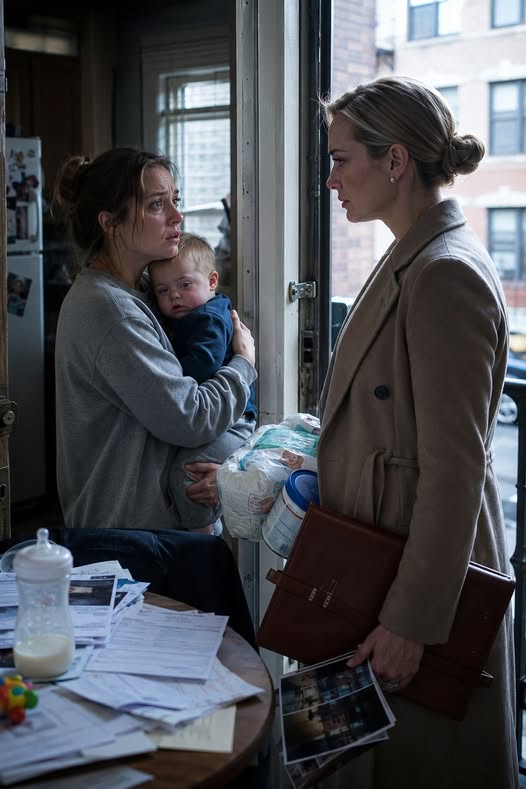
But because only one woman in New York City would show up at my door wearing sunglasses in January, holding three bags of baby supplies in one hand and a leather folder in the other, looking like she had spent the entire night crying without letting herself fall apart.
Her name was Rebecca Whitmore.
Daniel’s wife.
The wife he swore did not exist.
My son, Oliver, was asleep against my chest, his tiny mouth open, his soft breath warming the collar of my sweatshirt. His little fingers were curled around my necklace like he already knew I was the only safe thing he had.
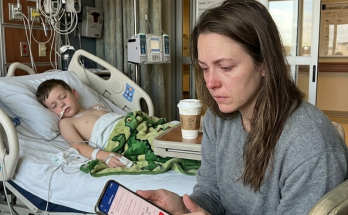
There were unpaid hospital bills on the kitchen table.
A bottle warming in a mug of water.
A stack of early-intervention paperwork I still had not filled out because every time I looked at it, I felt like I was drowning.
And now Daniel’s wife was standing outside my door.
I almost did not open it.
The night before, I had sent the message that could destroy my life.
Hi Rebecca. My name is Hannah Brooks. I have a three-month-old baby named Oliver. Your husband Daniel is his father. He told me he was separated and living alone. When I became pregnant, he disappeared. Oliver was born with Down syndrome, and I am completely alone. I do not want to hurt you, but I need help. I’m sorry.
Then I attached a photo of Oliver.
Then I turned off my phone and sat on the bathroom floor until the sun came up.
I expected her to call me a liar.
I expected lawyers.
Threats.
Maybe even police.
Instead, Rebecca stood in my hallway with red eyes and whispered, “Hannah?”
I could barely nod.
Her gaze dropped to Oliver.
For one terrifying second, I thought she would look at him with hatred.
Instead, her face broke.
“Oh my God,” she whispered. “He’s real.”
I felt my throat close.
“Yes.”
She swallowed hard and took off her sunglasses.
Her makeup was gone. Her eyes were swollen. But her voice was steady.
“I want to meet the baby who exposed my husband.”
That sentence nearly knocked the air out of me.
I stepped aside.
Rebecca walked into my tiny Queens apartment, her eyes moving across everything: the secondhand crib, the folded blankets, the formula cans, the tiny socks on the radiator, the medical bills, the life Daniel had left me to survive alone.
She set the bags on my kitchen table.
Diapers.
Formula.
Baby wipes.
Two soft blue onesies.
Then she looked at Oliver again.
“May I hold him?”
Every part of me screamed no.
This woman was not supposed to be gentle.
She was supposed to hate me.
She was supposed to hate him.
But her hands were shaking.
So I gave her my son.
Rebecca held Oliver like he was something precious she had almost lost without knowing he existed. He opened his almond-shaped eyes, blinked at her, and wrapped one tiny hand around her finger.
Rebecca covered her mouth.
“Hi, sweetheart,” she whispered. “Your father is a coward. But you are innocent.”
And that was when I broke.
I cried so hard I could not stand.
I cried for the six months Daniel called me beautiful. For every dinner in Manhattan where he said his divorce was almost final. For the weekends he claimed he spent helping his sick mother. For the night I showed him five positive pregnancy tests and watched his charming smile disappear.
“I need time, Hannah,” he had said.
Time meant silence.
Time meant blocked calls.
Time meant my belly growing while he turned into a ghost.
At twenty weeks, the doctor held my hand before telling me Oliver had Down syndrome.
At thirty-two weeks, they found the heart defect.
At birth, he was so small I was afraid to breathe too close to him.
And Daniel never came.
Rebecca sat on my couch, Oliver in her arms, and let me cry.
Not like an enemy.
Like someone who had been betrayed by the same man.
“I went through Daniel’s phone last night,” she said quietly.
I wiped my face. “I didn’t know he was married. I swear.”
“I believe you.”
That stunned me.
She looked down at Oliver.
“He lied to you the same way he lied to me.”
Then her face changed.
Pain became anger.
She nodded toward the leather folder.
“But Hannah, the affair is not the worst part.”
My stomach went cold.
“What do you mean?”
Rebecca opened the folder with one hand while holding Oliver close with the other.
Inside were papers.
A wire transfer receipt.
Twenty thousand dollars.
Recipient: Hannah Brooks.
But I had never received that money.
The next page was worse.
My address.
My doctor’s name.
My appointment dates.
Photos of me walking into the hospital.
Photos of me leaving a pharmacy with prenatal vitamins.
Photos of my apartment building.
My hands started shaking.
“Rebecca,” I whispered, “what is this?”
Her eyes filled with tears again.
“Hannah, Daniel didn’t disappear because he was confused.”
She placed one more document in front of me.
A contract.
Payment in exchange for silence.
No paternity claim.
No public statements.
No contact.
No disclosure of Oliver’s existence.
Rebecca’s voice broke.
“He was trying to erase your baby.”
PART 2
For a moment, I could not hear anything.
Not the traffic outside.
Not the radiator clicking.
Not even Oliver’s soft breathing in Rebecca’s arms.
Erase your baby.
The words did not feel human.
Daniel had been selfish. Daniel had been cruel. Daniel had been a coward.
But this was different.
This was planned.
This was typed, printed, organized, and hidden inside a leather folder like Oliver was not a child but a problem waiting for a signature.
I sat down because my legs stopped working.
“He told me he needed time,” I whispered.
Rebecca let out a bitter laugh.
“That’s what men like Daniel call strategy when they don’t want to admit it’s cruelty.”
She turned another page.
“There are payments here to someone named Grant Vale.”
I looked up.
“Who is that?”
“I don’t know yet. But the notes say things like ‘clinic confirmation,’ ‘residence watch,’ and ‘maternal status.’”
I pressed both hands over my mouth.
“He was having me followed?”
Rebecca’s jaw tightened.
“Yes.”
Oliver stirred, making a small sound.
She immediately rocked him.
That small movement hurt me more than any insult could have.
Because she was supposed to be the woman who destroyed me.
Instead, she was protecting my son from the same truth that was destroying both of us.
“I kicked Daniel out at six this morning,” she said.
I stared at her.
“You did what?”
“He cried. He begged. He called it a mistake.” Her voice turned cold. “Then he said, ‘Rebecca, you don’t understand what this could do to the company.’”
The company.
Sterling BioSystems.
Daniel’s family company.
The same company where I met him.
I had been working as a communications consultant for a Sterling product launch in Manhattan. Daniel Whitmore was the polished executive who remembered everyone’s name, wore custom suits, and spoke softly enough to make lies feel intimate.
He told me his marriage was over.
He told me he lived alone.
He told me he had never felt understood until me.
Now I knew I had not been loved.
I had been managed.
Rebecca called her cousin that afternoon.
His name was Michael Hart, a family law attorney in Brooklyn who looked at the folder and stopped tapping his pen after the third page.
“This is not just about child support,” he said.
Rebecca leaned forward. “Then what is it?”
“Surveillance. Possible intimidation. Attempted concealment of paternity. Potential corporate involvement if Sterling resources were used.”
My throat tightened.
Michael looked at me. “Hannah, did anyone else approach you during your pregnancy? Anyone strange?”
I opened my mouth to say no.
Then stopped.
Because there had been a woman at the hospital.
I had almost forgotten.
“She said she was from patient support,” I said slowly. “After Oliver’s diagnosis. She asked if I had family nearby. If I was overwhelmed. If I felt emotionally safe caring for a child with special needs.”
Rebecca’s face changed.
“What was her name?”
“I think… Natalie.”
The room went still.
Rebecca whispered, “Natalie Whitmore?”
My stomach dropped.
“Who is that?”
Rebecca looked at Michael.
Then back at me.
“Daniel’s sister.”
A coldness moved through my body.
Before anyone could say more, Daniel walked into the office.
He looked expensive and ruined at the same time.
Wrinkled charcoal suit.
Unshaven jaw.
Eyes full of panic.
He stopped when he saw Rebecca sitting beside me.
“Hannah,” he said.
Then his gaze fell on Oliver’s car seat beside my chair.
For the first time since I had known him, Daniel Whitmore looked afraid of a baby.
Michael pointed to the chair.
“Sit down.”
Daniel swallowed. “I think we should speak privately.”
Rebecca’s voice was ice.
“You lost the right to private the moment you put a newborn in a folder.”
The next hour was the autopsy of every lie he had ever told.
The messages.
The payments.
The fake transfer.
The surveillance photos.
The unsigned silence agreement.
At first, Daniel denied.
Then explained.
Then minimized.
Then said he was scared.
“I didn’t know what to do,” he whispered.
I looked at him.
“I didn’t know what to do when Oliver stopped breathing during a feeding at two in the morning. But I still did something.”
His eyes filled.
Rebecca leaned forward.
“Why was Natalie at the hospital?”
Daniel froze.
That was how we knew.
He knew.
“Daniel,” Rebecca said slowly, “what did your sister do?”
Before he answered, his phone rang.
He looked at the screen.
His face went pale.
Rebecca grabbed it before he could silence it.
She put it on speaker.
A woman’s voice came through.
Cold.
Controlled.
“Tell me you handled the girl before she ruins this family.”
Rebecca stared at Daniel.
Then said, “Hello, Natalie.”
There was a long silence.
Then Natalie Whitmore whispered:
“Oh, Rebecca. You have no idea what that child is going to cost us.”
PART 3
Nobody moved.
Oliver made a tiny sound in his car seat, completely unaware that grown adults were discussing him like a threat.
Rebecca held Daniel’s phone in her hand, her face pale but steady.
“What did you do at the hospital, Natalie?”
On speaker, Natalie laughed softly.
“You make it sound so dramatic.”
“I asked you a question.”
“I asked reasonable questions. Someone had to.”
“You are not Oliver’s mother.”
“No,” Natalie said. “But he carries Whitmore blood, whether any of us like it or not.”
My body went rigid.
Rebecca’s eyes darkened.
“That baby has a name.”
Natalie paused.
Then her voice dropped.
“Names do not change consequences.”
Michael leaned toward the phone.
“Natalie, this is Michael Hart. You are on speaker in a law office. Choose your next words carefully.”
The line went dead.
Daniel lowered his head into his hands.
Rebecca turned on him.
“Tell me everything.”
Daniel’s voice cracked. “Natalie has never been the same since Aaron died.”
Rebecca frowned. “Your brother?”
I looked between them.
Daniel had mentioned a younger brother once. Briefly. He said Aaron died when they were teenagers, but he never gave details.
“What does your dead brother have to do with my baby?” I asked.
Daniel looked at Oliver.
Something like shame moved across his face.
“The accident involved a boy with Down syndrome.”
The room went silent.
Rebecca whispered, “You told me Aaron died because of a drunk driver.”
Daniel did not answer.
Michael noticed.
“Daniel.”
Daniel swallowed.
“That was the story my father let people believe.”
Rebecca’s face drained of color.
“What does that mean?”
Daniel looked broken.
“I was seventeen.”
The room seemed to shrink.
“I had been drinking. Aaron got in the car with me. There was another vehicle. A boy named Lucas Bennett was nearby. He had a developmental disability. He was confused. Scared. My father’s lawyers twisted everything.”
My stomach turned.
“You blamed him.”
Daniel covered his face.
“I didn’t speak up.”
Rebecca stood slowly.
“You let a disabled boy carry the blame for killing your brother?”
Daniel’s silence answered.
I looked at Oliver.
My innocent baby.
Born into a family where disability had already been used as a weapon once before.
Daniel whispered, “Natalie hated Lucas. She believed he destroyed our family. When she heard Oliver had Down syndrome…”
He could not finish.
He did not have to.
Because suddenly every photo, every question, every cold document made terrible sense.
Natalie did not see Oliver as a baby.
She saw him as an old wound wearing a new face.
Michael filed legal paperwork the next morning.
Paternity.
Child support.
Protection.
Investigation into surveillance.
Rebecca came to my apartment that evening with groceries and a tired smile.
At first, I thought guilt brought her back.
Then she came again.
And again.
She learned how Oliver liked his bottle. She memorized his therapy schedule. She folded tiny onesies while I answered work emails. She sang to him while pacing my living room at midnight.
One night, I asked, “Why are you still here?”
Rebecca looked at Oliver sleeping between us on a blanket.
“Because Daniel made both of us feel replaceable,” she said. “And I refuse to let him teach that to this child.”
Three months passed.
Daniel paid support because the court made him.
Rebecca stayed because love made her.
Then one rainy Thursday night, someone knocked on my door.
Three sharp knocks.
Rebecca and I froze at the same time.
I looked through the peephole.
Daniel stood outside.
And beside him was a little girl in a yellow raincoat holding a stuffed rabbit.
Rebecca’s face went white.
“Lily,” she whispered.
Her daughter.
I opened the door halfway.
Daniel looked terrible.
His hair was messy. His expensive coat was wet. His eyes were red.
“Hannah,” he said. “Please. I just need five minutes.”
Rebecca stepped forward.
“You brought our daughter here without asking me?”
Daniel opened his mouth.
But the little girl spoke first.
“Are you my brother’s mommy?”
Everything stopped.
I looked at Rebecca.
Rebecca looked at Daniel.
Lily looked past us into the apartment, toward the sound of Oliver cooing on the play mat.
“Daddy said my baby brother lives here,” she whispered.
Rebecca closed her eyes like that sentence had wounded her.
Lily held up folded papers.
“I drew pictures for him.”
She walked inside carefully and knelt beside Oliver.
The drawings were covered in rainbows, stick figures, and hearts.
One said:
FOR MY BROTHER OLIVER.
I turned away before I cried.
Oliver reached for her stuffed rabbit.
Lily smiled.
“He likes Bunny.”
Then she said quietly, “Daddy cries about him in the garage.”
Daniel whispered, “Lily.”
But she kept talking.
“He looks at baby pictures on his phone. He told Grandma he made a terrible mistake.”
Rebecca stared at Daniel.
“What else did he say?”
Lily’s voice dropped.
“He said Aunt Natalie knows something nobody else knows.”
Daniel’s face lost all color.
Before anyone could speak, another knock hit the door.
This one was harder.
A man’s voice came from outside.
“Miss Hannah Brooks? My name is Thomas Keane. I need to speak with you about the photographs of your son.”
PART 4
Daniel looked like he had seen a ghost.
That terrified me more than the stranger outside.
Rebecca turned to him.
“You know that voice?”
Daniel did not answer.
That was answer enough.
The knock came again.
“Hannah Brooks?” the man called. “I’m not here to hurt you. But your son is in danger.”
Rebecca pulled Lily behind her.
I looked through the peephole.
A man in his fifties stood in the hallway wearing a dark coat, holding a folder under his arm. He looked calm, but not harmless. Calm like someone who had survived too many ugly rooms.
“Who are you?” I called.
“I used to work for Sterling Corporate Security.”
Daniel closed his eyes.
Rebecca’s voice turned sharp.
“Open the door.”
I opened it halfway.
The man raised both hands.
“My name is Thomas Keane. I was hired years ago by Sterling to manage internal risks. I left when I realized the risks were usually people they had hurt.”
He looked at Daniel.
“You should have told them.”
Daniel stared at the floor.
Thomas stepped inside.
My apartment suddenly felt too small for all the fear inside it.
He placed his folder on the table.
Inside were photographs.
Dozens of them.
Me leaving doctor appointments.
Me buying formula.
Me sitting in the hospital cafeteria while pregnant, crying into a paper napkin.
My apartment building.
My window.
Oliver in his swing.
My body went cold.
Rebecca covered her mouth.
“What the hell is this?”
Thomas’s face hardened.
“The investigator Daniel hired was not working alone.”
I turned on Daniel.
“You hired someone after everything?”
Daniel’s voice cracked. “I only wanted to know if you were going public.”
“You watched me while I was caring for your baby.”
“I panicked.”
“You keep using that word like it changes what you did.”
Thomas slid another page across the table.
A screenshot of a private gossip site draft.
STERLING EXECUTIVE’S SECRET DISABLED LOVE CHILD SCANDAL.
Under it was a blurry photo of me outside the hospital holding newborn Oliver.
I almost collapsed.
Rebecca grabbed my arm.
“No,” she whispered.
Thomas nodded grimly.
“The story hasn’t gone fully public yet. But photos are circulating in private media groups.”
Rebecca looked ready to kill someone.
“Who sold them?”
“Grant Vale,” Thomas said. “The man Daniel paid.”
Daniel whispered, “I didn’t know he would sell anything.”
Rebecca laughed bitterly.
“You paid a snake and acted shocked when it bit someone.”
Thomas pulled one more photo from the folder.
This one showed a woman in a black coat standing outside my apartment building.
Watching my windows.
I recognized her from Daniel’s family photos.
Natalie Whitmore.
Lily whispered, “Aunt Natalie?”
Rebecca immediately knelt beside her.
“Sweetheart, stay with me.”
I stared at the photo.
“She was here?”
Thomas nodded.
“Three nights ago.”
Daniel looked sick.
Rebecca turned to him.
“What did Natalie do at the hospital?”
Daniel whispered, “Rebecca…”
“No more.”
His shoulders dropped.
“She tried to convince staff Hannah was unstable.”
The room went silent.
My ears started ringing.
“What?”
Daniel’s voice was barely audible.
“She said you were overwhelmed. Alone. Financially strained. She thought if child services questioned your ability to care for Oliver, Sterling could control the situation.”
For a second, I could not breathe.
“She tried to take my baby.”
Daniel looked at me with tears in his eyes.
“I stopped it.”
“No,” Thomas said quietly. “You didn’t.”
Everyone turned.
Thomas’s expression was grim.
“A nurse stopped it.”
The next morning, we went to St. Anne’s Medical Center in Brooklyn.
The same hospital where Oliver was born.
The same hallways where I had held him after the diagnosis, terrified and alone.
The same place where strangers had apparently discussed whether I deserved to keep my own child.
At the front desk, an older nurse froze when she saw Oliver.
Her eyes filled instantly.
“Hannah?”
I remembered her.
Marjorie.
The nurse who had adjusted Oliver’s blanket at 3:00 a.m. when I was too scared to sleep.
She looked at Oliver and whispered, “He’s beautiful.”
Then she looked at me.
“I’m so sorry.”
My stomach twisted.
“For what?”
Marjorie led us into a quiet corridor.
“The night Natalie came,” she said, “she wasn’t alone.”
Rebecca stepped closer.
“Who was with her?”
“A doctor named Howard Ellis.”
Thomas muttered, “Of course.”
I looked at him.
“You know him?”
“He consults for wealthy families when medical situations become legal problems.”
My blood went cold.
Marjorie’s voice trembled.
“They wanted a psychological concern added to your file. Something that could justify a temporary review.”
Rebecca looked horrified.
“They were building a case against her while she was still recovering from birth?”
Marjorie started crying.
“I refused. Hannah was exhausted. Scared. But she loved that baby. Anyone with eyes could see it.”
I held Oliver tighter.
Marjorie looked at him.
“Dr. Ellis examined him. Oliver had been crying, but he calmed the second Hannah held him. And when Natalie kept pushing, Dr. Ellis finally told her something I never forgot.”
My voice shook.
“What?”
Marjorie wiped her tears.
“He said, ‘This child doesn’t need protection from his mother. He needs protection from people who see his diagnosis as a disaster instead of his life.’”
I broke silently.
Rebecca put her arm around me.
Then a cold voice came from the end of the hallway.
“Well. That was touching.”
We turned.
Natalie Whitmore stood there in a black coat, perfect makeup, and a calm smile.
In her hand was Oliver’s medical file.
PART 5
The hallway froze.
Natalie held my son’s medical file like it belonged to her.
Like he belonged to her.
Thomas stepped forward.
“How did you get that?”
Natalie smiled.
“You would be surprised what people hand over when they believe they are helping a concerned family member.”
Marjorie went pale.
“That file is confidential.”
“So are affairs,” Natalie said. “Yet here we all are.”
Rebecca moved in front of me.
“Give me the file.”
Natalie’s eyes shifted to Oliver.
He was awake now, blinking sleepily against my shoulder.
“That baby destroyed my family before he even opened his eyes.”
The silence afterward felt deadly.
Rebecca’s voice was low.
“Say that again.”
Natalie tilted her head.
“You still don’t understand, do you? Children like him change everything. Families become prisoners. Mothers become martyrs. Fathers disappear. Everyone pretends it’s beautiful because they are too guilty to say the truth.”
Before I could move—
SLAP.
The sound echoed through the hallway.
Natalie stumbled sideways, stunned.
Rebecca’s hand trembled in the air.
“You do not speak about him like he is a disease.”
Natalie touched her cheek.
“He is not yours.”
Rebecca’s voice broke.
“Yes, he is.”
Everyone went still.
Even Natalie.
Rebecca looked at Oliver, then back at her sister-in-law.
“Not by blood. Not by law. But by choice. And choice has done more for him than Daniel ever did.”
Natalie laughed bitterly.
“You’re defending your husband’s mistress and her disabled baby.”
“No,” Rebecca said. “I’m defending a mother and a child your brother tried to destroy.”
Lily stepped out from behind Rebecca, clutching Bunny to her chest.
“Mommy,” she whispered.
Rebecca immediately softened. “Stay back, sweetheart.”
But Lily looked at Natalie.
“Aunt Natalie?”
Natalie’s face softened slightly.
“What?”
Lily’s voice trembled.
“If Uncle Aaron was still alive… would he want you to hate babies?”
Natalie froze.
The entire hallway went silent.
Her face changed for half a second.
Pain cracked through the cruelty.
Then footsteps echoed behind us.
Daniel appeared at the end of the hall, breathing hard.
Two police officers stood behind him.
Natalie’s eyes narrowed.
“You called the police on your own sister?”
Daniel looked at the medical file in her hand.
“You crossed the line.”
Natalie laughed.
“No, Daniel. You crossed the line years ago. I just spent my life paying for it.”
Rebecca turned slowly.
“What does that mean?”
Daniel went pale.
“Natalie.”
But Natalie was already unraveling.
“No,” she said. “I’m done carrying the grief while you carry the secret.”
The officers exchanged a look.
Natalie pointed at Daniel.
“You told everyone Aaron died because of Lucas Bennett.”
Daniel closed his eyes.
“But that was a lie.”
Rebecca whispered, “What lie?”
Natalie’s voice cracked open.
“Daniel was driving.”
The hallway went dead silent.
I felt my heartbeat stop.
Natalie’s tears started falling.
“He was drunk. Aaron was in the passenger seat. Daniel crashed the car. Lucas Bennett was only nearby, confused and hurt, but Father’s lawyers blamed him because he had Down syndrome and couldn’t defend himself the way Daniel could.”
Rebecca covered her mouth.
Lily whispered, “Daddy?”
Daniel looked like he had been punched.
“I was seventeen,” he said.
Natalie screamed, “You were old enough to tell the truth!”
The officers went still.
Thomas looked horrified.
I looked down at Oliver.
My son.
My innocent baby.
Born into a family that had once used a person like him as a shield for their own crime.
Daniel’s voice broke.
“I didn’t know how to stop it.”
Natalie laughed through tears.
“You never know how to stop anything. You just let other people bleed.”
Rebecca stared at him like she no longer knew the man she had married.
“You let me believe your brother was killed by someone else.”
Daniel could not look at her.
Natalie turned toward Oliver.
For the first time, her eyes did not look hateful.
They looked broken.
“He looks like Aaron,” she whispered.
Oliver reached one tiny hand outward, toward nothing in particular.
Natalie stared at it like it was a ghost.
Then hospital security came rushing down the corridor.
Behind them was a hospital administrator holding a tablet.
“Miss Brooks,” he said, breathless, “we have a serious problem.”
My stomach dropped.
“What now?”
He looked at Oliver’s file in Natalie’s hand.
Then at me.
“Your son’s medical records were accessed and copied externally three months ago.”
Rebecca went white.
Thomas cursed under his breath.
Daniel whispered, “Grant.”
The administrator swallowed.
“There is media outside.”
I held Oliver tighter.
“How many?”
“At least eight reporters.”
Then his voice lowered.
“They are asking for the baby.”
PART 6
I thought I already knew what fear felt like.
I was wrong.
Fear was not the doctor saying your baby had Down syndrome while the father ignored your calls.
Fear was not staring at hospital bills you could not pay.
Fear was not discovering the man you loved had a wife, children, and a life you had never been allowed to see.
Real fear was standing in a hospital hallway holding your infant son while strangers outside shouted for him like he was evidence, entertainment, scandal, headline.
They are asking for the baby.
Rebecca stepped in front of me immediately.
“No.”
Thomas looked toward the windows.
“We need to move her through a private exit.”
The administrator nodded quickly. “Security can escort you through pediatrics.”
Daniel looked destroyed.
Natalie was still holding the stolen file, but her face had changed. She no longer looked triumphant. She looked sick.
The administrator’s radio crackled.
Another guard’s voice came through.
“Two black SUVs just arrived near the west entrance.”
Thomas went rigid.
Rebecca noticed.
“What?”
Thomas looked at Daniel.
“Sterling damage control?”
Daniel’s face lost all color.
“They’re not here for me anymore.”
My skin went cold.
“What does that mean?”
Daniel looked at Oliver.
Then at the floor.
“They’re here because Oliver’s story may expose something bigger than my affair.”
Rebecca’s voice sharpened.
“What are you talking about?”
Daniel rubbed both hands over his face.
“The research division.”
Thomas went very still.
“I knew it.”
Rebecca looked between them.
“Knew what?”
Daniel’s voice was barely above a whisper.
“Sterling BioSystems has been quietly settling internal complaints for years.”
“Complaints about what?” I asked.
“Chemical exposure. Lab safety failures. Employees with pregnancy complications. Developmental concerns in children.”
I felt the floor disappear beneath me.
“No.”
Daniel looked at me fast.
“Hannah, I am not saying Sterling caused Oliver’s Down syndrome. That’s not what I mean.”
“Then what are you saying?”
“I’m saying the company was terrified your pregnancy and Oliver’s diagnosis would make people look at things they had buried.”
Thomas nodded grimly.
“They didn’t see your son as a child. They saw him as a lawsuit trigger.”
My arms tightened around Oliver.
He yawned.
So small.
So human.
So far beyond the ugly words adults kept trying to wrap around him.
Rebecca turned to Daniel.
“You knew this?”
“I heard rumors.”
“You stayed.”
He had no answer.
Because silence was the answer.
A television in the waiting area suddenly switched to breaking news.
The screen showed a blurry stolen photo of me outside the hospital after Oliver’s birth, holding him against my chest, exhausted and crying.
Underneath it was the headline:
SECRET BABY OF STERLING EXECUTIVE BORN WITH DISABILITY.
My knees almost gave out.
Rebecca caught me.
“No,” she whispered.
People in the waiting area started turning.
Whispers spread.
Phones came out.
Oliver stirred as if he felt my panic.
Then a woman nearby said, “Poor baby.”
I hated it.
Poor baby.
Not because she meant harm.
Because Oliver was not poor.
Not pitiful.
Not tragic.
He was not a sad headline.
He was my son.
Natalie suddenly turned toward the staring people.
“Stop looking at him like he’s dying,” she snapped.
Everyone froze.
Even I stared at her.
Natalie’s eyes were wet.
“He is a baby. Not a scandal.”
Rebecca looked shocked.
Maybe Natalie was shocked too.
Because for the first time in years, she had defended someone like Oliver instead of blaming him.
Thomas’s phone rang.
He answered, listened, and his expression changed.
“What?” Rebecca asked.
Thomas slowly lowered the phone.
“An internal Sterling email just leaked.”
Daniel whispered, “No.”
Thomas looked at me.
“It refers to Oliver as a ‘potential sympathy risk connected to executive paternity exposure.’”
Rebecca’s mouth opened in horror.
Natalie looked like she might be sick.
I felt something inside me snap.
Not break.
Snap into place.
I was done hiding.
Done apologizing.
Done letting powerful people decide whether my child was acceptable enough to be seen.
Rebecca saw it in my face.
“Hannah?”
I looked at her.
“They want scandal?”
My voice shook.
“Then let them hear the truth.”
Daniel stepped forward.
“Hannah, please don’t do this without understanding what Sterling can do.”
Rebecca turned on him.
“No. What Sterling can do is exactly why she has to do it.”
The administrator looked nervous.
“We have a conference room.”
Thomas frowned.
“Public statement?”
Rebecca looked at me.
“If we stay silent, they write Oliver’s story for him.”
I was terrified.
But Lily, standing beside her mother, looked up and whispered, “If people meet Oliver, won’t they love him?”
The hallway went silent.
Rebecca knelt and kissed her daughter’s forehead.
“I hope so, sweetheart.”
Then she stood and took my hand.
“No more hiding.”
Thirty minutes later, I sat in a hospital conference room with Oliver in my arms.
Reporters crowded the doorway.
Cameras lifted.
Microphones pointed toward my son.
My voice shook when I began.
“My name is Hannah Brooks. This is my son, Oliver. He is not a secret. He is not a shame. He is not corporate damage control. He is a baby.”
The room went still.
“I was lied to by Daniel Whitmore. I was abandoned during pregnancy. I was watched, photographed, and pressured into silence. My son’s private medical information was accessed without consent.”
Rebecca stepped beside me.
“I am Rebecca Whitmore,” she said. “Daniel is my husband, though not for long. Hannah did not destroy my family. Daniel’s lies did. Sterling’s fear did. And every person who treated this child like a problem did.”
Then Natalie stepped forward.
No one expected it.
Not even Daniel.
“My name is Natalie Whitmore,” she said, trembling. “For twenty years, I blamed the wrong person for my brother’s death.”
Daniel whispered, “Natalie…”
She kept going.
“My family allowed a vulnerable young man with Down syndrome to carry blame that belonged to Daniel Whitmore. I let that hatred poison me. And when Oliver was born, I aimed that poison at him.”
Cameras flashed wildly.
Natalie turned toward Oliver.
“I was wrong.”
She looked back at the reporters.
“And Sterling BioSystems has been burying more than one family’s secret.”
The room exploded.
PART 7
By nightfall, Oliver’s name was everywhere.
Not just on gossip sites.
On national news.
On social media.
On every phone screen in the hospital waiting room.
At first, I was horrified.
Then the story began to change.
People were angry.
Not at me.
Not at Oliver.
At Sterling.
At Daniel.
At the hospital breach.
At the stolen photos.
At the idea that a baby with Down syndrome could be discussed in corporate emails as a “sympathy risk.”
Comments flooded in.
A child is not a legal threat.
Down syndrome is not shameful.
Protect Oliver.
This mother deserved support, not surveillance.
Then Lily became part of the story.
Someone had filmed her outside the conference room standing in front of Oliver’s stroller with her stuffed rabbit in one hand and her other arm stretched out like she could stop the cameras by herself.
The clip went viral.
Little girl protects baby brother from reporters.
Rebecca cried when she saw it.
Lily looked confused.
“Why are people talking about me?”
Rebecca hugged her tightly.
“Because you were brave.”
Lily frowned.
“I was just standing in front of my brother.”
That made me cry harder than the video.
Because children understand love before adults make it complicated.
Then Thomas received another call.
His face drained.
“What now?” Rebecca asked.
He looked at Daniel.
“Federal investigators are entering Sterling headquarters.”
Daniel sat down slowly.
The television switched again.
Breaking news.
Sterling BioSystems stock was dropping in real time.
Former employees were coming forward.
A woman named Karen Lowell appeared on screen holding a little girl around four years old.
“My husband worked in Sterling’s research division,” she said, crying. “When our daughter was born with medical complications, they offered us money if we signed confidentiality papers.”
The room went silent.
The reporter asked, “Why speak now?”
Karen looked into the camera.
“Because I saw baby Oliver today, and I realized no child should grow up believing they were something a company had to hide.”
I broke completely.
Not from fear this time.
From recognition.
We were not alone.
Other mothers.
Other children.
Other families.
Other secrets buried under money.
Daniel looked like he might collapse.
“You knew,” Rebecca whispered.
“I heard rumors.”
“You knew enough to be afraid.”
He closed his eyes.
“Yes.”
Natalie stared at him with disgust.
“And once again, you chose silence.”
Daniel started crying.
“I never wanted Oliver to become part of this.”
I looked directly at him.
“You made him part of it the second you chose fear over love.”
Oliver stirred in my arms.
Then, as if the universe needed to remind everyone who the real center of the room was, Lily shook Bunny gently in front of him.
Oliver blinked.
His little mouth opened.
And he laughed.
For the first time in his life, my son laughed.
Tiny.
Bright.
Unexpected.
The sound moved through the room like sunlight cracking through a sealed basement.
Rebecca covered her mouth and sobbed.
Lily gasped.
“He likes Bunny!”
She shook it again.
Oliver laughed louder.
Even Natalie cried.
Daniel stared at his son like he was watching a miracle he had chosen to miss.
“I missed this,” he whispered.
Nobody comforted him.
Because he had.
He missed the pregnancy.
The diagnosis.
The birth.
The first smile.
The nights.
The terror.
The love.
And now, by pure mercy, he had witnessed the first laugh.
Rebecca’s eyes were wet, but her voice was steady when she looked at him.
“Do not make his joy about your regret.”
Daniel nodded, broken.
Then my phone rang.
Unknown number.
Washington, D.C.
Thomas looked at it.
“Answer.”
I put it on speaker.
A calm woman’s voice said, “Miss Brooks, my name is Vanessa Cole. I am a federal investigator with the Department of Health and Human Services. We need to speak with you regarding Sterling BioSystems.”
My heart pounded.
“What do you need?”
A pause.
Then she said:
“Your son may not be the only child connected to this case.”
The room went dead silent.
Rebecca sat down.
Natalie covered her mouth.
Daniel whispered, “Oh my God.”
Investigator Cole continued.
“We are not making medical conclusions at this time. But several families connected to Sterling employees reported pregnancy complications, developmental diagnoses, and undisclosed settlement offers. We believe the company may have suppressed exposure reports and used intimidation to prevent public claims.”
I looked at Oliver.
He had stopped laughing and was now chewing happily on his blanket.
A baby.
Just a baby.
And somehow his existence had cracked open an empire.
Then the hospital television showed another breaking update.
A silver-haired man stepped in front of reporters outside Sterling headquarters.
Charles Whitmore.
Daniel’s father.
Sterling’s founder.
Natalie stiffened.
Daniel went pale.
A reporter shouted, “Mr. Whitmore, did your company monitor a pregnant woman connected to your son?”
Charles adjusted his tie.
“My family is experiencing a painful private matter that certain opportunistic individuals are exploiting.”
Rebecca laughed once.
Cold.
But then Charles looked directly into the camera.
“My grandson deserves dignity.”
Grandson.
The word hit the room like a weapon.
Natalie whispered, “Now he claims him.”
I held Oliver tighter.
Recognition from a man like Charles Whitmore was not love.
It was strategy.
PART 8
The next morning, the world wanted Oliver’s story.
I wanted him to sleep.
That was the strange thing about becoming news.
Everyone else thinks your life has turned into a movie.
But babies still need bottles.
Diapers still leak.
Appointments still happen.
Mothers still sit in hospital rooms with one hand on a tiny chest to make sure it rises and falls.
Rebecca stayed with us.
She had not gone home to Daniel.
Lily slept curled on a chair beside her, Bunny tucked under her chin.
Natalie sat near the window, silent, destroyed by the truth she had spent twenty years avoiding.
Daniel stood outside the room because I had told him he could not come in unless I invited him.
He did not argue.
For once.
At 10:00 a.m., Investigator Vanessa Cole arrived.
She was calm, professional, and kind in a way that made me want to cry.
She asked about Daniel.
The payments.
The surveillance.
The hospital.
The contract.
The stolen records.
She took notes when Rebecca explained the folder.
She listened carefully when Natalie admitted what her family had done to Lucas Bennett years earlier.
Then she asked the question that changed everything.
“Has anyone from Sterling ever offered you money directly?”
Everyone looked at the folder.
“Yes,” I said.
“Did the offer require silence?”
“Yes.”
She nodded.
“That matters.”
Daniel was brought in later.
He looked like a man whose old life had died but whose body had not caught up yet.
Investigator Cole asked, “Did Sterling legal know about Hannah Brooks before Oliver was born?”
Daniel swallowed.
“Yes.”
“Did they know she was pregnant?”
“Yes.”
“Did they discuss risk connected to the diagnosis?”
He closed his eyes.
“Yes.”
Rebecca looked away.
Natalie started crying again.
Daniel whispered, “I told myself I was protecting everyone.”
Investigator Cole did not look impressed.
“People often say that after protecting themselves.”
That sentence sat in the room like a verdict.
By afternoon, more families appeared on television.
One father held up a confidentiality agreement.
One mother described being pressured not to mention her pregnancy complications publicly.
A former Sterling lab manager said safety reports had been altered.
Thomas worked with Rebecca and Michael to preserve everything.
The folder.
The messages.
The photos.
The contract.
The stolen file logs.
By evening, Sterling’s board announced Charles Whitmore had stepped down pending investigation.
Daniel watched the news silently.
Natalie whispered, “He finally fell.”
Rebecca answered, “No. He was finally seen.”
A week later, another call came.
This time, it was not from an investigator.
It was from a woman named Diane Bennett.
Her brother was Lucas Bennett.
The young man Daniel’s family had blamed after Aaron’s death.
Diane’s voice trembled.
“My brother saw Oliver on the news,” she said. “He wants to meet him.”
I almost could not speak.
“Why?”
Her answer made my knees weak.
“Because he said your baby deserves the kindness he never received.”
We drove upstate two days later.
Rebecca came with me.
Lily insisted on coming.
Natalie sat in the back seat and cried most of the way.
Daniel followed in another car.
Not because I wanted him there.
Because Lucas Bennett deserved to face the man who had let him carry a lie.
The care facility sat between bare trees and gray winter sky.
Lucas came out slowly with Diane beside him.
He was in his thirties now, gentle-faced, nervous, wearing a blue sweater and holding a small photo album.
Natalie got out of the car and almost collapsed.
“I’m sorry,” she sobbed. “I hated you for something you didn’t do.”
Lucas looked at her for a long time.
Then said softly, “I know.”
“How can you say that?”
He looked at Oliver in my arms.
“Because sometimes people hurt the wrong person when they are sad.”
Natalie cried harder.
Daniel stood behind us, pale and silent.
Lucas turned to him.
“You were driving.”
Daniel’s face crumpled.
“Yes.”
“And you let me be blamed.”
“Yes.”
Lucas nodded slowly.
“That hurt me.”
Daniel started crying.
“I know.”
Lucas looked at Oliver.
Then back at Daniel.
“Don’t hurt him like that.”
Daniel whispered, “I won’t.”
I wanted to believe him.
But belief would take years.
Lily handed Lucas a drawing.
It showed all of us standing under a big yellow sun.
Me.
Oliver.
Rebecca.
Lily.
Natalie.
Lucas.
Daniel stood off to the side.
At the top, Lily had written:
OLIVER’S FAMILY.
I cried because children make room for truth faster than adults do.
Lucas looked at the picture and smiled.
“He has a big family.”
I looked at Oliver.
He smiled back at Lucas.
“Yes,” I whispered. “He does.”
PART 9
One year later, Sterling BioSystems no longer looked untouchable.
Federal investigations led to charges against several executives.
Confidential settlements were reopened.
Families came forward.
Employees testified.
Hospitals reviewed access procedures.
Charles Whitmore disappeared behind lawyers, statements, and silence.
Daniel lost his position.
Rebecca divorced him.
She did not celebrate it.
She simply walked out of the courthouse in a cream coat, took one deep breath, and said, “I can finally stop living inside a house built from lies.”
Then she came to my apartment with cupcakes for Lily and a stuffed elephant for Oliver.
Natalie entered therapy.
Real therapy.
Not the kind rich people use to sound healed at charity dinners.
The kind that makes you sit inside the ugliest room of yourself and stop blaming children for what adults destroyed.
She began volunteering with advocacy groups for families of children with disabilities. Not because it erased what she had done. It did not. But because guilt without change is just another performance.
Lucas Bennett became part of our lives slowly.
At first, he visited once a month.
Then more often.
Oliver loved him immediately.
Whenever Lucas walked in, Oliver reached for him with both hands.
Natalie always cried when that happened.
Maybe because forgiveness was not being handed to her.
But something gentler was being born around her anyway.
And Daniel?
Daniel did not get redemption wrapped in music.
He got consequences.
Court-ordered support.
Supervised visits.
Parenting classes.
Therapy.
Legal testimony.
Years of looking at a child who did not know how badly he had once been unwanted.
At first, Oliver stared at Daniel like he was a stranger.
Because he was.
Daniel did not complain.
He learned how to warm bottles.
How to clean feeding tubes.
How to sit through therapy sessions without making himself the tragedy.
How to show up when it was boring.
How to show up when no one praised him.
How to show up when Oliver cried and reached for me instead.
One afternoon, when Oliver was almost two, Daniel sat on the floor holding a soft blue ball.
Oliver crawled toward him.
Daniel froze.
“Don’t scare him,” Rebecca warned.
“I’m not moving,” Daniel whispered.
Oliver grabbed the ball, threw it sideways, and laughed.
Daniel laughed too.
Then he cried.
Oliver looked confused and patted Daniel’s knee.
“Da,” Oliver said.
Not Dad.
Not yet.
Just a sound.
But Daniel broke like it was a cathedral bell.
I did not comfort him.
Some grief belongs to the person who earned it.
Years passed.
Oliver grew into a joyful little boy with bright eyes, stubborn hands, and a laugh that could disarm the hardest room.
He needed therapies.
Patience.
Advocacy.
Heart follow-ups.
Some days were hard.
Some days I cried in the laundry room after he fell asleep because I was tired down to my bones.
But Oliver was never a tragedy.
Never.
At five, he walked into kindergarten with a backpack covered in dinosaurs.
Lily, older now and still fiercely protective, knelt beside him at the classroom door.
“What do we say?” she asked.
Oliver grinned.
“No hiding.”
“That’s right,” Lily said.
Then he marched inside.
Rebecca cried.
I cried.
Even Daniel wiped his eyes from several feet away.
At seven, Oliver stood on a small stage at a community event for children with disabilities. He was supposed to say one sentence into the microphone.
My name is Oliver.
Instead, he grabbed the microphone with both hands and said, “Hi, everybody!”
The room laughed and applauded.
Lucas Bennett cried in the front row.
Natalie cried beside him.
Rebecca squeezed my hand.
Daniel sat at the end of the row, silent and overwhelmed.
After the event, Oliver ran first to me.
Then Rebecca.
Then Lily.
Then Lucas.
Then Natalie.
Only after that did he turn to Daniel.
“Hi, Dad,” he said.
Daniel stopped breathing.
It was the first time Oliver had ever called him that clearly.
He knelt slowly.
“Hi, buddy.”
Oliver touched his face.
“You crying?”
Daniel nodded.
“Happy crying.”
Oliver frowned.
“Cake now?”
Everyone laughed.
And somehow, that was our ending.
Not perfect.
Not clean.
Not wrapped in easy forgiveness.
But honest.
The night I messaged Rebecca, I thought I was inviting destruction into my life.
I thought Daniel’s wife would hate me.
Expose me.
Punish me.
Maybe even enjoy watching me suffer.
Instead, she arrived with diapers, formula, and the truth.
She did not save me because I deserved it.
She helped because Oliver did.
Because some children arrive carrying more truth than adults are willing to face.
Oliver did not destroy a marriage.
Daniel’s lies did.
He did not ruin a family.
The Whitmores’ buried crimes did.
He did not bring down Sterling.
Sterling’s secrets did.
He was never the shame.
He was the light that made shame visible.
And every time I watch him laugh now, I think about the world that tried to label him before it knew him.
Disabled.
Secret.
Scandal.
Risk.
Evidence.
Burden.
But Oliver was never any of those things.
He was a baby.
Then a boy.
Then a life.
A beautiful, stubborn, bright life that forced every hidden lie around him into the open simply by existing.
And sometimes, the most shocking truth is not what people hide.
It is who finally gives them the courage to stop hiding.
THE END