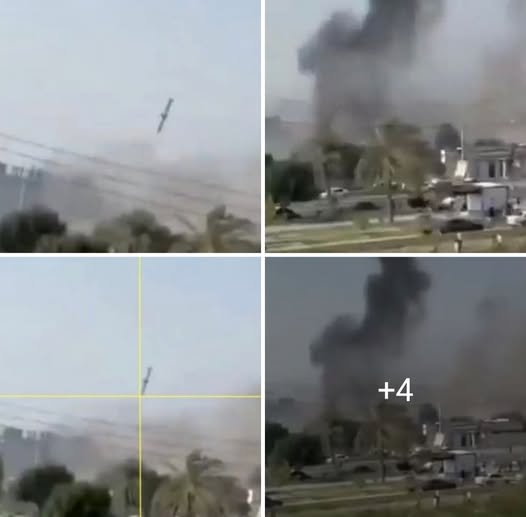
The morning in Minab began like any other—quiet streets, the steady rhythm of daily life, and the familiar sounds of students gathering at school. Inside a girls’ school in the southern Iranian city, classes were underway. Conversations filled the halls, notebooks opened, and lessons had just begun when everything changed in an instant.
A sudden, violent explosion shattered the calm.
The blast ripped through the air with a force strong enough to shake nearby buildings. Windows trembled, then shattered. The sound echoed across the neighborhood, sending shockwaves through homes and streets. Within seconds, confusion turned into panic. Students and teachers rushed for safety as debris scattered across the school grounds. Outside, residents poured into the streets, trying to understand what had just happened.
Smoke began rising from the area, dark and heavy against the sky. The school building had taken visible damage—parts of its structure compromised, glass strewn across the ground, fragments of material spread in all directions. The scene was chaotic, disorienting, and frightening.
Emergency responders arrived quickly. Sirens cut through the noise as firefighters, medical teams, and local authorities moved in. Injured individuals were located and transported to nearby hospitals. Among them were students who had been inside the school when the explosion occurred. The full extent of injuries was not immediately clear, but the urgency of the response reflected the seriousness of the situation.
As first responders worked to stabilize the scene, questions began to surface—fast, and with little clarity.
What caused the explosion?
In the immediate aftermath, information spread rapidly, especially online. Some early claims suggested that the blast might have been caused by a missile—specifically, a Raduga Kh-55, a long-range cruise missile originally developed during the Cold War. The idea gained traction quickly, fueled by speculation and the dramatic nature of the event.
But experts urged caution.
Identifying the cause of an explosion—especially one potentially involving military equipment—is not something that can be done in minutes or even hours. It requires careful, methodical investigation. Physical evidence must be collected, analyzed, and verified. Debris from the site needs to be examined for specific materials and structural signatures. Blast patterns must be studied to determine how the explosion occurred and where its origin point was. In some cases, radar data or satellite imagery may also be reviewed.
Until that process is complete, any claims about the exact cause remain speculative.
The Kh-55, frequently mentioned in early reports, is not a simple or obscure piece of equipment. It is a long-range, air-launched cruise missile designed for strategic military use. Known for its ability to fly at low altitudes to avoid detection and strike targets with precision, it has historically been associated with large-scale operations—not isolated incidents near civilian infrastructure. That alone raises questions about the likelihood of its involvement, reinforcing the need for verified evidence before drawing conclusions.
Meanwhile, the focus on the ground remained immediate and human.
For the people of Minab, this was not about military analysis or online speculation. It was about safety, fear, and uncertainty. Schools are meant to be places of stability—environments where children can learn without threat. When that sense of safety is broken, the impact runs deep.
Students who experienced the explosion firsthand were left shaken. Teachers had to manage both physical danger and emotional distress in real time. Families, hearing the news, rushed to find out if their children were safe. Even those not directly affected felt the weight of what had happened. An event like this doesn’t stay contained within the walls of a building—it spreads through a community.
Local authorities began assessing the damage to the school, determining whether it could continue operating safely or if alternative arrangements would be necessary. At the same time, medical teams focused on treating the injured, while support systems were expected to address the psychological toll left behind.
Beyond Minab, the incident quickly drew international attention.
Governments and organizations responded cautiously, emphasizing the importance of accurate information. Calls were made for a thorough and transparent investigation. No one credible rushed to assign blame or confirm early claims. Instead, the emphasis remained on evidence—on waiting for facts rather than amplifying assumptions.
Humanitarian groups also raised concerns, particularly regarding the involvement of a school. Educational institutions are considered protected spaces under international norms. Any incident affecting such a location—especially during active school hours—raises serious ethical and legal questions. The presence of students during the explosion intensified global concern and underscored the need for clarity.
At the same time, the situation highlighted a familiar problem: the speed at which misinformation can spread.
Within hours of the blast, social media was flooded with confident claims about what had happened. Specific weapons were named. Responsibility was implied. Narratives formed before facts were available. This pattern is common in high-impact events—where the demand for answers outpaces the ability to provide them.
But fast information is not always accurate information.
Experts consistently warn that early reports in breaking situations are often incomplete or wrong. Details evolve. Initial assumptions get corrected. What seems certain in the first hour can look entirely different after a full investigation. In this case, the gap between speculation and confirmed evidence remained significant.
Investigators now face the task of closing that gap.
Their work involves more than just identifying a cause. They must reconstruct the sequence of events—what happened, how it happened, and why. This includes documenting structural damage, collecting and analyzing debris, interviewing witnesses, and reviewing any available footage. It is a process that requires time, precision, and discipline.
Only after that process is complete can a reliable conclusion be reached.
In the broader context, the incident cannot be viewed in isolation. The region has long experienced political and military tensions, and events like this often exist within larger, more complex dynamics. Whether the explosion was accidental, deliberate, or connected to wider developments is something investigators will need to determine based on evidence—not assumption.
For now, what remains clear is the human impact.
An ordinary school day was disrupted by violence. Students were injured. A community was shaken. Questions remain unanswered.
And until those answers come, the priority stays where it should be—on the people affected, on uncovering the truth carefully, and on resisting the urge to replace facts with speculation.