The shadow of the American carceral system falls longest and most heavily upon its youngest inhabitants. Within the sprawling network of federal and state prisons, there exists a demographic that challenges the very moral foundations of modern jurisprudence: children. In the United States, at least 79 individuals who were under the age of 14 at the time of their offenses are currently serving life sentences without the possibility of parole. This stark reality—the condemnation of a child to die in prison—has ignited a firestorm of national and international outrage, positioning the U.S. as a global outlier in its treatment of juvenile offenders.
To understand the gravity of this issue, one must first confront the sheer finality of the sentence. “Life without parole” (LWOP) for a 13-year-old is not merely a long prison term; it is a definitive statement by the state that a child is beyond redemption before they have even reached the mid-point of adolescence. Human rights organizations, including Human Rights Watch and the Equal Justice Initiative, argue that these sentences represent a fundamental violation of international human rights standards. They contend that such harsh penalties ignore the biological and psychological realities of childhood, where the brain is still in a state of rapid development and the capacity for impulse control is famously erratic.
The backgrounds of these children are rarely a mystery. Statistical data reveals a staggering correlation between juvenile life sentences and environments defined by systemic failure. Most of these children come from “radioactive” settings—homes fractured by extreme poverty, neighborhoods ravaged by violence, and lives marked by physical or sexual abuse. When a 12-year-old commits a violent act, advocates argue, the court is often looking at the culmination of years of trauma that the state failed to intercept. In this context, sentencing a child to life without parole is seen by many as a second failure: the first being the failure to protect the child, and the second being the refusal to believe in their potential for change.
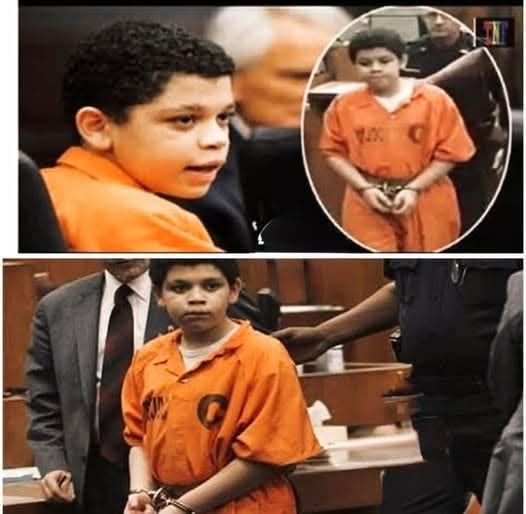
One of the most polarizing examples in American history is the case of Lionel Tate. In 1999, at the age of 12, Tate was responsible for the death of a six-year-old girl. Tate claimed they were “pro-wrestling” and that the death was a tragic accident during play. Despite his age and the lack of demonstrated premeditation, he was tried as an adult and became the youngest person in modern U.S. history to be sentenced to life in prison without parole. The image of a boy in a bulky orange jumpsuit, his feet barely touching the floor from the witness chair, became a symbol of a system that had lost its sense of proportion. Although Tate’s sentence was eventually overturned and reduced upon appeal, the case served as a catalyst for a national debate: at what age does a child stop being a child in the eyes of the law?
Neuroscience offers a compelling answer to that question. Brain imaging technology has consistently shown that the prefrontal cortex—the area of the brain responsible for complex decision-making, understanding consequences, and modulating social behavior—is not fully developed until a person reaches their mid-twenties. This means that a 13-year-old lacks the biological hardware required for the “maligned intent” that adult sentencing often assumes. Experts in adolescent psychology argue that because children are still “works in progress,” their characters are not yet fixed. Therefore, a crime committed at 12 is not an accurate predictor of who that person will be at 32 or 52.
The U.S. Supreme Court has begun to acknowledge these biological truths through a series of landmark rulings. In the 2012 case Miller v. Alabama, the Court ruled that mandatory life-without-parole sentences for juveniles are unconstitutional, citing the “diminished culpability and heightened capacity for change” that characterizes youth. This was followed by the 2016 ruling in Montgomery v. Louisiana, which made the Miller decision retroactive, offering a glimmer of hope to hundreds of “juvenile lifers” who had been locked away decades ago. However, the implementation of these rulings has been uneven. In many jurisdictions, the process of re-reviewing cases is bogged down by bureaucratic inertia, and some states have sought loopholes to maintain the status quo of “virtual” life sentences—terms so long they still guarantee the inmate will die behind bars.
The argument for a different path is rooted in the concept of restorative justice. Rather than a purely retributive model—which focuses solely on “an eye for an eye”—restorative justice looks at the harm caused and asks how it can be repaired, while also addressing the root causes of the offender’s behavior. For young offenders, this involves personalized rehabilitation programs that prioritize education, mental health support, and the development of empathy. The goal is accountability, not just punishment. By requiring a young person to confront the pain they have caused while providing them the tools to grow, the system can produce a rehabilitated citizen rather than a lifelong ward of the state.
Critics of these reforms often point to the severity of the crimes, arguing that some acts are so heinous that the age of the perpetrator should be irrelevant. They speak of the victims’ families, for whom “life without parole” represents the only form of closure. This tension between the need for public safety and the mandate for human rights is the fault line of the American justice system. Yet, advocates suggest that safety and mercy are not mutually exclusive. A system that allows for the possibility of parole after 20 or 25 years does not guarantee a release; it merely guarantees a review. It allows the state to ask: “Is this 40-year-old man still the dangerous 13-year-old boy he once was?”
As the world moves toward a more nuanced understanding of human development, the continued existence of 79 children-turned-lifers serves as a poignant reminder of work left unfinished. The stories of these individuals are often forgotten once the prison gates swing shut, but their presence remains a challenge to the American promise of “liberty and justice for all.” The shift toward rehabilitation and away from permanent disposal is not just a matter of legal policy; it is a matter of defining the kind of society we wish to be. It is a choice between a future defined by a person’s worst mistake and a future defined by their capacity to heal.
In the end, the movement to end juvenile life without parole is a movement for the recognition of human potential. It is a call to move away from the “superpredator” myths of the 1990s and toward a science-based, empathetic approach to justice. For those 79 individuals, and the many more who were sentenced as older teens, the road to redemption is long and paved with significant obstacles. But as long as the legal system allows for the possibility of change, there remains a path forward—a path that acknowledges that while a child may have committed an adult crime, they are still a child who deserves the chance to one day walk back into the world they left behind.