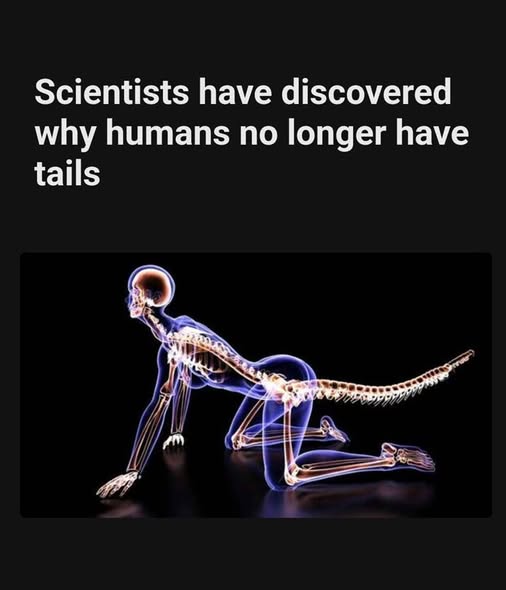
Why Humans Don’t Have Tails …And Why Losing Them May Have Helped Us Evolve
Humans don’t have tails. Neither do chimpanzees, gorillas, or orangutans.
But if you trace our evolutionary family tree far enough back, many of our ancient mammalian ancestors definitely did.
For decades, scientists have wondered: When did humans lose their tails — and why? Recent research combining genetics, fossil evidence, and anatomy is finally giving us clearer answers.
And surprisingly, losing our tails may have been a major advantage.
Tails: More Useful Than You Think
In much of the animal kingdom, tails serve important purposes.
Monkeys use them for balance and gripping branches.
Cats rely on them for sharp turns and coordination.
Kangaroos use them as stabilizing supports.
Many mammals use tails for communication and signaling.
Because tails are so widespread among mammals, early primates almost certainly had them too. The real mystery isn’t whether our ancestors had tails — it’s why humans and other great apes lost them while many monkeys kept theirs.
When Did the Tail Disappear?
Evidence suggests that tail loss began 20–25 million years ago, long before Homo sapiens appeared.
During this period, early apes were evolving in ways that made tails less necessary. These ancestors were adapting to a mix of tree-based (arboreal) and ground-based (terrestrial) environments.
As their bodies changed, so did their movement patterns:
Shoulders became more flexible.
Hips evolved for different weight distribution.
Some species began experimenting with upright posture.
When balancing strategies changed, the evolutionary pressure to maintain a tail weakened. Over time, mutations that reduced tail structures were no longer harmful — and eventually became permanent in ape populations.
Evolution doesn’t plan ahead. If a feature is no longer strongly beneficial, it can gradually fade away.
The Genetic Clues Behind Tail Loss
Modern genetics has provided some of the strongest evidence for how tail loss occurred.
Scientists have identified changes in specific genes responsible for tail development in mammals. In humans and other tailless apes, these genes were altered or disrupted in ways that suppressed tail growth.
In simple terms: the genetic “instructions” for building a long tail were switched off or modified.
Interestingly, humans still carry a small reminder of our tailed past — the coccyx, or tailbone. This tiny cluster of fused vertebrae at the base of the spine no longer functions as a tail, but it does serve as an attachment point for muscles and ligaments in the pelvic region.
So while our tails disappeared externally, their evolutionary trace remains inside us.
Why Losing a Tail May Have Been an Advantage
At first glance, losing a tail might seem like a disadvantage. But evolution only preserves traits that improve survival or efficiency.
Researchers propose several possible benefits of tail loss:
- Support for Upright Movement
As early apes experimented with upright posture and eventually bipedal movement, a long tail may have become unnecessary or even restrictive. - Greater Spinal and Hip Flexibility
Without a tail, the spine and pelvis may have evolved more freely, supporting complex climbing behaviors and, later, efficient walking.
- Energy Efficiency
Growing and maintaining a tail requires energy. If the tail no longer provided a strong survival benefit, individuals without it may have had a slight energetic advantage.
Over millions of years, these small advantages can reshape entire species.
What Tail Loss Reveals About Human Evolution
The disappearance of the tail wasn’t a sudden event. It was a gradual transition shaped by shifting environments and new movement styles.
More importantly, it reminds us how evolution works:
It doesn’t move toward a perfect design.
It responds to environmental pressures.
It favors flexibility and survival over tradition.
Losing our tails wasn’t about becoming “more advanced.” It was about adapting to new ways of living.
A Small Change With Big Implications
The story of human tail loss might seem like a minor anatomical detail. But it represents a massive turning point in our evolutionary history.
From tree-dwelling primates to upright walkers, from balancing on branches to walking across open landscapes — every small anatomical change tells part of the story.
And sometimes, evolution moves forward not by adding something new…
…but by letting something go.