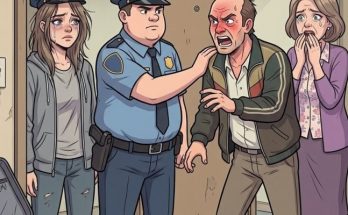
The tear of silk rang out across the grand hall of the Villareal mansion—sharp, unmistakable, and final. It wasn’t just fabric splitting. In that instant, it felt like my dignity had been ripped in front of everyone who mattered to them.
Cold air brushed my skin. I folded my arms over myself, trying to cover what my mother-in-law, Doña Bernarda, and my sister-in-law, Sofía, had deliberately revealed to a room packed with polished smiles and expensive perfume.
Bernarda lifted the shredded remains of my emerald dress like it proved something. “Look at her!” she announced, loud enough for every chandelier-lit corner to hear. “The thief. This is what desperate women do—hide valuables where no one should look.”
I couldn’t even process the accusation. I could only feel the heat of embarrassment rising to my face while the crowd’s whispers swelled into a cruel, buzzing chorus. Tears spilled before I could stop them.
- A dress torn apart for spectacle.
- An accusation thrown like a verdict.
- A room full of witnesses who chose entertainment over empathy.
My eyes searched for Roberto—my husband, the man who once promised I would be safe with him. I had left a quiet country life for him, believing love could soften the sharp edges of high society.
I found him near the fireplace, a glass of whiskey in his hand. He wasn’t looking at me. His gaze stayed fixed on the floor as if avoiding my eyes could erase what was happening.
“Roberto,” I begged, my voice cracking. “Please. Help me. I didn’t take anything. I’m being set up.”
Sofía answered instead. She barked for me to be quiet, and with a harsh shove that stole my balance, she knocked me down onto the ornate rug. My knees hit first, and the room seemed to tilt with my shock.
“We saw you,” she snapped. “You’re an embarrassment to this family.”
In that moment, I realized humiliation doesn’t just come from cruelty—it also comes from the silence of the person who should defend you.
Then Bernarda turned toward Roberto as if she were directing a performance. “Say something,” she demanded. “Tell her to get out.”
Roberto finally looked up. The warmth I once knew in his eyes was gone, replaced by a hollow distance that hurt more than any insult.
“Go, Elena,” he said, barely louder than the crackle of the fire. “Leave before we call the police.”
My stomach dropped. “You want me to leave… like this?” I whispered, glancing at myself, half-dressed and shaking.
Bernarda’s smile sharpened. “That’s how you came into the world,” she said sweetly, “and that’s how you’ll leave this house. With nothing—because that’s what you are.”
Two security guards stepped in as if they’d been waiting for their cue. They seized my arms and pulled me up, guiding—dragging—me through the marble hallway. I pleaded for a shawl, a blanket, anything to cover myself. No one moved. No one offered a hand. The party behind me continued as though I were just an inconvenience being removed.
- They didn’t just want me gone—they wanted me erased.
- They didn’t want truth—they wanted control.
- They didn’t want justice—they wanted a lesson.
Outside, the gravel driveway bit into my feet. The iron gate shut in front of me with a cold finality. Rain began to fall, fine at first, then heavier—soaking my hair, chilling my skin, making everything feel even more unreal.
There I was: Elena, the “country girl,” the daughter of a man they mocked as a dirty farmer—left outside like I didn’t belong anywhere at all.
I wrapped my arms around myself, trembling. Yet something cut deeper than the weather or the shame. Anger—clean, blazing, unmistakable—rose in my chest.
They thought my father was just a man who worked the land and came home with soil under his nails.
They assumed I had no safety net, no voice, no one powerful enough to make them face what they’d done.
They were wrong.
Some people mistake quietness for weakness—until the truth walks through the door.
My father, Don Augusto, had never been “just” a farmer. He owned more land than most people could imagine. He helped control food distribution across vast regions. He had resources and influence that didn’t need to be flaunted in fancy ballrooms to be real.
He kept his wealth out of sight for a reason: he wanted me to grow up grounded. He wanted me to learn humility, to value people over status, to build my character without money doing it for me.
But standing there in the rain, I understood something else, too: humility doesn’t mean accepting cruelty. And strength doesn’t always announce itself—until it must.
I pushed myself up and walked toward the guard booth near the gate. The guard looked at me with pity, his face tense as though he wanted to help but feared the consequences.
“Lend me your phone,” I said.
My voice didn’t shake this time. Not from cold. Not from fear.
He hesitated. “Ma’am… I can’t.”
I took a breath, steadying myself. Then I raised my voice—clear, firm, and commanding in a way I didn’t know I had.
“Give me the phone,” I said, each word deliberate. “Now.”
- I wasn’t asking for sympathy anymore.
- I wasn’t begging for protection anymore.
- I was taking back my power.
Because that night wasn’t going to end with me curled up outside a locked gate. It was going to end with the truth stepping into the light—and with the people who celebrated my humiliation finally understanding who they had underestimated.
Conclusion: Being publicly shamed nearly broke me, but it also uncovered something stronger than fear: certainty. Certainty that I deserved respect, certainty that silence was no longer an option, and certainty that the people who tried to crush me had made a mistake they could not undo.