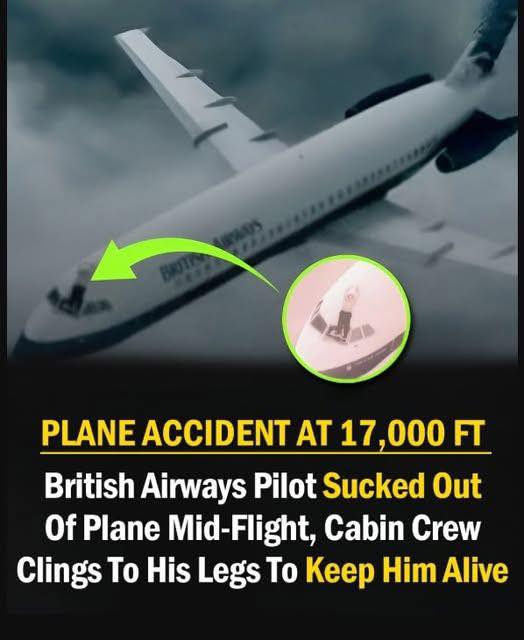
In 1990, a routine British Airways flight turned into one of the most shocking survival stories in aviation history. Captain Tim Lancaster was commanding a BAC 1-11 on a morning flight from Birmingham to Málaga when, at roughly 17,000 feet, the cockpit windshield suddenly failed. Without warning, the window blew outward, creating an explosive decompression that ripped Lancaster from his seat and violently forced him halfway out of the aircraft.
Only his legs remained inside the cockpit. The rest of his body was pinned against the fuselage, exposed to roaring wind, freezing temperatures, and dangerously low oxygen. His seat belt had snapped, and his body was wedged at an angle that made rescue both urgent and nearly impossible. Papers, charts, and loose objects blasted through the cockpit as the aircraft shook.
Flight attendant Nigel Ogden reacted instantly. Seeing Lancaster being pulled from the aircraft, Ogden grabbed the captain’s legs and held on with everything he had. The force was immense. The wind battered him, frost formed rapidly, and debris struck his body. Still, he refused to let go. For nearly twenty minutes, Ogden maintained his grip, even as his arms weakened and frostbite began to set in.
Meanwhile, co pilot Alastair Atchison took control of the aircraft. Despite the chaos in the cockpit, he managed to stabilize the plane, reduce speed to lessen the force of the wind, and initiate an emergency descent. His calm decision making under extreme pressure kept the aircraft controllable and prevented further structural damage.
Another flight attendant, Simon Rogers, entered the cockpit to assist. Seeing Ogden nearing exhaustion, Rogers helped support Lancaster’s legs, allowing Ogden to maintain his hold without collapsing. The crew worked in coordination, communicating over the deafening noise and focusing on one goal. Keep the captain inside the aircraft until they could land.
Passengers were aware that something was wrong, though few fully understood the horror unfolding just beyond the cockpit door. The aircraft diverted to Southampton, where emergency services waited on the runway. The BAC 1-11, built by the British Aircraft Corporation, remained structurally stable throughout the descent, a testament to its robust engineering despite the catastrophic windshield failure.
Against overwhelming odds, Lancaster survived. He suffered frostbite, shock, and multiple fractures, but he was alive. Doctors later noted that his survival was extraordinary, as exposure at that altitude and speed is almost always fatal. Investigation revealed that the windshield had been installed with incorrect bolts during maintenance, a small oversight with nearly deadly consequences.