We’d only been in Maine for three weeks when it happened.
My wife, Lily, our eight-year-old son, Ryan, and our Doberman, Brandy, were all still adjusting to the cold. After sixteen years in Texas, my bones should’ve hated it, but I loved it—the sting of crisp air in my lungs, the muffled crunch of pine needles under my boots, the way the whole town seemed to breathe in slow motion.
“This place smells like Christmas,” Lily whispered that first morning, standing barefoot at the back door in my flannel shirt, her hair still sleep-tangled.
Peace looked good on her. I remember thinking that. I remember praying this move would finally give it to her.
That Saturday, we decided to go on a mushroom hunt in the woods behind our rental cottage. Nothing fancy—just a few simple varieties Lily could sauté in butter and garlic while Ryan bragged about his foraging skills.
Brandy trotted ahead, barking at invisible enemies. Ryan rushed after him with a plastic bucket, whacking ferns like he was fighting dragons. The air was cold and clean. The sky was white with thin cloud.
It felt like one of those days you know will become a core memory before it even ends.
Right up until it twisted.
Brandy’s bark shifted—deeper, sharper, threaded with warning. That sound snapped every nerve in my body to attention.
I looked up.
Ryan was gone.
“Ryan?” My voice came out too loud, too fast. “Hey, buddy, answer me! This isn’t a game, okay?”
Brandy barked again somewhere ahead, then growled—a low, vibrating sound that made my stomach clench.
“Keep him safe, Bran. I’m coming,” I muttered, more prayer than command.
I pushed through the brush, careful of the roots that clawed out of the earth like fingers. The path thinned and twisted between tall pines, the light fading as the trees knitted together overhead. The air cooled, and a quiet settled in that didn’t feel peaceful anymore.
“Lily, come on!” I called over my shoulder.
“Coming!” Her voice sounded breathless and scared. “Travis, do you see him?”
“Ryan!” I shouted again, and this time, I heard him.
Not his voice—his laugh. High and bright. And Brandy’s bark was different now, happier, almost playful.
I picked up my pace and broke through the last screen of branches into a clearing I hadn’t known was there.
I stopped so fast Lily almost ran into me.
“Uh… guys?” I said, my voice shrinking. “You seeing this?”
Lily moved up beside me, her gaze sweeping the open space. Her eyebrows drew together.
“What is this place?” she whispered. “Travis… those are headstones, aren’t they?”
She was right. A handful of old gravestones sat scattered through the clearing, some crooked, some half-swallowed by moss. It was eerie, but in a strange way, it also felt… tended.
“And those are flowers,” Lily said. “Look—there are dried bouquets everywhere.”
She pointed to one grave where brittle stems lay in a neat bundle, still tied with faded ribbon.
“Someone’s been coming here,” I said slowly. “For a long time.”
Before she could answer, Ryan’s voice cut through the stillness.
“Daddy! Mommy! Come look!” He sounded thrilled, not scared. “I found something… I found a picture of Dad!”
My heart lurched.
He was kneeling in front of a small stone tucked between two elms, one hand on Brandy’s collar, the other pressed to the face of the headstone.
“What do you mean, my picture?” I asked, forcing my legs to move toward him. My chest had gone tight; my head felt oddly light, like I was standing up too fast from a deep sleep.
“It’s you, Daddy,” Ryan said, not even glancing back. “Baby you. Don’t we have a photo like this above the fireplace?”
I stepped beside him and looked down.
My breath left my body.
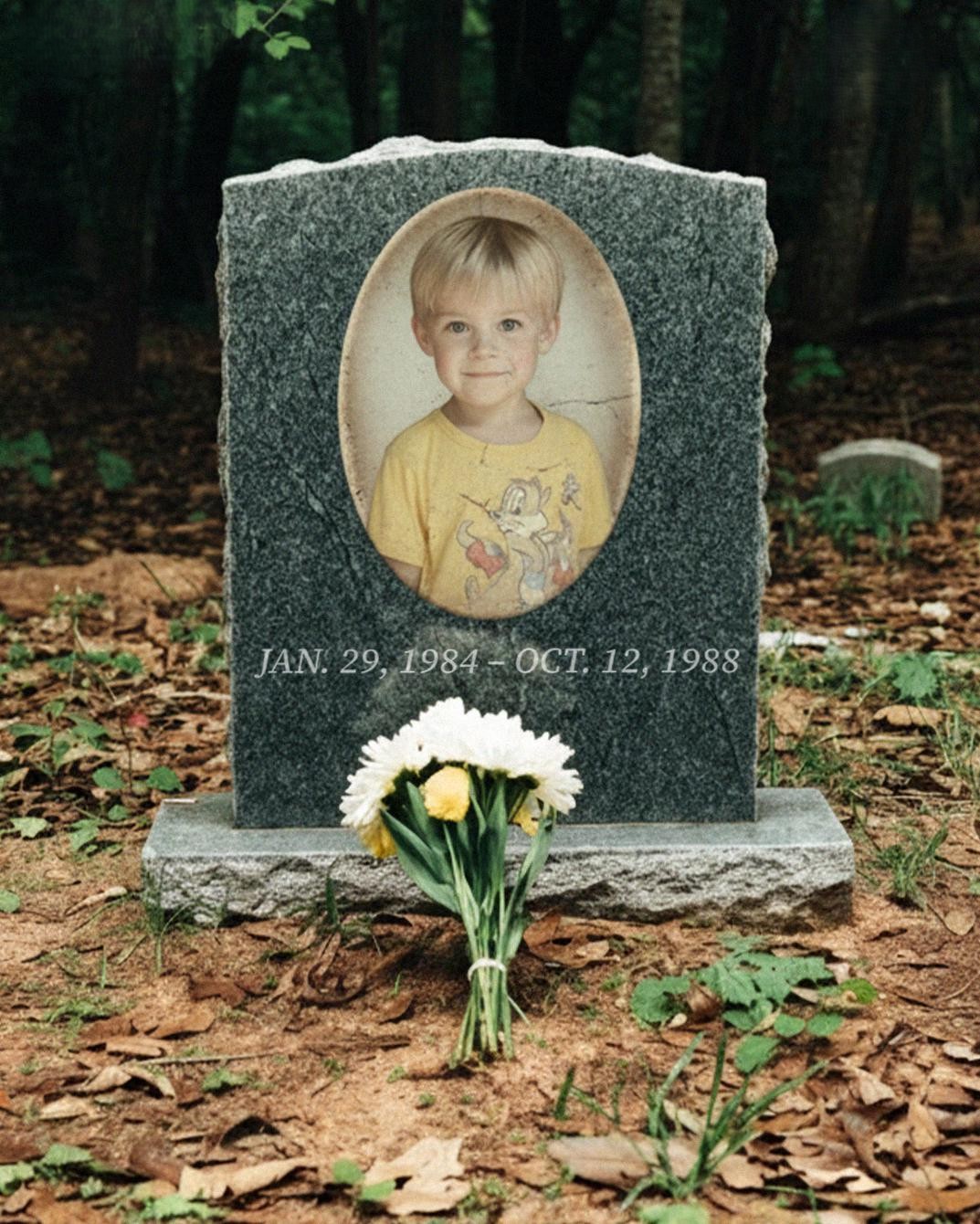
Set into the stone was a small ceramic photograph. It was chipped in one corner and dulled with age, but the image was still unmistakably clear.
It was me.
Four years old, maybe. Dark hair a little longer than Ryan’s. The same uneven eyebrows, the same wary, wide eyes. I was wearing a yellow shirt I only vaguely remembered from an old Polaroid back in Texas.
Beneath the photo, a date was carved into the stone.
January 29, 1984.
My birthday.
Not a birth date on a certificate. A birth date on a grave.
Lily’s hand closed around my arm. I hadn’t even heard her come up.
“Travis,” she said quietly, “please. This is too strange. I don’t know what this is, but I want to go home. Come on, Ryan.”
“No. Just… just a minute,” I said, my voice sounding far away in my own ears. “I just want to see.”
I knelt and touched the edge of the porcelain. It was cold. The world seemed to dim around the edges, and for a heartbeat, it wasn’t fear I felt—it was something like recognition, like my bones remembered something my mind didn’t.
That night, after Ryan finally crashed and the house went still, I sat at the kitchen table with my phone, staring at the photo I’d taken of the stone.
“What the hell is going on?” I whispered. “That’s me. There’s no way it isn’t. But I’ve never been here. I’d remember this. I’d have to.”
Lily sat opposite me, fingers wrapped around a mug she’d stopped drinking from twenty minutes ago.
“Is there any chance your adoptive mom ever mentioned Maine?” she asked.
I shook my head. “No. I asked her once, when I was a teenager. I wanted my story, you know? She said she didn’t know much. Just that a firefighter named Ed found me outside a burning house when I was four. I had a note pinned to my shirt. That was it.”
“What did the note say?” Lily asked, even though she already knew.
We’d talked about this before. It had always been sad, but now it felt sinister.
“‘Please take care of this boy. His name is Travis.’” I swallowed. “Mom probably still has it stuck in some old scrapbook.”
Lily reached across the table and squeezed my hand.
“Maybe someone here knows more,” she said. “About the fire, about your birth parents. Maybe… maybe we moved here for a reason, Trav.”
I nodded because I didn’t know what else to do. I’d always carried a vague sense of being unmoored, like there was a chapter missing at the beginning of my life. No memories of my birth parents. No clear images of any siblings. Just fog.
Now there was a headstone with my baby picture and my birthday, in the woods behind my house.
The next day, I went to the small town library. The woman at the front desk listened as I carefully left out the part about my face on a grave and just asked about the land behind our cottage.
She frowned. “There used to be a family living off-grid back there, long time ago,” she said. “Cabin burned down one winter. Spark from the fireplace caught the drapes. People don’t really talk about it anymore.”
“Does anyone around here remember them?” I asked.
She thought for a moment, then nodded. “Try Clara M. Oldest person in town. She sells apples in the market, has lived here forever. If anyone knows the story, it’s her.” She scribbled an address on a scrap of paper and slid it across the desk.
Clara’s house sat under the shade of towering pines. Lace curtains, peeling paint, a mailbox shaped like a school bus. When she opened the door, she peered at me through cloudy blue eyes—and froze.
“You… you’re Travis?” she asked.
The way she said my name made something prickle at the base of my neck.
“Yes, ma’am,” I said slowly.
“And you’ve come home.” It wasn’t a question. “Well. You’d better come in, then.”
Her living room smelled like cedar and apples and old paper. Books and knickknacks crowded every surface. I showed her the photo on my phone.
Clara brought it close to her face, hands trembling just slightly. She stared at it a long time.
“That picture was taken by your father,” she said finally. “Your real father. Shawn. Day after you and your brother turned four. I baked the cake myself—vanilla sponge, strawberry jam, whipped cream. It collapsed in the middle but you boys didn’t care.”
Her voice was matter-of-fact, but my world tilted.
“My… brother?” I managed. “Ma’am, are you sure?”
She smiled sadly. “Yes, son. You had a twin. His name was Caleb. You were identical in every way. Only ones who could tell you apart were your mama and me.”
The room seemed to sway. I pressed my hand to my forehead.
“No one ever told me,” I whispered.
“Maybe they just didn’t know,” Clara said gently. “There was that fire. Your family’s cabin was beyond the ridge. They didn’t have much, but they loved you boys. Everyone could see that.”
She paused, then went on.
“It was a brutal winter. Everyone had their fireplaces going around the clock. The fire started sometime in the night. By the time neighbors saw the smoke, the cabin was nearly gone. They found three bodies in the ashes.”
“My parents and my brother,” I said.
“That’s what we all believed,” she replied. “The report said your mother, your father, and one child.”
“And me?”
“No one knew where you were, Travis.”
She reached for an old photo album, slid a brittle newspaper clipping out of a plastic sleeve, and handed it to me.
“Fire Destroys Family Cabin — Three Dead, One Unaccounted.”
Below the headline was a photo of two little boys in a field—one grinning big, one half-smiling. Both of them me, and not me. Caleb.
“After the fire,” Clara said, “your daddy’s younger brother, Tom, came back. Stayed a while. Tried to rebuild what he could. He put up those headstones in the woods. One for your mama, one for your daddy, one for the boy they believed they lost.”
I shook my head slowly. “Why put my picture on a grave if you didn’t know I was dead?”
“Because there weren’t proper records back then,” she said softly. “Clinic where you were born flooded a year later; most of the files were ruined. No dental records, nothing formal. Tom always said he believed one of you might’ve made it out, but nobody listened. They were already moving on to the next tragedy. I think the headstone was his way of saying goodbye to both possibilities—burying you and calling you home at the same time.”
“Where is he now?” I asked.
“Tom?” She sighed. “Still here. Far end of town. Keeps to himself. He’s not the same man he was.”
The following morning, Lily came with me.
Tom’s house looked tired but lived-in. Overgrown yard, but neat bird feeders. A cracked wind chime swayed above the door, clicking hollowly in the breeze.
When he opened it, he stared at me like he was staring through time.
“I’m Travis,” I said, my throat dry. “I… think I’m your nephew.”
Something in his face melted. His shoulders dropped.
“You look just like your father,” he said quietly, then stepped aside. “Come on in, son.”
The inside of his house was warm, cluttered, and smelled of soup. Books were stacked everywhere. A kettle whistled softly on the stove.
“I came back after the fire,” he said, once we’d sat. “Everyone said the boys were gone, but I couldn’t accept it. I kept thinking… Mara would’ve tried. Your mama would’ve done anything to get at least one of you out. For years, I had this picture in my head of her running through the snow with a child in her arms.”
My eyes burned. “But nobody ever found me,” I said. “Not here, anyway.”
“No,” he said. “One day I woke up, and you were just… gone from the story. But I never stopped wondering.”
We spent the afternoon going through old boxes. Smoke-stained photographs. A birthday card addressed “To Our Boys.” Crayon drawings half burned at the edges. At the bottom of one box was a tiny yellow shirt, one sleeve singed.
The same shirt as the one in the grave photo. The same shirt my adoptive mother had folded and kept in my memory box, somehow.
A week later, we went back to the clearing in the woods—me, Lily, Ryan, and Tom walking slowly between the trees.
The headstone with my baby photo was waiting, as if it had simply been biding its time.
I knelt and placed the faded birthday card from the box at its base. My hand lingered on the stone.
“Dad? Are we visiting your brother?” Ryan asked, coming to stand beside me.
“Yes,” I said. “His name was Caleb.”
“I wish I could’ve met him,” Ryan murmured, leaning into my side. Brandy sniffed around the grave, tail low but wagging.
“Me too, buddy,” I said. “Me too.”
The wind moved through the pines with a sound like distant waves.
I glanced over at Tom. He was watching quietly, his expression a tangle of grief and something like relief. For a flicker of a moment, I wondered if he’d been the one who carried me from that burning cabin. If he’d pinned the note to my shirt and handed me to a stranger because it was the only way to save me from a life made of ashes.
Maybe giving me away had been the only way he knew to keep me alive.
I don’t know if I’ll ever have all the answers. But now, when I look at the woods behind our house in Maine, I don’t just see trees.
I see a life that almost ended and somehow didn’t. A brother I never knew I had. A family I lost, and a family I found.
And a headstone, deep in the forest, that pulled me back into a story I never knew I belonged to.
