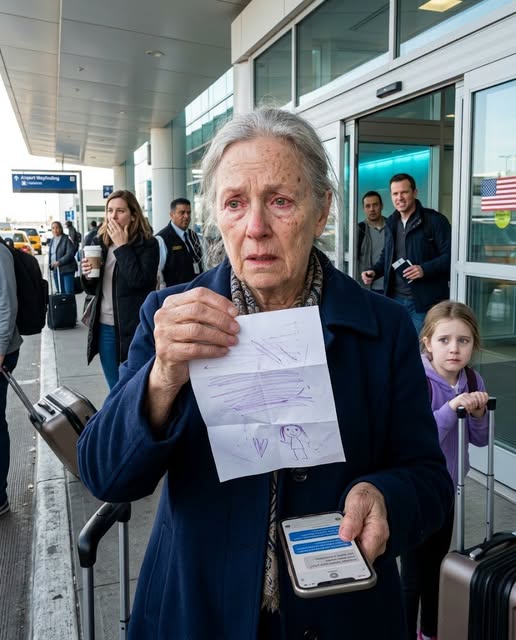
The paper was still warm when Lily pressed it into my palm.
Not from the airport heat.

From her hand.
That was the first thing I noticed, even before I understood why my eight-year-old granddaughter looked as if she had just committed a crime.
John F. Kennedy International Airport was loud that morning in the way airports are always loud, with wheels scraping over tile, announcements echoing from somewhere overhead, and strangers moving past one another like everyone had a life waiting somewhere else.
The air smelled like burnt coffee, floor cleaner, rain-soaked coats, and the sharp rubber scent of suitcase wheels.
My son Matthew stood at the airline counter with our passports in his hand.
He was smiling.
A stranger would have thought he was a devoted son taking his widowed mother to Paris for her retirement.
That was the story he had practiced for weeks.
“Mom deserves something beautiful,” he had told the woman from the moving company while she wrapped my dishes in paper.
“She shouldn’t be alone anymore,” he had told the bank representative during the final signing.
“She gets confused when she’s tired,” he had told the county clerk’s office employee when I asked why one form had three pages instead of two.
Every time, he had put one hand lightly on my shoulder.
Every time, he smiled.
The hand looked tender to other people.
To me, it felt like a warning.
“Grandma,” Lily whispered.
She was standing so close to me that her sneaker touched mine.
She wore her purple hoodie, the one with the little paint stain on the cuff from the school art fair.
Her sleeves were pulled over her hands.
Her ponytail was crooked because Matthew never had the patience to fix it right.
“Read it when he isn’t looking,” she said.
Then she stepped back as if the folded paper had burned her.
I wanted to ask her what was wrong.
I wanted to kneel in front of her, put both hands on her shoulders, and say her name until she told me the truth.
But Matthew’s voice cut across the terminal.
“Mom,” he called. “Let’s go. It’s almost time to check in.”
I had raised Matthew by myself after his father died.
I knew every version of his voice.
The sleepy voice he used as a boy when he came into my room after nightmares.
The proud voice he used when he got his first real paycheck.
The careful voice he used after his divorce, when Lily was small and he needed me more than he wanted to admit.
This voice was different.
It was the one he had started using when he wanted obedience but needed witnesses to think it was concern.
I opened my palm just enough to see the paper.
One word sat there in purple pencil.
RUN.
The whole airport narrowed down to that word.
Not France.
Not retirement.
Not the pretty lie Matthew had packed for strangers.
Run.
Lily looked at the floor.
Her lips were pressed together so hard they had gone pale.
“What do you have there?” Matthew asked.
He was already walking toward us.
His hand still held the passports, mine tucked under his like something that no longer belonged to me.
I closed my fist.
“Nothing,” I said. “A sticker she gave me.”
Matthew stopped in front of me.
His smile stayed where it was supposed to stay.
His eyes did not.
“Mom,” he said softly, “don’t start with your antics. The flight to Paris won’t wait.”
Paris.
He said the word like a blessing.
A small apartment near good doctors.
Walks through gardens.
Fresh bread.
A peaceful old age.
That was the version he told neighbors when they asked why the house in Brooklyn had sold so fast.
My house.
The one with the cracked front step my husband had meant to fix before he got sick.
The one with the narrow kitchen where Lily ate cereal on Saturday mornings while I made coffee.
The one with the mailbox Matthew had backed into with his SUV when he was seventeen, then fixed badly and pretended I would not notice.
I had lived in that house for thirty-eight years.
Matthew had convinced me to sell it in less than six weeks.
At first, I thought he was worried.
I was seventy.
My knees were not what they had been.
The basement stairs had gotten steeper every winter, or maybe I had just gotten older.
He brought groceries.
He changed a lightbulb over the back door.
He sat at my kitchen table with a folder and said, “Mom, I’m trying to make this easier for you.”
That is how betrayal often enters.
Not with a shout.
With help.
He had papers ready by 9:18 a.m. on a Tuesday.
He said they were for the sale.
He said one form gave him permission to talk to the title company.
He said another was about travel insurance.
He said a third was only to “streamline the transition.”
The phrase had bothered me.
People streamline boxes.
Files.
Processes.
Not mothers.
But he tapped the line with his finger and said, “Sign there, Mom.”
So I signed.
I told myself I had raised a good man.
I told myself grief and money stress had made him sharper around the edges.
I told myself fathers and sons get measured differently than mothers and sons, because mothers remember the baby and have trouble seeing the man.
Lily saw him clearly before I did.
Two weeks before the airport, she started drawing the same picture at my kitchen table.
A house.
A crossed-out window.
A black square beside the door.
At first, I thought it was something from school.
I asked if the black square was a dog door.
She shook her head.
“A mailbox?” I asked.
She shook her head again.
“What is it, baby?”
She looked toward the hallway, even though Matthew was not there.
“It’s where they don’t let you leave,” she whispered.
I should have listened harder.
But adults are very good at explaining away children’s terror when the truth would require us to act.
At the airport, Matthew’s fingers closed around my arm.
Too tight.
“Mom,” he said, “walk.”
The pressure of his hand went straight through the sleeve of my coat.
I looked at Lily.
Her eyes were full.
She did not move.
There was a crowd around us, but crowd and safety are not the same thing.
People will walk past fear if fear is wearing a family face.
I put one hand on my stomach.
“I don’t feel well,” I said.
Matthew’s jaw moved.
“Again?”
“I need the bathroom.”
“We don’t have time.”
“I’m sorry.”
He leaned closer.
For one second, the polite son fell away completely.
“If you make us miss this flight,” he said through his teeth, “I swear to—”
A couple rolled their carry-ons past us.
Matthew straightened.
His smile came back so quickly it made my skin go cold.
“I’ll wait right here, Mom,” he said, loud enough for them to hear.
I nodded.
I moved toward the restroom sign.
My steps were slow.
Painfully slow.
Not because I was sick.
Because I knew he was watching.
The note sat inside my closed fist.
The blue restroom sign hung ahead of me.
People brushed past on both sides.
A young man in a baseball cap glanced at me and then back at his phone.
A woman with a stroller apologized when one wheel bumped my ankle.
I smiled like nothing was wrong.
Then I turned.
Not sharply.
Not like someone running.
I simply followed the flow of people heading toward the automatic doors.
For three steps, I expected Matthew to shout.
For five steps, I expected his hand to catch my elbow.
For seven steps, I thought about Lily standing near him and almost turned back.
Then the doors opened.
Warm New York air hit my face.
It smelled like exhaust, wet pavement, and food from a cart somewhere down the curb.
A cab horn blared.
A shuttle bus hissed as its doors closed.
Life kept moving outside the airport, loud and ordinary and almost insulting.
I stood beside a concrete column and opened the paper fully.
The pencil had pressed deep enough to dent the page.
RUN. DO NOT GET ON THE PLANE. LOOK FOR THE BLACK SQUARE.
Under the words was Lily’s drawing.
The same house.
The crossed-out window.
The black square beside the door.
My phone vibrated.
Matthew: Mom, where are you?
I stared at the message.
Then another appeared.
Matthew: Stop playing games.
The third message came from a number I did not know.
Grandma, he lied.
My thumb hovered over the screen.
I could hear my own breathing.
Another message came.
He sold your house already.
Then another.
He said you signed everything.
Then another.
He told Dad’s friend you were going somewhere you couldn’t call us.
I leaned one hand against the concrete column because my knees suddenly felt unreliable.
My Brooklyn house rose in my mind all at once.
The chipped step.
The little flag Lily stuck in a flowerpot one Fourth of July.
The kitchen window.
The drawer where my husband used to keep coupons he never remembered to use.
The dining room wall where Matthew’s school pictures had hung in crooked frames.
Sold.
Already.
I looked back through the glass doors.
Matthew was no longer by the counter.
He was moving fast.
A fourth message arrived from the unknown number.
It was a photo.
Blurry.
Tilted.
Taken in a hurry.
But I could see enough.
A printed page sat on a kitchen table.
The words at the top read INTAKE AGREEMENT.
Below that were lines of dense text.
At the bottom was a signature that looked like my name.
Almost.
The letters were too smooth.
My hand had a small shake now, especially when I was tired.
Whoever had written that signature had copied my name from memory or from a clean document.
They had not lived inside my hand.
Behind the paper, in the blurry background of the photo, was a door.
Beside the door was a black square.
A keypad.
I understood then what Lily had been drawing.
Not a symbol.
Not a dream.
A location.
A place Matthew had planned to take me after Paris, or instead of Paris, or maybe before anyone realized I had disappeared into a system he could explain with a smile.
My phone rang.
Matthew’s name filled the screen.
I did not answer.
It rang again.
I still did not answer.
Then another name appeared.
Sarah.
My daughter-in-law.
Matthew’s ex-wife had never called me without warning.
Not once.
Their divorce had been quiet in the way dangerous things are sometimes quiet.
No screaming on porches.
No public fights.
Just Sarah getting thinner, Matthew getting smoother, and Lily growing old enough to watch both of them.
When I answered, Sarah was crying so hard I could barely understand her.
“Don’t come back to the car,” she whispered.
“Sarah?” I said. “Where is Lily?”
“She’s with me now. I got her away from him for a minute, but he knows she warned you.”
My chest tightened.
“What is that paper?”
There was a sound on her end, like a door closing softly.
“Your signature was on an intake form,” she said. “And on a power of attorney packet. He told me you agreed because you were scared of living alone.”
“I didn’t.”
“I know.”
The words came so quickly they almost broke apart.
“I know, Helen. I saw the dates. One of them was signed the same morning you were at Lily’s school concert. I have the video. You were sitting next to me at 10:04 a.m., and that document says you signed downtown at 10:15.”
For one strange second, I thought about Lily singing on the little riser in the public school auditorium.
Her yellow paper crown sliding over one eye.
Her waving at me with both hands.
Matthew had said he had a work call.
He had missed the concert.
Or he had been somewhere else entirely.
“Listen to me,” Sarah said. “He used your house money. I don’t know how much is left. He has a folder in the car, and there’s another address written inside it. I took pictures while he was inside paying for parking.”
The line crackled.
Then I heard Lily in the background.
“Mommy, is Grandma okay?”
I closed my eyes.
That little voice steadied me more than any prayer could have.
“I’m okay,” I said, though Sarah had not put me on speaker. “Tell her I’m okay.”
Sarah repeated it.
There was a small sound, half sob and half breath.
“Grandma,” Lily said faintly.
“I’m here,” I said.
Then Matthew’s voice sounded somewhere on Sarah’s end.
Not through the phone directly.
In the background.
“Where is she?” he demanded.
Sarah went silent.
The fear in that silence told me more than words would have.
I looked back through the airport doors again.
Matthew was near the exit now.
His phone was at his ear.
His smile was gone.
I had spent my whole life being careful.
Careful with money.
Careful with my son’s pride.
Careful not to burden anyone.
Careful not to become the kind of old woman people dismissed as difficult.
But there is a moment when careful becomes the leash someone else is holding.
I stepped behind a family SUV idling at the curb and lowered my voice.
“Sarah,” I said, “send me everything.”
“I already did,” she whispered. “Check your email.”
I opened it with shaking fingers.
The first attachment was a photo of the intake agreement.
The second was a scanned power of attorney packet.
The third was a settlement statement from the sale of my house.
The fourth was a screenshot of a wire transfer ledger.
There were dates.
Amounts.
Initials.
Enough details to turn fear into something with edges.
At 11:42 a.m., I forwarded the whole email to the only person I still trusted from my old neighborhood, a retired paralegal named Joyce who had lived across from me for twenty-two years.
Joyce was the kind of woman who wore sneakers with church dresses because she believed in being ready to move.
She called me thirty seconds later.
“Where are you?” she asked.
“JFK. Outside departures.”
“Do not get in a car with him.”
“I wasn’t planning to.”
“Helen, listen carefully. Go to the nearest uniformed airport officer. Not an airline employee. Not a helpful stranger. Uniform. Badge. Public place. Then say these exact words: I believe my son is attempting to remove me from the country using fraudulent documents.”
My mouth went dry.
Fraudulent documents.
The words sounded too large for my family.
But they fit.
I saw Matthew come through the automatic doors.
He scanned the curb.
His eyes passed over taxis, travelers, luggage carts.
Then he saw me.
For one second, he looked relieved.
Then he saw my phone in my hand.
His face changed.
That was the moment the story he had built began to collapse.
He walked toward me too quickly.
“Mom,” he called. “There you are. You scared us.”
Us.
He still had the nerve to say us.
I stayed beside the SUV, where people could see me.
“Where is Lily?” I asked.
He stopped just far enough away to keep his voice low.
“With Sarah. You know how dramatic they both get.”
“My phone says otherwise.”
His eyes flicked down to my hand.
“What did she send you?”
The question came out before he could dress it up.
There it was.
Not concern.
Not confusion.
Control.
I took one step backward.
Matthew’s hand rose, palm out, the way he used to calm a dog.
“Mom, you’re having an episode.”
“No.”
“You’re confused.”
“No.”
“People are watching,” he said.
This time, I smiled.
“Good.”
A uniformed airport officer stood near the next set of doors, talking to a curb attendant.
I lifted my hand.
Matthew’s eyes widened.
“Don’t do that,” he said.
For the first time all morning, his voice sounded like the boy he had once been.
Not innocent.
Caught.
The officer looked over.
I called out before Matthew could step between us.
“Excuse me. I need help.”
The officer came toward us.
Matthew laughed once, too loud.
“My mother is elderly,” he said quickly. “She gets disoriented. We’re catching an international flight.”
The officer looked at me.
I held up my phone.
“My son has my passport,” I said. “He sold my house. I believe he is trying to remove me from the country using fraudulent documents.”
Matthew’s mouth opened.
Nothing came out.
The curb noise seemed to thin around us.
A woman nearby stopped pretending not to listen.
The curb attendant turned fully in our direction.
The officer’s posture changed.
Not dramatic.
Not like television.
Just enough to show that my words had landed somewhere official.
“Sir,” he said to Matthew, “I’m going to need you to step back and keep your hands visible.”
Matthew looked offended.
He was always most dangerous when offended.
“This is absurd,” he said. “I’m her son.”
The officer did not move.
“Step back.”
Matthew did.
Barely.
I gave the officer my name.
I gave him Sarah’s number.
I showed him the note.
When he saw the child’s drawing, his expression tightened.
He did not say much.
Good people in serious jobs often do not.
They start documenting.
By 12:07 p.m., Sarah and Lily were escorted to a seating area near an information desk inside the terminal.
Lily ran to me so hard she almost knocked me backward.
Her arms wrapped around my waist.
She was trembling.
I held her head against my coat.
“I read it,” I whispered.
She nodded against me.
“I was scared he’d take you where the black square was,” she said.
“I know.”
“I didn’t know the address.”
“You knew enough.”
Sarah stood three feet away, shaking so hard she had both hands wrapped around a paper coffee cup she had not drunk from.
She looked at me like she expected me to blame her.
I did not.
Women who have been managed by the same man often recognize each other too late, but not never.
“I’m sorry,” she said.
“For what?”
“For not telling you sooner.”
Matthew sat with another officer several yards away.
He kept looking at us.
He kept trying to catch my eye.
I did not give it to him.
Joyce arrived at 1:19 p.m. in a tan coat and walking shoes, carrying a folder of her own because Joyce believed emergencies should be met with paper.
She had already called a lawyer she knew from Queens.
She had already printed the email Sarah sent.
She had already written a timeline across the top of a yellow legal pad.
“Start with dates,” Joyce said.
So we did.
February 3, first conversation about selling the house.
February 19, Matthew brought the first forms.
March 5, Lily’s school concert, the same morning one document claimed I signed downtown.
March 22, house closing.
April 4, airline tickets purchased.
April 9, international flight scheduled.
A life can be taken apart in dates if someone is patient enough.
A life can also be defended that way.
The passport issue was handled first.
Matthew had both passports in his jacket pocket.
He said he was holding mine so I would not lose it.
The officer asked whether I had given permission.
I said no.
Matthew said I had forgotten.
Joyce slid the printed note across the table.
Nobody at that table smiled then.
By late afternoon, we had not solved everything.
Real life does not wrap itself up before dinner.
The house money was still gone or hidden.
The documents still had to be challenged.
The address with the keypad still had to be identified by people with the authority to do something about it.
But I was not on that plane.
That was the first victory.
Lily sat beside me with her head against my arm.
She had stopped crying.
Sarah sat on my other side, answering questions in a small, steady voice.
Matthew had been separated from us.
I could still see him through the glass wall of the office area.
He looked smaller without the passport folder in his hands.
Near sunset, Joyce drove us back toward Brooklyn.
I sat in the passenger seat.
Sarah and Lily sat in the back.
Traffic crawled.
The city looked ordinary in the orange light, which felt almost rude after what had happened.
At a red light, Lily leaned forward.
“Grandma?”
“Yes, baby?”
“Are you mad at me?”
I turned around so fast my seat belt locked.
“Mad at you?”
“For taking the picture. For the note.”
Her eyes filled again.
I reached back and took her hand.
Her fingers were cold.
“Lily,” I said, “you saved me.”
She looked down.
“But Daddy said families don’t tell.”
Joyce made a sound under her breath that I will not repeat.
I squeezed Lily’s hand.
“Good families tell the truth when someone is being hurt.”
She nodded once, but I knew it would take longer than one sentence to undo what had been taught to her.
It always does.
That night, I did not sleep in my house.
I could not.
The locks had been changed after the sale.
Instead, Joyce put me in her guest room, the one with the quilt her sister made and the little framed map of the United States on the wall because Joyce’s late husband had wanted to visit every state and only made it to twenty-six.
Lily slept in the next room with Sarah.
At 2:13 a.m., I woke up and heard a soft sound in the hall.
I opened the door.
Lily stood there in her socks, holding the purple pencil.
“I drew it again,” she whispered.
She handed me a new picture.
This time, there was a house.
There was a window.
There was a black square by the door.
But beside the house, she had drawn three people holding hands.
Me.
Her.
Her mother.
And above us, in crooked letters, she had written one word.
HOME.
I sat down on the edge of the bed and pulled her into my arms.
For weeks, she had been drawing a warning because the adults around her had failed to speak plainly.
Now she was drawing a way out.
The legal fight took months.
There were meetings with an attorney, statements, bank records, and document comparisons.
There was a report showing the disputed signatures did not match the natural tremor in my handwriting.
There was school video placing me at Lily’s concert when one form claimed I was across town.
There were texts Sarah recovered.
There were calls Matthew could not explain.
I will not pretend it was easy to sit across from my own son in a lawyer’s office and hear strangers say words like coercion, forgery, elder exploitation, and financial abuse.
Every word felt like a stone being placed on the table.
But stones can build something too.
The house sale was challenged.
Some money was recovered.
Some was not.
The attempted travel became part of the record.
The intake agreement with the black-square keypad address became the thing Matthew could not smile his way through.
He tried anger.
He tried tears.
He tried saying he had only wanted what was best for me.
The problem with paperwork is that it has no memory of your charm.
It only remembers what you did.
I moved into a small apartment three blocks from Lily’s school.
Not Paris.
Not a garden apartment chosen by Matthew.
Mine.
The building had a stubborn elevator, a laundry room that smelled like detergent and warm quarters, and a neighbor who left grocery coupons by the mailboxes.
I bought a new kettle.
Sarah gave me a spare key to her place.
I gave her one to mine.
Lily came over every Wednesday after school.
We made grilled cheese.
She did homework at my kitchen table.
Sometimes she drew.
For a while, every house she drew had a door with no square beside it.
Then she stopped drawing houses altogether and started drawing dogs, even though none of us had one.
That felt like healing.
Small.
Ordinary.
Real.
I still think about the airport.
I think about how close I came to stepping onto that plane because my son had wrapped control in the language of care.
I think about all the times I mistook his hand on my shoulder for protection.
I think about Lily’s purple pencil.
A child should not have had to save her grandmother.
But she did.
Trust is not usually stolen all at once.
It is borrowed in small pieces until the day you reach for it and find your hands empty.
Lily put one folded piece of paper back into mine.
One word.
RUN.
And because I listened, I got to stay.
