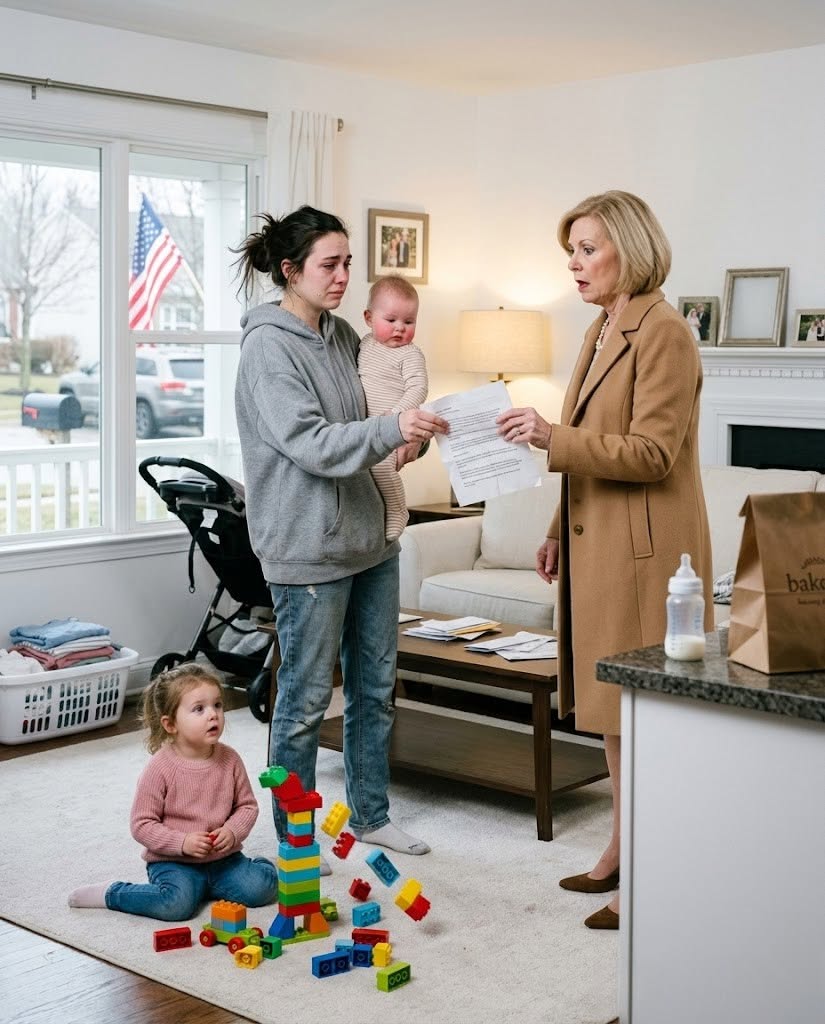
My mother-in-law came to see her grandchildren without knowing her son had left us for another woman.
But the second she walked through the door, her face changed.
It was a gray Tuesday afternoon, the kind that makes a house feel smaller than it is.

The windows looked dull, the porch flag tapped softly against its little wooden pole, and the living room smelled like warm formula, clean laundry, cinnamon rolls, and exhaustion.
I had Milo on my hip.
He was eight months old, heavy with that half-sleep babies fall into when they are not truly resting, only giving you a few minutes to breathe.
His cheek was warm against my hoodie.
Ruby was three, sitting on the rug in front of the couch, building a crooked tower out of plastic blocks.
Every time she added a block, the whole thing leaned a little more.
I remember that because when everything went wrong, those blocks were the first sound I heard.
Not Diane’s voice.
Not my own heartbeat.
The blocks.
I had not slept more than three hours at a time since Milo was born.
That is not an exaggeration people say to sound pitiful.
It was written in my body.
In the dirty coffee mug beside the sink.
In the baby blanket I had washed twice that morning.
In the preschool permission slip I had signed wrong because I wrote the date where Ruby’s name was supposed to go.
Eric used to laugh at things like that.
Then he started sighing.
Then he started saying I was always overwhelmed.
Then he left.
He moved out three weeks before Diane rang my doorbell.
He had taken one duffel bag, two pairs of dress shoes, his laptop, and the good phone charger from the kitchen counter.
He left behind a half-empty bottle of body wash, three old T-shirts in the laundry basket, and a coffee mug I still had not moved.
Grief makes you strange about objects.
You can hate a person and still stand in front of a mug like moving it means something is officially dead.
At 4:18 p.m., the doorbell rang.
I thought it was a package.
Maybe diapers.
Maybe one of the grocery substitutions I had complained about and forgotten.
I shifted Milo higher on my hip and walked past Ruby, who was talking softly to herself as she built.
Through the narrow window beside the door, I saw a camel coat.
Then blonde hair.
Then pearls.
Diane Caldwell.
My mother-in-law.
I opened the door before I had time to decide not to.
She stood on the porch with a perfect smile and a brown bakery bag in one hand.
The cold air pushed around her and into the hallway.
“Surprise,” she said. “I was nearby and thought I’d stop in to see my grandbabies.”
Diane was never nearby.
Diane did not wander.
She planned.
She planned Thanksgiving seating, Christmas card colors, birthday cakes, phone calls, and the exact amount of silence required to make a person feel guilty.
Still, Ruby saw her and shouted, “Grandma!”
So I stepped back.
Because children do not understand adult history.
They only know who brings cinnamon rolls.
Diane came in smelling like expensive perfume and sugar.
She kissed Ruby’s head.
She looked at Milo and softened her voice like someone in a commercial for family life.
“There’s my little girl,” she said to Ruby, then touched Milo’s socked foot.
“And my handsome little man.”
For one second, I wanted to believe she was just a grandmother.
Then her eyes moved around the room.
The toys in the corner.
The stroller beside the couch.
The laundry basket.
The unopened envelopes on the coffee table.
The hospital intake folder from Milo’s reflux appointment, still sticking out from under a burp cloth.
The kitchen counter with bottles drying on a towel.
Diane saw every flaw the way some people read headlines.
Fast.
With judgment already attached.
“Where’s Eric?” she asked. “Working late again?”
My throat tightened.
I had imagined telling her so many times.
In one version, I was calm and dignified.
In another, I cried.
In another, I showed her everything and watched her finally understand who her son really was.
None of those versions had Milo fussing against my shoulder while Ruby listened from the rug.
“He’s not here,” I said.
Diane’s smile stayed in place.
“Did he run to the store?”
I swallowed.
“Diane, can we sit down?”
She did not sit.
She looked toward the mantel.
That was when she saw the empty frame.
It had held our wedding photo until two nights earlier.
In the picture, Eric was smiling beside me in a rented navy suit.
I was holding a bouquet too tightly because I had been nervous and happy, both at once.
Diane had stood behind the photographer that day, telling Eric to fix his tie and telling me to turn slightly because the first angle was not flattering.
I used to tell myself that was just Diane.
Some women speak in corrections because praise feels too expensive.
That was what I told myself for years.
I had taken the photo out of the frame at 11:06 p.m.
on Sunday night.
I know the time because Milo had finally fallen asleep at 10:58, and I had stared at that picture for eight straight minutes before I pulled it loose.
I did not throw it away.
I folded it once and put it in the junk drawer under a roll of batteries.
Diane pointed at the mantel.
“Why is that frame empty?”
My hand tightened around Milo’s back.
He stirred and rubbed his face against my shoulder.
“Eric left,” I said.
Diane turned to me.
“What do you mean, he left?”
“He moved out three weeks ago.”
Her expression did not shift the way I expected.
There was no shock at first.
No pain.
Only irritation, as if I had started a conversation she did not want to have.
“Moved out where?”
I had a choice then.
I could say he was staying with someone.
I could say things were complicated.
I could protect her from the sharp edge of the truth the way everyone had protected Eric his whole life.
But I had spent too many nights protecting people who slept just fine while I shook in the dark.
“He’s living with another woman,” I said. “He started seeing her before he left.”
Ruby’s blocks scraped on the rug.
She was still building, but slower now.
Diane opened her mouth slightly.
“That’s impossible.”
“It isn’t.”
“Eric would not do that.”
There it was.
Not, Are you okay?
Not, What do the kids need?
Not, Where is my son and why did he abandon his family?
Eric would not do that.
Some mothers do not raise sons.
They raise excuses and call them love.
I walked to the coffee table and picked up the printed screenshot.
The paper had been sitting under a grocery receipt and beside a pacifier.
I had printed it at the county library the morning after Eric finally admitted the truth.
The message came at 2:12 a.m.
I had been awake because Milo had spit up twice and Ruby had crawled into my bed after a bad dream.
Eric wrote that he deserved to be happy.
He wrote that I had become too much stress.
He wrote that he needed peace.
Peace.
That word sat on my phone like a slap.
I took a screenshot before he could delete it.
The next morning, I loaded both kids into the SUV, drove to the library, paid twenty cents, and printed his words on plain white paper.
It was not dramatic.
It was proof.
A timestamp.
A document.
Something I could hold when everyone else tried to make his betrayal sound like my mood.
I handed it to Diane.
“He wrote this,” I said.
She took it with stiff fingers.
Her nails were pale pink and perfect.
Mine were short, rough, and one had a little tear near the edge from opening a formula canister.
She read the first line.
Then the second.
Her face changed slowly.
Not like grief.
Like calculation.
She read it again, and the color drained from her cheeks in stages.
Ruby stopped moving.
The dryer thumped once from the laundry room.
Milo made a soft breathy noise against me.
Diane looked up.
For half a second, I thought I had reached her.
I thought the paper had done what tears could not.
Then her eyes hardened.
She lowered the page.
“Well,” she said, “what did you expect him to do?”
The words were so calm that I almost missed the cruelty inside them.
I stared at her.
Ruby’s tower leaned.
One blue block slipped.
Then another.
The whole thing came down with a hollow plastic clatter.
Ruby flinched.
Diane did not even look at her.
“What?” I said.
Diane folded the screenshot once.
Then again.
“A man can only take so much pressure.”
I laughed once, but there was no humor in it.
It came out dry and ugly.
“Pressure?”
“You know what I mean.”
“No, Diane.
I really do not.”
She glanced at Milo, then at the laundry basket, then at the mail.
“You have been overwhelmed for months. Every time I called, you sounded exhausted.
Every time Eric came by, he looked worn down. Marriage is not supposed to feel like a hospital waiting room.”
The baby shifted in my arms.
I could feel heat rising in my neck.
For one second, I pictured myself yelling so loudly the whole street heard it.
I pictured throwing the folded screenshot back at her polished coat.
I pictured telling her to get out before she could poison the room any more than she already had.
But Ruby was watching.
Children remember the shape of your rage even when they forget the words.
So I breathed in through my nose.
Warm formula.
Cinnamon.
Laundry.
Betrayal.
“I had a baby eight months ago,” I said.
“Your son left me with two children and bills he promised he was paying.”
Diane’s eyes flicked to the envelopes.
“He always paid what mattered.”
“No,” I said. “He paid what made him look responsible.”
That landed.
I saw it.
Her jaw tightened.
I set Milo gently into his bouncer near the couch.
He fussed, but the little toy bar distracted him for a second.
Then I reached under the stack of mail.
Diane watched my hand.
“What is that?” she asked.
“The packet I picked up this morning.”
I pulled out the child support worksheet from the family court hallway information packet.
It still had the intake stamp from 10:15 a.m.
The woman at the desk had not been unkind.
She had slid the papers toward me and said, “You will want to keep copies of everything.”
So I did.
I kept the screenshot.
I kept the utility notice.
I kept the bank statements showing the missing deposits.
I kept the pediatric visit summary from Milo’s 9:30 appointment because Eric had promised to meet me there and never showed.
I kept everything.
Not because I wanted revenge.
Because when a man walks away from a house full of children, someone will eventually ask the woman to prove the door was ever open.
Diane looked at the worksheet.
Her mouth parted.
For the first time, she looked less angry and more afraid.
Ruby’s little voice broke through the room.
“Grandma, is Daddy mad at Mommy?”
That question did what the screenshot had not.
It cracked something.
Not in Diane all the way.
Not yet.
But enough.
Diane turned toward Ruby, and her perfect posture sagged.
Ruby was sitting in the middle of scattered blocks, clutching one red piece in both hands.
Her eyes were too wide.
She looked like a child standing at the edge of a swimming pool, unsure whether the water was safe.
“No, sweetheart,” Diane said automatically.
I looked at her.
“Do not lie to her to make yourself feel better.”
Diane snapped her eyes back to me.
“I am not lying.”
“You just blamed me for him leaving.”
“I said there are two sides.”
“There are two sides to stress,” I said.
“There are not two sides to abandonment.”
The room went still again.
Milo kicked once in the bouncer.
The toy rattled.
Diane looked down at the child support worksheet.
Then at Eric’s folded message.
Then at Ruby.
I could see her trying to find the old path.
The one where Eric was tired.
Eric was misunderstood.
Eric was pressured.
Eric was only looking for peace.
But the room would not let her have it cleanly.
The baby was there.
The toddler was there.
The empty frame was there.
The stamped paper was there.
So were his words.
Diane unfolded the screenshot again.
This time, she read it more slowly.
Her lips moved over one line.
I knew which one.
I cannot keep carrying everyone.
He had written that while I was carrying Milo on one hip and Ruby through a fever on the other side of the house.
Diane lowered herself onto the edge of the couch.
Not gracefully.
Carefully.
As if her knees had stopped trusting her.
“Why didn’t he tell me?” she whispered.
I almost laughed again.
Because that was still about her.
Of course it was.
“He did not tell you because he knew you would either protect him or make him explain himself,” I said. “And Eric hates explaining himself more than he hates hurting people.”
Her eyes flashed.
“That is my son.”
“I know.”
“Do not speak about him like he is some monster.”
“I am speaking about him like he is a man who left two children and called them stress.”
Ruby began gathering her blocks quietly.
That hurt most of all.
Not Diane’s words.
Not Eric’s message.
Ruby cleaning up the mess because adults had made the room feel unsafe.
I crossed to her and knelt carefully.
“Sweetheart, you do not have to pick those up right now.”
She whispered, “I knocked them down.”
My chest tightened.
“No, baby.
They fell.”
Diane looked away.
I saw it.
The first real shame of the afternoon.
Not full shame.
Not enough.
But a shadow of it.
I stood again.
“Did you know about her?” I asked.
Diane’s head snapped up.
“No.”
The answer came too fast.
I waited.
She pressed her lips together.
“I knew he was unhappy.”
There it was.
A smaller confession wearing a clean dress.
“What did he tell you?”
Diane looked at her hands.
“That you were always upset. That the house felt tense.
That he did not know how to help anymore.”
“He helped by leaving?”
“He said he needed space.”
“When?”
She hesitated.
“When what?”
“When did he say that?”
Diane looked toward the window.
The porch flag tapped again, small and bright in the gray air.
“About a month ago.”
A month.
Before he left.
Before he told me.
Before he admitted anything.
He had prepared his mother.
Not with the truth.
With a version of me.
A tired wife.
A difficult woman.
A house too heavy to come home to.
He had built the road out before he walked it.
That realization made me colder than the message ever had.
I picked up the family court worksheet and the screenshot and placed them flat on the coffee table.
Side by side.
“Look at both,” I said.
Diane did not move.
“Look.”
She did.
I pointed to the timestamp on the message.
“2:12 a.m. He sent that while both kids were asleep in my bed because Ruby was scared and Milo was sick.”
Then I pointed to the stamp on the worksheet.
“10:15 a.m.
I picked this up today because I cannot pay for diapers with excuses.”
Diane swallowed.
Her eyes were wet now, but I did not trust tears that arrived only after paperwork.
“I can talk to him,” she said.
“No.”
She blinked.
“I said I can talk to him.”
“I heard you.”
“He listens to me.”
“That is part of the problem.”
Diane stared at me as if I had slapped her.
Maybe I had.
Not with my hand.
With accuracy.
The front of her coat had a tiny cinnamon sugar smudge from the bakery bag.
I noticed it because sometimes your mind grabs the smallest detail when the big thing is too much.
She looked down at Ruby again.
Ruby had stopped pretending not to listen.
Milo gave a soft cry from the bouncer.
I picked him up.
He settled instantly against me, his body warm and trusting.
That trust almost broke me.
Diane stood.
For one terrible second, I thought she was going to leave the same way she came in.
Perfect coat.
Perfect hair.
Perfect denial.
Instead, she walked to the kitchen counter and set down the cinnamon rolls.
Then she took off her coat.
I did not know what to do with that.
“What are you doing?” I asked.
She folded the coat over a chair.
“I am going to wash my hands,” she said.
“Why?”
“Because that baby smells like formula, Ruby looks hungry, and I cannot call my son while you are standing here holding the whole house together by yourself.”
The words were not an apology.
Not yet.
But they were the first useful thing she had said all afternoon.
I watched her walk to the sink.
Her hands shook as she turned on the water.
She washed them too long.
Like she was trying to clean off what she had said.
When she came back, she did not reach for Milo without asking.
That mattered.
“May I hold him?”
I looked at her for a long moment.
Then I handed him over.
Her face changed the second his weight settled into her arms.
Not into judgment.
Not into performance.
Into something older.
Something frightened.
Milo grabbed one of her pearls with his tiny fist.
Diane let him.
Ruby stood beside the coffee table.
“Are we having rolls?” she asked in a small voice.
Diane’s mouth trembled.
“Yes,” she said. “If your mom says it is okay.”
Ruby looked at me.
I nodded.
So Diane cut cinnamon rolls on a paper plate while holding Milo in one arm.
She did it awkwardly.
She got icing on her finger.
Ruby smiled a little.
It was not healing.
People like to rush pain into a lesson because they cannot stand sitting with damage.
But real damage does not become wisdom in one afternoon.
It becomes a paper trail.
A quiet kitchen.
A child eating half a cinnamon roll while adults learn how much truth costs.
At 5:02 p.m., Diane called Eric.
She put the phone on speaker without asking me to hide.
He answered on the fourth ring.
“Hey, Mom.”
His voice was easy.
Too easy.
Like a man driving somewhere with music on, convinced the house he left behind had stayed exactly where he put it.
Diane looked at me.
Then at Ruby.
Then down at Milo, asleep in her arms.
“Eric,” she said, and her voice was different now.
“I am at your house.”
There was silence.
Then he said, “Why?”
That one word told me enough.
Not concern.
Not guilt.
Annoyance.
Diane closed her eyes.
“I saw your message.”
“Mom.”
“I saw the packet from family court too.”
Another silence.
This one longer.
Then Eric laughed under his breath.
A small, irritated laugh.
“She is making this bigger than it is.”
Diane opened her eyes.
For the first time in all the years I had known her, I watched her hear him clearly.
Not as her little boy.
Not as the golden son who needed grace.
As a grown man trying to step over his own children.
“No,” Diane said. “She is making it documented.”
I looked at her.
She did not look back.
Eric’s voice sharpened.
“What is that supposed to mean?”
“It means you are coming here tonight,” she said.
“You are bringing the checkbook, the insurance cards, and whatever keys you took. And you are going to look at your daughter when you explain why she thinks you are mad at her mother.”
My eyes burned.
I turned away before Ruby could see my face.
Eric said something I could not make out.
Diane’s face went pale.
Then she said, “Do not speak about your wife like that in my hearing again.”
Wife.
The word hurt.
It also steadied me.
Because for once, someone had used it like it meant responsibility, not possession.
Eric hung up.
Diane stared at the phone.
Ruby whispered, “Is Daddy coming?”
I crouched in front of her.
“I do not know, baby.”
Diane looked at me then.
The apology finally came, but not the way dramatic people imagine apologies.
No speech.
No crying performance.
No begging me to forgive her.
She walked to the coffee table, picked up the folded screenshot, smoothed it flat with both hands, and said, “Make another copy.”
I nodded once.
Then she added, “Make three.”
That was the beginning.
Not of us becoming close.
Not of everything being fixed.
But of Diane choosing, for the first time I had ever seen, not to protect Eric from the truth.
Later that night, after Ruby was asleep and Milo had finally stopped fussing, I found the wedding photo in the junk drawer.
I did not put it back in the frame.
I did not throw it away either.
I placed it in a folder with the screenshot, the worksheet, the pediatric visit summary, and the unopened bills.
The empty frame stayed on the mantel for a while.
Not because I could not move on.
Because it reminded me of the afternoon everything changed.
Diane had walked into my house thinking she was visiting her grandbabies.
She had walked in ready to believe her son.
Then she saw the empty frame, the printed words, the stamped packet, the little girl on the rug, and the baby who smelled like formula and sleep.
My mother-in-law showed up to see her grandchildren without the faintest idea that her son had walked out on us for another woman.
But the second she walked through the door, her face changed.
By the time she left, so had mine.
Because I was done begging people to believe pain they could see with their own eyes.
I had proof now.
I had my children.
And for the first time in three weeks, I did not feel crazy.
I felt awake.
