Part 2
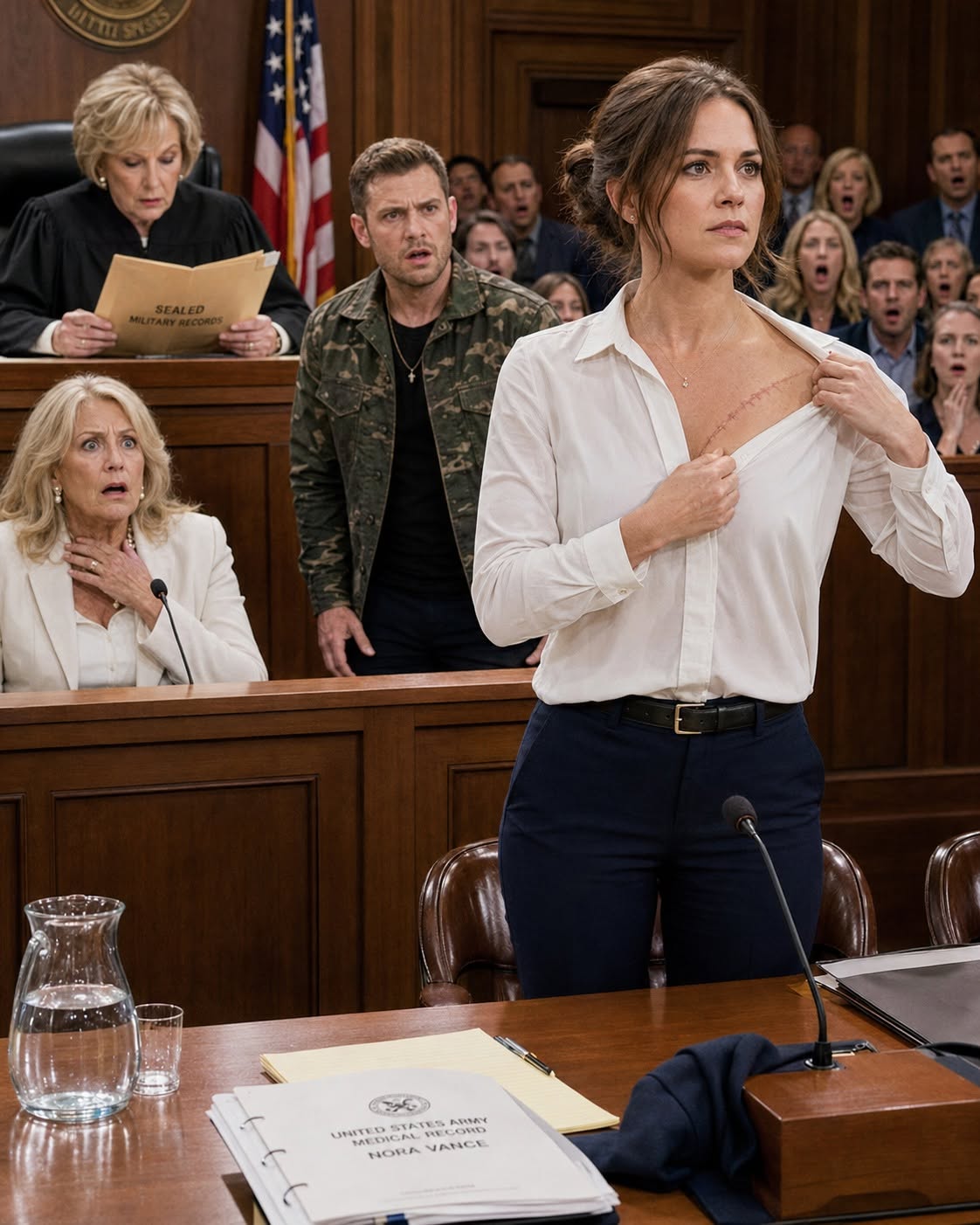
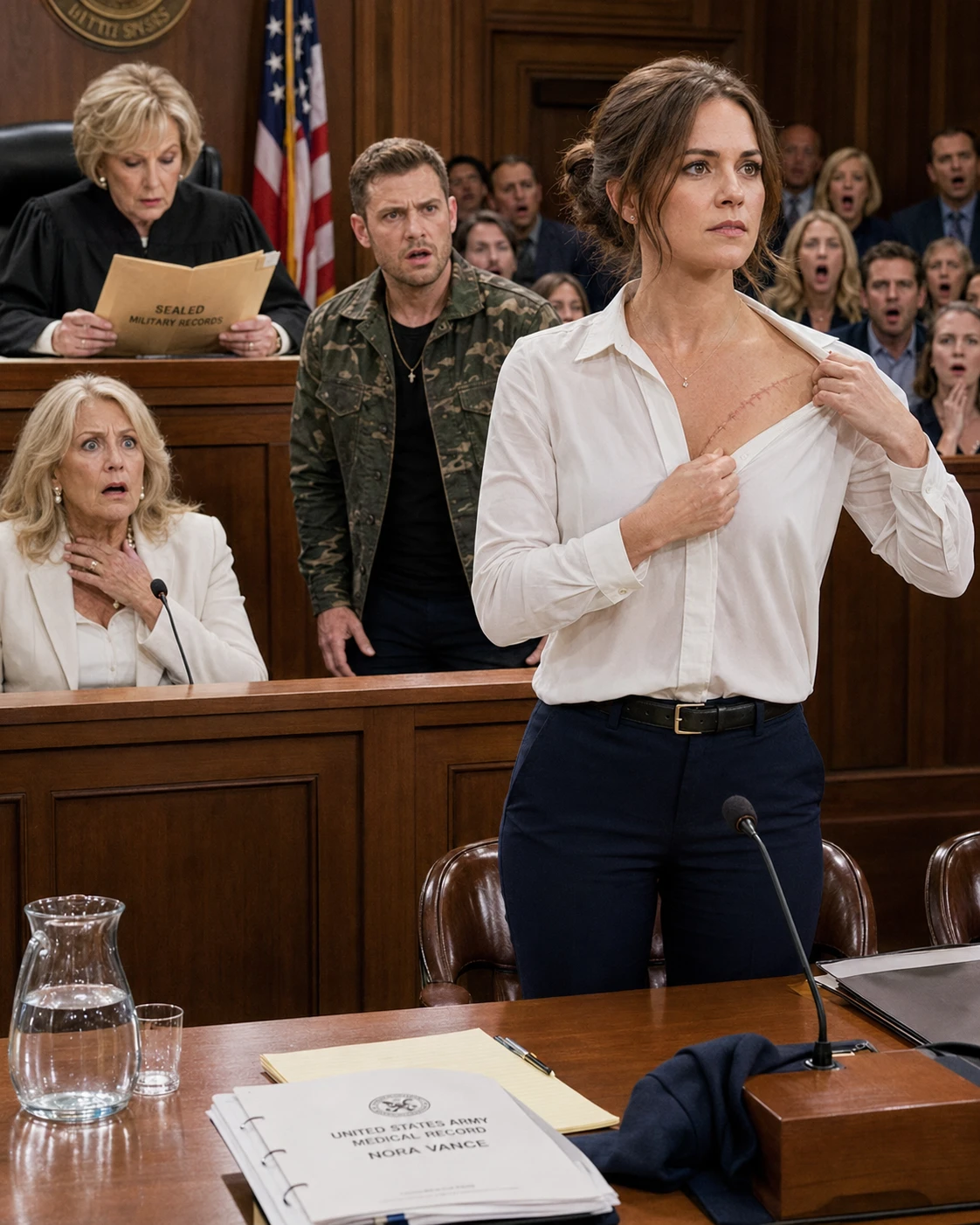
Judge Marian Sterling opened the sealed folder as if it were a bomb.
The courtroom had gone so quiet I could hear the fluorescent lights buzzing overhead. My shoulder was still exposed, the old scar stretched white and angry across my skin, a map of the day an explosive device tore through a convoy outside Kandahar and turned my life into before and after.
My attorney, Isaac Bell, stood beside me without speaking.
He had warned me before the hearing began.
“Let them build the noose,” he had said. “Then we hand the judge the knife.”
Across the aisle, my mother gripped the edge of the witness stand. For the first time that morning, Evelyn Vance did not look elegant, wounded, or righteous. She looked afraid.
Derek’s cheap camouflage jacket made one last stiff rustle as he shifted in his chair.
Judge Sterling removed the first document from the folder. Her eyes moved slowly down the page. Then she lifted another. And another.
The longer she read, the heavier the room became.
“This is your DD-214,” she said.
“Yes, Your Honor,” I replied.
“Honorable discharge. Eight years of service. Combat medic. Multiple deployments.”
“Yes, Your Honor.”
Her eyes flicked toward my mother.
Evelyn opened her mouth, but no sound came out.
Judge Sterling continued. “Bronze Star Medal with Valor. Army Commendation Medal. Combat Medical Badge. Purple Heart.”
The words landed one by one like stones dropped into deep water.
The people who had stared at me with disgust minutes earlier now stared at my mother.
Derek leaned forward sharply. “Those could be forged.”
Isaac did not even look at him. “They were sent directly from the National Personnel Records Center under court seal, Your Honor.”
Judge Sterling’s expression hardened. “Mr. Vance, you are not a witness at this moment. Sit back.”
Derek sank into his chair, but his face twisted red.
My mother’s hands began to tremble.
I remembered those hands from childhood. Hands that had fastened my hair before church. Hands that had slapped me when I tracked mud across her kitchen floor. Hands that had signed my enlistment celebration card with three words: Don’t embarrass us.
Judge Sterling lifted another page.
“What is this attached medical report?” she asked.
Isaac stepped forward. “A record of Sergeant Vance’s injuries from an attack on June 17th, eight years ago. It includes surgical notes, field trauma documentation, and the recommendation for the Purple Heart.”
The judge looked at me. “Sergeant Vance, are you able to explain the incident?”
I pulled my blouse back into place and sat down slowly.
For a moment, the courtroom disappeared.
The polished wood, the flags, the rows of spectators, the sharp smell of paper and dust—it all vanished under a rush of heat and sand.
I was twenty-six again, kneeling in the dirt with blood on my hands.
“We were returning from a medical supply run,” I said. “Three vehicles. I was in the second. There was an explosion under the lead vehicle. Then gunfire. I moved toward the first truck because two soldiers were trapped.”
My voice remained steady, but inside, every word scraped something raw.
“One of them was Specialist Aaron Pike. Twenty-two years old. He had a photograph of his wife taped inside his helmet. The other was Sergeant Luis Mateo. He had shrapnel in his neck. I pulled Mateo out first. Pike was pinned.”
Someone in the gallery sniffed.
“I was treating Pike when a second blast hit. That is what did this.” I touched my shoulder through the fabric. “I kept pressure on his femoral artery until evacuation arrived. He survived.”
Judge Sterling’s face softened for half a second.
Then she returned to the documents.
“And your mother claims you were in Ohio collecting checks at the time?”
“Yes, Your Honor.”
The judge turned to Evelyn. “Mrs. Vance, do you still maintain that your daughter faked her military service?”
My mother’s eyes darted to Derek.
That one small glance told the whole story.
Derek had planned the attack. Derek had handed her the lines. Derek had convinced her she could cry on command, point a finger, and turn my eight years of service into a costume.
But Evelyn Vance had always been skilled at survival. When she saw the ground cracking beneath her, she looked for someone else to throw into it.
“I may have been misled,” she whispered.
A bitter laugh almost escaped me.
Misled.
Not cruel. Not greedy. Not lying under oath.
Misled.
Derek shot to his feet. “Don’t you put this on me.”
“Sit down,” Judge Sterling snapped.
He did not.
“She told me Nora was lying for years,” he said, pointing at our mother. “She said Dad never believed it either.”
My stomach tightened at the mention of my father.
Thomas Vance had died when I was nineteen, one month before I left for basic training. He never saw me in uniform. Never watched me walk across the stage. Never knew I survived my first deployment.
He had been a quiet man, tired from factory work and softer than my mother wanted him to be. Sometimes, late at night, I used to hear them arguing in the kitchen.
“She’s not weak,” he would say.
And my mother would answer, “No. She’s worse. She’s stubborn.”
Judge Sterling raised her voice. “Mr. Vance, one more outburst and you will be removed.”
Derek sat, but his knee bounced violently.
Isaac reached for the second folder.
This one was not sealed.
This one was mine.
The first folder proved who I was.
The second proved who they were.
“Your Honor,” Isaac said, “in light of these documents, we ask the court to dismiss the petition challenging Ms. Vance’s inheritance. We also ask permission to introduce evidence relevant to the plaintiffs’ credibility and motive.”
My mother’s face sharpened. “What evidence?”
Isaac glanced at me.
I nodded once.
He opened the folder.
“Eight weeks,” Isaac said.
Derek went still.
“Excuse me?” Judge Sterling asked.
Isaac held up a document. “The plaintiffs have repeatedly mocked my client’s service. Mr. Derek Vance has presented himself in family communications as someone with military experience. He wore camouflage to court today, made public accusations of stolen valor, and helped submit affidavits claiming Ms. Vance fabricated her record.”
Derek’s jaw clenched.
Isaac’s voice remained calm. “But records show Mr. Vance enlisted in the Army at age twenty. He was separated during basic training after eight weeks.”
The gallery shifted. Someone whispered.
Derek’s face turned a darker shade of red.
“That has nothing to do with this,” he said.
Isaac looked at him for the first time.
“It does when the discharge was connected to theft.”
The word seemed to slap him.
The judge looked down sharply. “Theft?”
Isaac handed the paper to the clerk. “According to the disciplinary records obtained during discovery, Mr. Vance was accused of stealing personal property and cash from fellow recruits. He received an entry-level separation.”
“It wasn’t like that,” Derek snapped.
Judge Sterling’s eyes narrowed. “Mr. Vance.”
But Derek was already unraveling.
“That was twenty years ago. That was nothing. Everybody stole stuff.”
No one moved.
No one breathed.
Even my mother stared at him as if he were a stranger who had entered wearing her son’s face.
Isaac let the silence do its work.
Then he placed another sheet on the table.
“Additionally, Your Honor, bank records show Derek Vance transferred twenty-eight thousand dollars from Arthur Vance’s personal checking account during the final six months of Mr. Vance’s life.”
My mother’s mouth fell open.
That reaction was real.
For the first time all day, Evelyn Vance looked genuinely shocked.
I turned toward Derek.
He would not look at me.
Arthur Vance had been eighty-seven when he died. His hands had shaken too badly to sign birthday cards. His eyesight had dimmed so much he had once poured orange juice into his coffee and laughed until he coughed.
Twenty-eight thousand dollars.
I thought of Grandpa sitting at his kitchen table, counting pills into a plastic organizer, trusting the grandson who stopped by to “help with errands.”
“Those were gifts,” Derek said.
Isaac slid a photograph across the table.
It showed a signature.
Arthur Vance.
But it was wrong.
Grandpa wrote his A like a narrow roof. Always had. The signature in the bank transfer authorization curled at the top like Derek’s handwriting.
Isaac spoke softly. “The signatures are being reviewed by a forensic handwriting expert.”
My mother turned on Derek.
“You told me Nora manipulated him.”
Derek laughed once, ugly and sharp. “She did.”
“You told me he was confused when he changed the will.”
“He was.”
“You said she stole the farm from us.”
“She did!”
“I was in Afghanistan when Grandpa changed the will,” I said.
My words cut across the room.
Every head turned to me again.
Isaac lifted one final document from the folder.
“This is a notarized letter from Arthur Vance to his estate attorney, dated four months before his death,” Isaac said. “It was included in the attorney’s file and produced under subpoena.”
My chest tightened.
I had not read that letter.
Isaac had offered to show me before court. I told him no.
There are some wounds you postpone because you know they will open at the wrong time.
Judge Sterling accepted the page.
Her eyes moved across it.
Then she paused.
“Would you like this read into the record?” she asked me.
I swallowed.
“Yes, Your Honor.”
The judge adjusted the paper and began.
“To whom it may concern, I am of sound mind. I know exactly what I am doing. My granddaughter Nora is to receive the farm because she is the only one who ever loved it without trying to sell it.”
My mother flinched.
“She wrote to me from deserts and hospitals. She asked whether the south fence still leaned, whether the pear tree bloomed, whether the barn cats had kittens. She sent money when the roof leaked, though she never had much. She never asked what the land was worth. She only asked if I was keeping warm.”
My throat burned.
I stared at the table.
The judge continued.
“My daughter Evelyn believes love is measured by obedience. My grandson Derek believes family is a wallet with a heartbeat. Nora came home from war carrying pain she does not speak of, and still she sat with me through every doctor visit and every long afternoon. This farm is hers because she knows how to care for wounded things.”
The words blurred.
For years, I had held pressure on wounds. I had stitched skin. I had carried men heavier than myself through smoke.
But that letter broke me.
Not loudly.
Not dramatically.
One tear fell onto the back of my hand.
I let it stay there.
The judge lowered the letter.
Evelyn was crying too, but her tears were different. Mine had grief in them. Hers had calculation. She cried like a woman watching a door close.
Derek’s chair scraped backward.
“This is ridiculous,” he said. “All of it. She comes back with her medals and her sad stories and suddenly she gets everything?”
Judge Sterling’s voice became ice. “Mr. Vance, you will control yourself.”
“No. You don’t know her. None of you know her. She thinks she’s better than us because she wore a uniform.”
I finally turned to him fully.
“No, Derek,” I said. “I think I’m better than you because I don’t steal from dying old men.”
He lunged.
It happened fast.
One second he was behind the plaintiff’s table. The next, he was moving toward me, face twisted, hands out, rage boiling through him because truth had cornered him and he had never learned to fight anything but people weaker than himself.
The bailiff moved, but I moved first.
Training does not ask permission.
I stepped aside, caught Derek’s wrist, turned with his momentum, and drove him down against the floor hard enough to knock the breath from his lungs.
A collective gasp filled the courtroom.
The bailiff was on him immediately.
Derek cursed, struggling as the officer pinned his arms behind his back.
I stood over him, breathing evenly.
My scar throbbed under my blouse.
Judge Sterling slammed her gavel.
“Remove him.”
Derek screamed as they dragged him up.
“She ruined everything! She ruined everything!”
His eyes found our mother.
“Tell them!” he shouted. “Tell them what you did!”
Evelyn froze.
My pulse changed.
The room changed with it.
Even Judge Sterling noticed.
“What does he mean, Mrs. Vance?” she asked.
My mother wiped her cheeks with trembling fingers. “He is angry. He does not know what he’s saying.”
But Derek laughed as the bailiff pulled him toward the side door.
“Oh, she knows. Ask her about Dad.”
The courtroom went silent again.
Not the same silence as before.
This one was deeper.
Colder.
My father’s name rose between us like a ghost.
I looked at my mother.
Her face had gone bloodless.
“Derek,” she whispered.
It was not a warning.
It was a plea.
He smiled then, even with the bailiff gripping him. A cruel, ruined smile.
“You want to play victim, Mom? Tell Nora why Dad didn’t come to her graduation. Tell her why he never mailed the letter.”
My heart stopped.
The letter.
There had been no letter.
After my father died, my mother told me he had left nothing. No message. No goodbye. No blessing.
She had stood in the kitchen three days after the funeral, stirring coffee she never drank, and said, “Your father was too tired for sentimental things.”
I had believed her because grief makes liars sound practical.
Judge Sterling leaned forward. “Mr. Vance, you are making allegations in open court. Be specific.”
Derek’s smile widened.
“The lockbox,” he said. “Grandpa had it.”
My mother let out a sound so small only I seemed to hear it.
A broken little inhale.
The bailiff paused at the door, waiting for the judge.
“What lockbox?” I asked.
My voice did not sound like mine.
Derek looked at me, enjoying the one weapon he had left.
“Grandpa’s old green lockbox. The one from the feed room. Mom took it after he died. Said it had insurance papers in it.”
I turned to Evelyn.
She looked away.
I knew that look.
I had seen it when I was twelve and she blamed me for breaking the porcelain angel she had dropped herself.
I had seen it when I was seventeen and Derek wrecked her car, but she told my father I had taken it without asking.
I had seen it all my life.
The sideways glance of a woman searching for the lie before the truth reached her mouth.
Isaac leaned closer to me. “Nora.”
I barely heard him.
“Mother,” I said.
She closed her eyes.
Judge Sterling’s voice cut through. “Mrs. Vance, do you possess a lockbox belonging to Arthur Vance’s estate?”
“No,” she said quickly.
Too quickly.
Isaac stood. “Your Honor, given the new allegation, and considering the plaintiffs’ credibility issues, we request an emergency order requiring preservation and production of any property removed from Arthur Vance’s farm after his death.”
My mother shook her head. “This is harassment.”
Judge Sterling looked at her for a long moment.
“Mrs. Vance, you came into this court accusing your daughter of falsifying military service, falsifying combat injuries, and manipulating an elderly man. Documentary evidence appears to contradict every significant claim you made. Your son has now made statements suggesting possible concealment of estate property.”
Evelyn’s lips pressed into a thin line.
The judge continued. “This court is granting the request. You will produce the lockbox, if it exists, by tomorrow morning at nine o’clock.”
“It doesn’t exist,” my mother said.
Derek laughed from the doorway.
“She burned half of it.”
The judge’s head snapped toward him.
My mother stood so quickly her chair tipped backward.
“Shut up!”
There she was.
Not the grieving daughter.
Not the concerned mother.
The real Evelyn Vance.
The woman who could turn venom into a lullaby and make cruelty sound like sacrifice.
Derek’s grin faltered, as if even he realized he had gone further than planned.
But the words were already loose.
They moved through the courtroom, through me, into places I had kept sealed for fifteen years.
She burned half of it.
Half of what?
My father’s things?
Grandpa’s papers?
A letter?
The bailiff took Derek out, and the door shut behind him with a final metallic click.
Judge Sterling recessed the hearing for thirty minutes.
The moment she left the bench, the courtroom erupted.
Reporters who had come for a simple inheritance dispute were suddenly whispering into phones. Strangers stared. My mother grabbed her purse and tried to leave through the side aisle, but Isaac stepped in front of her.
“Mrs. Vance,” he said, “I advise you not to destroy anything.”
She looked at him with pure hatred.
Then she turned that hatred on me.
“You just had to humiliate me.”
I laughed once, but there was no humor in it.
“You accused me of faking my war record in court.”
“You always make everything about you.”
There it was.
The sentence that had raised me.
I could have been bleeding, starving, burning alive, and my mother would still find a way to call it selfish.
“What was in the lockbox?” I asked.
Her expression flickered.
“Nothing that concerns you.”
“My father concerns me.”
She stepped closer. Her perfume hit me first—rosewater and powder, the same scent that had followed me through childhood hallways.
“Your father was weak,” she whispered. “He filled your head with nonsense. Told you that you were brave. Told you that you could leave. He would have let you throw your life away.”
“I did leave,” I said. “And I survived.”
Her eyes dropped to my shoulder.
For a second, something like shame crossed her face.
Then it vanished.
“You survived because strangers kept you alive. Don’t confuse that with strength.”
My hand curled at my side.
Isaac said my name again, quietly.
I forced myself to step back.
My mother smiled, thinking she had won that small exchange.
But then the doors at the back of the courtroom opened.
An old man entered with a cane in one hand and a manila envelope in the other.
He wore a dark suit that hung loose on his frame. His white hair was combed neatly back, and his face was lined deeply from age and weather. I knew him instantly, though I had not seen him in years.
Walter Keene.
Grandpa’s closest friend.
The man who had taught me to drive a tractor when I was thirteen. The man who brought peach cobbler after my father’s funeral and sat on the porch with Grandpa until sunset.
My mother went rigid.
Walter removed his hat.
“Nora,” he said gently.
I could barely answer. “Mr. Keene.”
He looked past me to my mother.
“Evelyn.”
She swallowed. “Walter. This is not your business.”
“I told Arthur I’d make it my business when the time came.”
The envelope in his hand seemed suddenly brighter than anything in the room.
Isaac noticed it too.
“What do you have there, Mr. Keene?” he asked.
Walter’s hand tightened around it.
“Something Arthur gave me two weeks before he died. Said if Evelyn tried to take the farm from Nora, I was to bring it to court.”
My mother whispered, “No.”
The word was soft.
Terrified.
The judge returned before anyone could move.
When she saw Walter standing there, envelope in hand, she paused only briefly before taking her seat.
“Mr. Bell,” she said, “I assume this is relevant.”
Isaac’s eyes did not leave the envelope.
“Very much so, Your Honor.”
Walter was sworn in.
He moved slowly to the witness stand, every step measured, but his voice was steady when he spoke.
“Arthur knew they’d come after her,” he said. “He knew Evelyn wouldn’t accept the will.”
My mother stared at the table, her hands folded so tightly her knuckles turned white.
Judge Sterling asked, “What is in the envelope?”
Walter placed it before the clerk.
“A copy of a letter. And a cassette tape.”
A cassette tape.
The courtroom stirred with confusion.
But my mother understood.
Her shoulders sagged as if an invisible hand had pressed down on her.
Isaac arranged for a small player to be brought from the clerk’s office. While we waited, the judge read the letter silently. Her face revealed nothing, but once she finished, she looked at me differently.
Not with pity.
With warning.
The cassette player arrived ten minutes later.
It was old, black, and scratched along the edges.
The clerk inserted the tape.
Pressed play.
At first, there was only static.
Then my grandfather’s voice filled the courtroom.
Thin. Raspy. Familiar.
“Nora, sweetheart, if you’re hearing this, then your mother has done exactly what I feared.”
My breath caught.
I had heard that voice in dreams.
In memories.
In the creak of the barn door on windy nights.
The tape hissed.
“I’m sorry I didn’t tell you sooner. Your father left you a letter before he died. He gave it to Evelyn the night before the surgery. He told her if anything happened, she was to give it to you when you left for training.”
I turned slowly toward my mother.
She did not look up.
Grandpa’s voice continued.
“She never did. I found it years later, hidden in her cedar chest. Opened. Read. Burned along one edge.”
The room tilted.
My father had left me a letter.
My mother had stolen it.
Not misplaced it.
Not forgotten.
Stolen it.
Grandpa coughed on the tape, then continued.
“I kept what was left. I should have given it to you, but I thought it might reopen wounds. That was my mistake. I gave the original to Walter for safekeeping because I knew Evelyn would search the house after I passed.”
Tears blurred my vision.
Walter looked down at his hands.
The tape crackled again.
“There’s more, Nora. Your father suspected Derek had stolen from him before the accident at the mill. There were records. Notes. Names. Your mother begged him not to report it. Said it would destroy the family.”
Derek had stolen from my father too.
My fingers went numb.
“Your father was going to come clean after the surgery,” Grandpa’s voice said. “He said he was tired of covering for a boy who kept hurting people and a wife who kept calling it love.”
My mother made a small sound.
A sob, perhaps.
Or a protest dying in her throat.
Then Grandpa’s voice softened.
“Nora, your father was proud of you. Don’t ever believe different. He said you were the strongest person he knew. He said the day you walked out of that house, the whole place would lose its light.”
The tape clicked.
Stopped.
No one moved.
No one spoke.
I stared at the cassette player as if my father might say one more thing if I waited long enough.
But the dead are allowed only what the living preserve.
And my mother had tried to burn even that.
Judge Sterling recessed the hearing again, but this time, no one rushed to speak.
My mother remained seated.
Small.
Silent.
A woman surrounded by the ashes of her own lies.
Walter stepped down and came toward me. His hands shook as he opened the manila envelope.
Inside was a plastic sleeve.
Inside the sleeve was a piece of paper, yellowed with age.
Burned along one edge.
Folded once.
My name was written on the outside.
Nora.
My father’s handwriting.
I took it like it was something alive.
My hands trembled so badly Isaac placed a chair behind me.
I sat and opened what remained.
Some lines were gone forever, eaten by fire.
But enough survived.
My brave girl,
Your mother thinks I don’t see you. I do. I see the way you stand in rooms where no one makes space for you. I see how you take blame because it is easier than fighting people who enjoy the fight. I see how badly you want to leave, and I want you to know something.
Go.
Not because you owe this family an escape, but because you owe yourself a life.
I am scared for the surgery tomorrow, but I am more scared you will stay here and become quiet. Promise me you won’t.
There was a burned gap.
Then the final lines.
You are not hard to love. Some people are just too small to love anything that does not obey them.
I am proud of you.
Dad
I pressed the letter to my chest.
For fifteen years, I had carried the weight of a goodbye I thought he never gave.
For fifteen years, my mother let me believe my father died without leaving me a word.
I looked at her through the blur.
“Why?” I asked.
She finally lifted her face.
Her makeup had streaked. Her lips trembled. But her eyes were dry now.
“Because he chose you,” she said.
The answer was simple.
Too simple.
And somehow worse than any explanation.
“He always chose you,” she continued. “Arthur chose you. Thomas chose you. Everyone forgave your stubbornness because they called it courage. Derek needed help. I needed help. But you—”
She pointed at me.
“You were always leaving.”
I stared at her.
“I was a child.”
“You were mine,” she snapped. “And you looked through me like I was a locked door.”
Judge Sterling returned to the bench, and my mother fell silent again.
The court moved quickly after that.
The petition challenging my inheritance was dismissed.
My mother’s testimony was referred for possible perjury review.
Derek’s financial transfers from Grandpa’s account were referred to the district attorney.
An order was entered requiring my mother to produce the green lockbox and any estate property by nine the next morning.
But I barely heard the legal words.
Dismissed.
Referred.
Ordered.
They floated around me without landing.
All I could feel was the thin paper in my hands.
My father had loved me.
My father had known me.
My father had told me to go.
When the hearing ended, I walked out of the courthouse into the white glare of afternoon.
Reporters called my name.
“Sergeant Vance, did your family know your records were real?”
“Do you plan to pursue charges?”
“What was on the tape?”
Isaac guided me through them, one hand near my elbow but not touching unless I needed it.
Walter followed close behind.
My mother exited minutes later, alone.
Derek did not come out. He had been taken through another door.
For one moment, my mother and I stood on the courthouse steps facing each other.
The sun lit every line in her face.
She looked older than she had that morning.
Not softer.
Just older.
“You think this is over,” she said.
Isaac stiffened beside me.
I folded my father’s letter carefully and placed it inside my bag.
“No,” I said. “I think it finally started.”
Her eyes shifted then.
Not to me.
To someone behind me.
I turned.
Across the street, parked under the shade of a sycamore tree, was a black pickup truck I did not recognize.
A man sat behind the wheel.
He wore a baseball cap pulled low, but I saw enough of his face to know he was watching us.
Watching me.
Walter saw him too.
The color drained from his face.
“Mr. Keene?” I asked.
He did not answer.
The black truck started.
Slowly, it pulled away from the curb and disappeared into traffic.
Walter gripped his cane so tightly his fingers shook.
“Walter,” I said, “who was that?”
He looked at my mother.
For the first time since entering the courthouse, Walter Keene looked afraid.
My mother smiled.
It was small.
Exhausted.
Triumphant.
“You really should have left the dead buried, Nora.”
Walter leaned close to me, his voice barely above a whisper.
“There was another copy of your father’s notes,” he said. “And if that man is who I think he is, Derek wasn’t the only one your father was about to expose.”
My phone buzzed in my pocket.
An unknown number.
One message.
No words.
Just a photograph.
The green lockbox, open on a table.
Inside lay my father’s missing records, Grandpa’s old revolver, and a military dog tag stained dark brown with dried blood.
The name stamped into the metal was not mine.
It was my father’s.
Then a second message appeared.
Stop digging, Sergeant, or the next grave we open will be yours.
…If you want to know what happened next, please type “YES” and like for more.