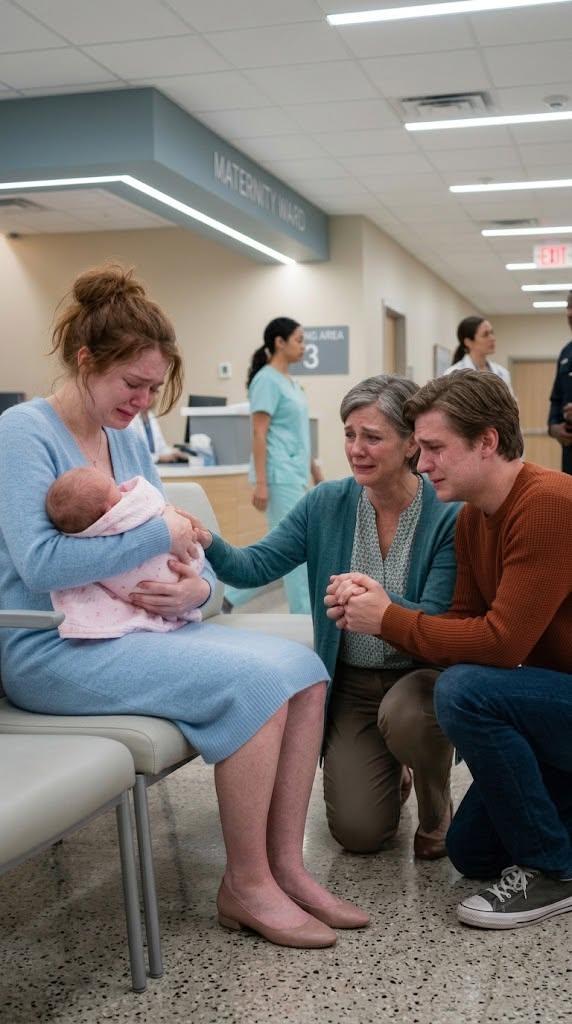
The emergency room doors opened before I had fully stopped the car.
A nurse rushed toward me, took Lily from my shaking arms, and called for a trauma team.
I tried to follow, but another nurse stopped me just long enough to ask what had happened.
“My mother-in-law slapped me,” I said. “I lost my balance. My baby fell.”
Saying it aloud made everything feel even more impossible.
Three weeks earlier, I had been sitting in this same hospital holding Lily against my chest, crying because she had finally opened her eyes after delivery.
Now strangers were running down a hallway with her motionless body beneath white blankets.
“Please,” I said. “Please don’t let her die.”
The nurse squeezed my shoulder.
“We’re taking care of her.”
Then the doors closed.
I stood there in my slippers and pajama pants with one side of my face burning from Patricia’s hand.
I didn’t even realize I was bleeding until another nurse touched a piece of gauze beneath my nose.
“You’re hurt too.”
“I don’t care.”
“You need to sit down.”
“I need my daughter.”
“We’ll tell you as soon as we know something.”
I hated those words.
As soon as we know something.
They meant nobody knew yet.
They meant Lily could be alive behind those doors or slipping away while I stood helpless in a fluorescent hallway.
About fifteen minutes later, Daniel arrived.
Patricia came with him.
The second I saw her, every muscle in my body tightened.
She had changed clothes.
That detail stayed with me.
She had been wearing a pale blue robe when she slapped me.
Now she was dressed in dark pants and a sweater, her hair brushed, her purse hanging neatly from one shoulder.
She had taken time to make herself presentable.
My daughter had been unconscious, and Patricia had changed clothes.
Daniel hurried toward me.
“Rachel.”
I stepped backward.
“Where is she?”
“They’re examining her.”
He reached for me.
I moved away.
His expression changed.
“Rachel, I’m sorry. I didn’t know what happened.”
“You were standing there.”
“I came in afterward.”
“And your mother lied to you.”
Patricia walked closer.
“This is not the time.”
I stared at her.
Her cheek wasn’t red.
Her hands weren’t shaking.
Nothing about her looked like a woman horrified by what she had done.
“She’s confused,” Patricia told the receptionist. “She’s been unstable since the birth.”
My mouth fell open.
“Don’t.”
Patricia looked at the nurse as though I hadn’t spoken.
“She hasn’t been sleeping properly. She’s emotional. We’ve all been worried.”
“Stop talking about me.”
Daniel lowered his voice.
“Mom, enough.”
But he didn’t tell her she was lying.
That was what I noticed.
He told her to stop.
He did not tell anyone she was lying.
A doctor stepped into the waiting area before I could confront him.
“Mrs. Miller?”
I nearly ran toward him.
“I’m Dr. Chen.”
“How is she?”
His face was serious.
“Your daughter is already showing signs of a significant head injury. We’re taking her for emergency imaging. She is breathing independently, and her heart rate is stable right now.”
Right now.
Those two words nearly destroyed me.
“Is she going to live?”
“We’re doing everything we can.”
My knees weakened.
Daniel grabbed my elbow.
This time I let him because I thought I might fall.
“What kind of injury?” he asked.
“We need the scans before I can tell you more.”
“Can I see her?”
“Not yet.”
I pulled out my phone.
Daniel looked at me.
“Who are you calling?”
“The police.”
Patricia’s expression changed instantly.
Not dramatically.
Just a small tightening around her eyes.
“You don’t understand what you’re doing,” she said.
I pressed the emergency number.
“I understand exactly what I’m doing.”
“Rachel,” Daniel whispered.
I looked at him.
“If you tell me not to call them, I will never forgive you.”
He said nothing.
That silence answered more than words could have.
I made the call.
I told the dispatcher where I was.
I told her my mother-in-law had struck me while I was holding my infant daughter and that Lily had fallen because of it.
Patricia began pacing.
“This is absurd.”
I kept talking.
“She’s trying to blame me.”
“Rachel,” Patricia snapped.
I turned away.
The dispatcher told me officers were being sent.
They arrived quickly.
One was a woman named Officer Alvarez. The other was an older man named Officer Bennett.
They separated us immediately.
Officer Alvarez sat beside me.
“Start from the beginning.”
So I did.
I told her about Lily crying.
About Patricia coming into the hallway.
About the slap.
About my arms opening.
About the sound of Lily hitting the floor.
My voice broke there.
Officer Alvarez waited.
“She stopped crying,” I whispered.
I pressed both hands over my mouth.
“That was the worst thing. She just stopped.”
Officer Alvarez gave me a moment before asking another question.
“Had Patricia ever hit you before?”
“No.”
“Threatened you?”
I hesitated.
“Not exactly.”
“What does that mean?”
“She said things.”
“What kinds of things?”
I looked across the waiting room.
Patricia was talking to Officer Bennett.
Daniel stood ten feet away, pale and silent.
“She said I was too sensitive. That I was making Daniel weak. That mothers today acted like babies were made of glass. She kept telling me I spoiled Lily by picking her up when she cried.”
“How long has she lived with you?”
“Six weeks.”
“Why?”
“Her apartment building had a pipe burst. There was water damage. She said repairs would take a month.”
Officer Alvarez wrote something down.
“Was she supposed to leave soon?”
“Yes.”
“How soon?”
“Tomorrow.”
That made me stop.
I had almost forgotten.
Daniel and I had argued about it that morning.
Patricia had told him the repairs weren’t finished.
I had insisted she had to leave anyway.
I could no longer handle her criticism.
Every feeding became a lecture.
Every nap became an argument.
Every time Lily cried, Patricia acted personally offended.
Daniel kept asking me to be patient.
“She’s my mom.”
“That’s just how she is.”
“She means well.”
I had heard those sentences so often they had begun to feel like a second marriage vow.
Officer Alvarez looked toward Patricia.
“Did you discuss her leaving tonight?”
“Yes.”
“What happened?”
“She got angry.”
“How angry?”
“She said I was trying to separate Daniel from his family.”
Daniel looked over as if he had heard.
I lowered my voice.
“She said this was Daniel’s house and I didn’t have the right to throw her out.”
“Whose house is it?”
“Ours. Both our names are on the deed.”
Officer Alvarez nodded.
“Anything else?”
I remembered something.
At around ten that evening, Patricia had stood in the kitchen while I sterilized bottles.
She had said, “Women who can’t control their children shouldn’t be mothers.”
I had been too tired to argue.
I told Officer Alvarez.
She wrote it down.
Then Officer Bennett approached.
He spoke quietly to Alvarez.
I couldn’t hear most of it.
But I heard three words.
“Camera in hallway.”
Daniel heard them too.
His face changed.
Officer Alvarez looked at me.
“Do you have interior cameras?”
“Yes.”
Daniel answered before I could.
“They aren’t recording.”
I turned toward him.
“What?”
“We stopped the subscription months ago.”
“No, we didn’t.”
He looked at me.
I could see panic beginning behind his eyes.
I had bought the cameras when I was eight months pregnant.
One faced the front door.
One faced the kitchen.
One covered the hallway outside the nursery.
The system uploaded clips to the cloud whenever it detected movement.
I paid the subscription.
It came out of my personal account.
“It’s recording,” I said.
Daniel shook his head.
“I thought you canceled it.”
“I didn’t.”
Nobody spoke for a second.
Then Patricia stood.
“I want to go home.”
Officer Bennett turned.
“Ma’am, we need you to remain here.”
“I’ve answered your questions.”
“We’re not finished.”
“This is harassment.”
Officer Alvarez asked me if I could access the security system from my phone.
My fingers trembled so badly that I entered the password wrong twice.
On the third attempt, the app opened.
There were dozens of clips from that evening.
I handed the phone to Alvarez.
“I don’t want to watch.”
She nodded.
“You don’t have to.”
She and Bennett stepped aside.
Daniel stared at the floor.
Patricia sat down.
For the first time since arriving, she looked afraid.
Then Officer Bennett looked toward her.
“Mrs. Miller.”
Patricia crossed her arms.
“What?”
“We need to discuss the security footage from the house.”
Daniel went completely still.
Patricia stopped pretending to cry.
I watched Officer Alvarez’s expression.
Police officers are trained not to react easily.
Even so, something in her face told me the video showed more than the slap.
“What did you see?” I asked.
She glanced at Bennett.
Then at me.
“Rachel, I’d prefer to speak with you privately.”
My stomach dropped.
“It’s my daughter.”
“Yes.”
“What did you see?”
She guided me farther down the hallway.
Daniel started to follow.
Bennett stopped him.
“Stay here, sir.”
Officer Alvarez lowered her voice.
“The camera captured the incident.”
I closed my eyes.
“So you saw her hit me.”
“Yes.”
Relief and horror arrived together.
I hadn’t imagined it.
I hadn’t exaggerated it.
There was proof.
“But there’s something else.”
I opened my eyes.
“What?”
“There are several earlier clips.”
“How much earlier?”
“Approximately forty minutes.”
My skin went cold.
“What happens in them?”
“Your mother-in-law enters the nursery while you’re downstairs.”
I stared at her.
“She went into Lily’s room?”
“Yes.”
“What did she do?”
Alvarez chose her words carefully.
“She appears to move the camera slightly. Then she walks toward the crib. We can’t see everything because of the angle.”
“What did she do?”
“We don’t know yet.”
My heart started pounding harder.
“Where was Lily?”
“In the crib.”
“Was she crying?”
“Not initially.”
I felt sick.
“What happens next?”
“She leaves. A few minutes later, the baby begins crying. You eventually come upstairs.”
“That’s why she was crying?”
“We don’t know.”
I pressed my hands against the wall.
The hallway seemed to tilt.
Then I remembered something else.
When I had picked Lily up, her blanket had been loose.
I had assumed she had kicked it.
A small stuffed rabbit normally sat on a shelf beside the crib.
That night it had been on the mattress near Lily’s legs.
I had moved it without thinking.
“What else did she do?”
“We’ll need investigators to review all of the video.”
I looked past Alvarez.
Patricia was watching us.
Daniel stood near the vending machines.
And suddenly I knew.
Daniel knew something.
I couldn’t explain why.
Maybe it was the way he avoided my eyes.
Maybe it was the speed with which he had claimed the cameras weren’t recording.
Maybe it was every small hesitation from the moment he entered the hallway at home.
I walked toward him.
Officer Alvarez followed.
“Daniel.”
He looked up.
“What?”
“Why did you say the cameras weren’t recording?”
“I thought they weren’t.”
“That isn’t what I asked.”
“Rachel, this isn’t the time.”
“Why did you say it?”
Patricia interrupted.
“Daniel, don’t answer her.”
Officer Bennett stepped between them.
“Ma’am.”
I stared at my husband.
“Did you know your mother went into Lily’s room?”
“No.”
He answered too quickly.
“Did you?”
“No.”
“Look at me.”
He did.
And I knew he was lying.
Before I could say anything else, Dr. Chen returned.
Everything disappeared except Lily.
I ran to him.
“The scan shows a skull fracture and bleeding around the brain.”
I stopped breathing.
Daniel made a sound behind me.
Dr. Chen continued.
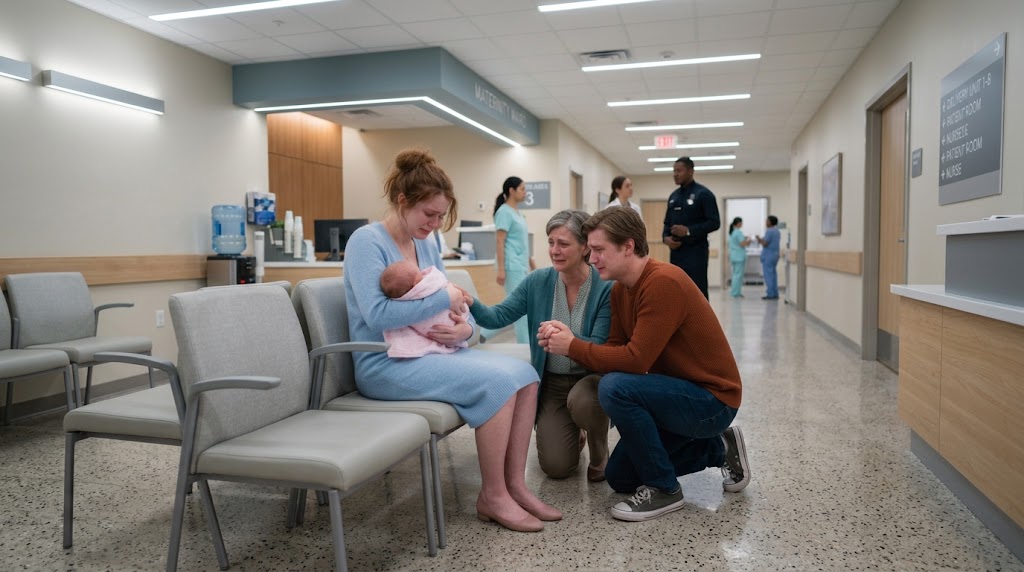
“The good news is that the bleeding appears limited. The neurosurgical team does not believe she needs surgery at this moment, but she needs close monitoring in the pediatric intensive care unit.”
“Is she awake?”
“Not fully.”
“Will she wake up?”
“We are hopeful.”
Hopeful.
Not certain.
“What happens now?”
“We monitor pressure, breathing, neurological responses, and repeat imaging. The next several hours are important.”
“Can I see her?”
“Yes.”
I followed him.
Daniel tried to come with me.
I turned at the doors.
“No.”
His face crumpled.
“Rachel.”
“I said no.”
“She’s my daughter too.”
“And your mother almost killed her.”
“My mother—”
“You stood in our house and listened while she said I dropped Lily by myself.”
“I was confused.”
“So was I. I still called 911.”
He had no answer.
Officer Alvarez touched his shoulder.
“Sir, we need to speak with you.”
I went inside alone.
Seeing Lily in the pediatric intensive care unit changed me.
She looked impossibly small beneath the monitors.
There was a bandage near her head.
Wires crossed her tiny chest.
A soft tube ran beneath her nose.
Her eyes were closed.
I sat beside the crib and put one finger into her palm.
For a second nothing happened.
Then her fingers curled weakly around mine.
I started crying so hard I had to turn away.
“I’m here,” I whispered.
“I’m right here.”
I stayed beside her for nearly an hour before Officer Alvarez appeared at the doorway.
She asked if I could step outside.
I kissed Lily’s hand.
In the hallway, Alvarez was no longer alone.
A detective introduced herself as Karen Whitmore.
She carried a tablet.
“We’ve reviewed more of your security footage.”
I didn’t want to hear it.
I needed to hear it.
Detective Whitmore sat with me in a consultation room.
“There are several clips that concern us.”
“Show me.”
“You’re sure?”
“Yes.”
She placed the tablet on the table.
The first video was from the kitchen.
Timestamp: 11:08 p.m.
Patricia stood at the counter.
Daniel entered.
There was no sound for the first few seconds, then audio activated.
Patricia said, “She wants me gone tomorrow.”
Daniel opened the refrigerator.
“You knew she did.”
“She doesn’t get to decide that.”
“It’s her house too.”
Patricia laughed.
“She thinks having that baby made her queen.”
Daniel rubbed his forehead.
“Mom, just give her space.”
“I raised you better than this.”
“I’m not doing this tonight.”
Then Patricia said something that made my stomach twist.
“That child cries because Rachel has trained her to cry.”
Daniel sighed.
“She’s three weeks old.”
“She’ll learn.”
The clip ended.
The next started at 11:31.
Patricia walked down the hallway toward Lily’s room.
She looked directly at the camera.
Then she reached up.
The angle shifted toward the wall.
But not completely.
The edge of the nursery doorway remained visible.
Patricia entered.
Three minutes passed.
She came out carrying something.
A small white object.
“What is that?” I whispered.
“We’re not sure.”
She slipped it into her robe pocket.
Then she adjusted the camera back.
Six minutes later, Lily began crying.
The sound came through faintly.
The next clip showed me coming upstairs.
I watched myself take Lily from the crib.
I paced.
I checked her diaper.
I touched her forehead.
I kissed her cheek.
The video made my chest hurt.
At 12:04 a.m., Patricia came out of the guest room.
She stood at the end of the hall.
I couldn’t hear what she said at first.
Then the audio became clear.
“For God’s sake, Rachel.”
“I’m trying.”
“You’ve been trying for twenty minutes.”
“She’s a newborn.”
“She’s a nuisance.”
I turned toward Patricia in the video.
“Go back to bed.”
“This is my son’s house.”
“It’s my house too.”
“Then act like you belong in it.”
“Patricia, please.”
Lily kept crying.
Patricia walked closer.
“You’ve done nothing but create chaos since you brought that child home.”
“Don’t call my daughter that child.”
“I’ll call her whatever I want.”
“Go back to your room.”
Then Patricia raised her hand.
The slap was unmistakable.
My head snapped sideways.
My arms loosened.
Lily fell.
The detective paused the video before the impact.
I covered my face.
“I’m sorry,” she said.
“No.”
I forced myself to look again.
“Keep going.”
The video resumed.
I dropped to the floor.
Daniel rushed out.
Patricia said, “She dropped the baby.”
I shouted, “You hit me.”
Then Patricia looked directly at Daniel.
This was the moment I had missed because I was staring at Lily.
Patricia mouthed something.
The microphone barely caught it.
Daniel nodded.
“What did she say?” I whispered.
Whitmore replayed it louder.
Three words.
“Back me up.”
I felt something inside me break.
Daniel had seen his mother strike me.
Maybe not the slap itself.
But he had entered seconds later.
He had heard me accuse her.
He had seen Lily unconscious.
And when Patricia told him to back her up, he nodded.
The next clip came from the kitchen.
It was less than two minutes later.
I had already carried Lily outside.
Daniel stood beside Patricia.
He looked terrified.
“What did you do?”
“She lost her grip.”
“You hit her.”
“I barely touched her.”
“The camera.”
Patricia looked up.
“What camera?”
“The hallway camera.”
She stared at him.
Then Daniel said the sentence I would hear in my dreams for months.
“I think Rachel canceled the recording plan.”
That was why he had told police the cameras weren’t recording.
He hadn’t been mistaken.
He had hoped.
The video continued.
Patricia grabbed his arm.
“Then there’s nothing to worry about.”
“Mom, Lily isn’t moving.”
“She’ll be fine.”
“She hit the floor.”
“She’ll be fine.”
“And if she isn’t?”
Patricia stared at him.
“Then you need to decide whether you want your wife to ruin your mother’s life over an accident.”
Daniel whispered, “This isn’t an accident.”
Patricia answered calmly.
“Then make it one.”
The detective stopped the video.
I sat completely still.
There are moments when grief becomes so large that it turns numb.
I had expected betrayal.
I had not expected evidence of it.
“What was she holding when she left the nursery?” I asked.
“We obtained consent from your husband to search the home.”
“Why would he give consent?”
“He has started cooperating.”
I laughed once.
There was no humor in it.
“Of course he has.”
“We found an infant pacifier in the pocket of the robe Patricia had been wearing.”
“That’s Lily’s?”
“We believe so.”
“Why was it in her pocket?”
“We don’t know.”
I remembered something.
Lily had rejected pacifiers since birth.
Patricia hated that.
She said all babies could be trained to take one.
Two nights earlier, she had complained that if Lily would “just keep something in her mouth,” the house might finally be quiet.
I told the detective.
Whitmore wrote it down.
“Patricia claims she entered the nursery to calm the baby.”
“She wasn’t crying yet.”
“That’s correct.”
“So why was she calming her?”
Whitmore didn’t answer.
The hospital later examined Lily thoroughly.
There were no injuries suggesting Patricia had harmed her before the fall.
That mattered.
It meant the nightmare had not been even worse than I feared.
But investigators believed Patricia had gone into Lily’s room, tried to force the pacifier into her mouth, disturbed her, and triggered the crying that eventually brought me upstairs.
Patricia denied it.
She denied everything.
She denied hitting me even after being told there was video.
Then she claimed I had provoked her.
Then she claimed she had been reaching for the baby.
Then she claimed the video angle made it look worse.
By sunrise, Patricia Miller was arrested.
I did not watch them take her away.
I stayed beside Lily.
Daniel was allowed into the hospital only after I finally agreed to speak with him in a family consultation room.
He looked twenty years older.
His eyes were swollen.
His shirt was wrinkled.
“I’m sorry.”
I stared at him.
He kept talking.
“I panicked.”
“Our daughter was unconscious.”
“I know.”
“Your mother told you to lie.”
“I know.”
“And you did.”
“I didn’t tell the police you dropped her.”
“You told them the cameras weren’t recording.”
“I thought—”
“Don’t.”
He stopped.
“You knew they might be recording. That’s why you said it.”
He lowered his head.
“Yes.”
I had expected admitting it would make me feel better.
It didn’t.
“Why?”
His voice cracked.
“Because I thought Lily would be okay.”
I stared at him.
“What?”
“I thought if she was okay, then maybe we could handle it privately. Mom would leave. We would never see her again. We could—”
“We?”
“I mean us.”
“There is no us.”
He looked up.
“Rachel.”
“No.”
“Please don’t say that right now.”
“When should I say it? After our daughter wakes up? After your mother hires a lawyer? After you decide the video was somehow my fault?”
“I would never do that.”
“You already did worse.”
He started crying.
I felt nothing.
That frightened me more than anger.
“I’ve spent two years asking you to stand up to her,” I said. “Every insult. Every boundary she ignored. Every time she treated me like I was borrowing you from her. You always said she meant well.”
“I was wrong.”
“You weren’t wrong. You were comfortable.”
He flinched.
“You let me absorb everything because it was easier than disappointing her.”
“I know.”
“And last night your daughter paid for it.”
“I know.”
“Stop saying that.”
He covered his face.
“I don’t know what to say.”
“There’s nothing left to say.”
I removed my wedding ring.
I placed it on the table.
Daniel stared at it.
“Rachel, please.”
“Go home.”
“I don’t want to leave Lily.”
“You stopped protecting Lily the moment your mother told you to protect her instead.”
“That’s not fair.”
I stood.
The rage finally came.
“Fair?”
My voice rose.
“My three-week-old daughter has a skull fracture because your mother slapped me while I was holding her. Then, while I was racing to the hospital not knowing whether Lily was alive, you stood in our kitchen discussing whether the security camera had saved evidence.”
He looked shattered.
Good.
For one ugly second, I wanted him shattered.
Then I realized I didn’t want anything from him anymore.
Not pain.
Not apology.
Not revenge.
Nothing.
I picked up the ring and put it into my pocket.
“You can see Lily when the hospital and police say you can. But you do not come near me without asking.”
He nodded.
I returned to the PICU.
At 9:17 that morning, Lily opened her eyes.
It lasted only a few seconds.
Her tiny face tightened.
She made the softest sound.
Barely a cry.
It was the most beautiful sound I had ever heard.
I pressed the call button so hard my thumb hurt.
Nurses came in.
Then Dr. Chen.
He checked her pupils.
Her responses.
Her breathing.
I stood against the wall with my hands clasped beneath my chin.
After several minutes, he looked at me.
“This is encouraging.”
I cried.
Not the terrible crying from before.
This was different.
Hope had returned.
Fragile.
Terrifying.
But real.
Lily remained in intensive care for three days.
Her repeat scans showed the bleeding had not increased.
She began feeding again.
She responded normally to light and sound.
Doctors warned me that head injuries in newborns required long-term monitoring.
There could be developmental concerns later.
There could be seizures.
There could be complications nobody could predict.
But there could also be a completely normal childhood.
Nobody promised me anything.
I learned to stop asking for promises.
I began asking only one question.
“What does she need today?”
That question saved me.
Today she needed rest.
Today she needed feeding.
Today she needed another scan.
Today she needed me.
I could survive today.
The criminal case against Patricia moved quickly at first.
The security footage destroyed most of her story.
Her attorney tried to argue that the slap was impulsive and that Lily’s fall had been an unintended consequence.
The prosecutor agreed the fall had not been planned.
But intent was not the only thing that mattered.
Patricia had assaulted me while I was holding a newborn.
She had then lied.
She had attempted to influence Daniel.
She had gone into the nursery earlier under suspicious circumstances.
And perhaps worst of all, according to prosecutors, she had shown almost no concern for Lily after the fall.
One clip from the front door camera captured me running outside with Lily.
Patricia stood behind Daniel.
She watched me leave.
Then she closed the door.
She never called 911.
She never asked Daniel to call.
She never followed us.
She went upstairs and changed clothes.
Investigators later determined she had washed her hands and placed the blue robe in the laundry room.
That explained why she arrived at the hospital dressed differently.
Her lawyer insisted changing clothes proved nothing.
Maybe it didn’t.
But to me, it proved everything.
While I was begging my baby to breathe, Patricia had been thinking about herself.
Daniel gave a full statement to police the day after Lily woke.
He admitted Patricia told him to “back her up.”
He admitted he hoped the cameras had stopped recording.
He admitted he had initially intended to describe the incident as an accident if Lily recovered.
That confession ended our marriage.
Not legally.
That took months.
But emotionally, it ended in that interrogation room whether he understood it or not.
My sister, Megan, flew in from Denver four days after the incident.
She walked into Lily’s hospital room, hugged me for almost a minute, then said, “You’re never going back to that house alone.”
“I know.”
“No, I mean it. I don’t care if Daniel says Patricia is gone. You do not step inside without someone with you.”
“I know.”
She studied me.
“When did you sleep?”
“I don’t remember.”
She took the chair beside Lily.
“Go.”
“I’m not leaving.”
“Then close your eyes right there.”
I slept for three hours with my head against the side of Lily’s crib while Megan watched her.
It was the first real sleep I’d had since the fall.
When Lily was discharged, I did not take her home.
I took her to a furnished apartment that Megan had rented for a month.
Daniel asked to visit.
I allowed supervised visits after speaking with Lily’s doctors and my attorney.
Yes, I had an attorney now.
Her name was Claire Benson.
She was recommended by one of the hospital social workers.
Claire listened to the entire story without interrupting.
When I finished, she asked one question.
“Do you want to preserve this marriage?”
“No.”
It was the first time I answered without hesitation.
“Then we’ll proceed accordingly.”
Daniel begged me not to file.
He sent messages.
He wrote letters.
He left flowers at the apartment building until I asked the concierge to refuse them.
He said he had started therapy.
He said he understood enmeshment now.
He said he had spent his whole life managing Patricia’s emotions.
He said he finally saw how badly he had failed me.
Maybe all of that was true.
People can change.
People can understand themselves.
People can become better.
That does not mean you owe them access to the life they helped destroy.
I filed for divorce six weeks after Lily came home.
Daniel did not contest it.
That surprised me.
Then Claire told me he was cooperating with almost everything.
“He may actually understand that fighting you would make things worse.”
“He understands consequences.”
Claire raised an eyebrow.
“There is a difference.”
Yes.
There was.
Patricia, on the other hand, fought everything.
She blamed me publicly.
A cousin of Daniel’s sent me screenshots of Patricia’s friends posting vague messages online about “postpartum instability” and “families being destroyed by false accusations.”
I gave the screenshots to the prosecutor.
Then I stopped looking.
My job was Lily.
She had follow-up appointments every few weeks.
At two months old, she smiled at me for the first time.
A real smile.
Not gas.
Not random muscle movement.
A smile.
I burst into tears.
Megan happened to be visiting.
She laughed.
“Rachel, you’re scaring her.”
“I know.”
Lily smiled again.
I cried harder.
At four months, she rolled over.
At six months, she sat with support.
At eight months, she crawled toward a set of plastic measuring cups and immediately tried to chew them.
Her neurologist laughed during the next appointment.
“She seems determined.”
“That’s one word for it.”
Her development remained on track.
Every milestone felt stolen back from the night Patricia had almost taken them all away.
The criminal case went to court when Lily was nearly ten months old.
I testified.
I had dreaded it for weeks.
Walking into the courtroom and seeing Patricia made my legs shake.
She looked smaller than I remembered.
Her hair had gone almost completely gray.
For months, part of me had imagined she would look monstrous.
She didn’t.
She looked ordinary.
That taught me something I never forgot.
The people who hurt you most rarely look like monsters.
Sometimes they look like family.
Sometimes they bring casseroles.
Sometimes they hold your baby and tell neighbors how blessed they are to be a grandmother.
Sometimes they slap you at midnight and then tell everyone you imagined it.
The prosecutor played the security footage.
I stared straight ahead.
Patricia stared at the table.
When the video showed Lily falling, someone in the courtroom gasped.
The judge immediately demanded silence.
I did not look at Daniel.
He was sitting several rows behind me.
Patricia eventually accepted a plea agreement rather than risk a harsher sentence at trial.
She pleaded guilty to assault and child endangerment-related charges.
The exact legal language mattered to the court.
To me, only one thing mattered.
She finally had to say “guilty.”
Not misunderstood.
Not provoked.
Not exaggerated.
Guilty.
At sentencing, I gave a victim impact statement.
I brought no photographs.
No dramatic props.
I stood at the podium and looked at the judge.
“My daughter was three weeks old when this happened,” I said. “She had never done anything to Patricia except cry.”
My voice trembled.
I continued.
“Newborn babies cry because that is the only language they have. They cry when they are hungry, cold, frightened, uncomfortable, or simply when they need to know someone is near.”
Patricia stared straight ahead.
“I spent weeks after the injury being afraid of every sound Lily made. Then I spent weeks being afraid when she was too quiet. I watched her sleep because I was afraid she would stop breathing. I took videos of her smiling because I was afraid someday doctors would tell me she could no longer do it.”
I glanced toward Patricia.
“You told me to shut her up or get out of the house.”
For the first time, she looked at me.
“So I did.”
The courtroom was silent.
“I got out.”
I turned back to the judge.
“And Lily will grow up in a home where crying does not make her unsafe.”
Patricia received a custodial sentence followed by probation, mandatory counseling, and a strict no-contact order protecting Lily and me.
I felt no celebration when the judge announced it.
Justice did not feel like victory.
It felt like closing a door.
Daniel waited outside the courthouse.
I almost walked past him.
“Rachel.”
I stopped.
He looked tired but calm.
“How’s Lily?”
“She’s good.”
“Standing yet?”
“Pulling herself up.”
He smiled faintly.
“I’d like to see that.”
“You will at your next visit.”
Our custody arrangement had been finalized.
Daniel had supervised parenting time initially, with the possibility of expanding it if he followed therapy and safety requirements.
He had also agreed Patricia would never have contact with Lily.
Not letters.
Not photographs.
Not phone calls.
Nothing.
“I know,” he said.
He looked toward the courthouse doors.
“I’m sorry.”
“I know.”
This time I allowed the phrase.
He nodded.
“I wish I could change what I did.”
“You can’t.”
“I know.”
“But you can decide what you do next.”
He looked at me.
“For Lily.”
“For yourself.”
That seemed to surprise him.
I meant it.
I didn’t want Daniel destroyed.
I wanted him accountable.
There is a difference.
For most of our marriage, he had believed keeping peace meant preventing his mother from becoming angry.
Now he had to learn that peace built around one person’s temper is not peace.
It is surrender.
I walked away.
A year after the fall, I bought a small house on a quiet street outside Columbus.
Nothing fancy.
Three bedrooms.
A fenced backyard.
A maple tree by the front porch.
Megan called it aggressively normal.
I loved that.
Normal became precious.
Lily’s first birthday was held in the backyard.
There were balloons tied to the fence.
Cupcakes on a folding table.
A plastic splash pool she refused to sit in but insisted on throwing toys into.
My parents came.
Megan came.
A few friends came.
Daniel came for part of the afternoon.
He stayed on the opposite side of the yard from me except when we both stood near Lily’s cake.
He had changed.
Not magically.
Not enough to undo anything.
But genuinely.
He no longer defended Patricia.
He no longer asked me to reconsider the no-contact order.
He no longer acted as though his pain deserved equal space beside the consequences of what happened.
He simply showed up for Lily.
That was all I asked.
At one point he watched her toddle between two chairs.
“She’s amazing.”
“Yes.”
“She looks like you.”
“She has your ears.”
He laughed.
Poor Lily.
For a moment, we were almost the people we used to be.
Then the moment passed.
That was okay.
Some relationships do not need to become what they were.
Sometimes healing means allowing them to become something smaller and safer.
Later that afternoon, after everyone left, I sat on the porch holding Lily.
She was exhausted.
Frosting remained in her hair.
One sock was missing.
Her head rested beneath my chin.
The scar from everything we had survived was invisible now.
Doctors had cleared her after her latest neurological exam.
No seizures.
No developmental delays.
No evidence of lasting damage.
They still wanted yearly monitoring for a while.
I would have taken her every week if they asked.
I looked down at her.
“You caused a lot of trouble, you know that?”
She yawned.
I smiled.
“Three weeks old and already exposing everybody.”
She grabbed my necklace.
I kissed her forehead.
For months after the attack, I had blamed myself.
Quietly.
Illogically.
I knew Patricia had caused the fall.
I knew I hadn’t released Lily intentionally.
I knew being struck without warning was not something I could have predicted.
Still, at three in the morning, guilt does not care about logic.
I would replay the moment.
What if I had held tighter?
What if I had turned differently?
What if I had stayed downstairs?
What if I had told Patricia to leave a week earlier?
What if I had never let her move in?
Therapy helped me understand the cruelty of those questions.
They all began with the assumption that I should have been able to predict another adult choosing violence.
The responsibility belonged where it had always belonged.
With Patricia.
Daniel had his own responsibility.
And I had mine.
Mine was what I did afterward.
I ran.
I called police.
I told the truth.
I protected Lily.
Those were the things I chose.
Those were the things I could own.
Months later, I received a letter from Patricia.
It never reached me directly.
Because of the no-contact order, her attorney sent it to Claire.
Claire called.
“She says it’s an apology.”
“Have you read it?”
“Yes.”
“Is it an apology?”
Claire was silent for a second.
“Parts of it are.”
“And the other parts?”
“Explanations.”
“Then I don’t want it.”
“You don’t have to read it.”
“Destroy it.”
“You’re sure?”
“Yes.”
I never read Patricia’s letter.
For a long time, I wondered whether that made me cruel.
Then I understood something else.
Forgiveness is not a bill that arrives because someone finally feels sorry.
An apology can be offered.
It cannot demand an audience.
Two years after the incident, Patricia was released under supervision.
The protective order remained in effect.
Daniel told me ahead of time.
“I thought you should know.”
“Thank you.”
“She asked about Lily.”
I said nothing.
“I told her she can’t.”
“Good.”
“She says she understands.”
I looked at him.
“Do you believe her?”
Daniel thought carefully.
“I believe she understands the rule.”
That answer showed me how much he had changed.
The old Daniel would have told me she had learned her lesson.
The old Daniel would have asked me to consider her feelings.
The new Daniel knew understanding a boundary and respecting the reason for it were two different things.
Lily was almost three when she asked why Mommy and Daddy lived in different houses.
We were sitting at the kitchen table coloring.
She held a purple crayon in one hand.
“Because Mommy and Daddy are better at being your parents when we live in different houses.”
She considered this.
“Daddy has pancakes.”
“Yes.”
“You have waffles.”
“Yes.”
She nodded as if the divorce suddenly made perfect sense.
Then she colored the sun purple.
Children do not always need the entire story.
They need the truth appropriate for the age they are living in.
Someday, when Lily is older, I will tell her more.
I will not make Patricia into a fairy-tale villain.
I will not turn Daniel into one either.
I will tell Lily that adults sometimes fail badly.
That love does not erase responsibility.
That family titles do not grant permission to hurt people.
That apologizing after a boundary is broken does not automatically restore access.
That leaving can be an act of love.
And I will tell her that the loudest thing she ever did as a newborn saved us.
Her crying exposed Patricia’s resentment.
The slap exposed Patricia’s violence.
The security cameras exposed the lie.
And the hospital exposed the truth about my marriage.
For years, I had thought my biggest problem was that Patricia disliked me.
It wasn’t.
The problem was that Daniel believed avoiding conflict mattered more than confronting wrongdoing.
The night Lily fell changed that.
Not because suffering is some magical teacher.
I hate when people say that.
Some suffering teaches nothing.
Some suffering is simply damage.
We taught ourselves afterward.
That distinction matters.
I learned to trust discomfort earlier.
Daniel learned that silence can become complicity.
And Lily, without knowing it, grew up surrounded by adults who now understood that protecting her mattered more than preserving appearances.
When she was five, we walked past a crying baby in a grocery store.
The mother looked exhausted.
The baby screamed from the cart.
Lily covered her ears.
“That baby is loud.”
“Very.”
“Why doesn’t the mommy make it stop?”
My heart tightened.
For half a second, I was standing in that midnight hallway again.
Then I crouched beside Lily.
“Because babies aren’t machines.”
She frowned.
“What?”
“You can help them. You can feed them. Hold them. Change them. But sometimes babies cry because crying is how they talk.”
Lily looked toward the mother.
“Oh.”
Then she whispered, “That’s okay, baby.”
I nearly cried beside the cereal aisle.
That night, after Lily went to bed, I opened the small fireproof box where I kept important documents.
Birth certificate.
Passport.
Divorce decree.
Medical records.
There was also a flash drive.
The security footage.
I had not watched it since the trial.
For years, I kept it because I thought I needed proof.
Proof that I had not imagined anything.
Proof that Patricia hit me.
Proof that Daniel hesitated.
Proof that Lily’s injury was not my fault.
I held the drive between my fingers.
Then I placed it back in the box.
Not because I needed to watch it again.
Because someday Lily might want the truth without anyone’s interpretation.
She deserved that choice.
I closed the box.
Then I went upstairs.
Lily slept sideways across her bed with her blanket kicked onto the floor.
I picked it up and covered her.
She stirred.
“Mommy?”
“I’m here.”
“Stay?”
“For a minute.”
I sat beside her.
Her hand found mine in the dark.
Within seconds, she was asleep again.
Five years earlier, those same tiny fingers had curled weakly around mine in the pediatric intensive care unit.
I had begged the universe for one more breath.
Then one more hour.
Then one more day.
Now I had thousands of ordinary days behind us.
Days of spilled juice.
Daycare pickups.
Fevers.
Birthday candles.
Lost shoes.
Cartoons.
Bedtime stories.
Crayons on the wall.
Arguments about vegetables.
Morning hugs.
Ordinary life.
The thing Patricia almost took.
I used to think surviving that night meant Lily lived.
Of course that was part of it.
The most important part.
But survival became larger with time.
It meant I stopped shrinking myself to keep other people comfortable.
It meant Daniel stopped pretending neutrality was kindness.
It meant our daughter grew up without Patricia’s anger shaping the rooms around her.
It meant the story did not end on the hardwood floor.
That floor was only where one life ended.
The life where I tolerated everything because I wanted my marriage to work.
The life where Daniel believed refusing to choose sides made him innocent.
The life where Patricia’s cruelty was dismissed as personality.
Another life began at the hospital.
It began when the doctor told me my daughter was already showing signs of a serious injury.
It began when I took out my phone.
It began when Patricia whispered that I didn’t understand what I was doing.
She was wrong.
For the first time in a long time, I understood perfectly.
I was choosing my daughter.
I was choosing truth.
And I was choosing to stop protecting people who had never protected us.
Years later, someone asked me whether I regretted calling the police that night.
The answer came easily.
“No.”
Not because I enjoyed what followed.
I didn’t.
Court hearings are not empowering when you are living through them.
Divorce is not glamorous.
Fear does not disappear because someone gets arrested.
Healing is repetitive and frustrating and sometimes very boring.
But I never regretted the call.
Had I remained silent, Patricia would have rewritten the night.
Daniel might have helped her.
I might eventually have questioned my own memory.
And Lily would have grown up inside a family built around a lie.
Instead, the truth entered the room before anyone could lock it outside.
That call changed everything.
The police came.
The footage was found.
Patricia was held accountable.
Daniel faced what he had become.
And I learned the difference between keeping a family together and keeping a child safe.
Sometimes you cannot do both.
When that happens, you choose the child.
Every single time.
Tonight, Lily is seven.
She is upstairs asleep beneath a ceiling covered in glow-in-the-dark stars.
She loves strawberries, hates socks, and believes every dog in the neighborhood is personally waiting for her to pet it.
She has no memory of the night she fell.
I am grateful for that.
I remember enough for both of us.
There is still a framed photograph from her first birthday on my mantel.
Lily is covered in pink frosting.
Megan is laughing behind her.
I am kneeling beside the high chair.
And in that photograph, I am smiling.
Not the smile I used to wear at family dinners when Patricia insulted me.
Not the smile I used when Daniel whispered, “Just ignore her.”
Not the smile women sometimes learn when they are trying to make everyone believe they are fine.
A real smile.
Because we were safe.
Because Lily was alive.
Because our home was quiet in the way homes should be quiet.
Not the terrible silence after a baby hits the floor.
Not the silence of a husband refusing to challenge his mother.
Not the silence of swallowing your own fear.
It was the quiet of peace.
And now, whenever Lily wakes from a nightmare and calls for me, I go to her.
Sometimes she cries loudly.
Sometimes she kicks the blankets away.
Sometimes she needs water, another story, or simply my hand on her back.
I never tell her to shut up.
I never tell her she is too much.
I never make her afraid that needing comfort might cost her a home.
I sit beside her until her breathing slows.
Then I whisper the same words I whispered in the hospital while her fingers wrapped around mine.
“I’m here.”
And I mean it.
Always.
 THE END! THANK YOU FOR READING!
ADS..
https://ntnews999.store/archives/60717