For nearly a decade after losing my husband, Arthur, to a long illness, I firmly believed that the romantic chapter of my life was closed forever. I had settled into a quiet, predictable routine of gardening, spending time with my grandchildren, and keeping busy with community projects.
Then came Harold.
We ran into each other at a regional high school alumni luncheon. Harold had been two years ahead of me in high school, but he instantly recognized me. Within minutes of sitting together over coffee, he fondly recalled the exact shade of the yellow dress I had worn to my graduation ceremony in 1973, as well as the playful, encouraging note I had slipped into his chemistry textbook before final exams.
At seventy-one, being remembered so vividly felt like magic.
In the weeks that followed, Harold proved to be extraordinarily attentive. He was old-fashioned in his manners: he carried my heavy grocery bags, insisted on starting and warming up my car on freezing winter mornings, and always listened with quiet respect whenever I spoke about my late husband.
When he got down on one knee in my kitchen six months later and opened a velvet box containing his grandmother’s vintage diamond ring, I felt seventeen again.
However, my enthusiasm wasn’t shared by my two adult children, David and Sarah. From the beginning, they maintained a cautious distance. Over a weekend dinner, David gently brought up their concerns.
“Mom,” David began carefully, setting down his fork. “We want you to be happy, but none of us has ever visited Harold’s house or met anyone from his past. Whenever we ask about his previous retirement firm or his old neighborhood, he gives vague, shifting answers.”
“His stories keep changing,” Sarah added, reaching across the table to take my hand. “Please, Mom, just postpone the wedding for thirty days. Let us hire a background investigator to verify his details. If we’re wrong, we’ll humbly apologize and celebrate with you.”
Their request was calm and reasonable, but in my excitement, I felt insulted. I interpreted their concern as a lack of confidence in my judgment.
“I am seventy-one years old,” I snapped, pulling my hand back. “I am not helpless, and I do not need my children giving me permission to live my life.”
In the days that followed, Harold subtly reinforced my frustration. He whispered that my children were simply nervous about their future inheritance being divided.
“They’re worried about the estate, Maggie,” Harold warned gently, wrapping an arm around my shoulders. “When adult children see an older parent moving on, they worry about money. They’ll invent any suspicion they can think of to keep us apart.”
The rift widened quickly. Unwilling to validate what I viewed as unfair suspicion, I refused to delay the wedding. In response, both David and Sarah sent formal RSVP cards marking “No.”
On the morning of the wedding, the sun shone brightly over the manicured rose garden behind the historic chapel I had rented. In the front row, I had placed two empty chairs, reserving them for David and Sarah in the faint hope that they might change their minds.
Harold stepped up beside me under the flowered arch, looking handsome in his suit and smiling warmly. He noticed me glancing at the empty seats in the front row and squeezed my trembling fingers.
“Don’t look at those seats, Maggie,” he whispered softly. “Today is about us.”
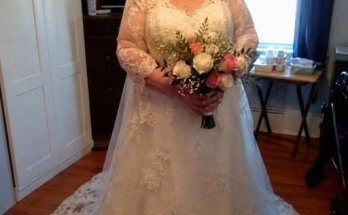
I took a deep breath, smoothing the lace on my dress, and turned toward the officiant.
The ceremony began smoothly. The organist played softly, the sun filtered through the rose bushes, and the officiant delivered a gentle message on second chances in love.
Then came the traditional question: “If anyone present knows of any reason why these two individuals should not be joined in holy matrimony, let them speak now, or forever hold their peace.”
Before the officiant could continue, the heavy wrought-iron garden gate swung open with a sharp metallic clang.
Every head in the small gathering turned. A tall woman in her late fifties stepped into the garden path. Her face was pale, one of her hands clutched a thick manila envelope, and her shoulders trembled slightly as she walked toward the altar.
Harold’s warm smile vanished instantly. His posture went rigid, and his face turned ash-gray.
“Margaret?” the woman called out, her voice unsteady but clear. “Your children contacted me two days ago. They told me this envelope had to reach your hands personally before you signed any legal documents.”
Harold immediately stepped off the altar platform, placing his body directly between the woman and me.
“This is completely inappropriate!” Harold raised his voice, pointing toward the gate. “This is a private private ceremony. Leave right now or I will call security!”
“Move out of the way, Harold,” the woman replied steadily, completely unfazed by his outburst. She stepped around him and extended her arm, pressing the thick manila envelope directly into my hands.
My fingers trembled as I unsealed the top clasp and pulled out a stack of court documents, bank records, and certified legal affidavits.
The top document was a certified marriage record from two counties over, accompanied by a recent decree of power of attorney and a fraud complaint.
I began reading through the pages, the words blurring before my eyes:
Harold was not a retired civil engineer, nor was he single. He was currently named in three active civil lawsuits for financial fraud involving elderly widows. Over the past six years, he had operated under slightly altered aliases, marrying or securing power-of-attorney rights over senior women, gradually transferring their property and liquid savings into private holdings before disappearing.
The woman standing in front of me was his legal wife’s daughter—a woman whose mother had been left financially ruined two years prior.
My children hadn’t skipped the wedding out of disrespect or greed. They had spent the last two weeks tirelessly investigating Harold’s past, tracking down court records across state lines, and locating his previous victims to protect me from total financial and emotional ruin.
My bridal bouquet slipped from my frozen fingers, crashing into the grass below.
I slowly looked up from the documents to face Harold.
He wasn’t confused. He wasn’t offering an immediate explanation. He stood frozen under the floral arch, staring at the papers in my hand with a look of sheer, unmasked terror. The gentle, old-fashioned gentleman I thought I knew had vanished entirely, replaced by a calculating stranger caught in his own trap.
“Maggie…” he began, his voice lacking its smooth confidence. “I can explain… it’s not what it looks like…”
“Do not say another word,” I said, my voice steady and quiet.
I turned away from the altar, stepped past the empty chairs in the front row, and walked out of the garden without looking back. Ten minutes later, I called David and Sarah. When they picked up the phone, I didn’t offer excuses—I simply thanked them for loving me enough to look past my anger and protect me when I couldn’t protect myself.