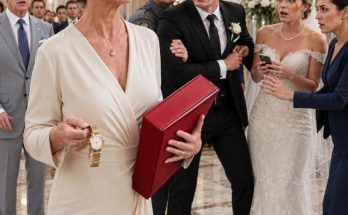
My father glared at her.
She ignored him.
“Tax debt. Vendor lawsuits. Loans.”
I stared at Dad.
“And my house?”
Mom cried harder.
“He needed collateral.”
I understood.
Suddenly, horribly.
“The house wasn’t for Grant.”
Grant looked at Dad.
“What?”
Mom shook her head.
“Martin planned to transfer it to Grant, then have Grant take a loan against it. If the company recovered, he’d repay it.”
“And if it didn’t?”
Nobody answered.
Grant whispered, “I’d be responsible.”
Dad said, “You would’ve been protected.”
Grant laughed.
It was ugly.
Disbelieving.
“You used Claire to use me.”
There it was.
The family hero finally realizing he had never been the favorite.
He had only been useful.
But Uncle Raymond was staring at the insurance papers.
“There’s still something wrong.”
I looked at him.
“What?”
“The settlement.”
He pointed.
“If Rachel caused the crash, why was Grant paid?”
I had wondered the same thing.
So had the investigator I hired two weeks earlier.
That was the final document still inside my envelope.
I pulled it out.
My father whispered, “Claire.”
His voice was different now.
Afraid.
Really afraid.
I unfolded the photocopy.
“The $180,000 check was issued to Grant Bennett.”
Grant nodded.
“But it was deposited into a joint custodial account.”
Grant frowned.
“What account?”
I looked at him.
“You seriously don’t know?”
His face emptied.
I read the names.
“Martin Bennett.”
Dad closed his eyes.
“And Grant Bennett.”
Grant stared.
“I never had a joint account with Dad.”
“No.”
I placed the second page down.
“You were listed because you were twenty-two. But the withdrawal authorization…”
My hands began trembling again.
“…was signed by Dad.”
Grant grabbed the statement.
His eyes raced across it.
Then his face went white.
“You took it.”
Dad said nothing.
“You took the money?”
Grant’s voice cracked.
“All of it?”
Mom whispered, “Martin…”
Grant turned on her.
“You told me it paid Claire’s medical bills!”
Rachel covered her face.
I stared at Dad.
Eleven years.
Every accusation.
Every guilt trip.
Every time they told me Grant had sacrificed financially for me.
The $180,000 had never belonged to Grant in any meaningful way.
My father had taken it.
“What did you spend it on?” I asked.
Dad sank into his chair.
His answer was barely audible.
“The company.”
Grant laughed again.
Then he started crying.
Not dramatically.
Not loudly.
He simply stood there holding a bank statement, tears running down his face.
“You made me hate her.”
Dad looked up.
Grant pointed at me.
“You told me she was ungrateful. You said I gave up that money because of her.”
Dad said, “I was trying to keep us together.”
“You destroyed us.”
For the first time in eleven years, I looked at my brother and saw something other than resentment.
I saw another victim.
Not innocent.
He had lied.
He had accepted the hero story.
He had used it against me whenever it benefited him.
But he had also been manipulated.
The difference was that I was finally ready to stop excusing anyone.
I picked up my envelope.
“My attorney already has copies.”
Dad stood.
“What attorney?”
“The one handling the forged deed.”
Mom gasped.
“And the insurance records.”
Dad’s face collapsed.
“And the investigator interviewed the paramedic yesterday.”
Grant stared at me.
“You knew before today?”
“Most of it.”
“Why come here?”
I looked around the backyard.
At every relative who had heard me called selfish.
At every person who had watched my family remind me of what I supposedly owed.
“Because lies survive best in private.”
No one spoke.
I walked toward the gate.
“Claire!”
Rachel ran after me.
I turned.
Her face was soaked with tears.
“I was the one who pulled you out.”
I froze.
“What?”
She wiped her face.
“The paramedic didn’t know because I ran before they arrived.”
I couldn’t breathe.
Rachel stepped closer.
“The car landed sideways. You weren’t wearing your seat belt right. Your head hit the window. There was water coming into the ditch.”
Her voice shook.
“I couldn’t open your door.”
I stared at her.
“So I broke the rear window with a tire iron.”
Her hands were trembling.
“I cut my palms pulling the glass out. I crawled inside. You weren’t moving.”
Memories flashed.
Rain.
Blood.
Someone screaming my name.
Small hands pulling my jacket.
Rachel.
Not Grant.
“I dragged you through the back window,” she whispered. “Then I called 911 from a house down the road.”
“Why run?”
“Because Dad came.”
I looked past her.
My father was standing beside the table.
Rachel continued.
“He told me if police found me there, everything was over. He made me leave with Mom.”
My throat burned.
“And Grant?”
Rachel looked at him.
“Dad called him later.”
I closed my eyes.
The family hero had never saved me.
The family screwup had.
A frightened fifteen-year-old girl who caused the crash had also risked her life to pull me from it.
I should have hated her.
Part of me did.
But the truth was more complicated than hate.
She had made a terrible choice.
Then she had saved me.
Then adults had buried the truth and built a family hierarchy out of the lie.
Rachel whispered, “I wanted to tell you so many times.”
“Why didn’t you?”
Her answer destroyed me.
“Because every time I tried, Dad reminded me you loved Grant because you thought he saved you.”
I stared at her.
“He said if you learned I caused the crash, you’d hate me forever.”
I looked at my father.
And suddenly I understood the full cruelty of what he had done.
He had not merely hidden a crime.
He had designed relationships.
He made me indebted to Grant.
He made Grant resent me.
He made Rachel fear me.
He made Mom complicit.
And he kept himself in the center, the only person who knew enough truth to control everyone.
I opened the gate.
Dad shouted my name.
I turned one last time.
He looked smaller than I had ever seen him.
“You’re destroying this family,” he said.
I shook my head.
“No, Dad.”
I looked at Grant.
At Rachel.
At my mother.
Then at him.
“I’m just the first person who stopped protecting the man who already destroyed it.”
I left.
Six months later, my house was still mine.
The forged deed investigation uncovered two other fraudulent loan documents tied to my father’s business.
Bennett Commercial Supply filed bankruptcy.
My father eventually pleaded guilty to fraud-related charges under a deal that spared my mother prosecution in exchange for her cooperation.
Grant sold his truck and closed his struggling contracting company.
He also did something I never expected.
He repaid me.
Not all at once.
He showed up one morning with a cashier’s check for $22,000—the exact amount I had loaned his business years earlier.
“I should’ve done this a long time ago,” he said.
I took the check.
“I’m not forgiving everything.”
“I know.”
“But this is a start.”
He nodded.
Then he left.
Rachel took longer.
For months, we barely spoke.
Then one rainy night in October, she came to my house carrying a cardboard box.
Inside was the sweatshirt she had worn the night of the crash.
Our mother had kept it hidden in the attic.
The fabric was faded.
One sleeve was torn.
And across the front were dark brown stains that time had never erased.
Blood.
Mine.
And hers.
I sat on the floor holding it while Rachel cried beside me.
Then something fell from the box.
A tiny silver pendant.
A crooked little star.
I recognized it instantly.
I had given it to Rachel when she turned thirteen.
“I thought this was lost,” I whispered.
She shook her head.
“You were holding it when I pulled you out.”
I turned it over.
On the back, barely visible beneath scratches, were four engraved words:
YOU’RE MY LITTLE HERO.
I stared at them.
Rachel stared too.
Neither of us spoke.
Eleven years before the accident, when she had been four and afraid of thunderstorms, she used to crawl into my bed.
One night, after she tried to protect me from what she called “the sky monsters,” I had jokingly called her my little hero.
Years later, I had engraved it on that necklace.
And somehow, on the worst night of our lives, those words had come true.
Not cleanly.
Not beautifully.
But truly.
Grant had never been the hero.
Rachel had never been only the villain.
And I had never been the debtor.
The strangest truth was that the person who almost killed me was also the person who refused to leave me in that car.
I closed my fingers around the pendant.
Rachel whispered, “Do you think you’ll ever forgive me?”
I looked at her.
Then I took her scarred hands in mine.
“I don’t know.”
She nodded.
And strangely, she looked relieved.
Because for the first time in our family, the truth didn’t need to be softened.
I continued.
“But I want to know you without Dad’s version of you.”
Her face crumpled.
“So maybe we start there.”
Outside, rain tapped gently against the windows.
For years, that sound had made me uneasy without knowing why.
That night, it sounded different.
Not like an accident.
Not like fear.
Like something being washed clean.
And as my sister sat beside me beneath the roof of the house my father had tried to steal, I finally understood something I should have learned years ago:
Gratitude should never be a prison.
Love should never require a debt.
And the truth, no matter how ugly, is still kinder than a beautiful lie designed to control your entire life.