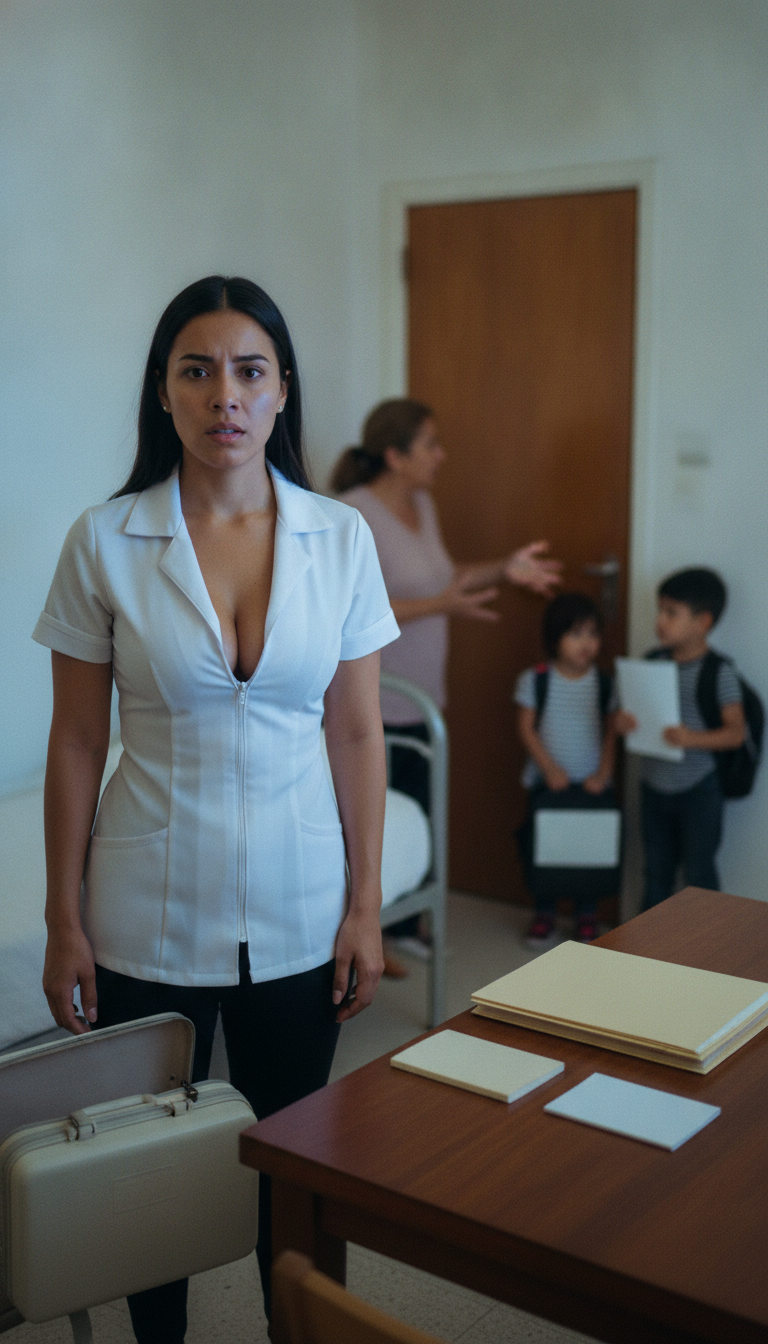
The call cut before I reached the hostel gate.
I did not remember wearing slippers.
I did not remember locking my room.
I only remembered the word.
Dubai.
It sat inside my skull like a match near kerosene.
By the time I reached Seelampur, my night-duty friend Farzana was driving the hospital ambulance van because no cab would come fast enough and she had looked at my face once before saying, “Get in.”
My mother’s lane was awake.
Not fully.
But enough.
Two neighbours stood near the paan shop whispering. A police bike was parked outside our building. The staircase smelled of damp cement, fried onions, and fear.
I ran up two floors.
Our door was open.
Inside, the house looked like a small storm had passed through it.
School papers scattered across the floor.
One broken lunchbox near the sofa.
Ishvi sat in the corner clutching Tavish, both of them crying silently.
My mother sat on the plastic chair, face grey, lips moving in prayer.
And Pragyara stood near the almirah with a torn file in her hands.
The moment she saw me, she smiled.
That scared me more than her anger.
“Finally,” she said. “The responsible guardian has arrived.”
I walked straight to Ishvi.
She threw herself at me so hard I almost fell.
“Masi, Mumma was tearing my papers.”
Tavish hid behind my kurta.
I looked at Pragyara.

“Give me the file.”
She lifted her chin.
“You left this house. You don’t get to give orders here.”
Farzana entered behind me, still wearing her hospital ID around her neck.
“No problem,” she said calmly. “I love calling police twice in one night.”
Pragyara’s smile vanished.
I saw the school file on the floor beside the sofa.
Blue cover.
Ishvi’s name written on top.
I picked it up before anyone could stop me.
Inside were photocopies.
My Aadhaar card.
My hospital ID.
My salary slip.
My bank statement.
A signed declaration.
**Primary guardian: Mriganayani Keshri.**
**Financial sponsor: Mriganayani Keshri.**
**Medical consent provider: Mriganayani Keshri.**
The signature beneath each line looked like mine.
Almost.
The M was too sharp.
The y had no loop.
But to a school clerk, it would pass.
Because nobody expects a mother to forge her sister’s name to escape her own children.
I turned the next page.
A petition draft.
**Transfer of legal custody due to biological mother’s overseas employment relocation.**
My breath stopped.
Overseas employment.
Relocation.
Pragyara had planned to leave.
Not for a week.
Not for a site visit.
Leave.
I looked up slowly.
“You were going to Dubai.”
She folded her arms.
“For work.”
“And the children?”
Her eyes flicked toward Ishvi and Tavish.
There was irritation there.
Not shame.
“They are settled here. Their school is here. Ma is here. You are here.”
I laughed once.
It hurt.
“You mean your maid is here.”
Pragyara’s face hardened.
“Don’t be dramatic. I was arranging everything legally.”
“By forging my signature?”
“You were already doing everything!” she shouted. “Who took them to school? You. Who paid fees when I was short? You. Who handled doctor appointments? You. So what is the big crime if papers say the truth?”
“The truth?” I stepped closer. “The truth is you wanted to run to Dubai and leave your children like unpaid luggage.”
My mother whispered, “Mrigu, don’t say such things.”
I turned to her.
“You knew.”
Her eyes filled.
“Your sister got a good opportunity.”
I stared at her.
“And my life?”
She looked away.
That answer finished something.
Not loudly.
Not with a crack.
Just finished.
Pragyara pointed toward the door.
“You left, remember? You said I should remember they are mine. Fine. They are mine. So I decide what is best.”
Ishvi’s small hand tightened around my dupatta.
“Masi, Mumma said Dubai has no place for children.”
Tavish whispered, “She said we will disturb her new uncle.”
The room went dead.
Pragyara’s face went white.
Farzana looked at me.
New uncle.
I turned to my sister.
“Who?”
Nobody spoke.
Then my mother began crying.
That was when I knew the worst part had not arrived yet.
I picked up the torn file from the table.
Behind the school custody draft was a printout.
Flight ticket.
Delhi to Dubai.
Passenger: Pragyara Keshri.
Passenger: Rohan Mehra.
Departure: Monday night.
My stomach turned.
Rohan Mehra.
I knew that name.
Not as family.
Not as fiancé.
As the married builder from Noida Extension whose flats Pragyara sold.
The man who sent her late-night “client updates.”
The man whose wife had once called our house and Pragyara had told me, “Some women are insecure for no reason.”
I held up the ticket.
“You were leaving with him?”
Pragyara snatched for it.
I moved back.
“He is separated,” she hissed.
Farzana muttered, “Of course. Men are always separated when hotels have rooms.”
Pragyara ignored her.
“You don’t understand, Mrigu. You never had ambition. You never wanted more than hospital shifts and school tiffins.”
I looked at her children.
Their faces were wet.
Their eyes were wide.
They were old enough to hear.
Too young to survive what they heard.
I lowered my voice.
“Ambition does not require abandoning your children.”
She laughed bitterly.
“You can say that because they love you more anyway.”
There it was.
Not guilt.
Jealousy.
For five years, she had given me her children like chores, then hated me because they reached for me in sleep.
The policewoman who had been sitting near the door stood.
I had not even seen her properly until then.
She was from the child welfare unit, perhaps forty, with tired eyes and a notebook in hand.
“Mrs. Pragyara Keshri,” she said, “you told the school you were temporarily transferring caregiving due to a one-month training program.”
Pragyara’s jaw tightened.
“It changed.”
“To permanent relocation?”
“I was going to update.”
The officer looked at the forged signatures in my hand.
“With your sister’s forged consent?”
Pragyara’s confidence cracked.
Only slightly.
Enough for me to see fear.
My mother stood suddenly.
“Madam, please. Sisters fight. Don’t make case. Children will suffer.”
The officer looked at Ishvi and Tavish.
“They are already suffering.”
For once, someone said it in that house.
For once, the suffering did not have my name alone.
Pragyara began crying then.
Not real crying.
Beautiful crying.
Mascara untouched.
Voice trembling just enough.
“I am a single mother. Nobody understands my pressure. My husband left. Clients exploit me. I am doing everything alone.”
I almost laughed.
Alone.
She had not packed one lunchbox in five years.
She had not once sat through Tavish’s nebulizer at 3 a.m.
She had forgotten Ishvi’s class section twice.
But suffering looks more convincing when spoken by the person who caused it.
The officer turned to me.
“Do you wish to confirm that these signatures are yours?”
“No.”
“Were you aware of this custody petition?”
“No.”
“Did you consent to becoming legal guardian?”
I looked at Ishvi.
Her eyes were begging.
Not for documents.
For me.
My answer had to be careful.
Children are not revenge weapons.
“No,” I said. “But I will not let the children be harmed.”
The officer nodded, as if she understood exactly how heavy that sentence was.
Pragyara’s face changed.
Hope entered it.
The old hope.
The ugly hope.
See? Mrigu will do it.
Mrigu always does it.
I saw it.
And I killed it.
“I will cooperate with child welfare,” I continued. “Not with forged papers. Not as my sister’s servant. Not so she can disappear. Any temporary care arrangement must be court-monitored, with financial responsibility on the biological parent.”
Pragyara’s mouth opened.
No sound came.
Farzana smiled.
My mother whispered, “Beta…”
I turned to her.
“No.”
She flinched.
I had never said it to her like that before.
“No more beta. No more adjust. No more ‘your sister needs help.’ No more using me because I love these children.”
Tavish began crying again.
I knelt in front of him.
“This is not your fault,” I said softly. “Listen to me. None of this is your fault.”
He sobbed, “Will you leave again?”
The question cut deep.
Because the honest answer was not easy.
I cupped his face.
“I will not disappear. But I cannot live here like before.”
He did not understand fully.
But Ishvi did.
She was nine, and nine-year-old girls in bad homes understand too much.
“Masi,” she whispered, “can we come with you?”
The room broke.
My mother covered her mouth.
Pragyara snapped, “No. Enough. This emotional blackmail ends now.”
The officer looked at her sharply.
“Lower your voice.”
“This is my house!”
“No,” I said.
Everyone turned.
I walked to the almirah, opened the lower drawer, and pulled out the old rent file.
My mother kept everything.
Electricity bills.
Ration card copies.
Father’s death certificate.
I had seen the documents many times but never cared.
Now I opened the file with hands that no longer trembled.
The original allotment paper was inside.
Name: **Bhagwati Prasad Keshri.**
My father.
Below it, after his death, the mutation application.
Applicant: **Shakuntala Devi Keshri.**
Nominees listed:
Pragyara Keshri.
Mriganayani Keshri.
Equal daughters.
I placed it before my mother.
“This is not your house alone.”
She looked away.
Pragyara stared at the paper.
She had not known.
Good.
Some daughters are kept ignorant.
Some are kept arrogant.
Both serve the same household lie.
I said, “If you want rent, Ma, we will calculate property share. Five years of expenses also. School fees. Groceries. Medicines. Childcare hours. Hospital leave lost. Everything.”
Pragyara whispered, “You won’t.”
I looked at her.
“I left once. Try me again.”
At 2:40 a.m., the child welfare officer sealed the school file in an evidence envelope.
Pragyara was told not to leave Delhi until inquiry.
Her passport was photographed.
Rohan Mehra’s name was noted.
My mother sat silently, as if age had finally reached her in one night.
I took Ishvi and Tavish with me to the hospital hostel for that night only, officially recorded as emergency protective supervision in the presence of the officer.
Pragyara objected.
The officer asked, “Do you have their inhaler?”
She did not.
“Do you know the dosage?”
She did not.
“Do you know their school transport number?”
She did not.
I answered all three.
That ended the argument.
In the auto, Tavish fell asleep with his head in my lap.
Ishvi sat beside me, clutching the little Ganesh idol I had packed in my trolley bag.
“Masi,” she whispered, “will Mumma go to jail?”
“I don’t know.”
“Will you?”
“No.”
“Because your signature was there.”
“It was not my signature.”
“But teacher thought it was.”
I looked out at the dark roads of Delhi, at shutters down, dogs sleeping, one tea stall still open under a yellow bulb.
“Sometimes adults lie so confidently that good people believe them,” I said. “That does not make the lie true.”
She leaned against me.
“I don’t want to go to Dubai.”
I closed my eyes.
“You won’t.”
By Monday afternoon, Pragyara’s career began to fall apart.
Rohan Mehra’s wife came to the school.
Not quietly.
She arrived in a white SUV, slapped him in the parking lot, and told the welfare officer he had already emptied money from a joint account for “Dubai expansion.”
By evening, his company suspended him.
By night, Pragyara called me from an unknown number.
This time, she was not angry.
She was shaking.
“Mrigu,” she whispered, “Rohan is saying I trapped him. His wife is threatening police. Ma is not speaking to me. Please come home. Please just say signatures were a misunderstanding.”
I stood in the hostel corridor, watching Ishvi help Tavish color a dinosaur blue because “green is overused.”
“No.”
“You are enjoying this?”
“No. I am surviving it.”
“My children need stability.”
I looked at them.
“They needed that five years ago.”
She began crying.
“Please. I made one mistake.”
“One mistake?” I said softly. “A mistake is forgetting tiffin. You forged my identity, tried to transfer your children to me, planned to leave the country, and made your daughter carry custody papers in her school bag.”
Silence.
Then she said something so ugly I knew it was true.
“You love being needed.”
My chest tightened.
She continued, “Don’t act pure. You liked that they ran to you. You liked being better than me.”
I almost answered in anger.
But Ishvi looked up then and smiled because Tavish had drawn the dinosaur with doctor glasses.
My anger changed shape.
Became calmer.
Sharper.
“No, Pragya,” I said. “I liked loving them. You are the one who made love look like labour.”
I ended the call.
Three days later, we went to the child welfare office.
I wore my cleanest cotton kurta.
My mother came with Pragyara.
She looked smaller.
Pragyara looked ruined.
No blow-dry.
No polished nails.
No confidence borrowed from men with cars.
The officer placed three options before us.
One: children remain with mother under supervision, with mandatory counselling and periodic school reporting.
Two: temporary kinship care with me, court-monitored, with financial support from mother.
Three: formal custody proceedings if neglect and fraud were proven.
Pragyara immediately said, “I am their mother.”
Ishvi looked at the table.
Tavish clung to my sleeve.
The officer noticed.
So did my mother.
For the first time in my life, my mother looked ashamed.
Not because neighbours would talk.
Because two small children had answered without speaking.
The officer asked Ishvi gently, “Beta, where do you feel safe?”
Ishvi’s lips trembled.
Pragyara leaned forward.
“Ishu, tell properly.”
The officer lifted a hand.
“No prompting.”
Ishvi looked at me.
Then at her mother.
Then whispered, “With Masi. But I want Mumma to want us also.”
Pragyara burst into tears.
Real ones this time.
Messy.
Ugly.
Late.
Tavish said, “I want Mumma to know my inhaler.”
That broke even Farzana, who had come as my witness and pretended she was only there because she liked government paperwork.
The officer recorded temporary kinship care for thirty days.
Not because I asked.
Because the children did.
Pragyara was ordered to pay a fixed monthly amount into a monitored account for school, food, transport, and medical needs.
She looked at me when the amount was announced.
It was less than she spent on hair treatments.
Still, her face twisted.
Good.
Responsibility should have weight.
On the way out, my mother stopped me near the stairwell.
“Mrigu.”
I turned.
She touched my arm, then withdrew her hand as if she no longer knew whether she had the right.
“I was wrong.”
I waited.
She swallowed.
“I made you the son, daughter, maid, nurse, everything. Because you did not refuse. Because she always did.”
It was not enough.
But it was the first true thing she had said.
“I needed a mother too,” I said.
Her face crumpled.
“I know.”
“No,” I said. “You are learning now.”
I walked away before her tears could become my work again.
That night, in my tiny PG room, I cooked Maggi on a hot plate while Ishvi and Tavish sat on the bed doing homework.
There was barely space to turn.
The window still faced a wall.
The bathroom tap leaked.
The fan made a clicking sound.
But no one called me a free guest.
No one charged me for breathing.
Tavish ate his Maggi and said, “Masi, tomorrow can you put extra masala?”
I looked at him.
“Tomorrow your mother is coming to learn tiffin packing.”
His eyes widened.
“Really?”
“Yes.”
Ishvi looked uncertain.
“Will she come?”
I did not know.
But I said, “We will see.”
At 10:18 p.m., after the children slept, my phone buzzed.
Unknown number.
For one tired second, I thought it was Pragyara again.
It was not.
The message was a photograph.
A scanned page from the custody file.
My forged signature circled in red.
Below it, a line typed neatly:
**Your sister did not forge this. She only submitted it. Ask your mother who signed first.**
My breath stopped.
A second photograph arrived.
Old.
Yellowed.
My mother sitting at a desk.
A pen in her hand.
The school admission form in front of her.
My name written as guardian.
My signature already practiced on rough paper beside it.
Then the final message came.
**Some prisons are built by mothers before sisters learn how to use them.**
I looked at the sleeping children.
Then at the small Ganesh idol near the window.
My phone rang.
This time, the caller ID showed no name.
Only one word.
**MA.**