Her own aunt and uncle abandoned Emma, an orphaned little girl, in the middle of nowhere with only the clothes on her back, but what happened next made that moment not the end.
It became the beginning of something no one in that family had expected.
At first, Emma thought the SUV would come back.

She stood on the shoulder of the country road with the baby tucked against her chest and watched the bend where the taillights had vanished.
The rain was not heavy yet.
It was the mean kind, cold and thin, the kind that soaked slowly through cotton and made every breath feel smaller.
Her bare feet pressed into gravel.
The little stones bit her skin, but she did not move at first because Aunt Sarah had said to wait.
Grown-ups came back when they said wait.
That was one of the rules Emma still believed in because she was eight, and because too many other rules had already broken.
Her mother was supposed to come home from work.
Her father was supposed to fix the loose kitchen cabinet like he promised.
The baby was supposed to sleep in the bassinet near the window while Emma drew pictures on the floor.
Instead, there had been a crash.
There had been a police report.
There had been hospital voices speaking softly over Emma’s head.
There had been a nurse who gave her a paper cup of apple juice and kept saying, “Sweetheart, I’m so sorry,” like saying it enough times could make the world put itself back together.
Her parents had been gone for thirty-two days.
Thirty-two days was long enough for adults to stop bringing casseroles.
Long enough for people to stop whispering when Emma walked into the room.
Long enough for Aunt Sarah to begin sighing every time the baby cried.
Long enough for Uncle David to start looking at bills instead of looking at Emma.
The first week after the funeral, they had acted gentle.
Aunt Sarah brushed Emma’s hair and told her she was brave.
Uncle David carried boxes from the old apartment to the garage and said, “We’ll figure this out.”
But by the second week, “we” started sounding like a burden.
By the third, Aunt Sarah stopped calling the baby by his name.
She called him “him.”
Then “that baby.”
Then, one night when she thought Emma was asleep on the couch, “the problem.”
Emma did not know how money worked, not really.
She knew bills came in envelopes.
She knew Aunt Sarah opened them at the kitchen table with her mouth pressed into a hard line.
She knew Uncle David rubbed his forehead whenever the baby needed formula.
She knew nobody wanted to talk about the cardboard box marked BABY THINGS that had been pushed into the laundry room like it had done something wrong.
That morning, Aunt Sarah had packed quickly.
Not like a trip.
Like escape.
She put one bottle in a tote bag, then took it out again.
She folded a blanket around the baby, then unfolded it and chose a thinner one.
Uncle David stood by the back door with the keys in his hand.
Emma had asked where they were going.
“To get some air,” Aunt Sarah said.
Her voice had that tight sound adults used when they had already decided not to explain.
They drove for a long time.
Long enough that houses thinned out.
Long enough that the gas stations disappeared.
Long enough that Emma stopped recognizing anything outside the window.
The baby slept against her lap in the back seat.
Aunt Sarah did not turn on the radio.
Uncle David kept both hands on the wheel.
At 6:32 p.m., according to the dashboard clock Emma could barely see from the back seat, the SUV pulled onto the shoulder.
Aunt Sarah got out first.
She opened Emma’s door and lifted the baby from the seat.
For one foolish second, Emma thought maybe the baby needed changing.
Then Aunt Sarah pushed the bundle into Emma’s arms.
“Take care of him,” she said.
Emma blinked up at her.
“What?”
“You’re the older one.”
Uncle David did not get out.
He stared through the windshield.
Emma could see only the side of his face, the muscle jumping near his jaw.
Aunt Sarah pulled Emma by the elbow until both of Emma’s bare feet were on the gravel.
Emma had forgotten her shoes because Aunt Sarah had told her to hurry.
The baby stirred and made a small sound.
“Aunt Sarah, where are you going?” Emma asked.
Aunt Sarah looked down the road, not at Emma.
“Just wait here.”
Then she closed the door.
The sound was not loud.
It was ordinary.
That made it worse.
The SUV pulled away in a slow crunch of tires over wet gravel.
Emma stood there with the baby in her arms and watched the red taillights shrink.
She waited.
One minute.
Three.
Five.
At first, she told herself they had gone to turn around.
Then she told herself they had forgotten something.
Then she told herself grown-ups did not leave children on empty roads because that was not something real people did.
But the road stayed empty.
The baby woke fully and began to cry.
Emma shifted him higher against her chest.
“Shhh,” she whispered.
She had seen her mother do that.
Her mother had moved like holding a baby was part of breathing.
Emma moved like every part of her might break if she got it wrong.
“Shhh, it’s okay.”
The baby cried harder.
The rain slid down Emma’s hair and into her collar.
Her dress clung to her knees.
She turned toward the road, still hoping for the SUV.
“Uncle David!” she screamed.
Her voice went thin over the fields.
“Aunt Sarah!”
No one answered.
A crow lifted from a fence post and vanished into the trees.
Emma’s arms began to shake.
She looked at the baby’s face, red and wet and furious with hunger.
He had no idea they had been thrown away.
He only knew cold.
He only knew the small body holding him was not enough.
That was when Emma understood.
They were not coming back.
There are moments when childhood does not fade.
It gets cut.
One minute you are waiting for an adult to fix the world, and the next you realize the adult was the danger.
Emma sat down on the roadside because her knees gave out.
She pressed the baby under her chin and tried to cover him with her body.
She thought of her mother’s sweater, the blue one that smelled like vanilla lotion.
She thought of her father singing badly while washing dishes.
She thought of the boxes Aunt Sarah had packed after the funeral.
Kitchen.
Books.
Photos.
Baby things.
Lives reduced to marker words on cardboard.
Emma had asked if she could keep the picture from the hallway.
Aunt Sarah said later.
Later had become never.
Now never was standing on a road in the rain.
The baby screamed again.
“I know,” Emma whispered.
She did not know.
But she knew he needed to hear a voice that was not leaving.
Then the howl came.
It rolled from somewhere beyond the trees, low and long enough to make the hair rise at the back of Emma’s neck.
She froze.
The fields had gone darker.
The road, which had seemed empty before, now seemed hungry.
Emma stood up so quickly she almost slipped.
“No,” she said.
The baby’s cries broke into choking little bursts.
Emma looked left.
Nothing.
She looked right.
Nothing.
No porch light.
No gas station.
No passing car.
Only wet grass, ditch water, fence posts, and trees closing in under the gray sky.
She began walking.
The first few steps were on gravel.
Then her feet hurt too badly, so she moved into the grass along the edge of the road.
The grass was colder.
It soaked her legs.
Every few yards, mud sucked at her toes.
She kept one hand under the baby’s head because she remembered her mother saying babies could not hold their heads up yet.
She kept the other arm tight around his back.
“I’m here,” she said.
The words came out again and again.
“I’m here. I’m here.
I’m here.”
She said it until it sounded less like comfort and more like a rope she was throwing into the dark.
At 6:47 p.m., Emma saw the lights.
She stopped so suddenly the baby jerked in her arms.
They were not moving.
They were not headlights.
They were square and warm and steady.
House lights.
For a moment, Emma was more afraid of them than of the road.
A house meant people.
People could help.
People could also shut doors.
She had learned that in thirty-two days.
Still, the baby was crying weaker now.
That frightened her more than the crying had.
Emma left the road and crossed the ditch.
Mud climbed between her toes.
She slipped once and caught herself with her free hand, scraping her palm against a rock.
She did not let the baby fall.
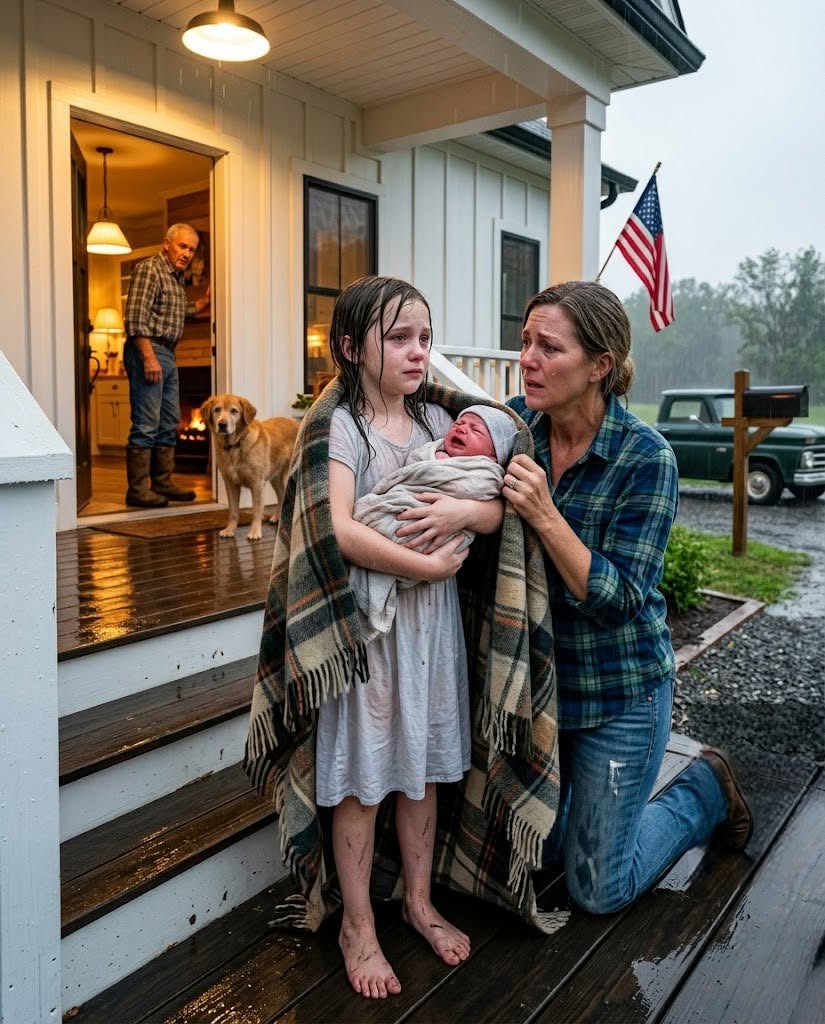
The house came into shape as she got closer.
A small farmhouse.
A pickup truck near the porch.
A white mailbox at the end of the gravel driveway.
A little American flag on a bracket beside the steps, wet and drooping in the rain.
Smoke lifted from the chimney in thin gray lines.
The sight of it made Emma’s chest hurt.
It looked like a place where people had dinner.
It looked like a place where someone might say, “Take your shoes off before you track mud in,” because they expected you to have shoes.
Emma climbed the porch steps.
The boards were slick under her feet.
Before she could knock, a dog began barking inside.
Deep, booming barks that made the baby start crying hard again.
The door opened.
A woman stood there in jeans and an old flannel shirt, her hair pulled back, her face sharp with alarm.
“Who’s out there?” she called.
Emma tried to speak.
Her mouth opened.
Nothing came out.
The baby answered for her.
The woman’s face changed before Emma understood why.
Her eyes dropped from Emma’s soaked hair to her bare feet.
Then to the baby.
Then to the road behind them.
“Oh my God,” she whispered.
She stepped out into the rain without shoes.
That was the first thing Emma noticed.
The woman did not stop to put on boots.
She did not ask a question first.
She did not look annoyed.
She came straight down onto one knee in front of Emma and pulled a thick blanket from the porch bench around both children.
“You poor babies,” she said.
Her voice cracked on babies.
“What happened to you?”
Emma stared at her.
The woman smelled like laundry soap, woodsmoke, and coffee.
Her hands were warm.
Emma had forgotten hands could be warm without taking something from you.
“Where are your people?” the woman asked.
Emma swallowed.
“My aunt,” she managed.
The woman went still.
“What did your aunt do?”
Emma looked at the driveway.
She looked at the mailbox.
She looked at anything except the woman’s face.
“She told me to wait.”
The woman’s mouth tightened, but she did not say the words adults say when they want children to stop telling the truth.
She did not say maybe you misunderstood.
She did not say your aunt will be back.
She just nodded once, like she had already decided Emma would not be argued out of what had happened to her.
“Come inside,” she said.
Emma hesitated.
The woman softened her voice.
“I’m Mary,” she said.
Emma did not answer.
Mary did not seem offended.
She lifted the baby gently from Emma’s arms, then immediately tucked him back against Emma when Emma made a panicked sound.
“Okay,” Mary said. “Okay, you hold him.
I’ve got you both.”
That mattered.
Emma did not have words for why, but it mattered.
Mary guided her into the house.
Heat hit Emma so hard she flinched.
A fire burned in the living room.
A lamp glowed near a worn brown couch.
On the wall by the hallway hung a framed map of the United States, the glass shining softly in the light.
A pair of work boots sat by the back door.
A mug of coffee steamed on the kitchen counter.
Normal things.
Safe things.
Things from a life that had not been torn open and packed into boxes.
Mary shut the door behind them and called, “Tom!”
An older man appeared from the hallway.
He wore a faded baseball cap and a work shirt with one sleeve rolled higher than the other.
He stopped when he saw Emma.
His eyes moved over the mud, the wet dress, the baby, the blanket.
“What in God’s name,” he whispered.
“Get towels,” Mary said.
He moved immediately.
No questions.
No argument.
No complaint about the floor.
Mary led Emma to the couch and knelt in front of her.
“I need to check him, sweetheart,” she said. “Just to make sure he’s breathing okay and not too cold.
You can keep your hands on him.”
Emma nodded because nodding was easier than trusting.
Mary peeled the thin wet blanket away from the baby’s face.
He was tiny.
Smaller than he should have looked in that big room.
His cheeks were blotchy from crying.
His cap had slipped to one side.
Mary reached to straighten it.
Then she stopped.
The whole room seemed to pause with her.
The fire kept crackling.
Rain tapped the windows.
Somewhere in the kitchen, the refrigerator hummed.
Mary stared at the baby’s face.
The color drained from her cheeks.
Emma felt the old fear return.
“What?” she whispered.
Mary did not answer.
She lifted the edge of the cap with two fingers.
The baby squirmed.
Mary’s breath caught.
“No,” she said, but it came out like a prayer and a denial at once.
Tom came back with towels and stopped halfway across the room.
“Mary?”
Mary looked at the baby like she was seeing a ghost that had learned how to cry.
She touched the edge of the blanket near his collar.
There, just below his left collarbone, was a small crescent-shaped birthmark.
Emma had seen it before.
She had never thought it meant anything.
Mary covered her mouth.
Tom’s towel slipped from one hand.
“Mary,” he said again, quieter now.
The baby fussed.
Emma pulled him closer.
“Do you know him?” she asked.
Mary’s eyes filled.
She sat back on her heels as if her legs could no longer hold her.
“I don’t know,” she said.
But everybody in that room heard the lie.
Tom moved closer slowly.
“Let me see.”
Mary shook her head once, not to refuse, but because the whole thing seemed impossible.
Then something slid from the baby’s wet blanket.
It landed on the rug near Emma’s foot.
A hospital bracelet.
Emma had not known it was there.
Maybe Aunt Sarah had not noticed it.
Maybe she had noticed and not cared.
The plastic band was bent and rain-smeared, but the printed label was still partly readable.
Mary picked it up.
Her fingers trembled.
Tom leaned over her shoulder.
Emma saw three things before Mary’s hand closed around it.
11:18 PM.
County Hospital Intake Desk.
And a last name Emma knew from the cardboard boxes in Aunt Sarah’s garage.
Not the baby’s first name.
Not Emma’s.
A family name.
The kind grown-ups acted like children did not notice until the child noticed everything.
Tom sat down hard in the chair across from them.
“No,” he whispered.
Mary looked at him.
All the strength had gone from her face.
“Tom,” she said.
He stared at the bracelet.
Then at the baby.
Then at Emma.
His eyes changed when they landed on her.
Not suspicion.
Grief.
As if Emma had carried a story to their porch without knowing it.
“Sweetheart,” Mary said, turning back to Emma, “who gave you this baby?”
Emma’s throat tightened.
“My aunt Sarah.”
Mary closed her eyes.
Tom’s hand gripped the arm of the chair so hard the veins rose.
“And your uncle?”
“David.”
The names dropped into the room like two stones.
Mary opened her eyes.
“Where are they now?”
Emma looked toward the window.
The rain blurred the dark yard.
“They left.”
Mary made a sound that was almost a sob, almost rage.
Tom stood.
He crossed to the wall phone near the kitchen.
His movements were slow, but not uncertain.
Mary reached for Emma’s scraped hand and wrapped it gently in a towel.
Emma flinched at first.
Then she let her.
Care, she was learning, had a different speed than cruelty.
Cruelty rushed you.
Care waited until you could breathe.
Tom picked up the phone.
Mary looked at the hospital bracelet again.
The baby had quieted now, worn out from crying.
He made a small hiccuping sound in Emma’s arms.
Tom dialed three numbers.
Then he looked at Mary and said, “If this is what I think it is, we are not calling them first.”
Emma did not know who them meant.
But Mary did.
Her face folded.
The operator must have answered because Tom straightened.
“I need to report two abandoned children,” he said.
Emma went cold again.
Report sounded like police.
Police sounded like being taken.
Mary saw it happen.
She leaned close.
“Listen to me,” she said. “You did nothing wrong.”
Emma stared at her.
It was the first time anyone had said that since the crash.
Not be brave.
Not stop crying.
Not help your aunt.
You did nothing wrong.
The sentence went somewhere deep, but it did not fix everything.
Nothing that broken fixed all at once.
Tom gave the dispatcher the road marker from the mailbox and the time.
He described the SUV as best as Emma could remember it.
Dark gray.
One dent near the back.
A sticker on the rear window.
He wrote it down on the back of an envelope with a hardware store logo while Mary brought warm milk for Emma and formula for the baby from a can she found in an emergency donation box at the back of the pantry.
Emma watched every move.
The scooping.
The shaking.
The testing of drops against Mary’s wrist.
Her mother used to do that.
Emma looked away before she cried.
A county deputy arrived twenty-six minutes later.
His boots were wet when he stepped inside, and he apologized for the floor before he asked a single question.
That made Mary nod at him like he had passed some private test.
He took a statement at the kitchen table.
Not in a loud way.
Not like Emma was in trouble.
He wrote down her words slowly and read parts back to her.
“At approximately 6:32 p.m., your aunt and uncle stopped the vehicle,” he said gently.
“Is that right?”
Emma nodded.
“You were told to wait.”
She nodded again.
“And they drove away.”
This time she could not nod.
Mary put one hand on the back of Emma’s chair.
The deputy waited.
Finally Emma whispered, “Yes.”
The baby slept on a folded towel in a laundry basket Mary had padded with blankets.
Tom stood near the hallway, arms crossed, eyes never leaving the bracelet sealed now in a plastic sandwich bag because the deputy said it was evidence.
Evidence.
Emma had only heard that word on television.
Now it meant the little strip of plastic Aunt Sarah had failed to throw away.
It meant proof that the baby had existed somewhere before that road.
It meant grown-ups could not pretend the story was only Emma’s fear.
The deputy asked Mary how she knew the baby.
Mary went very still.
Tom looked at the floor.
Mary sat down across from Emma.
“I don’t know him,” she said carefully.
The deputy waited.
Mary swallowed.
“But I knew another baby with that same birthmark.”
Emma looked up.
Mary’s eyes shone.
“Years ago,” she said. “My daughter had a baby boy.
He was taken from her before we ever got to bring him home. We were told he didn’t survive.”
The room became so quiet that even the rain seemed to soften.
Emma did not understand all of it.
She understood enough.
Somebody had lied to Mary.
Somebody had lied for years.
And somehow the baby in Emma’s arms had brought that lie back to the porch.
The deputy’s pen stopped moving.
Tom said, “We filed papers.
We asked for records. We were told there was nothing else to see.”
Mary added, “There was a hospital intake form.
A discharge note we never got to read ourselves. A social worker who stopped returning calls.”
The deputy wrote that down too.
Process words filled the kitchen.
Filed.
Recorded.
Verified.
Documented.
For the first time in a month, Emma watched adults use their seriousness to protect instead of erase.
That night, nobody made Emma leave.
The deputy called child services from the kitchen, but Mary kept one hand on Emma’s shoulder while he spoke.
Tom made toast because he said warm food sat easier on a scared stomach.
Emma ate one triangle at a time.
The baby drank two ounces, then slept.
When the child services worker arrived, she had kind eyes and a tired face.
She spoke to Emma at eye level.
She did not call her brave like it was a job.
She said, “You kept him alive.”
Emma looked at the baby.
His mouth was open a little in sleep.
“I almost dropped him,” she confessed.
“But you didn’t,” the worker said.
Mary turned away and wiped her face.
By morning, Aunt Sarah and Uncle David had been found.
They were not far away.
That was the part that made Tom slam his palm once against the kitchen counter before stepping outside to cool off.
They had driven to a motel near the highway.
They had paid cash.
They had told the front desk clerk they were headed out of state to start over.
When the deputy asked about Emma and the baby, Aunt Sarah said she thought a church would find them.
There had been no church on that road.
Uncle David said nothing.
Silence had always been easier for him than stopping Sarah.
But silence is still a choice when a child is standing barefoot in the rain.
The investigation moved quickly after that.
The hospital bracelet led to old records.
Old records led to mismatched signatures.
Mismatched signatures led to a file someone had buried under the wrong last name.
The baby was not Mary’s lost grandson.
Not exactly.
The truth was stranger and sadder.
Mary’s daughter had given birth years before, and that child had died, just as the records said.
But the same nurse who handled that case had later been connected to several irregular private placements.
Emma’s baby brother had been born at the same county hospital under emergency circumstances after the crash that killed their parents.
The crescent birthmark was not proof of identity.
It was proof of why Mary had opened the door all the way.
It had made her look closer.
And because she looked closer, the bracelet was found.
Because the bracelet was found, the abandonment could not be explained away.
Because it could not be explained away, Emma and the baby did not vanish into somebody else’s lie.
Mary cried when she learned the baby was not connected to her daughter.
Then she picked him up anyway.
Grief does not make love smaller when the heart is decent.
Sometimes it teaches the hands exactly what to do.
At the emergency family court hearing two days later, Emma wore borrowed shoes that were half a size too big.
Mary had bought them from a discount store at 8:15 that morning because Emma’s feet were still too sore for anything stiff.
Tom carried the diaper bag.
The child services worker carried a folder.
Inside were the deputy’s report, the hospital bracelet photo, the motel receipt, and Emma’s statement.
Aunt Sarah cried in the hallway.
Not quiet tears.
Angry tears.
The kind meant to make everyone look at her suffering instead of what she had done.
“I was overwhelmed,” she said.
Mary stood between her and Emma.
“So was she,” Mary said.
That was all.
No speech.
No shouting.
Just four words that landed harder than any lecture could have.
Uncle David looked smaller than Emma remembered.
He tried once to say her name.
Mary turned her body slightly, blocking him without touching him.
Emma held the baby and looked down at his sleeping face.
She did not feel powerful.
She felt tired.
But she was not on the road anymore.
The judge granted emergency placement with a licensed foster family for the first week while background checks moved.
Emma cried when she heard that because she thought it meant Mary was sending them away.
Mary knelt in the courthouse hallway, right there by the row of plastic chairs and the flag near the clerk’s window.
“Look at me,” she said.
Emma did.
“I am not leaving you at a road,” Mary said.
Emma’s face broke.
Mary kept going.
“We have rules to follow so nobody can take you from one unsafe place and put you in another.
But Tom and I already started the paperwork.”
“Paperwork?” Emma whispered.
Tom held up a folder.
“Background checks,” he said. “Home inspection.
Foster certification. Whatever they tell us to do, we’re doing it.”
Emma looked at the folder like it was a door.
For weeks, paperwork had meant death certificates, bills, and boxes.
Now it meant a way back.
The foster family that took them for those first days was kind.
They had a yellow porch light and a basket of clean baby clothes.
But every evening Mary called.
At 7:00 p.m.
exactly.
She asked what Emma ate.
She asked if the baby had taken his bottle.
She asked if Emma wanted her to stay on the phone until she fell asleep.
Emma always said no.
Then she always kept listening.
On the ninth day, Mary and Tom were approved for temporary kinship-style foster placement, even though they were not blood relatives.
The worker explained the exception in careful language.
Existing bond.
Emergency circumstances.
Demonstrated protective capacity.
Emma did not understand every phrase.
She understood Mary had come back every time she said she would.
That was enough to start.
When Emma returned to the farmhouse, the small American flag by the porch had dried in the sun.
The pickup truck was still in the driveway.
The mailbox leaned slightly to the left.
Everything looked the same and completely different.
Mary had put a crib in the spare room.
Tom had fixed a nightlight shaped like a moon.
On the dresser sat the framed picture Emma had thought she lost forever.
Her mother.
Her father.
Emma between them, missing one front tooth.
Emma stared at it.
Mary stood in the doorway.
“I asked the deputy to help retrieve a few things from your aunt’s garage,” she said. “Only what belonged to you.”
Emma touched the frame.
For a long time, she did not speak.
Then she said, “She said later.”
Mary’s eyes softened.
“I know.”
“Later meant never.”
Mary came closer, but stopped before touching her.
“Not here,” she said.
That night, Emma slept in a bed with clean sheets and woke three times to check that the baby was still breathing.
Each time, Mary appeared in the doorway before Emma could call out.
Not hovering.
Just there.
By the third time, Emma whispered, “How did you know?”
Mary leaned against the frame.
“Because I’ve been listening for babies a long time.”
Emma did not ask about Mary’s daughter that night.
She asked weeks later, in the kitchen, while Mary washed bottles and Tom repaired the loose hinge on a cabinet.
Mary told her gently.
There had been a daughter named Grace.
There had been a baby they never brought home.
There had been years of wondering whether one more question, one more form, one more phone call could have changed anything.
Emma listened.
Then she said, “Is that why you helped us?”
Mary turned off the faucet.
“No,” she said.
“That’s why I recognized the feeling. I helped because you were children on my porch.”
Emma thought about that for a long time.
Months passed.
Aunt Sarah and Uncle David faced charges for abandonment and child endangerment.
Emma did not go to every hearing.
Mary said children should not have to sit in rooms where adults argue about whether hurting them was understandable.
But Emma gave one recorded statement with her worker beside her and Mary waiting outside.
She told the truth.
She told it once.
Then the adults who had promised to protect her carried it the rest of the way.
The baby grew rounder.
He learned to laugh at Tom’s terrible animal noises.
He learned to fall asleep against Mary’s shoulder.
Emma started school in town with a backpack Mary let her choose herself.
The first week, she kept her shoes beside her desk because part of her still believed she might need to run.
Her teacher noticed but did not make a scene.
She simply said, “You can keep them wherever you need for now.”
That was how healing entered Emma’s life.
Not as a miracle.
As small permissions.
Shoes by the desk.
A nightlight left on.
A second helping without being called greedy.
A grown-up saying, “I’ll be there at three,” and then actually standing in the pickup line at 2:57.
One year after the road, Mary and Tom became the children’s permanent guardians.
The hearing was short.
Emma wore a blue dress and shoes that fit.
The baby, now walking badly and proudly, tried to hand the judge a cracker.
Everyone laughed, even the judge.
Afterward, they went back to the farmhouse.
Mary made chicken soup because that was what Emma had eaten the first night.
Tom hung a new porch swing.
Emma stood on the steps and looked toward the driveway.
The flag moved softly in the afternoon light.
For a second, she remembered the road.
The rain.
The taillights.
The terrible shape of being left.
Then the baby toddled into her leg and grabbed her dress with one sticky hand.
Emma picked him up.
He was heavier now.
Warm.
Alive.
Hers, but not her burden alone.
Mary came to the doorway.
“Dinner’s ready,” she said.
Emma looked at her.
A year before, those words would have sounded like something from another world.
Now they sounded like home.
She carried the baby inside.
The road had been meant to erase them.
Instead, it led them to a porch where somebody opened the door, looked closer, and refused to let their story end in the rain.