I believed them for years because he was my son.
My name is Caroline Mercer, and I am 62 years old.
For thirty-eight years, I taught literature to teenagers in Portland, Oregon, and I used to think that made me good at reading between the lines.

I could hear a lie in an essay before the student reached the second paragraph.
I could tell when a girl was writing about grief without naming it.
I could spot fear hiding behind sarcasm, pride hiding behind bad grammar, loneliness hiding behind jokes.
But I did not see what my own son was hiding from me.
Or maybe I saw pieces of it and chose not to put them together.
That is the dangerous part of motherhood.
Love can make evidence feel rude.
My life before all this was small in the safest way.
Coffee at 6:15 every morning.
Rain tapping the porch roof while I stood in my robe and watched the neighborhood wake up.
Dirt under my fingernails from the flower beds behind my little house.
The sharp, clean smell of lavender soap on my hands after I pruned the roses.
Michael used to tease me about those roses.
“Mom, you talk to them more than you talk to people.”
“That is because roses answer honestly,” I would tell him.
He would laugh, and when he laughed, I could still see the boy who used to run across my backyard with mud on his cheeks and a book tucked under one arm.
Michael was my only child.
His father left when Michael was nine, not dramatically, not violently, just with a suitcase, a bank withdrawal, and a sentence I can still hear if the house is too quiet.
“I can’t do this anymore.”
So Michael and I did it ourselves.
I graded papers at the kitchen table while he did homework beside me.
I stretched grocery money with casseroles, coupons, and soup that lasted three dinners.
I sat in public school gyms and clapped for him in winter concerts where nobody could find the right key.
When he got into college, I cried in the parking lot before I told him because I did not want him to feel responsible for my pride.
That was the history between us.
A thousand ordinary loyalties.
A thousand small proofs.
That is why I believed him when he told me I could not visit his house.
The first time he said it, I hardly noticed.
“Not yet, Mom,” he said. “The house is still under renovation. It’s a mess.”
He and Sophie had bought the place outside Mendocino after he joined a consulting firm that allowed him to work remotely.
He sent me photos of the outside.
White siding.
A cliff beyond the back deck.
Fog hanging over the Pacific like the whole world was holding its breath.
“It’s beautiful,” I said.
“You’ll see it when it’s done,” he promised.
Sophie was on speaker that day.
“You’d hate the dust, Caroline,” she said. “We’ll invite you when it’s finished.”
Her voice always sounded neat.
That is the best word I have for it.
Neat, polished, carefully placed.
She never raised her voice.
She never said anything ugly enough for me to hold in my hand.
She simply made every boundary sound reasonable.
At first, I told myself young couples needed privacy.
Then Thanksgiving came, and they said the kitchen was torn apart.
Christmas came, and they said contractors were delayed.
Michael’s birthday came, and Sophie said the guest bath was unusable.
My birthday came, and Michael sent flowers instead of an invitation.
One year became two.
Two became five.
I mailed housewarming gifts to an address I had never entered.
I sent Christmas ornaments to a tree I had never seen.
I shipped lemon cake in a cooled box one November because Sophie said the oven was disconnected.
The thank-you note came in Michael’s handwriting.
Love the cake, Mom. Next year, in person.
Next year never came.
By the fourth year, my friends had started asking questions.
My neighbor Janice asked me once while we stood near my mailbox with wet grocery bags hanging from our wrists.
“You’ve never been down there?”
“They’re still renovating,” I said.
“For four years?”
I smiled too quickly.
“It’s an old house.”
Janice did not push.
Kind people know when a person is defending something fragile.
I defended Michael because defending him felt like defending the child I had raised.
But there were moments.
There was the time I heard a machine in the background during a phone call.
A soft pulse.
A mechanical breath.
I asked if someone was there.
Michael paused for half a second too long.
“Dehumidifier,” he said.
There was the time Sophie answered his phone at 7:30 in the morning and sounded startled, almost annoyed, before she softened her voice.
“He’s sleeping, Caroline. The contractors were here late.”
There was the time Michael forgot what excuse he had given me the week before.
First the floors were being refinished.
Then the roof was open.
Then the plumbing was being replaced.
No house needs five years of excuses unless the renovation is not the house.
Still, I believed him.
On Tuesday at 9:12 a.m., my kitchen phone rang.
I remember the time because the wall clock above the sink had just made its small wooden click.
My spoon was resting against the rim of my coffee cup.
Rain slid down the kitchen window in thin silver lines.
Daniel Price introduced himself as Michael’s attorney from Price & Wexler Estate Law.
He spoke with the measured softness people use when every word has been weighed before delivery.
“Mrs. Mercer, I’m very sorry.”
That was all he needed to say before my body understood.
There had been an accident on Highway 128.
Wet pavement.
A sharp curve.
A truck that crossed the center line.
Michael and Sophie were gone.
The spoon slipped from my fingers and struck the tile.
Such a small sound for such a permanent thing.
I did not scream.
I did not faint.
I sat down at my kitchen table and stared at the steam rising from my coffee until it disappeared.
Grief does not always arrive as crying.
Sometimes it arrives as a room that keeps standing even though your life has collapsed inside it.
Three days later, I sat in Daniel Price’s office.
The fluorescent light hummed above me.
The room smelled like cedar furniture polish, printer paper, and old carpet warmed by a floor vent.
Daniel was a man in his fifties with careful hands and tired eyes.
He had a wedding ring, reading glasses, and the expression of someone who had seen families turn death into paperwork too many times.
He placed a cream envelope on the desk.
Michael’s handwriting was on the front.
Caroline Mercer.
Beside it sat a ring of keys and a folder labeled MENDOCINO PROPERTY DEED TRANSFER.
Daniel pushed both toward me.
“It’s yours now,” he said.
I looked at the keys before I touched them.
There were four on the ring.
Front door.
Back door.
Garage.
One small brass key with no label.
“What does that mean?” I asked.
“It means Michael transferred the property to you through his estate plan,” Daniel said.
He opened the folder and turned it toward me.
There were signatures, notary stamps, filing dates, and a copy of the deed.
The transfer had been prepared months before the accident.
Not after.
Before.
“When?” I asked.
Daniel looked down at the first page.
“Signed March 14 at 2:30 p.m. Filed with the county clerk the following week.”
My son had given me a house I had never been allowed to enter.
I should have opened the envelope right there.
I did not.
There are moments when a person chooses the smaller fear because the larger one is standing too close.
I put the envelope in my purse.
I put the keys in my coat pocket.
I told Daniel I would likely sell the property.
“That may be simplest,” he said, but his voice did not sound convinced.
I planned to sell it immediately.
That was the practical answer.
The clean answer.
Turn grief into paperwork, sign where they told me to sign, close escrow, and go back to Portland before sorrow found another room inside me.
But that night, I set the keys under my kitchen lamp and stared at them until the brass went dull.
I kept seeing Michael at eight years old in my garden.
Mud on his cheeks.
A gap where his front tooth had been.
A fist full of weeds he thought were flowers.
I couldn’t sell a secret I had never seen.
At 6:04 the next morning, I drove south through fog on Highway 1.
The Pacific rolled beside me, gray and endless.
Salt mist hit the windshield in bursts.
My hands stayed tight on the steering wheel.
White knuckles.
Locked jaw.
No tears.
Not yet.
I stopped once at a gas station and bought a paper coffee cup I barely drank from.
The woman at the register told me to be careful on the curves.
I almost told her I had already lost the thing I was supposed to be careful with.
Instead, I nodded and got back in the car.
The house stood on a cliff outside Mendocino.
White.
Still.
Impossibly clean.
There was no scaffolding.
No tarps.
No paint cans.
No contractor sign in the driveway.
No old lumber stacked beside the garage.
Nothing about that house had been under renovation for five years.
It had only been waiting.
A small American flag hung from a porch bracket near the front steps, faded at the edges from salt air.
That ordinary little flag nearly undid me.
It made the house look normal.
Neighborly.
Like the kind of place where a mother might arrive with lemon cake and be asked whether she wanted coffee.
The key slid into the lock without resistance.
Inside, the air hit me first.
Not dust.
Not paint.
A cold, faintly chemical smell, sharp as a hospital corridor after midnight.
The floors were polished so brightly they caught the shape of my shoes.
The furniture looked untouched, arranged with a precision that made the silence feel staged.
On the entry table were three things.
A stack of paid utility bills clipped by month.
A service log from Mendocino Coast Home Care.
A framed photograph of Michael at eight years old, standing in my Portland garden with mud on his cheeks.
That photograph stopped me harder than the smell.
Not abandonment.
Not renovation.
Maintenance.
Someone had been keeping this place alive.
I took out my phone and started taking pictures.
I do not know why.
Maybe thirty-eight years of teaching had trained me to document what people tried to hide.
Dining room.
Kitchen.
Guest bath.
No broken walls.
No construction dust.
No missing fixtures.
Every surface clean.
Every curtain pressed.
Every clock stopped at a different hour.
On the kitchen counter, I found a clipboard with dates and initials.
Monday, Wednesday, Friday.
Supplies checked.
Linens changed.
Air filter replaced.
Medication inventory reviewed.
Medication.
I stood there with the phone in my hand while that word opened a door inside my mind I did not want to walk through.
Then I heard it.
A tiny, steady sound from the back hallway.
Not a voice.
A machine.
My body knew before my mind did.
The faint mechanical hum.
The soft pulse of air.
The almost-breathing rhythm behind a half-closed door.
I walked toward it slowly.
At the end of the hallway, white light shone beneath the door.
My fingers closed around the knob.
For one furious second, I almost turned away.
I almost let Michael keep whatever he had hidden.
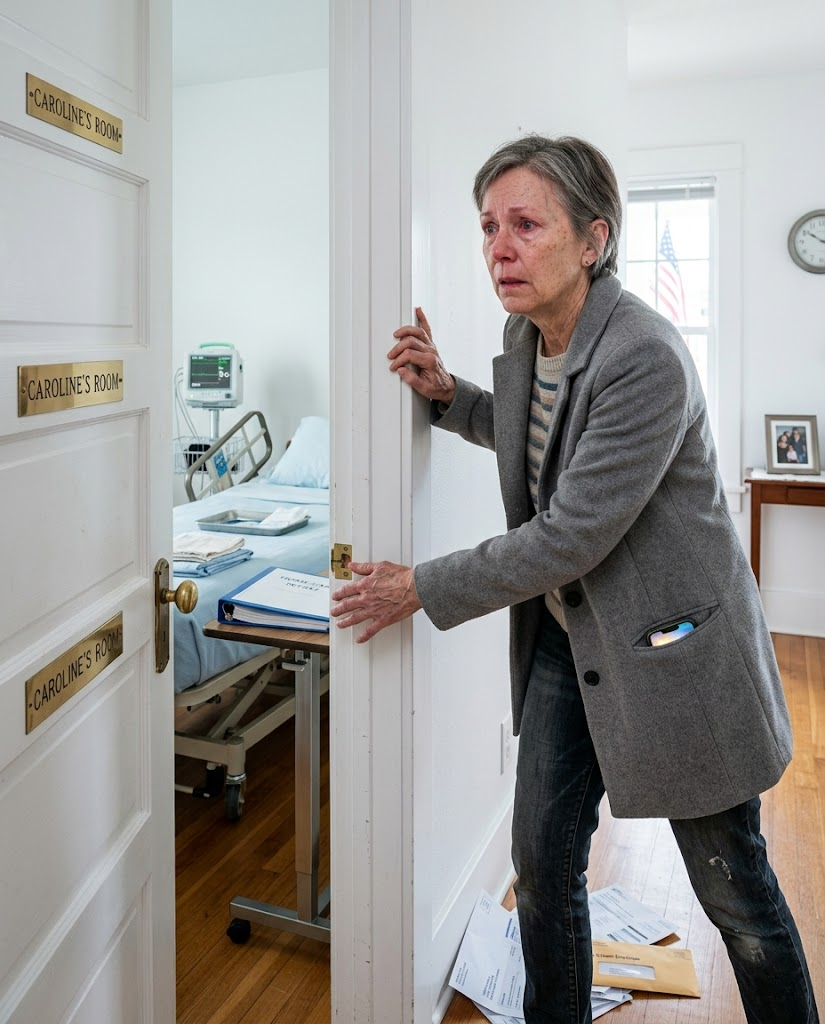
Then I saw the brass plate screwed into the wood.
CAROLINE’S ROOM.
The door opened only a few inches at first.
White light spilled across the hallway floor.
The machine kept breathing in that soft, steady rhythm, and I stood there with one hand on the knob and one hand pressed against my chest, trying to make my lungs remember their job.
Inside was not a guest room.
Not a renovated bedroom.
Not anything a mother imagines when her son says, “It’s a mess.”
There was a hospital-style bed beside the window.
A rolling tray.
Folded linens stacked with almost military neatness.
A reading chair angled toward the ocean.
A small bookshelf filled with the novels I used to teach.
And on the dresser, a binder labeled HOME CARE INTAKE — CAROLINE MERCER.
My name.
On a file for a room I had never been allowed to enter.
I sat down in the chair because my knees could not be trusted.
The binder was thick.
Inside were forms, schedules, emergency contacts, insurance notes, and printed instructions.
Some pages were blank.
Some were completed.
My date of birth.
My allergies.
My old knee surgery.
My primary doctor in Portland.
There was a medication schedule for prescriptions I did not take.
There was a fall-risk assessment I had never agreed to.
There was a page titled LONG-TERM CARE PLAN.
At the top, in Michael’s handwriting, were the words:
For Mom, when she cannot live alone safely.
I covered my mouth.
Not because I was touched.
Because I was afraid of what tenderness had been used to hide.
The room was not cruel.
That was the worst part.
It was thoughtful.
It had soft blankets, a view of the water, my favorite books, a lavender soap dispenser, framed family photos, and a lamp like the one beside my bed in Portland.
Michael had built a place for me.
Then he had spent five years lying about it.
On the nightstand was a photograph of the three of us at his college graduation.
Michael, Sophie, and me.
My arm wrapped around his waist.
His smile wide and young.
Sophie standing on the other side, already polished, already careful.
I lifted the photo and found an envelope beneath it.
Michael’s handwriting again.
WHEN SHE FINDS IT.
My hands shook so hard the paper rattled.
I called Daniel Price before I opened it.
I do not know why.
Maybe I wanted a witness.
Maybe I wanted someone in the world to know that this room existed before I learned what it meant.
He answered on the second ring.
“Caroline?”
“I’m inside the house,” I said.
There was a pause.
A heavy one.
“You found the room.”
The words were too calm.
“You knew?”
“I knew there was a room prepared,” he said carefully. “I did not know the contents.”
“Did Michael tell you why?”
Daniel exhaled.
“He said the letter would explain.”
I opened the envelope.
There were four pages inside.
The first page began, Mom, if you are reading this, I failed to tell you the truth while I was alive.
I read that sentence three times.
Then I kept going.
Michael wrote that five years earlier, Sophie had found a copy of my medical power of attorney paperwork in a folder I had sent him after a minor surgery.
I had sent it because I trusted him.
That was the trust signal.
My emergency documents.
My medical history.
My passwords for utilities, insurance, and my doctor’s portal.
Things a mother gives a son because she believes love will hold them safely.
Sophie had not seen responsibility.
She had seen opportunity.
According to Michael, she became convinced I was going to become dependent sooner than expected.
She told him I was lonely.
She told him I was aging faster than I admitted.
She told him my little Portland house was unsafe because of the porch steps and winter rain.
She told him they should prepare.
At first, he wrote, he believed she was being practical.
Then practical became controlling.
The room was prepared without telling me.
The care service was hired to maintain it.
The house was kept perfect because Sophie did not want me visiting until she had finished what she called “the transition plan.”
The transition plan was not just a bedroom.
It was my life.
On page two, Michael wrote that Sophie had contacted a realtor about my Portland house.
Not officially.
Not with my permission.
She had asked about value, timing, and how quickly an older owner could sell if family was helping.
She had printed county property records.
She had made notes about my pension.
She had a folder labeled Caroline Assets.
I felt cold from the inside out.
Daniel was still on the phone.
I could hear him breathing.
“Keep reading,” he said quietly.
On page three, Michael’s handwriting became uneven.
He admitted he had been ashamed.
He admitted he had let Sophie manage too much.
He admitted that every time I asked to visit, he panicked because if I saw the room, I would ask the one question he did not know how to answer.
Why did you build this without asking me?
And the answer was uglier than neglect.
He had allowed my future to be discussed like storage space.
He had allowed love to become logistics.
He had allowed Sophie to turn concern into control while he called it marriage.
By the time he understood what she was doing, he wrote, he was afraid.
Not of Sophie screaming.
She did not scream.
He was afraid of the quiet way she made consequences appear.
Emails forwarded.
Accounts locked.
Documents missing.
Arguments remembered differently.
He had transferred the Mendocino house to me because it was the only thing he could still move out of her reach.
The fourth page was shorter.
I have been a coward, Mom.
I told myself I was protecting you from stress.
I was protecting myself from having to admit I had let my wife plan your life like you were already gone.
Sell the house if you want.
Burn the room if you need to.
But look in the bottom drawer of the dresser first.
I am sorry.
Your son,
Michael.
For a long time, I did not move.
The machine breathed beside the bed.
The ocean shifted beyond the window.
Somewhere in the house, a clock that had stopped at the wrong hour sat silent on a polished shelf.
“Caroline,” Daniel said through the phone.
“I’m here.”
“Do you want me to come?”
“No,” I said.
My voice sounded strange.
Steady.
Older than it had that morning.
“Not yet.”
I opened the bottom dresser drawer.
Inside was the folder.
Caroline Assets.
Sophie’s handwriting was on the label.
The folder contained printed property records for my Portland house, notes about my pension, copies of insurance forms, and a draft letter addressed to my doctor.
The draft letter said my family had concerns about my memory.
My memory.
I had spent my life remembering books, birthdays, lunch preferences, permission slips, parent-teacher conferences, Michael’s allergies, his favorite soup, the exact sound he made when he was trying not to cry.
And Sophie had prepared a letter questioning my memory.
That was when I began to shake.
Not from grief.
From rage.
For one ugly heartbeat, I wanted to tear the room apart.
I wanted to rip the linens from the shelves, throw the binder against the wall, smash the lamp, scatter the forms, and make the house look as ruined as the lie had made me feel.
I did not.
I took pictures.
Page by page.
Drawer by drawer.
Label by label.
Then I called Daniel back and asked what could be done with documents prepared without my consent.
He told me the first step was preserving everything.
So that is what I did.
I preserved the truth.
By 4:18 p.m., Daniel was at the house.
He walked through the room with his jaw tight and his glasses low on his nose.
He did not touch anything until he had taken his own photographs.
The care binder.
The service logs.
The asset folder.
The draft doctor letter.
The medication schedule.
The letter from Michael.
Then he looked at me and said, “This changes how we handle the estate.”
“I don’t care about the estate,” I said.
“I care about my life being treated like something they could pack and move.”
Daniel nodded once.
“That is exactly why we document it.”
Over the next two weeks, the truth came out in pieces.
The care service had been told that I would be moving in eventually.
The realtor Sophie contacted had saved email notes.
The county records in the folder had been printed six months before the accident.
The draft letter to my doctor had never been sent.
That mattered legally.
It mattered emotionally in a different way.
A bullet not fired is still a bullet someone loaded.
Daniel helped me lock down my accounts, update my medical documents, and notify my doctor that nobody had permission to speak for me.
I changed passwords.
I revoked access.
I filed copies of Michael’s letter with my own attorney in Portland.
I had the house professionally inventoried.
Not because I wanted revenge.
Because I had spent five years being polite to a locked door.
I was done confusing politeness with safety.
Michael’s funeral happened on a gray Saturday.
I stood beside his grave with my hands folded around a tissue I never used.
People told me he loved me.
I believe that.
That is the complicated part.
Michael loved me.
He also lied to me.
One truth does not erase the other.
After the funeral, Sophie’s sister approached me and said she hoped there were no hard feelings.
No hard feelings.
The phrase landed between us like a dropped plate.
I looked at her, this woman who had likely known some version of the story and chosen not to ask the next question.
“There are feelings,” I said. “They are exactly as hard as they need to be.”
She looked away first.
Three months later, I sold the Mendocino house.
But before I did, I emptied that room myself.
I donated the medical bed.
I shredded the medication schedules.
I kept the novels.
I kept the photograph of Michael at eight years old in my garden.
I kept his letter in a fireproof box, not because it comforted me, but because truth deserves a place where nobody can quietly move it.
The money from the sale paid off the last of my mortgage in Portland.
I repaired the porch steps Sophie had used as evidence against me.
I planted two new rosebushes by the back fence.
On the first dry morning of spring, Janice found me kneeling in the garden with mud on my jeans.
“You okay?” she asked.
I looked at the dirt under my nails.
I looked at my small house, my own porch, my own front door, my own mailbox at the curb.
“I’m still here,” I said.
And that was the whole answer.
I still think about the room sometimes.
Not every day.
But sometimes.
I think about the polished floor, the folded linens, the binder with my name on it.
I think about how something can look like care and still be a cage.
I think about Michael, my son, my boy, the child with mud on his cheeks who grew into a man who loved me too weakly to protect me from his own silence.
That is the part grief cannot simplify.
People want villains and saints.
Life gives you sons who lie because they are ashamed, daughters-in-law who call control preparation, and rooms built in your name without your permission.
I believed them for years because he was my son.
Now I believe doors.
If one stays closed too long, I ask why.
And if someone tells me not to look, I look.