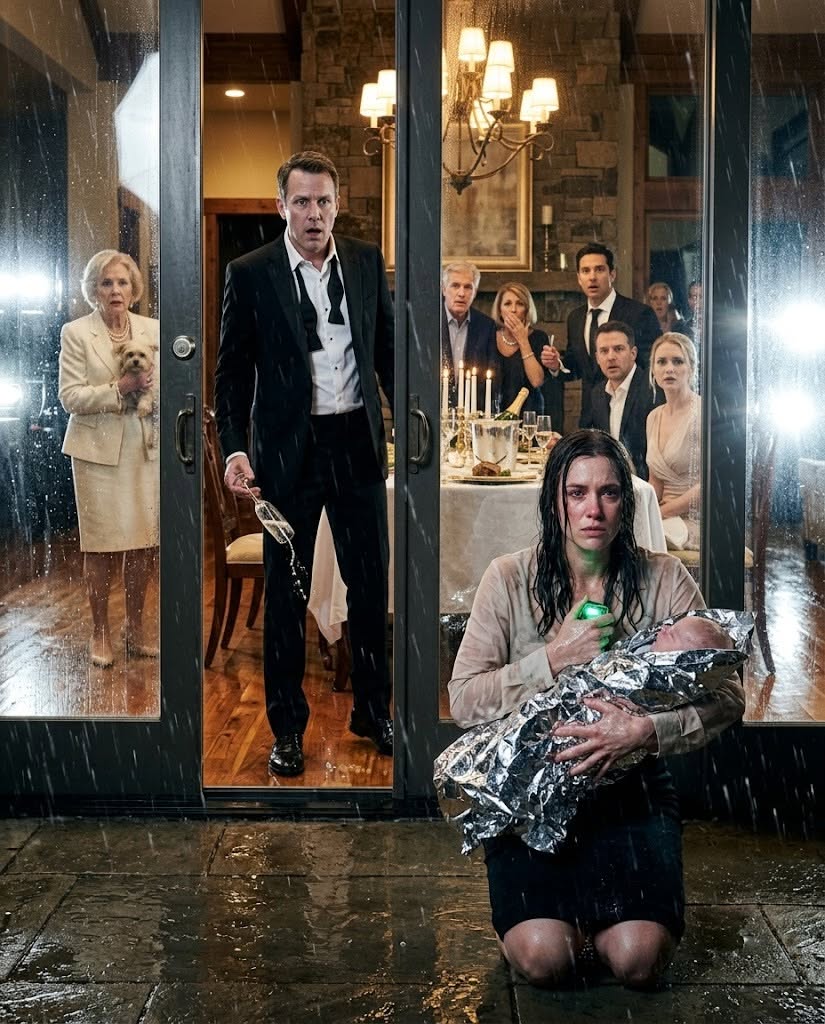
By the time Leo stopped breathing, the rain had already become sleet.
The room smelled like warm formula, lavender detergent, and the sharp antiseptic wipes the neonatal nurses had taught her to use before every feeding.
Leo had been home from St. Agnes Neonatal Unit for only twelve days.
Twelve days was not long enough for Maya to trust silence.
A healthy newborn’s silence can mean sleep.
A premature baby’s silence can mean the world has narrowed to seconds.
At 8:41 PM, the baby monitor app flashed an oxygen-alert banner across her phone.
Maya saw it at the same moment Leo’s mouth went slack against her chest.
His lips were not pink anymore.
They were violet at the edges, then bruised blue, the color spreading with a speed that made her training and motherhood collide inside her ribs.
“Leo,” she whispered.
She rubbed his back.
Nothing.
She tilted his head the way the discharge nurse had shown her.
A faint sound came from his throat, thin and wrong.
The discharge folder from St. Agnes was still open on the changing table.
The page titled NEONATAL RESPIRATORY DISTRESS: HOME RESPONSE had been circled in blue ink.
Under it, the nurse had written one instruction in capital letters.
DO NOT WAIT.
Maya did not wait.
She wrapped Leo in the hospital blanket embroidered with his name, grabbed the diaper bag, and ran toward the garage door.
The keys were not there.
The key rack held Eleanor’s spare house key, a brass tag for the guest house, and nothing else.
Richard had the car keys.
Richard always had the car keys when there were guests.
He liked arriving in control and leaving in control.
That was how Richard Whitmore moved through the world.
His family had built half the town’s luxury developments and donated enough money to have their name on hospital wings they never had to sit inside.
Richard had inherited the house, the reputation, and the talent for making cruelty sound like standards.
Maya had married him three years earlier after a charity security event in Denver.
He had been charming then.
He had made her laugh in a way she had not expected after years of military discipline and classified deployments.
He had told her he admired strong women.
Later, she learned he admired strength only when it stood behind him in photographs.
Still, she had tried.
She had given him the soft trust that did not come easily to her.
She had told him about deployments without telling him what could not be told.
She had let him see her cry after the first pregnancy loss.
She had let his mother into the nursery after Leo was born early, even though every instinct in her body recoiled from Eleanor’s perfume and inspection.
That was the trust signal Maya would remember later.
She had opened the door to people who had never seen her as family.
They had seen access.
Downstairs, laughter floated from the dining room.
It was polished laughter, expensive laughter, the kind people use when they want the person at the head of the table to know they understand the rules.
Richard was hosting a senator that night.
There were two tech billionaires at the table, one hedge fund couple from Jackson Hole, and Eleanor seated where she always sat, just close enough to Richard to remind everyone who had made him.
Vintage champagne had been opened at 8:15 PM.
The lamb had been served at 8:32 PM.
At 8:41 PM, Leo’s lips turned blue.
Maya ran.
She came down the back staircase with the baby pressed to her collarbone, her bare feet sliding once on the polished wood.
The hallway outside the dining room was warm.
Too warm.
She could smell butter, rosemary, wine, candle wax, and the clean mineral scent of rain blowing in from some draft beneath the doors.
She hit the dining room doors with her shoulder.
They opened hard enough to make the nearest candle flame jump.
Richard stood at the head of the table in a black tuxedo.
His champagne glass was raised toward the senator.
The senator was smiling.
Eleanor was smiling.
Then everyone looked at Maya.
She was soaked from the nursery balcony hall, because the side door had blown open in the storm and rain had whipped across the corridor.
Her hair was plastered to her cheeks.
Her blouse clung to her shoulders.
In her arms, Leo was too still.
“Richard,” she said, but it came out as a scream. “Keys. Now. Leo is turning blue.”
The room went quiet in the wrong way.
Not the quiet of people preparing to help.
The quiet of people deciding whose discomfort mattered most.
Forks hovered above plates.
A woman in diamonds lowered her wineglass halfway and stopped there.
The senator’s wife looked at the gold charger in front of her as though the pattern required all her attention.
One of the tech billionaires shifted back from the table but did not stand.
A knife clicked once against porcelain.
Nobody moved.
An entire room taught a dying baby that reputation could matter more than breath.
Eleanor reached Maya before Richard did.
She smelled like powder, gardenia perfume, and champagne.
Her manicured nails closed around Maya’s bare arm with a force that made pain spark up to her shoulder.
“You low-class embarrassment,” Eleanor hissed.
Her voice was quiet because quiet cruelty had always been her preferred instrument.
“You do not interrupt my son’s business for a common temper tantrum!”
Maya lifted Leo higher.
“He is turning blue! He is dying! Give me the keys!”
Richard’s face changed.
Maya saw the shift as clearly as she had once seen enemy movement through a thermal scope.
His expression did not become fear.
It became rage.
A certain kind of man does not hear emergency when his reputation is in the room.
He hears disobedience.
He hears a woman forgetting her assigned place.
Richard came around the table with his jaw clenched and his champagne smile gone.
He did not look at his son first.
He looked at the senator.
Then he looked at Maya.
“You are ruining the most important night of my quarter,” he snarled.
He grabbed her other arm.
His grip was brutal.
It was not the grip of a husband guiding his panicked wife away from guests.
It was punishment.
For one flash of a second, Maya’s body chose violence.
Her knee could have driven into his stomach.
Her elbow could have broken his nose.
Her hand could have stripped the keys from his tuxedo pocket before Eleanor finished drawing breath.
She had been trained to do all of that faster than Richard could understand.
But Leo made a broken sound against her chest.
Maya chose the baby.
She locked her jaw hard enough to taste copper and curled both arms around him.
Richard and Eleanor dragged her backward across the polished hardwood.
The guests remained seated.
Someone whispered Richard’s name.
No one said stop.
At the patio doors, the storm roared loud enough to swallow the room.
Sleet struck the glass in bright silver lines.
Beyond the patio, the mountain dropped into darkness.
“Richard, please,” Maya said.
She hated the word as it left her mouth.
But mothers will beg monsters when their child needs one more breath.
Richard shoved her through the doors.
Maya hit the freezing mud on her side.
Pain detonated through her shoulder, but she twisted before impact so Leo’s head never struck stone.
Mud soaked her skirt.
Sleet slapped her face.
The cold entered her body like teeth.
Leo’s hospital blanket dragged across the patio, and Maya tucked it back around him with fingers already going numb.
Eleanor stood in the warm golden doorway, holding her pampered lapdog against her silk suit.
“Sleep in the shed, street trash,” she said.
Then she gave a little smile.
“Maybe the cold will teach you some manners.”
Richard looked down at Maya through the open doorway.
For a moment, his face was perfectly calm.
Then he raised his champagne glass in a mocking salute.
He closed the doors.
CLACK.
The deadbolt turned.
The sound was small.
The meaning was not.
For three seconds, Maya was only a mother in the mud with a dying baby and a house full of witnesses pretending glass made them innocent.
Then something old and disciplined opened inside her.
Before she was Mrs. Richard Whitmore, before she was the woman Eleanor introduced with a smile that never reached her eyes, before she was the acceptable civilian wife standing beside a rich man at fundraisers, she had been Major Maya Hayes.
Joint Special Operations Command.
JSOC had not trained her to feel nothing.
It had trained her to feel everything and still move.
It had trained her to count breaths under fire.
To read exits before entering rooms.
To catalogue objects by usefulness.
To understand that panic is a luxury when someone else’s life depends on your hands.
In Kandahar, Maya had once kept a wounded interpreter alive for nineteen minutes with one hand compressed over an artery while rounds cut brick over her head.
At Fort Bragg, she had completed cold-water extraction drills until her bones shook so hard her teeth felt loose.
In training, she had been told again and again that the difference between survival and death could be the ability to make fingers work when every nerve screamed stop.
Her fingers worked now.
The diaper bag had two linings.
Richard knew about the upper lining, with diapers, wipes, bottles, formula packets, and a tiny knit hat.
He did not know about the lower lining.
Inside it was a compact medical pouch.
Maya had packed it the day Leo came home from St. Agnes.
There was an epinephrine ampule, a sterile airway bulb, a thermal foil wrap, a laminated neonatal instruction card, and one device no Whitmore guest had ever imagined being carried into their perfect dining room.
A military emergency beacon.
It was not standard issue anymore.
It had been modified through a private recovery channel after an operation Maya would never discuss with Richard, Eleanor, or any senator at any dinner table.
It linked to one person.
Colonel Dana Voss.
Maya wrapped Leo in the foil blanket.
She cleared his mouth.
She tilted his head.
She rubbed his sternum with two fingers in a firm line the way the neonatal nurse had shown her.
“Come on,” she whispered.
Leo’s chest fluttered.
Barely.
She pressed the beacon twice.
One red flash.
A second red flash.
Then green.
Inside the dining room, Richard had returned to the table.
Maya saw him through the glass, lifting his champagne again, pretending the story had already been contained.
He had always believed containment was the same thing as control.
He was wrong.
Maya looked through the door at him, mud on her cheek, sleet in her eyelashes, Leo’s blue lips near her collarbone.
Her voice was quiet.
“You just declared war on the wrong mother.”
Ten minutes later, the first black vehicle came through the estate gates without slowing.
The senator saw it first.
He stood so fast his chair struck the wall behind him.
Richard turned toward the windows, irritation already forming on his face because men like Richard resent interruption even when consequence is coming to collect them.
The vehicle crossed the drive and stopped at the patio line.
A second vehicle blocked the garage.
A third rolled toward the front entrance.
No sirens sounded.
No one shouted.
Doors opened in sequence.
Men and women in dark tactical gear stepped out with controlled calm.
That was when Richard’s champagne glass slipped from his hand.
It hit the hardwood and shattered.
Eleanor went pale.
The senator’s wife covered her mouth.
One of the tech billionaires finally stood, then seemed to realize he had nowhere useful to go.
Outside, Maya kept one hand under Leo’s neck and one hand over the beacon.
His chest moved again.
Still shallow.
Still not enough.
Then Colonel Dana Voss stepped out of the last vehicle.
She wore a dark agency coat, gloves, and the kind of expression that makes explanations feel childish before they are even offered.
In her left hand was a laminated emergency medical authority card.
In her right was a sealed folder marked EMERGENCY PROTECTIVE ACTION.
Richard did not know her.
Maya had trusted her with her life twice.
Voss reached the patio doors and looked through the glass.
Richard did not unlock them.
For one long second, the entire scene balanced there.
The locked door.
The dying child.
The mother in the sleet.
The rich man inside his golden room, finally understanding the house was not protecting him.
Voss lifted one gloved hand and spoke through the glass.
Maya could not hear the words over the storm.
But she could read lips.
“Maya, give the order.”
Maya looked down at Leo.
His mouth opened with a thin, ragged sound.
Then she looked at Richard.
The man who had thrown his own son into the cold was staring at her as if she had become a stranger.
He was finally right about something.
Maya nodded once.
The patio glass shattered inward.
Not in an explosion of chaos.
In a controlled breach.
A precise break.
A door becoming irrelevant.
Two operators moved past Richard before he could step back.
One secured him against the wall.
Another reached the lock and opened the ruined frame wide enough for Voss and the medic to come through.
The medic went straight to Leo.
Maya did not want to let go.
Her arms tightened instinctively.
Voss crouched beside her in the sleet.
“Maya,” she said, softer now. “Let him breathe with us.”
That sentence did what orders could not.
Maya released her grip just enough.
The medic placed oxygen over Leo’s face and checked his airway with hands that were fast, gentle, and certain.
Another medic wrapped Maya in a thermal blanket.
She did not remember anyone putting it around her shoulders.
She remembered Richard yelling.
At first he yelled about property damage.
Then about trespassing.
Then about knowing people.
Every sentence sounded smaller than the one before.
Eleanor tried to say there had been a misunderstanding.
The senator stepped away from her as though cruelty were contagious.
The guests who had sat frozen during the emergency suddenly discovered movement when tactical officers began asking for names.
Statements were taken at 9:04 PM.
The baby monitor alert was preserved on Maya’s phone.
The St. Agnes discharge instructions were photographed upstairs.
The empty key rack was photographed by the garage.
The security system logs showed the patio deadbolt engaged at 8:46 PM.
The dining room camera, installed by Richard himself to monitor staff, recorded everything.
That was the final artifact.
The one Richard had created for his own control became the one that documented what he had done.
Leo was transported under emergency priority to St. Agnes.
Maya rode with him.
She sat belted beside the medic with foil still around her shoulders and mud drying on one side of her face.
She did not cry until Leo’s oxygen numbers rose.
At 9:37 PM, a doctor said the words she had been holding her breath to hear.
“He is responding.”
Maya put both hands over her mouth.
The sound that came out of her was not elegant.
It was animal.
It was relief leaving the body through a wound.
Leo stayed in the hospital for observation.
He survived.
Richard and Eleanor did not arrive at St. Agnes that night.
They were not permitted to.
By morning, emergency protective restrictions were in motion.
Voss did not handle the civilian legal side herself, but she made three calls before sunrise.
One went to the hospital administrator.
One went to a family law attorney who owed her no favors but respected facts.
One went to a county investigator who understood that wealth often enters a report as fog unless someone clears it fast.
Maya gave her statement at 6:20 AM.
She spoke plainly.
She did not embellish.
She did not need to.
The documents did the work.
The hospital intake form recorded Leo’s condition.
The security logs recorded the lock.
The dining room camera recorded Richard’s salute.
The witnesses, when separated from each other and from the Whitmore dining table, began remembering what they had seen.
The senator’s wife cried during her statement.
One of the tech billionaires admitted he had thought about standing but did not want to offend Richard.
Eleanor claimed Maya had been hysterical and that nobody understood the child was in danger.
Then the investigator played the dining room audio.
“He is turning blue! He is dying! Give me the keys!”
Eleanor stopped talking.
Richard’s attorneys tried to frame the breach as excessive.
They tried to frame Maya as unstable.
They tried to frame the whole thing as a domestic argument distorted by postpartum fear.
Maya’s attorney placed the St. Agnes discharge folder on the table.
Then the oxygen-alert screenshot.
Then the security log.
Then the video still of Richard raising champagne while his infant son lay in the sleet.
There are moments when a room decides which lie it can no longer afford to believe.
That was one of them.
The divorce filing was not theatrical.
Maya did not need theater.
She needed custody, medical safety, and distance.
Temporary full custody was granted first.
Then permanent restrictions followed after the investigation concluded.
Richard’s business dinner became a scandal, but Maya refused to let the public version swallow the private truth.
This was not a story about a powerful woman calling soldiers because her feelings were hurt.
This was a story about a mother using the only seconds she had to keep her child alive.
It was also a story about bystanders.
Maya thought about them more than she expected.
The senator.
The wife.
The billionaires.
The hedge fund couple.
People with money, education, influence, and working legs.
People who heard a mother say her baby was dying and chose the comfort of stillness.
An entire room taught a dying baby that reputation could matter more than breath.
That sentence stayed with Maya long after the legal documents were signed.
Not because it was poetic.
Because it was true.
Months later, Leo grew stronger.
His lips were pink.
His grip became fierce.
He learned to wrap his tiny fingers around Maya’s thumb with an authority that made nurses laugh.
Maya moved into a smaller house near the hospital, with locks she chose and keys she controlled.
The first night there, she placed the St. Agnes folder in a fireproof box.
Beside it, she placed the broken champagne-glass photograph from the evidence packet.
Not because she wanted to live inside the memory.
Because she understood evidence.
Evidence is what remains when powerful people start editing themselves.
Eleanor sent one letter through attorneys.
Maya did not open it.
Richard sent none.
In the end, that silence suited him better than any apology could have.
Some people are sorry only when the room changes sides.
Maya did not teach Leo to hate his father.
She taught him to breathe, to reach, to grow, to laugh, and eventually, when he was old enough to understand small pieces of a larger truth, to know that love is not proven by blood, money, or a last name.
Love is proven by who moves when you cannot.
On Leo’s first birthday, Colonel Dana Voss came by with a small wooden airplane and no uniform.
She stood in Maya’s kitchen while Leo banged frosting onto his high chair tray.
Maya looked at her son, then at the woman who had come through the storm when called.
“Thank you,” Maya said.
Voss shook her head.
“You gave the order,” she said.
Maya smiled then, tired and real.
Outside, rain tapped softly against the window.
Not sleet this time.
Just rain.
Leo laughed at nothing, pink-cheeked and alive, and Maya understood that survival is not the same as returning to who you were before.
Sometimes survival is a door breaking open.
Sometimes it is a mother in the mud deciding the people inside the warm room no longer get to define her.
Sometimes it is a tiny chest rising again after the world tried to make stillness look polite.
And sometimes the wrong mother is exactly the one you should never have locked outside.
