The morning Evelyn Cooper went into labor, she woke before dawn with a pain that felt too deliberate to be false.
It began low in her back, then wrapped around her abdomen with a tightening force that made her grip the edge of the bathroom sink until her fingers ached.
For a few seconds, she stared at herself in the mirror and tried to decide whether the woman looking back at her was terrified or simply done waiting.

Her hair was loose around her face.
Her skin was pale.
Her nightgown clung to her shoulders with sweat.
Down the hall, Nathan was still asleep.
That, too, was something she remembered later.
Not because sleep was a crime, but because peace looked obscene on him after she learned what he had done.
Evelyn was thirty-two years old, married for three years, and exhausted in a way she had never been able to explain to people who had conceived children by accident and called it a surprise.
For two years, her life had been calendars, injections, blood draws, ultrasound appointments, and hope measured in numbers on a lab report.
Briar Hill Fertility Center had become a second address.
The nurses knew her preferred arm for blood work.
The receptionist knew Nathan liked black coffee.
Evelyn knew the exact pattern in the ceiling tiles of exam room four because she had stared at them during procedures that made her feel less like a wife and more like a vessel being negotiated with.
Nathan had been beautiful during all of it.
That was the word people used.
Devoted.
Attentive.
A husband who held her coat, warmed her hands, asked doctors intelligent questions, and kissed her forehead after every injection like love could be proven by choreography.
Evelyn had believed him.
She had believed him because believing your husband is one of the first vows people expect a wife to keep, even when no one says it aloud.
She had signed every consent form he placed in front of her.
She had handed him passwords to patient portals because he said he wanted to help manage the appointments.
She had let him sit beside her during consultations, let him speak when she was too tired, let him tell friends they were doing everything together.
That was the trust signal he later weaponized.
Access.
He had access to her body, her records, her signatures, and her silence.
When the second contraction came, Evelyn braced herself against the sink and called his name.
Nathan appeared in the doorway wearing pajama pants and a white T-shirt, his hair flattened on one side.
For half a second, he looked almost normal.
Then his face changed.
Not fear.
Calculation.
It passed quickly, but Evelyn saw it.
“Is it time?” he asked.
“I think so,” she said.
He looked at her belly, then at the clock.
It was 5:46 a.m.
By 6:18 a.m., they were in the car.
By 6:41 a.m., Evelyn was admitted.
By 7:05 a.m., a nurse clipped the hospital intake form to the end of her bed and wrapped the fetal monitor bands around her stomach.
The baby’s heartbeat filled the room in a steady rhythm that should have comforted her.
Instead, it made everything feel counted.
Nathan changed before the nurses came back.
He had packed a navy suit in the overnight bag.
Evelyn watched him button the shirt between contractions, her breath coming in short bursts, and felt the first cold thread of unease pull through her pain.
“Why are you wearing that?” she asked.
He did not look at her.
“There may be paperwork later. I want to look presentable.”
Presentable.
The word sat between them like an object with sharp edges.
Most husbands in delivery rooms looked rumpled, frightened, tender, useless in the sweet way frightened men can be useless.
Nathan looked prepared.
That was when Evelyn began to understand that something was already in motion.
The sky outside the hospital window had gone the pale gray color of dirty cotton.
She kept staring at it between contractions, trying to anchor herself to anything that did not live inside her body.
The room smelled of antiseptic, warm plastic, and the metallic fear rising from her own mouth.
The sheets twisted under her fists.
Her hair stuck to her neck.
The fetal monitor kept beeping.
Nathan sat beside her bed with both hands clasped and one knee bouncing.
He was quiet.
Nathan Cooper was never quiet when someone might admire him for being tender.
He knew when to touch her shoulder.
He knew when to ask a nurse for ice chips.
He knew when to lower his voice and say sweetheart in the exact tone that made older women at church smile as if Evelyn had won something.
Men like Nathan did not stumble into performances.
They rehearsed them until even cruelty had good posture.
At 8:17 a.m., Nurse Mara checked Evelyn’s dilation and said things were moving quickly.
At 8:19 a.m., Nathan took Evelyn’s hand, and his palm was cold.
Not nervous cold.
Decision cold.
Evelyn looked at his face.
His eyes were not on her.
They were on the door.
A wife learns patterns before she learns truths.
She learns the difference between a man who is afraid for her and a man who is afraid of being interrupted.
Without fully knowing why, Evelyn reached for her phone when Nathan turned toward the window.
She opened the voice memo app.
She pressed record.
Then she set the phone faceup on the bedside table, half tucked beneath a folded washcloth.
At 8:24 a.m., Nathan stood.
Then he knelt beside the bed.
For one wild second, she thought he was praying.
“Evelyn,” he said, and his voice cracked in a way that sounded practiced. “I’ve told you three lies. I need to come clean.”
A contraction tightened through her back.
She turned her head slowly.
Sweat slid from her temple into her ear.
“Wait until after I give birth,” she said.
The sentence was not a plea.
It was a boundary.
Nathan stepped over it before it had finished landing.
“I’m sorry,” he said. “When we did IVF, I switched your eggs with Diana’s.”
The room did not move.
The monitor kept beeping.
Somewhere outside, wheels squeaked against the hallway floor.
Diana.
His first love.
The woman he had described for years as a sad chapter, a closed door, a person life had injured but time had placed safely behind him.
Evelyn had sent Diana flowers once after a minor heart procedure because Nathan said it would be kind.
She had prayed for her.
She had even felt guilty for the small, human discomfort she experienced whenever Nathan’s voice softened around Diana’s name.
“She has a heart condition,” Nathan continued quickly. “Pregnancy would have been too risky for her. I had to borrow your womb.”
Borrow.
That was the word he used.
Not steal.
Not violate.
Not betray.
Borrow.
A white flash of pain cut through Evelyn so sharply that the room blurred.
She dug her fingers into the sheet and stared at the man she had slept beside for three years.
He had kissed her forehead after every hormone injection.
He had brought her ginger tea after retrieval.
He had told her their baby might have her eyes.
Now he was kneeling beside her bed and explaining that the child inside her had been assigned to her like a secret errand.
His face was wet, but not with tears.
Sweat shone above his lip.
He was afraid.
But he was not afraid of hurting her.
He was afraid she would stop cooperating.
“For the sake of our marriage,” he whispered, “you’ll still deliver the baby safely, right?”
Evelyn stared at him.
Then she laughed.
It was not a pretty sound.
It came out rough and low, almost ugly, and Nathan flinched as if she had thrown something.
“That’s it?” she asked.
He blinked.
“Evelyn, please.”
“Nathan, why now?”
“What?”
“Why tell me when I’m already in labor?”
His eyes flicked toward the door.
Just once.
But she saw it.
The hospital intake form was clipped to the bed.
The fetal monitor paper curled onto the floor.
Her signed IVF consent was somewhere in Briar Hill’s system, tucked under electronic timestamps and clean administrative language.
Everything around her had become proof.
“You know inducing labor now would risk both my life and the baby,” she said. “You know I can’t stand up and walk away. So you picked the one hour when my body was a locked room.”
Nathan’s face paled.
There it was.
Not guilt.
Exposure.
Shame entered him and immediately turned into anger because shame had nowhere else to go.
He stood slowly.
“You’re unbelievable,” he hissed. “Even now, you make yourself the victim. Giving birth is giving birth. You get to experience motherhood. Diana gets to have the child she never could carry. Everyone gets something.”
Evelyn looked at him for a long moment.
She looked at his polished shoes.
She looked at the wedding ring on his hand.
She looked at the IV taped into her skin.
Her jaw locked so hard it hurt.
For one second, she pictured tearing the monitor leads off her body and dragging herself out of the bed just to prove he had not trapped all of her.
But another contraction rose.
Her body bent around it.
She stayed where she was.
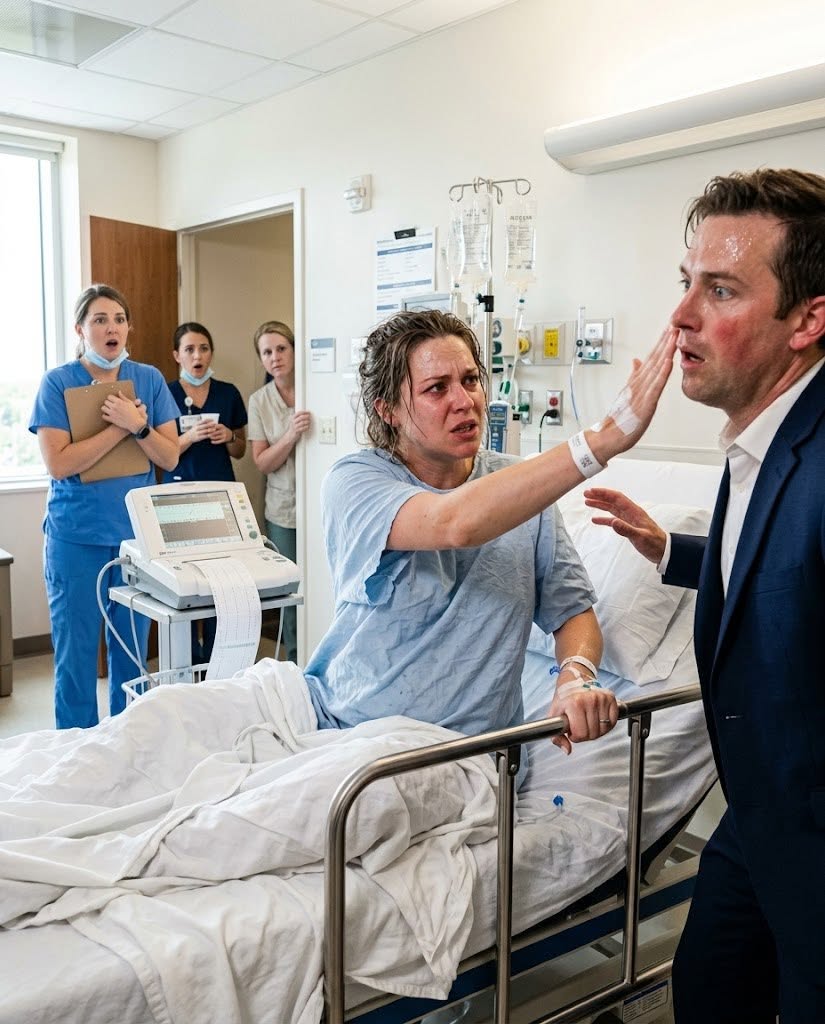
Outside the room, two nurses paused near the doorway.
One held a clipboard.
The other held a paper medication cup.
They had heard enough to know something was wrong, but not enough to decide whether it was their place to enter.
Their shoes stopped squeaking.
Their eyes shifted from Nathan to Evelyn, then to the floor.
Nobody moved.
Nathan leaned closer.
“Evelyn, don’t make this dramatic. Diana and I already spoke with someone at the clinic. After the birth, we can make this look clean.”
Clean.
That word changed the temperature in the room.
Evelyn stopped laughing.
She understood then that the baby was not the only thing Nathan intended to deliver that day.
He wanted her silence delivered with it.
Her hand moved before she fully decided to move it.
The slap cracked across the delivery room.
Nathan stumbled back into the visitor chair, one hand pressed to his cheek.
The nurse in the doorway gasped.
The fetal monitor kept beeping as if the room had not just split open.
“You hit me,” Nathan whispered.
Evelyn’s palm burned.
“You stole from me,” she said.
Nurse Mara stepped inside first.
She did not tell Evelyn to calm down.
She did not ask Nathan to explain himself.
Her eyes moved to the fetal monitor strip, then to Evelyn’s face, then to the phone glowing on the bedside table.
Recording.
Nathan saw it a second later.
The color drained from his face in a way Evelyn would remember for the rest of her life.
He had calculated pain.
He had calculated risk.
He had calculated the locked room of her body.
He had not calculated proof.
“Delete it,” he said.
Mara’s voice sharpened. “Sir, step away from the patient.”
“Evelyn,” Nathan said, and now the polish was gone. “You don’t understand what Diana will lose.”
Another contraction hit.
Evelyn gripped the rail so hard the tendons in her hand rose under the skin.
“Call the hospital administrator,” she said. “And document that he admitted to an embryo transfer fraud involving Briar Hill Fertility Center.”
Mara looked at her for one beat.
Then she moved.
By 8:31 a.m., the charge nurse was in the room.
By 8:38 a.m., hospital security stood outside the door.
By 8:44 a.m., Nathan had been removed from the delivery suite after refusing twice to leave voluntarily.
He did not shout then.
That was the part that stayed with Evelyn.
He adjusted his jacket.
He told security there had been a misunderstanding.
He asked whether anyone had called Diana.
Mara closed the door before Evelyn could hear more.
Labor does not pause for betrayal.
That was the cruelest thing.
The body keeps going.
The body contracts, opens, bleeds, pushes, survives.
Evelyn labored for six more hours with Mara at her side and her sister Claire on speakerphone until Claire arrived breathless, crying, and furious enough to shake.
Evelyn did not delete the recording.
Claire took her phone, backed up the file, emailed it to herself, and wrote down the exact time stamps.
She photographed the hospital intake form.
She photographed Nathan’s name on the visitor log.
She asked Mara for the name of the hospital administrator and wrote that down too.
Panic breaks things.
Documentation builds a bridge over the wreckage.
At 2:57 p.m., Evelyn delivered a baby girl.
The room changed when the baby cried.
Not healed.
Not fixed.
Changed.
The nurse placed the child on Evelyn’s chest, and for one suspended moment, every legal question, every ethical horror, every future grief narrowed to the weight of a newborn body against her skin.
The baby was warm.
Her cry was thin and furious.
Her tiny fist opened against Evelyn’s collarbone.
Evelyn wept then, not because she knew what would happen, but because she did not.
She had carried this child.
She had fed this child with her blood.
She had nearly been destroyed to deliver her.
And still, somewhere beyond that room, Diana existed.
A woman with a heart condition.
A woman who may have known everything.
Or may have been lied to with the same clean voice Nathan had used on Evelyn.
That question mattered later.
In the first hour, only survival mattered.
The hospital administrator came that evening with a risk management representative and a woman from patient advocacy.
They spoke gently, but their faces had the tight, careful look of people who understood liability before morality.
Evelyn gave them permission to preserve all records related to her admission.
Claire gave them the time of the recording.
Mara provided a written incident statement before her shift ended.
The next morning, Evelyn contacted an attorney.
Not Nathan’s attorney.
Hers.
By the end of the week, the attorney had requested the complete file from Briar Hill Fertility Center, including transfer records, chain-of-custody documentation, embryology notes, consent forms, and all communications tied to Nathan Cooper, Evelyn Cooper, and Diana Vale.
Briar Hill responded first with concern.
Then with caution.
Then with outside counsel.
That progression told Evelyn more than the words did.
Nathan tried to see her twice.
Security turned him away both times.
He sent messages that began as apologies and ended as threats.
He wrote that she was emotional.
He wrote that she would regret making this public.
He wrote that no court would punish a man for trying to save the woman he had loved first.
Evelyn read that message three times.
Then she forwarded it to her attorney.
Diana came to the hospital on the fourth day.
Not into the room.
She stood near the nurses’ station wearing a gray coat and no makeup, one hand resting against the wall as if standing cost her something.
Claire saw her first and moved like she might block a doorway with her whole body.
Evelyn surprised herself by asking to speak with her.
Diana entered alone.
She looked at the baby in the bassinet, then at Evelyn, and her face collapsed.
“I thought you agreed,” she whispered.
That sentence did not absolve her.
It did not save her.
But it changed the shape of the crime.
Nathan had told Diana that Evelyn had agreed to be a surrogate after their own IVF cycle failed.
He had told her Evelyn wanted privacy because the arrangement was emotionally complicated.
He had shown Diana forged emails from an account Evelyn had never used.
Diana had believed him because love makes people stupid, and desperation makes them obedient.
Evelyn did not comfort her.
She did not forgive her.
She simply asked one question.
“Do you have those emails?”
Diana nodded.
Within twenty-four hours, Diana’s attorney sent them to Evelyn’s attorney.
That was when the case stopped being a marital disaster and became something larger.
The forged emails had headers.
The clinic records had timestamps.
The consent forms had signatures.
One signature was Evelyn’s.
One was not.
A forensic document examiner later concluded that at least two signatures connected to the disputed embryo authorization had been traced or digitally manipulated.
Briar Hill suspended one staff member pending investigation.
Nathan denied everything until the voice memo was played in a conference room with attorneys present.
Evelyn did not attend that meeting.
She stayed home with the baby, who had begun making tiny hiccuping noises after feeds.
Claire attended in her place.
She told Evelyn afterward that Nathan sat very still when his own voice filled the room.
“When we did IVF, I switched your eggs with Diana’s.”
No one spoke over it.
No one explained it away.
Evidence has a way of making powerful men suddenly prefer silence.
The legal process took longer than strangers on the internet would have wanted.
Real consequences rarely arrive with the clean speed of revenge fantasies.
There were hearings.
There were emergency filings.
There were sealed medical records and temporary custody questions complicated by biology, gestation, fraud, and intent.
There were days Evelyn felt as if every institution wanted to discuss the baby as a problem before anyone remembered she was a person.
Evelyn named her Grace.
Not because the situation was graceful.
Because the child was innocent.
Grace deserved a name that belonged to her, not to the crime that created the fight around her.
Diana did not try to take Grace by force.
That mattered.
She provided records.
She testified that Nathan had lied to her.
She admitted what she should have questioned and what she had chosen not to see.
Her grief was real, but grief did not make her entitled.
Evelyn’s grief was real too, and hers had been carved directly through her body.
Nathan lost more than his marriage.
He lost the story he had built about himself.
The investigation into Briar Hill led to civil claims, professional sanctions, and a settlement Evelyn was not allowed to discuss in detail.
The staff member who had helped Nathan access records never worked in fertility medicine again.
Nathan faced charges connected to fraud, forgery, and unlawful manipulation of medical consent.
He pleaded to lesser counts after months of denial.
At sentencing, he tried one final performance.
He spoke about love.
He spoke about Diana’s heart condition.
He spoke about impossible choices.
Evelyn sat in the courtroom with Grace sleeping against Claire’s shoulder and listened without moving.
When it was her turn, she did not cry.
She told the judge about the contractions.
She told him about the hospital bed.
She told him about the way Nathan had waited until her body was a locked room.
Then she said, “He did not borrow my womb. He stole my consent.”
The courtroom went quiet.
Not the stunned quiet of people avoiding responsibility.
A different quiet.
The kind that finally makes space for the truth.
Grace grew.
Babies do that, even when adults are still sorting through wreckage.
She learned to roll over while attorneys were still arguing about sealed exhibits.
She laughed for the first time on a morning when Evelyn had expected to spend the whole day angry.
She grabbed Evelyn’s necklace during feedings and refused to let go.
Motherhood did not arrive neatly for Evelyn.
It arrived tangled in trauma, paperwork, love, rage, and sleepless nights.
But it arrived.
Years later, Evelyn would still remember the pale gray sky outside the hospital window.
She would still remember the smell of antiseptic and the steady little beep of the monitor.
She would still remember Nathan kneeling as if confession were courage.
But she would also remember Mara stepping into the room.
She would remember Claire backing up the recording.
She would remember Grace’s first cry cutting through all the lies.
And when Grace was old enough to ask why her baby book began with hospital wristbands, legal envelopes, and one printed voice memo transcript sealed in a folder, Evelyn told her the simplest true thing.
“You were loved,” she said. “But love is not real unless it protects consent too.”
The child inside her had not been the only thing he planned to deliver that day.
He wanted Evelyn’s silence delivered with it.
He did not get it.
