Lena stood in the middle of her tiny rented one-bedroom and stared at the scuffed linoleum. The landlord had promised to replace it for three years running. The rent was twenty thousand a month, plus utilities—money that could have gone toward a down payment instead of vanishing into “temporary housing.”
“Hey, what are you thinking about?” her husband Anton asked, stepping out of the bathroom and drying his hands. “Your sister called. She wants to know if they can come over tomorrow for dinner.”
Lena’s face tightened. “Again? That’s the third time in two weeks.”
Anton shrugged in that gentle, optimistic way of his. “She says she misses you. It’s nice when families get together.”
Lena nodded, but a small, unpleasant sting settled in her chest. Half a year earlier, her younger sister Oksana and Oksana’s husband Vadim had bought a two-bedroom apartment with a mortgage. They celebrated loudly and proudly. Lena truly felt happy for them—while quietly wishing she and Anton were that close to their own place.
- Lena and Anton rented and tried to save.
- Oksana and Vadim had a mortgage and talked constantly about “tight budgets.”
- Family dinners slowly stopped feeling like simple get-togethers.
For Lena and Anton, saving never went smoothly. The car would break down. Her mother would get sick and need help. Their savings shrank faster than they could rebuild them.
After the apartment purchase, Oksana changed. She stopped saying yes to cafés and movies. Every invite got the same response: “We have a mortgage, you know how it is. We need to cut back.”
At first, the “cutting back” looked sensible: no takeout coffee, no gym membership, clothes only on sale. Lena understood. Mortgages are heavy. But soon, the frugality took a strange turn.
It began with small requests: “Can you lend me three thousand until payday?” Then five. The money rarely came back, but Lena didn’t chase her—she was her sister.
Then came the dinners. Oksana and Vadim would arrive empty-handed, smiling widely, and eat like they hadn’t seen food in days. Lena would cook for the week, and half of it disappeared in one evening. They’d leave cheerful and satisfied.
“Maybe ask them to bring something?” Anton suggested one night, staring at the newly empty fridge.
“They’re drowning in payments,” Lena said, waving it off—though irritation had already started to build.
The real wake-up call came midweek, when Lena and Anton sat down with their budget again. Bank offers for a future mortgage lay on the table. They were inching toward their goal—slowly, but surely. Another six months, and they could apply.
Anton frowned, scrolling through their expense list. “Why do we have so little left this month? We didn’t even splurge.”
Lena mentally rewound the month. Two weeks ago, Oksana had asked her to pay the internet bill “so it doesn’t get cut off.” Two thousand. Then there was little Dasha’s birthday—Lena bought the expensive building set Dasha had begged for, eight thousand. And then, three family dinners in a row. Each time, groceries cost at least three thousand.
- Internet “just this once”: 2,000
- Birthday gift: 8,000
- Three “simple” dinners: ~9,000
- Total: roughly a month’s rent
“That’s around twenty thousand in one month,” Lena said slowly. Her stomach turned. Twenty thousand was their rent. Twenty thousand was also a meaningful piece of their down payment plan.
Anton’s voice stayed calm, but firm. “You need to talk to her. We want our own home too—not to sponsor theirs.”
Lena agreed, but kept delaying. How do you tell your sister she’s become someone who takes without noticing? How do you set a boundary without turning it into a family war?
The decision arrived on its own when Oksana called again with a new idea—bright and confident, as if she were offering a gift.
“Lenochka, I’ve been thinking,” Oksana said. “We’ve got holidays coming up—Defender’s Day, then March 8th. Let’s celebrate everything together! You cook better anyway. We’ll come over, you’ll treat everyone—family-style. We’re totally broke with this mortgage, we won’t have anything left for celebrations.”
Lena held the phone tightly and listened as Oksana kept going, cheerful as ever.
“Nothing fancy,” Oksana added. “Potatoes, some Olivier salad—simple stuff. We’re not picky, it’s the togetherness that matters!”
Lena finally asked the question she’d been swallowing for months. “Oksana… will you bring anything?”
Oksana sounded genuinely surprised. “But we have a mortgage! Every penny counts. So it’s settled, right? Kisses!”
Lena ended the call and realized she wasn’t just annoyed—she was done.
Anton took one look at her face. “What happened?”
“She wants us to cover every holiday meal,” Lena said, pacing. “For them. Because they have a mortgage. As if we don’t have bills, rent, and our own goal.”
She stopped, exhaled, and a sharp clarity took its place. “March 8th is next week. We’ll invite them. And I’ll set the table. A table they’ll remember.”
March 8th arrived cold and sunny. Lena woke at six and started cooking. When Anton came into the kitchen, she was surrounded by pots, pans, and neatly arranged ingredients.
“You’re really doing this?” he asked, eyeing the groceries.
“Completely,” Lena said, chopping vegetables with calm focus. “Just trust me.”
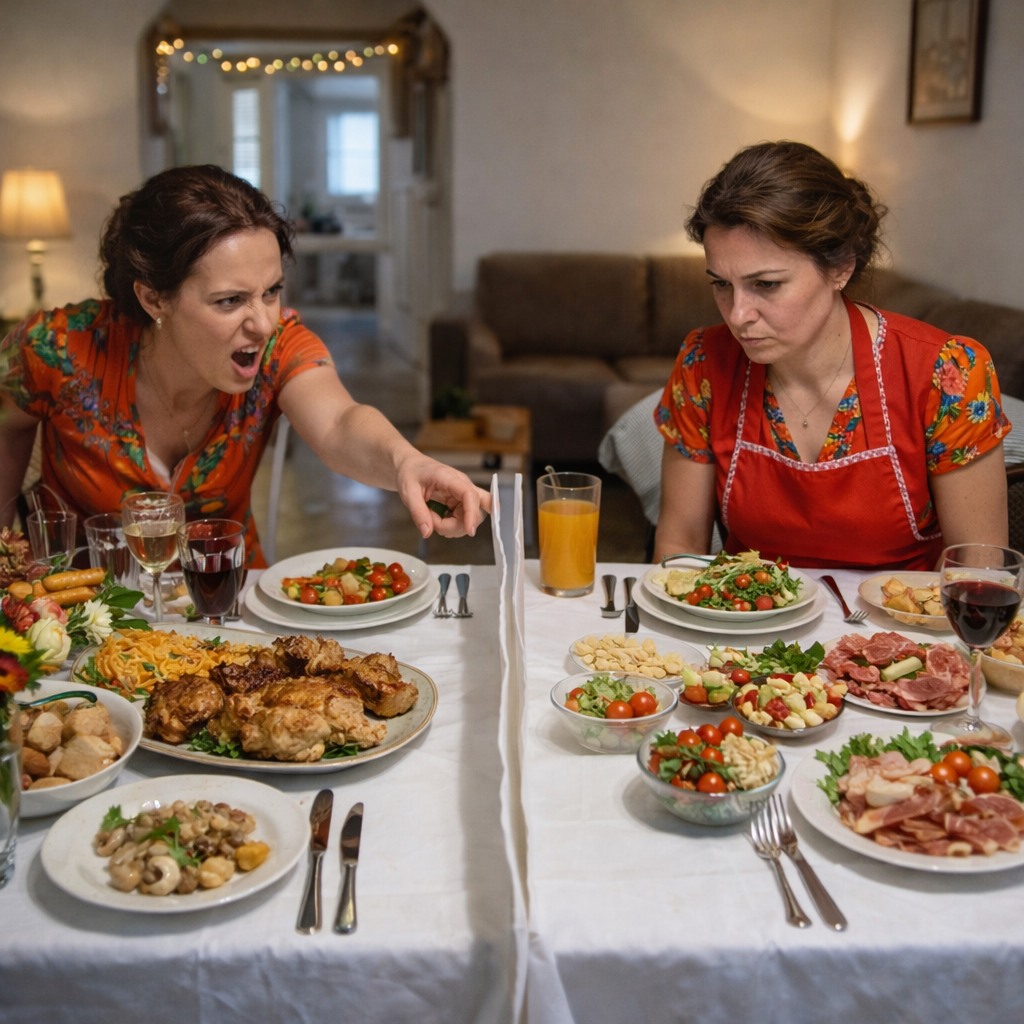
By five o’clock, the table was ready. Or rather, the tables. Their extendable dining table was stretched to its maximum, covered with a tablecloth—and divided into two very clear halves.
On the left side: baked salmon with lemon and rosemary, a shrimp-and-avocado salad, slices of homemade ham, a cheese board with bold and creamy cheeses, small tartlets topped with red caviar, and a bottle of good Spanish wine. For dessert—berry pastry cups.
On the right side: baked potatoes, a small bowl of Olivier, the most basic cheese and sausage slices, herring with onion rings, a two-liter bottle of soda, and ordinary sliced white bread.
- One side: festive, special, and carefully planned
- The other: modest, simple, and “budget-friendly”
- The message: two families, two contributions
Anton let out a low whistle when he saw it. “Are you sure?”
“More than sure,” Lena said, setting out plates and cutlery. “Two families—two menus. That’s fair.”
The doorbell rang at exactly five. Oksana swept in holding a small sprig of chrysanthemums. Vadim followed with six-year-old Dasha. Dasha ran to Lena for a hug—Lena adored her and never blamed the child for the adults’ choices.
“Happy holiday, sis!” Oksana said, kissing Lena’s cheek and sniffing the air. “It smells amazing! I’m starving—we didn’t even eat lunch so we could try everything.”
Lena kept her smile steady. “Come on in. Let’s go to the table.”
When they entered the room, Oksana froze. Her eyes darted from salmon to potatoes, from the cheese board to the soda bottle, as if her brain couldn’t sort what it was seeing.
“What… is this?” she asked, her voice thinning.
Lena gestured calmly. “That’s your half of the table. And this is ours.”
Silence dropped into the room. Vadim’s brows knitted. Oksana opened her mouth, then closed it. Dasha stared with innocent curiosity, sensing tension without understanding why.
“You’re joking,” Oksana finally whispered.
“I’m not,” Lena said, taking her seat on her side. “Anton, sit down.”
Anton sat beside her. Lena poured wine into two glasses—hers and Anton’s.
Vadim’s face reddened. “Are you serious right now? What is this supposed to be?”
Lena met her sister’s eyes. “It’s called fairness. You wanted me to set the table—I did. But here’s the part you keep skipping, Oksana: you have a mortgage. We have rent. We pay twenty thousand a month, plus utilities. And we’re saving too. Or at least, we’re trying.”
Oksana looked pale. “What does that have to do with dinner?”
“It has everything to do with it,” Lena said evenly. “For the past few months, you’ve been leaning on us—little bills, ‘temporary’ loans, dinners where you bring nothing but appetite. That money was supposed to become our down payment. Instead, it turned into your convenience.”
Oksana’s lips pressed together, then she snapped, “We’re family! Family doesn’t count money.”
“Family,” Lena answered, “doesn’t turn each other into a long-term solution.”
She kept her tone controlled, but every word landed with intention. “Family helps when it’s truly hard. Family doesn’t casually propose that every holiday should be funded by someone else because it’s easier that way.”
Lena glanced at the divided table, then back at her sister. “You can absolutely celebrate with us. But from now on, we do it respectfully: either we plan a shared menu and split costs, or each family brings their own dishes, or we meet somewhere simple. What won’t happen anymore is us quietly paying for everything while our own plans are pushed further away.”
She softened her voice at the end, especially because Dasha was there, listening with wide eyes. “I love you. And I love Dasha. This isn’t about punishing anyone. It’s about boundaries.”
- Option 1: split grocery costs ahead of time
- Option 2: potluck—each family brings dishes
- Option 3: a simpler gathering that fits everyone’s budget
The room stayed quiet for a moment longer. Whatever happened next, Lena knew one thing: pretending nothing was wrong had been costing them more than money. It had been costing them peace.
Conclusion: Sharing a meal should bring people closer, not create hidden resentment. Once Lena and Anton named the problem and set clear rules, the “family dinner” stopped being a one-sided obligation and became what it should have been all along—an honest gathering where everyone carries their part.
