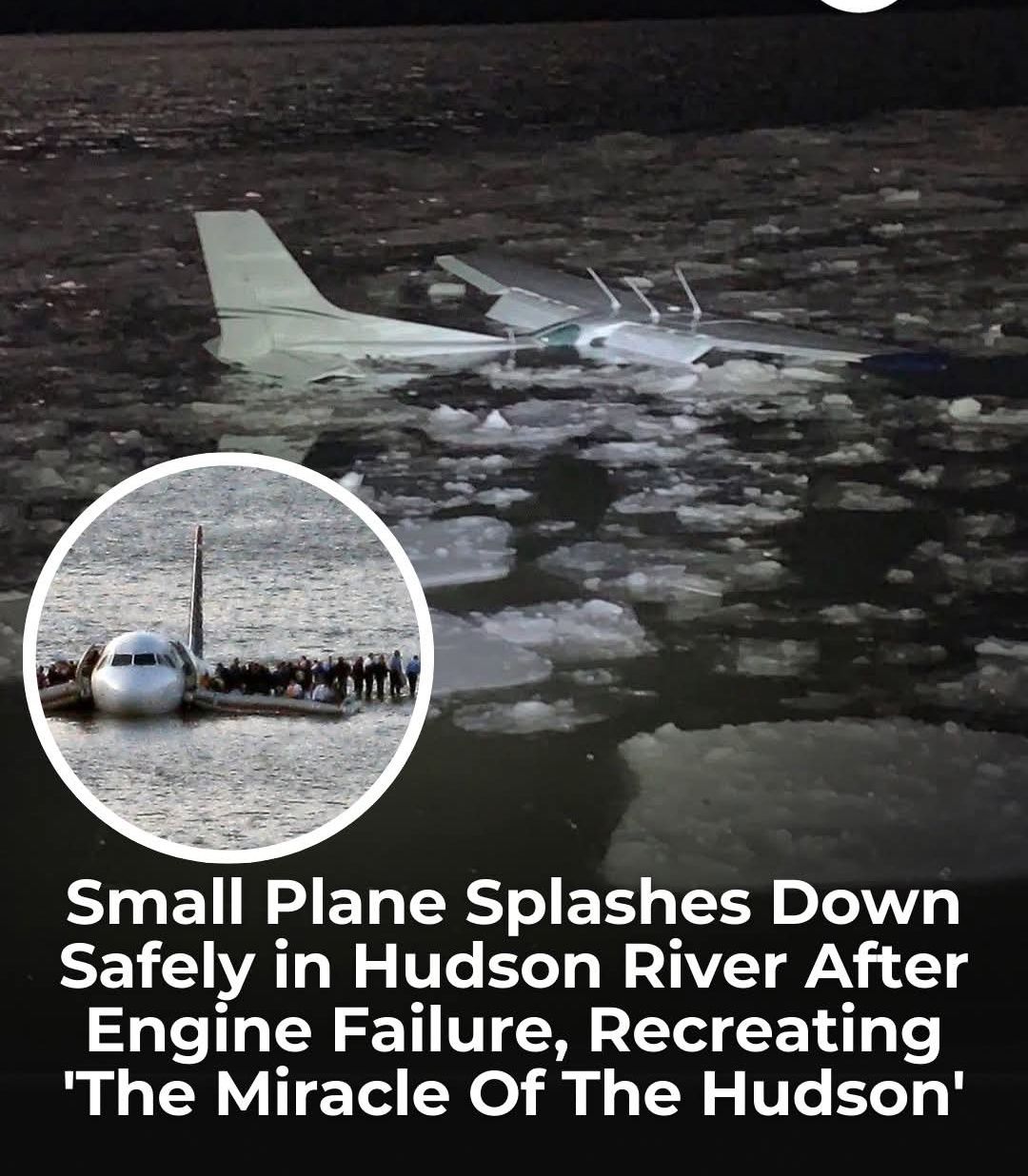
On a bitterly cold Monday evening, the icy waters of the Hudson River became the unlikely runway for a small training aircraft in distress. What could have turned tragic instead became a powerful reminder of calm under pressure and the power of preparation.
A single-engine Cessna, carrying a flight instructor and a student pilot, had departed from Long Island for what was expected to be a routine training flight. But somewhere over the Hudson Valley, the lesson took an unexpected turn.
Trouble in the Air
Mid-flight, the aircraft’s engine failed.
With seconds ticking away and altitude dropping, the pilot radioed air traffic control, delivering the chilling message: they would not make it to the runway. The nearest safe option? The frigid expanse of the Hudson River near the Newburgh-Beacon Bridge.
Demonstrating extraordinary composure, the instructor guided the powerless plane into the icy water, executing a controlled emergency landing that aviation experts say requires both precision and nerves of steel.
Into the Freezing Hudson
The Hudson in early spring is unforgiving. Temperatures hover near freezing, and survival windows can be painfully short. Yet in a testament to both training and resilience, both occupants managed to escape the aircraft on their own and swim to shore.
Emergency responders were quick to arrive. Medical teams evaluated the pair for hypothermia and other injuries, but remarkably, both were expected to recover fully.
Investigating the Engine Failure
The Federal Aviation Administration has launched an investigation into the engine failure that forced the emergency landing. Officials will examine maintenance records, mechanical components, and weather conditions to determine what caused the loss of power.
While mechanical issues in small aircraft are rare, training protocols emphasize preparedness for exactly this type of emergency — and in this case, that preparation may have made all the difference.
Echoes of a Historic Landing
New York’s governor praised the swift response and the skill of the pilot, drawing comparisons to one of aviation’s most famous survival stories: the 2009 “Miracle on the Hudson.”
In that incident, Chesley Sullenberger successfully landed US Airways Flight 1549 in the Hudson River after a bird strike disabled both engines shortly after takeoff from LaGuardia Airport. All 155 people on board survived — a moment that became etched in American aviation history.
Though Monday’s aircraft was much smaller and carried only two people, the parallels are undeniable: engine failure, a quick-thinking pilot, and the Hudson River serving once again as an emergency runway of last resort.
A Lesson in Calm and Courage
For the student pilot aboard, the experience was surely unforgettable — a real-world emergency that no simulator can fully replicate. For the instructor, it was proof that preparation saves lives.
As investigators work to determine what went wrong mechanically, one thing is already clear: what could have been a devastating crash became instead a story of survival.
On the banks of the Hudson, in waters still winter-cold, training, teamwork, and steady hands turned crisis into a second miracle.
