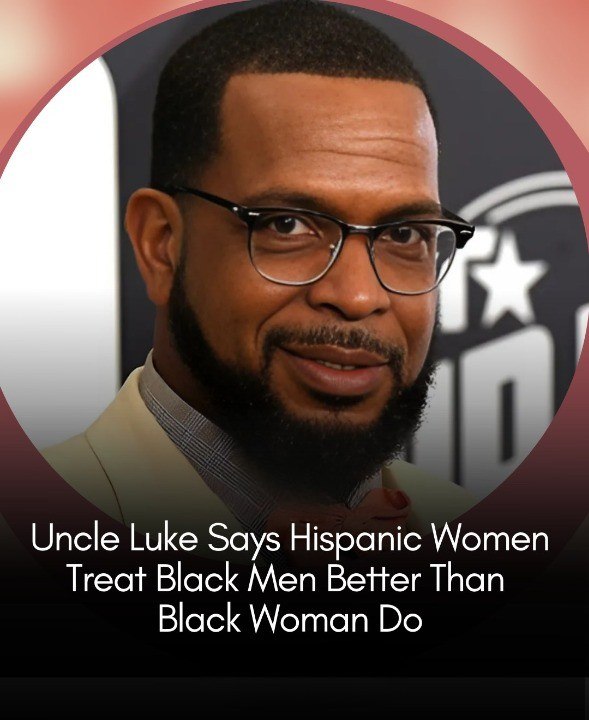
Uncle Luke recently sparked widespread discussion after sharing comments that many Black women found upsetting, once again highlighting how quickly personal opinions can ignite broader conversations about relationships, culture, and gender expectations.
The 1990s rapper and media personality claimed that Hispanic women treat Black men better than Black women do, a statement that immediately drew criticism for its generalization. To support his viewpoint, Uncle Luke shared a personal anecdote meant to illustrate what he sees as a difference in attitude and approach between the two groups.
According to his story, he once asked two women — one Black and one Hispanic — if they would bring him breakfast. He said the Black woman responded by asking him to arrange transportation for her and suggested they go get breakfast together. In contrast, he claimed the Hispanic woman simply asked him what he wanted, implying a more accommodating response. Uncle Luke interpreted this interaction as evidence of a deeper issue in how Black women, as a whole, treat Black men.
His comments quickly traveled across social media, prompting strong reactions. Many Black women pushed back, calling his statement unfair, outdated, and rooted in stereotypes. Critics pointed out that comparing entire groups of women based on a single personal experience ignores individuality and context. They also argued that expectations around dating, effort, and reciprocity have evolved, and that a woman wanting shared effort does not equate to disrespect.
Others noted that Uncle Luke’s framing places unnecessary blame on Black women while overlooking the broader social, economic, and historical pressures that shape relationship dynamics. Some argued that Black women are often expected to give without receiving the same level of care, consideration, or protection in return, and that asserting boundaries should not be labeled as a problem.
Supporters of Uncle Luke, however, interpreted his comments differently. Some felt he was attempting — albeit clumsily — to speak about what he views as differences in dating culture and expectations. They suggested his point was less about race and more about attitudes toward traditional relationship roles, though many acknowledged that the way he expressed it was likely to cause offense.
The controversy underscores a recurring issue in public conversations about relationships: sweeping generalizations. Personal experiences, while valid, do not represent entire communities. Relationship dynamics vary widely depending on personalities, values, upbringing, and individual expectations, not simply ethnicity or background.
It also raises questions about how men and women communicate their needs and assumptions. What one person sees as consideration, another may see as independence. What feels like effort to one person may feel like obligation to another. These differences are often rooted in communication styles rather than character flaws.
Ultimately, the backlash reflects a deeper frustration many Black women feel when they are collectively criticized or compared unfavorably to others. Many emphasized that healthy relationships are built on mutual respect, shared effort, and understanding — not on one-sided expectations or stereotypes.
Uncle Luke’s comments may have been intended to spark conversation, but they also reveal how sensitive and complex discussions around race, gender, and relationships can be. While dialogue is important, many argue it should be grounded in nuance, accountability, and respect rather than broad comparisons.
In the end, the situation serves as a reminder that individual experiences should not be used to define entire groups. Relationships thrive when both people feel valued, heard, and respected — regardless of background.