Expanded Detailed Narrative: The January 2026 Minneapolis Incident and Its Broader Implications
In late January 2026, a federal immigration enforcement operation in Minneapolis, Minnesota, culminated in a deadly confrontation that quickly drew intense national scrutiny, local outrage, and sustained civic protest. What began as a coordinated operation involving U.S. Border Patrol and other federal officers escalated into a fatal encounter with a civilian — the 37-year-old registered nurse Alex Jeffrey Pretti, a U.S. citizen — whose death sparked widespread debate over law enforcement practices, transparency, and the role of federal agencies in local communities.
The Fatal Encounter: January 24, 2026
On the morning of January 24, 2026, in south Minneapolis shortly after 9:00 a.m. local time, federal agents participating in an immigration enforcement action confronted what they described as an individual who posed a potential threat. The Department of Homeland Security (DHS), the federal agency overseeing both U.S. Immigration and Customs Enforcement (ICE) and U.S. Border Patrol, later stated that the agents were operating in pursuit of an undocumented immigrant suspected of violent criminal behavior when the situation unfolded. According to DHS, the man — later identified as Pretti — approached federal officers with a 9 mm handgun and resisted attempts to disarm him, prompting an agent to fire what the agency described as defensive shots.
Within minutes, the man was struck by gunfire, and responding officers rendered medical aid. He was transported to a nearby hospital — Hennepin County Medical Center — but was pronounced dead shortly thereafter. No formal details about the number of shots fired or precise sequence of events were made immediately available by federal authorities.
Local police officials, including Minneapolis Police Chief Brian O’Hara, later confirmed that a man had been shot and killed by federal agents but initially did not identify him by name pending notification of family members. State and city law enforcement also expressed concern over the lack of cooperation from federal agents in providing immediate details or allowing state investigators unimpeded access to the scene.
Identification and Personal Background of the Victim
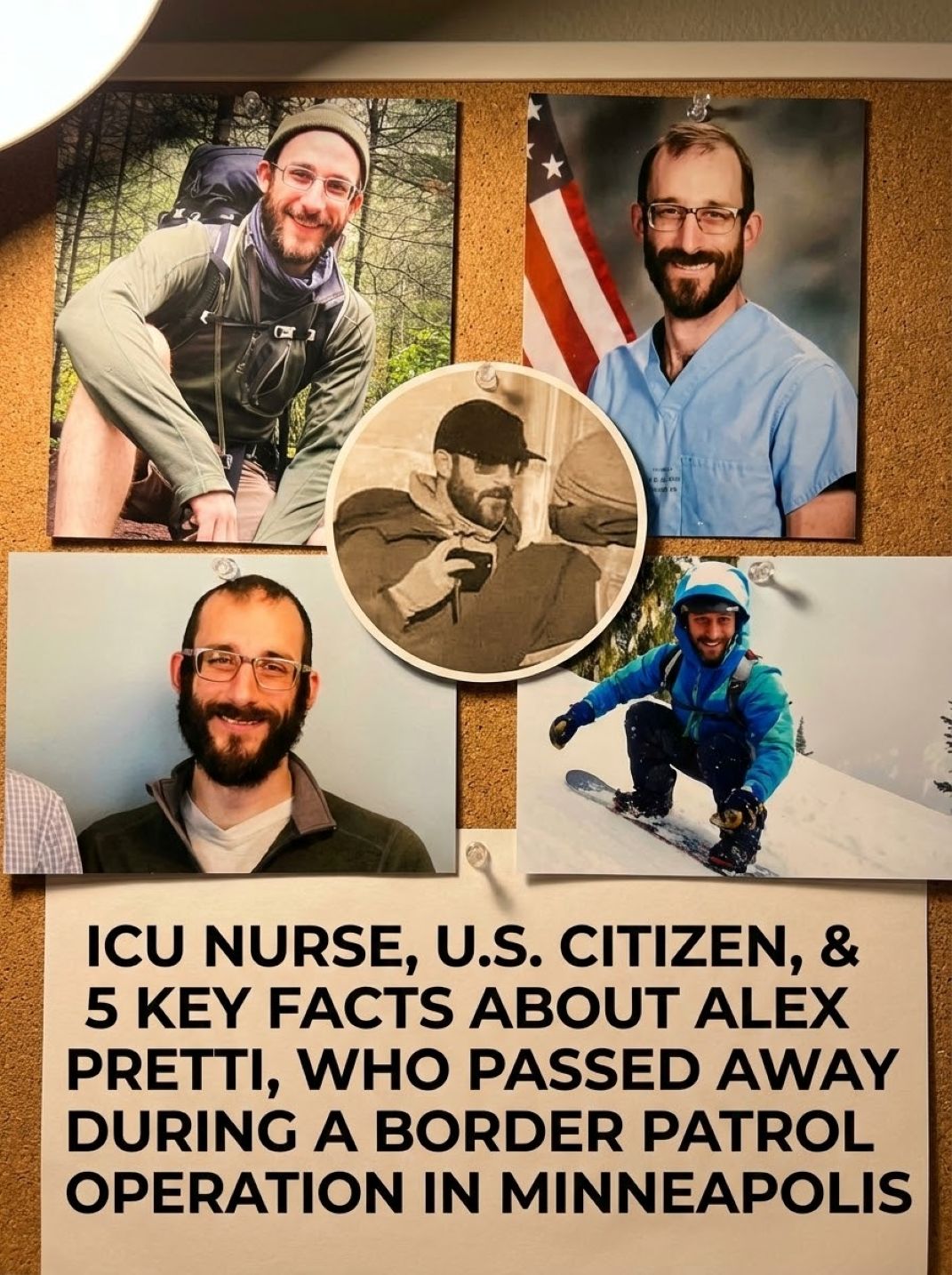
Hours after the shooting, family members identified the man as Alex Jeffrey Pretti, a 37-year-old registered nurse employed in the intensive care unit (ICU) at the Minneapolis Veterans Affairs (VA) Health Care System. They described him as a deeply compassionate and skilled healthcare professional whose career was dedicated to caring for others.
Pretti was remembered by colleagues, friends, and family as a gentle and principled man who valued empathy, fairness, and service. His work in the VA hospital’s ICU earned widespread respect; peers noted his ability to remain calm under pressure and his steadfast commitment to patient care. Originally from the Midwest, Pretti had pursued higher education at the University of Minnesota, where he studied a field connected to health sciences before earning his nursing license. He had been practicing as a registered nurse since 2021, specializing in the critical care of veterans — a calling his loved ones said reflected his broader belief in helping people and contributing positively to society.
Family members released statements after the shooting emphasizing his generosity, his love for community, and his belief in open dialogue. In private conversations and public remarks, they noted that he had recently been distressed by the political climate and federal immigration enforcement tactics in the city — something that had motivated him to be present near the scene that morning.
Contrasting Accounts: Federal Versus Video Evidence and Witness Testimony
In the days after the incident, conflicting accounts of what happened rapidly emerged — deepening public confusion and fueling political and legal controversy. Federal officials maintained that Pretti had approached the agents with a firearm and resisted repeated attempts to disarm him, justifying the use of lethal force as necessary and consistent with department policy. DHS spokespersons framed the encounter as a lawful defense situation in the context of an active operation.
However, bystander videos, eyewitness accounts, and independent analyses told a markedly different story. Multiple clips posted on social media and verified by news organizations show Pretti holding what appeared to be a cell phone, not a weapon, as he approached federal agents and attempted to assist a woman who had been shoved to the ground nearby. In these videos, Pretti’s hands are visible throughout the early moments of the confrontation, and no obvious threatening posture or weapon display is seen prior to agents engaging him physically.
Eyewitness accounts further described federal agents first pepper-spraying Pretti in the face, then wrestling him to the ground with multiple officers participating in the restraint. At one point, one of the agents appears to remove a firearm from Pretti’s waistband area during the struggle; seconds later, shots are heard and Pretti collapses.
These discrepancies between the federal narrative and visual evidence have become central to the controversy. Critics argue that, even if Pretti was legally armed, the sequence of events — especially video showing him pinned or defenseless immediately prior to gunfire — calls into question whether lethal force was necessary or justified under constitutional standards for law enforcement use of force.
Political and Legal Reactions
The killing of Pretti not only reignited debate over federal immigration enforcement tactics but also had significant political reverberations. National, state, and local leaders from both major political parties publicly weighed in on the incident, reflecting growing unease over the handling of federal enforcement operations.
Minnesota Governor Tim Walz condemned the shooting, arguing that the federal response to immigration enforcement in Minneapolis had been heavy-handed and lacked adequate oversight. He demanded increased transparency and raised concerns about federal agents blocking state crime scene investigators from accessing key evidence, including body camera footage.
At the federal level, although some officials initially backed the actions of the agents involved, others — including members of both Republican and Democratic caucuses in Congress — called for a “transparent investigation” into the incident, emphasizing the need for independent review of all available evidence. These calls escalated as public pressure mounted and bipartisan worry grew over agency oversight and accountability.
Civil liberties organizations and legal advocacy groups — including Human Rights Watch — also criticized the manner in which the operation was conducted and alleged that federal authorities had hindered independent examination of the scene. They argued that blocking state investigators and limiting access to critical evidence undermined public confidence and transparency.
Community Response and Protests
The death of Pretti occurred amid a broader backdrop of protest and tension in Minneapolis, where a federal immigration enforcement surge — known internally as Operation Metro Surge — had already triggered civil resistance. Earlier in January 2026, another fatal shooting involving federal agents had occurred, and clashes between activists and law enforcement were increasingly common.
Pretti’s death intensified these dynamics. Vigils, marches, and community gatherings were held across Minneapolis in the days following the incident, and spontaneous memorials appeared at the site of the shooting. Many opponents of federal immigration operations joined in calling for accountability, police reform, and changes to how federal enforcement is conducted in urban areas.
Beyond Minnesota, protests and solidarity demonstrations took place in cities nationwide as part of a broader critique of federal immigration policy and the expansion of armed federal task forces into local communities.
Some local business leaders also voiced concern about civic stability, urging de-escalation and collaborative engagement to reduce tensions in the city and protect public safety, while community groups organized forums and discussions about the intersection of immigration enforcement, civil liberties, and public trust in law enforcement.
Ongoing Investigation and Broader Implications
State and federal investigations into the circumstances surrounding Pretti’s death remain active and ongoing. Legal actions have been filed aimed at preserving and securing evidence; a federal judge granted a temporary restraining order preventing alteration or destruction of critical material, underscoring the contentious nature of access to investigatory data.
The tense standoff between state and federal authorities — particularly the dispute over scene control and evidence access — highlights longstanding questions about jurisdiction, transparency, and accountability when different layers of government converge in law enforcement operations.
Additionally, the incident has broader implications for immigration policy debates, debates over policing standards, and discussions about civil liberties in the context of federal enforcement actions. Democrats, Republicans, civil liberties advocates, and public health professionals have all inserted their perspectives into the public conversation, reflecting the multifaceted nature of the issue and its resonance across political and social lines.
Personal Legacy and Public Memory
In the wake of the incident, thousands of tributes, reflections, and testimonials appeared online and across community spaces, celebrating Pretti’s character, professional contributions, and the relationships he built throughout his life. Memorial gatherings emphasized his commitment to caregiving, his devotion to family and friends, and his broader commitment to fairness and empathy.
Family members, while grieving, have continued to call for a thorough and transparent review of the shooting, urging officials not only to reveal all evidence but to engage meaningfully with community concerns about systemic practices in federal law enforcement.