Every year as the holidays approached, people online shared glossy snapshots of their festive routines: perfectly coordinated pajamas, cookies arranged with painstaking symmetry, soft warm lights that made everything glow, smiles carefully posed. Life, it seemed, was meant to follow a script—predictable, polished, picture-perfect.
Our Christmases were nothing like that.
My mother had her own way of celebrating, one that wasn’t about appearances or social approval. Every Christmas Eve, she would cook with deliberate care, filling our small apartment with smells that wrapped around you like a comforting hug. It wasn’t always lavish. Some years, we had a honey-baked ham, golden and glistening, if the money allowed. Other years, it was simpler: mashed potatoes dripping with butter, green beans sautéed with bacon, cornbread with a crust that cracked just so when you sliced it. But no matter the budget, my mother made it feel abundant. Warmth, she seemed to believe, was not something bought—it was something you could create, plate by plate.
Yet, the most important plate was never meant for us.
She would wrap it carefully in foil, nestle it into a grocery bag, and tie the handles so tightly it felt almost ceremonial—as if she were safeguarding more than just food. I first noticed it when I was eight.
“Mom… who’s that for?” I asked, watching her sling the bag over her shoulder like she always did.
She paused. She zipped up her coat, checked the bag, and finally said, simply, “That one isn’t for us.”
That answer felt incomplete. I remember thinking so even then. Over the years, my curiosity grew, stubbornly pushing against her quiet answers. By the time I was fourteen, I asked more directly.
“Mom, really… who’s it for?”
She handed me my jacket, her hands steady and calm. “Someone who needs it,” she said. That was it. No lectures, no lengthy explanations, no moralizing—just a quiet truth, stated plainly, as if it were a fact of the universe: some people need help, and some people give it.
We lived in a small town where privacy was scarce, and everyone seemed to know everyone else’s business. But there were those who seemed invisible—people you walked past without noticing, people it was easier to pretend weren’t there. And that’s where Eli came in.
At the end of our street was a laundromat, open all night, humming with fluorescent lights that never seemed to turn off. It smelled of detergent and hot metal, a kind of sterile, constant presence in our otherwise quiet town. Eli stayed there.
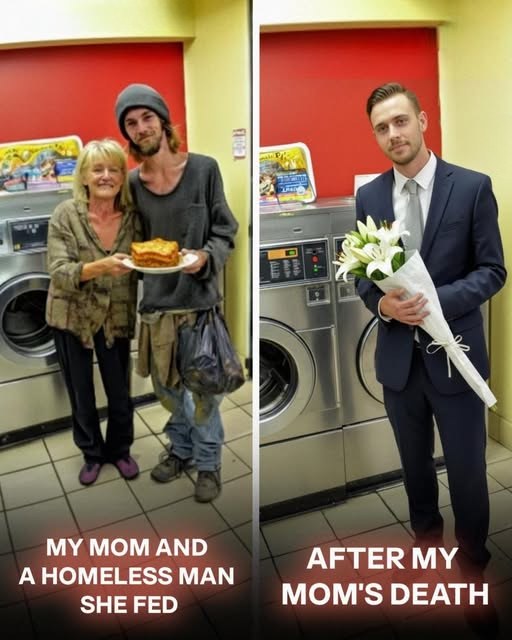
The first time I truly saw him, he was thin, pale, and seemed older than his years, though still only in his twenties. His hoodie was worn thin at the sleeves; everything he owned fit into a single plastic bag and a tattered backpack. He curled himself up near the soda machine, small and careful, taking up as little space as possible. He never asked for anything, never made eye contact, never intruded.
But every Christmas, my mother approached him as though he were the most natural part of the evening. She knelt beside him, keeping her posture gentle so she wouldn’t loom over him. Placing the foil-wrapped bag into his hands, she spoke softly, the same tone she used when comforting me or tending to my scraped knees.
“Hey,” she’d say. “I brought you some dinner.”
Eli’s eyes would widen slightly, as though he had to remind himself that this was real. He always responded politely, his voice hoarse but calm.
“Thank you… ma’am. You don’t have to.”
And my mother always replied the same way:
“I know. But I want to.”
As a child, I didn’t understand this kind of generosity. I thought acts of kindness required justification or, at least, reciprocity. Danger, I believed, lurked in the corners of the world, and those corners often housed people like Eli. Once, walking behind her as she approached him, I whispered, worried:
“Mom… what if he’s dangerous?”
Her eyes didn’t leave the road. Her tone was steady. “Dangerous is a hungry person the world forgot, not a man who says thank you.”
Through the years, glimpses of Eli’s life trickled in. He told us little, yet enough to make the silence between words meaningful. One year, when I was sixteen, he was awake when we arrived. He seemed tired, tense, and raw in a way that made my chest ache. My mother handed him the dinner as always and asked quietly, “You okay, Eli?”
He hesitated, then said softly, “I used to have a little sister.”
The weight of those words hit me harder than anything I expected.
“We aged out of foster care together,” he continued, “and she died in a car accident.”
He didn’t go further. He didn’t need to. That Christmas, my mother added gloves and thick socks to the bag. The next year, she tucked a grocery card inside with a vague excuse about it arriving in the mail. Another year, she offered to help him find a place to stay. He recoiled, hesitant.
“I can’t,” he said.
“Why not?” I asked, bluntly.
He looked away. “I’d rather freeze than owe anyone.”
My mother never pressed. “Okay,” she said. “Dinner still stands.”
Then, the unthinkable happened. My mother fell ill. At first, it was small things: fatigue, a thinning smile, laughter that lost its warmth. She brushed it off. “Probably nothing,” she said, as if hope could be summoned by ignoring reality. But it wasn’t nothing.
She was gone in less than a year.
That Christmas, there was no one to cook, no one to wrap a plate with gentle precision, no one to remind me why it mattered. But I remembered her words, her quiet insistence: “It’s for someone who needs it.” And I cooked. Not perfectly. Not beautifully. Chicken instead of ham, instant potatoes, canned vegetables, boxed cornbread. I wrapped the plate, tied the bag, and drove to the laundromat, my hands gripping the steering wheel as if it could hold me together.
The building looked the same. Flickering neon sign. Harsh light. Familiar smells. But inside, everything had changed.
Eli stood in the middle of the room. He was upright, alert, wearing a dark suit that fit him like it had been waiting there for him. In his hands, he held white lilies.
I froze.
“You came,” he said softly.
“Eli?” My voice cracked.
He nodded. “It’s me.”
I held up the grocery bag instinctively. “I… I brought food.”
He smiled, a small, shaky smile. “She taught you well.”
He told me he had come to honor my mother, that he had dressed for her. And then, he shared the most unexpected stories: memories of me as a child, her kindness toward him, and how she had supported him quietly for years—counseling, job training, and guidance—without ever forcing him to accept it.
“I promised her,” he said, “if I ever got my life together, I’d wear a suit so she could see I was okay.”
He handed me an envelope. Inside was a photograph of my mother and me at a fair—an image I had long forgotten. In the background, slightly blurred, was Eli.
“She didn’t just feed me,” he said. “She saved me.”
We went to the cemetery together. He placed the lilies on her grave. He told me she had asked him to look out for me, like family. That night, we ate together, quietly. He didn’t ask for anything. He just showed up.
And that’s when I realized something extraordinary: my mother had saved me, too. Not through grand gestures, not through wealth or fame, but through the steady, patient demonstration of love. Love, she had shown me, didn’t disappear when someone died. It lived on—in our actions, in those we touched, in the quiet continuity of generosity.
Family isn’t always blood. Sometimes it’s the people fed by the same hands that raised you. Sometimes it’s the ones your mother refused to let the world discard. And sometimes, it’s the person who shows up—because that’s what she taught them to do.