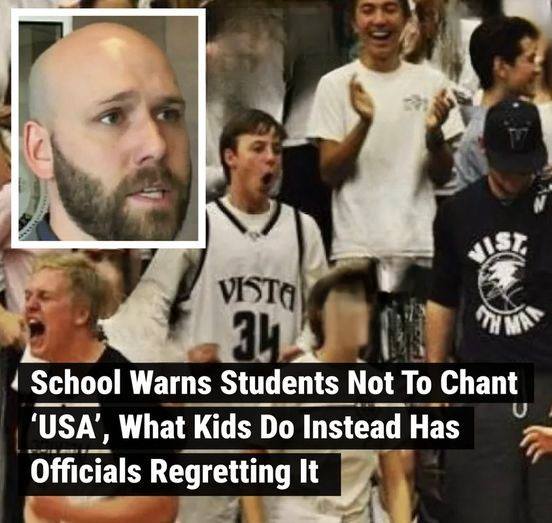
A familiar tradition at Vista Del Lago High School has recently become the center of a broader community discussion about patriotism, school culture, and inclusivity. What began as routine student behavior—chanting “USA” during pep rallies, sporting events, and assemblies—prompted school administrators to issue guidance encouraging students to be more mindful of when and how the chant is used.
The advisory did not prohibit the chant outright. Instead, it asked students to consider context and audience, a distinction that has fueled debate among students, parents, and community members about whether expressions of national pride are being unfairly constrained or responsibly guided.
For many students, the chant has long been understood as a spontaneous show of unity. Senior Ryan Bernal, speaking to local media, described it as inclusive rather than divisive. In his view, chanting “USA” represents shared belonging and school spirit, not exclusion. “It doesn’t matter what your skin tone is or where you’re from,” he said. “It’s just pride in our country and our community.”
School officials, however, framed the guidance as an exercise in empathy rather than restriction. According to Folsom Cordova Unified School District communications director Daniel Thigpen, the goal is to encourage students to practice kindness, awareness, and patriotism simultaneously. Administrators emphasized that while the chant is appropriate during structured patriotic moments—such as after the Pledge of Allegiance or the national anthem—it can carry unintended meanings when used casually or directed at specific groups or individuals.
This concern is not isolated to one school. The California Interscholastic Federation, which oversees school athletics statewide, has advised schools to consider how chants and crowd behavior may be perceived. CIF representatives note that while national pride is encouraged, schools must ensure that expressions do not appear aggressive, exclusionary, or targeted.
The principal of Vista Del Lago communicated this perspective in a message to families, explaining that the guidance was intended to preserve a welcoming environment for all students. The email clarified that the chant is not banned, but encouraged students to be thoughtful about its use to avoid misinterpretation.
Reactions in the community have varied. Some parents support the school’s emphasis on inclusivity, seeing it as part of preparing students for a diverse society. Others view the guidance as unnecessary or overly cautious, arguing that patriotism should not require contextual qualification. Social media commentary reflected both positions, ranging from strong criticism of school leadership to calls for balance and dialogue.
At its core, the situation highlights a broader challenge facing schools nationwide: how to support free expression and school spirit while also teaching students to recognize how words and actions can affect others. Educators note that adolescence is a formative period for learning social awareness, and schools play a role in helping students navigate expression responsibly.
Vista Del Lago’s approach underscores that patriotism and empathy are not mutually exclusive. By encouraging students to think about context rather than silencing expression, the school aims to foster a culture where pride is shared, not misunderstood.
The conversation continues within the school community, reflecting a larger national dialogue. What remains clear is that the issue is less about banning a chant and more about guiding young people to express identity and enthusiasm in ways that strengthen, rather than fracture, a diverse community.