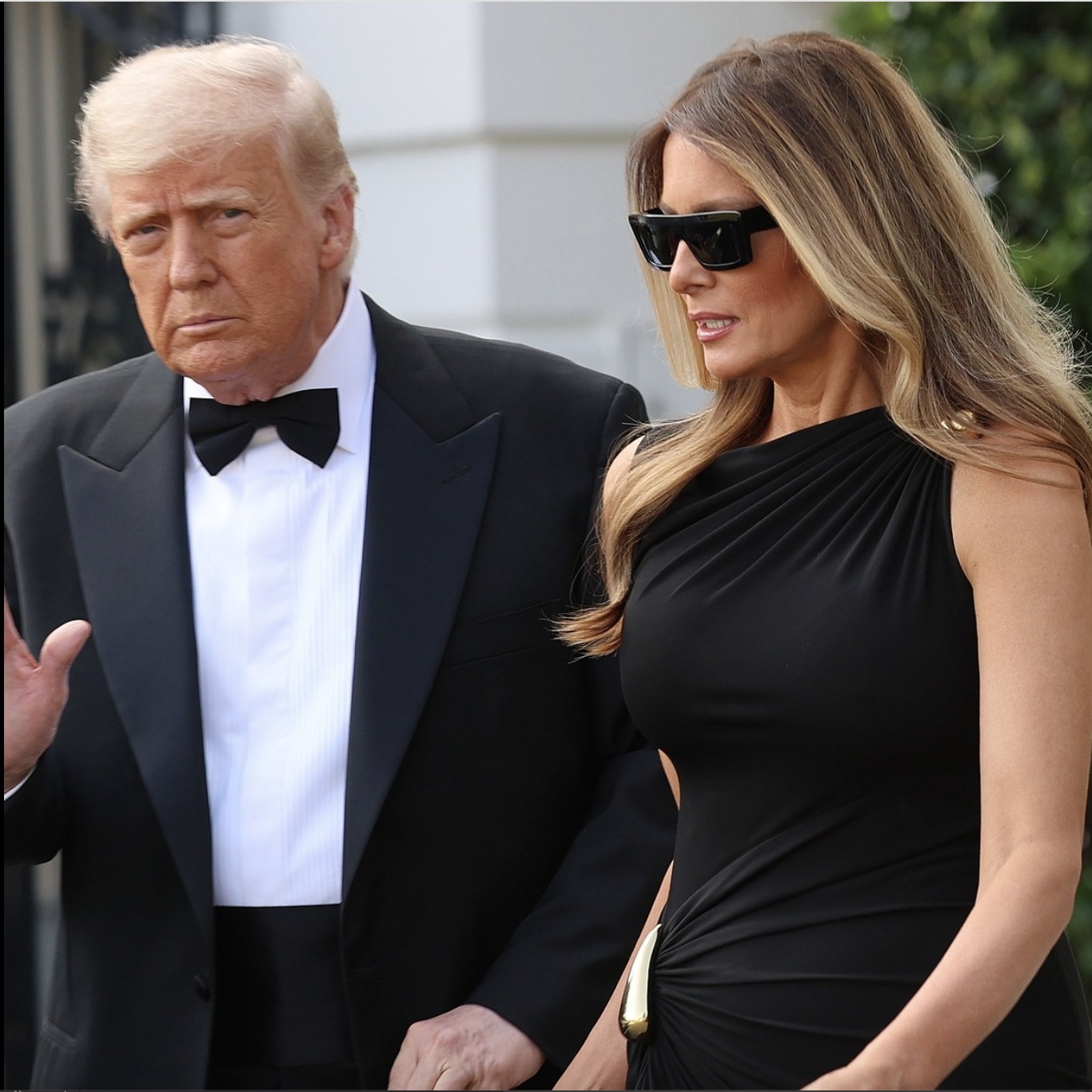
President Donald Trump and First Lady Melania Trump returned to the Kennedy Center on June 11 for a performance of Les Misérables, marking Trump’s first appearance at the venue since installing new leadership and pushing the institution toward a more conservative artistic direction. What unfolded inside the theater quickly turned into a microcosm of the national mood—fractured, loud, political, and impossible to ignore. From the moment the presidential box lights came up, the audience responded with a mix of applause, boos, cheers, and shouted slogans, creating an atmosphere as charged as the revolutionary drama playing out onstage.
Trump, unfazed, told reporters beforehand that he had seen Les Mis many times and counted it among his favorite shows. That familiarity didn’t soften the theater’s reception. During intermission, the tension reached its peak. As the house lights brightened, spectators erupted into overlapping outbursts—some chanting his name or yelling “U.S.A.,” others shouting pointed criticism and profanity. The president answered the noise with a three-pump fist, a gesture instantly recognizable to his supporters and just as instantly provocative to his critics. News outlets later described the reaction as nearly split down the middle, an audible reminder of how differently Americans view both the man and the moment.
Behind the scenes, the evening had already been shaped by political ripples. Reports surfaced that several cast members chose not to perform that night, a decision allowed by the production out of respect for personal discomfort or political objections. Their absence didn’t halt the performance, but the symbolism was unmistakable—artists quietly signaling dissent during a presidential visit to a venue still wrestling with its shifting identity under Trump-friendly leadership.
Another unexpected detail caught public attention: a group of drag performers seated in tickets donated by patrons who opposed Trump’s presence at the show. Their attendance became a symbolic counterpoint to Trump’s earlier pledge to eliminate what he called “woke” programming from the Kennedy Center, including drag-themed productions. The contrast—drag performers seated in the audience while Trump occupied the presidential box—created a cultural tableau that was impossible to miss.
All of this unfolded against the backdrop of a week dominated by news that federal forces had been deployed to quell protests in Los Angeles. The parallels between the real-world headlines and the story onstage were striking enough that commentators seized on the irony. Les Misérables, after all, is built on themes of state power, rebellion, and the voices of the oppressed rising against authority. The optics of Trump attending a show filled with barricades and battle cries, while his administration faced scrutiny for crackdowns on civil unrest, became an irresistible talking point across political media. Many pointed out that the timing almost seemed scripted, a collision of art and politics too sharp to overlook.
The performance also served a strategic purpose beyond cultural signaling. Trump used the event to highlight fundraising wins and reinforce his narrative that the Kennedy Center needed—and was benefiting from—his intervention. He announced that the evening had generated over $10 million, presenting the figure as proof of renewed financial vitality under the reshaped board and leadership structure. Critics, however, accused him of overstating the impact, pointing to earlier controversies over cancellations, shifts in programming tone, and questions about declining subscriptions. The Kennedy Center issued its own clarifications, attributing subscription fluctuations to changes in the renewal calendar, not ideological purges.
Then came the photograph that dominated social media long after the curtains closed. As Trump and Melania exited the building, cameras captured a moment that quickly went viral: his hand appeared to be clasping only her thumb, not her full hand. Body-language watchers, meme-makers, and amateur analysts pounced immediately. The image joined a growing archive of scrutinized interactions between the couple—those awkward hand swats on tarmacs, stiff walkaways at ceremonies, and other small moments that repeatedly fuel speculation about their dynamic. While the photo had no bearing on policy or the evening’s larger political implications, it became the internet’s favorite takeaway, illustrating how even trivial gestures involving the Trumps become cultural lightning rods.
The night ultimately became less about a musical and more about what people chose to see in it. Supporters viewed Trump’s presence as a declaration of cultural reclaiming—a president boldly stepping back into one of Washington’s most iconic arts spaces, raising money, restoring control, and showing he would not be cowed by hostility. Detractors saw something entirely different: a jarring collision of imagery, a leader facing public dissent inside a hall famous for artistic expression, attending a show centered on revolution at a time when his administration was accused of suppressing protest. For them, the event encapsulated hypocrisy, spectacle, and tone-deafness.
In truth, the evening functioned as a kind of national Rorschach test. The reactions—inside the theater, on social media, and across political commentary—revealed more about the people interpreting the event than about the event itself. To one side, it was a triumphant cultural moment; to the other, a symbol of deep political contradiction. And to many watching from the outside, it was simply another reminder that in the Trump era, no public appearance exists outside the gravitational pull of conflict, optics, and narrative battles.
Les Misérables is a show built on emotion, unrest, and the fight for dignity. On this particular night, those themes echoed far beyond the stage. The performance ended, but the discourse did not. The booing, the cheering, the cast absences, the drag performers, the policy critiques, the viral photo—each became a strand in a larger story about culture, politics, and the polarized lens through which Americans now view almost everything.
In the end, the evening did what live theater is meant to do: provoke, unsettle, inspire discussion, and reflect the world back to its audience. Whether it was seen as a moment of defiance or a moment of contradiction depends entirely on the observer. But no one denied that it left an imprint, and that for a few hours in Washington, the drama in the seats nearly eclipsed the drama on the stage.